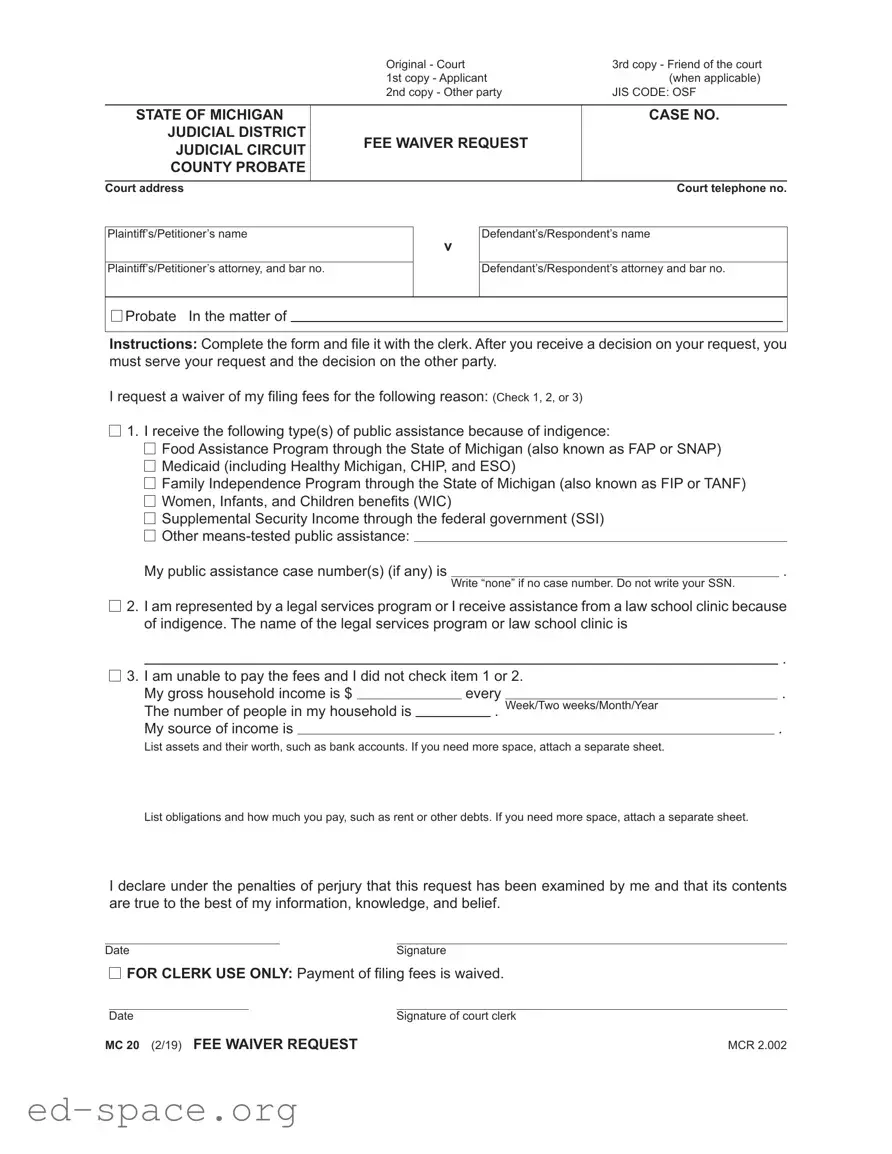
The Michigan MC 20 form is a crucial document for individuals seeking to waive court filing fees due to financial hardship. This form is specifically designed for those who may struggle to afford the costs associated with legal proceedings. It allows applicants to request a waiver based on various criteria, including eligibility for public assistance programs like SNAP or Medicaid, representation by legal aid organizations, or a demonstrated inability to pay due to low household income. The form requires detailed information about the applicant's financial situation, including income sources, household size, and any relevant assets or obligations. Once completed, the MC 20 must be filed with the court clerk, and the applicant is responsible for serving the request and any subsequent decision to the opposing party. Understanding the requirements and process of the MC 20 form is essential for anyone navigating the Michigan court system who may need financial relief to pursue their legal rights.

Original - Court |
3rd copy - Friend of the court |
1st copy - Applicant |
(when applicable) |
2nd copy - Other party |
JIS CODE: OSF |
STATE OF MICHIGAN JUDICIAL DISTRICT JUDICIAL CIRCUIT COUNTY PROBATE
FEE WAIVER REQUEST
CASE NO.
Court address
Plaintiff’s/Petitioner’s name
Plaintiff’s/Petitioner’s attorney, and bar no.
v
Court telephone no.
Defendant’s/Respondent’s name
Defendant’s/Respondent’s attorney and bar no.
Probate In the matter of
Instructions: Complete the form and file it with the clerk. After you receive a decision on your request, you must serve your request and the decision on the other party.
I request a waiver of my filing fees for the following reason: (Check 1, 2, or 3)
1. I receive the following type(s) of public assistance because of indigence:
Food Assistance Program through the State of Michigan (also known as FAP or SNAP)
Medicaid (including Healthy Michigan, CHIP, and ESO)
Family Independence Program through the State of Michigan (also known as FIP or TANF)
Women, Infants, and Children benefits (WIC)
Supplemental Security Income through the federal government (SSI) Other
My public assistance case number(s) (if any) is |
|
. |
|
Write “none” if no case number. Do not write your SSN. |
|
2. I am represented by a legal services program or I receive assistance from a law school clinic because of indigence. The name of the legal services program or law school clinic is
|
|
|
|
|
|
|
|
|
. |
3. I am unable to pay the fees and I did not check item 1 or 2. |
|
||||||||
|
My gross household income is $ |
|
every |
|
. |
||||
|
The number of people in my household is |
|
|
. Week/Two weeks/Month/Year |
|
||||
|
My source of income is |
|
|
|
|
|
. |
||
List assets and their worth, such as bank accounts. If you need more space, attach a separate sheet.
List obligations and how much you pay, such as rent or other debts. If you need more space, attach a separate sheet.
I declare under the penalties of perjury that this request has been examined by me and that its contents are true to the best of my information, knowledge, and belief.
Date |
|
Signature |
FOR CLERK USE ONLY: Payment of filing fees is waived.
|
Date |
|
Signature of court clerk |
MC 20 (2/19) FEE WAIVER REQUEST |
MCR 2.002 |
||

Fee Waiver Request (2/19)Case No.
ORDER
IT IS ORDERED:
1. Payment of filing fees is waived because:
a. Your gross household income is under 125% of the federal poverty guidelines.
b. Your gross household income is above 125% of the federal poverty guidelines, but payment of the fees would constitute a financial hardship for you.
c. Other:
If you become able to pay the fees before this case is resolved, you must notify the court.
2. The fee waiver request is denied because:
a. Your gross household income is above 125% of the federal poverty guidelines and payment of the fees would not constitute a financial hardship for you.
b. Other:
Date |
|
Judge |
Bar no. |
| Fact Name | Fact Description |
|---|---|
| Form Purpose | The Michigan MC 20 form is used to request a waiver of filing fees in probate cases. |
| Governing Law | This form is governed by Michigan Court Rule (MCR) 2.002. |
| Copies Required | Applicants must submit multiple copies: original for the court, one for the Friend of the Court, one for themselves, and one for the other party. |
| Eligibility Criteria | Applicants can qualify for a fee waiver based on public assistance, legal representation, or inability to pay. |
| Public Assistance Types | Types of public assistance include Food Assistance, Medicaid, and Supplemental Security Income (SSI). |
| Income Reporting | Applicants must report their gross household income and the number of people in their household. |
| Signature Requirement | The form must be signed by the applicant, affirming the truthfulness of the information provided. |
| Clerk's Use | The court clerk will review the request and indicate whether the fee waiver is granted or denied. |
| Decision Notification | After a decision is made, the applicant must serve the decision to the other party involved in the case. |
After completing the Michigan MC 20 form, it will be submitted to the court clerk. Once the clerk processes your request, you will receive a decision regarding your fee waiver. It is essential to serve both your request and the court's decision to the other party involved in the case.
What is the Michigan MC 20 form?
The Michigan MC 20 form is a Fee Waiver Request used in probate cases. It allows individuals to request a waiver of filing fees due to financial hardship. This form is essential for those who cannot afford the costs associated with filing a case in court.
Who can use the MC 20 form?
Anyone facing financial difficulties can use the MC 20 form. If you receive public assistance, are represented by a legal services program, or have a low income that makes it hard to pay fees, you qualify to fill out this form.
How do I complete the MC 20 form?
To complete the MC 20 form, provide your personal information, including your name and case number. Indicate your reason for requesting a fee waiver by checking the appropriate box. Be sure to include any necessary details, such as public assistance case numbers or income sources. Finally, sign and date the form before submitting it to the court clerk.
Where do I file the MC 20 form?
File the completed MC 20 form with the clerk at the court handling your case. Ensure that you keep copies for your records. After filing, you will need to serve the request and the decision on the other party involved in your case.
What happens after I file the MC 20 form?
Once you file the MC 20 form, the court will review your request. You will receive a decision regarding your fee waiver. If your request is approved, you will not have to pay the filing fees. If denied, the court will provide a reason for the denial.
How long does it take to get a decision on the MC 20 form?
The time it takes to receive a decision can vary. Generally, it may take a few days to a couple of weeks, depending on the court's workload. It’s important to check in with the court if you haven’t heard back within a reasonable timeframe.
What should I do if my fee waiver request is denied?
If your fee waiver request is denied, you can still proceed with your case but will need to pay the filing fees. If you believe your financial situation has changed, you may reapply for a fee waiver at a later date. Additionally, consider seeking advice from a legal professional to explore your options.
Can I appeal the decision on my fee waiver request?
Yes, you can appeal the decision if your fee waiver request is denied. The process for appealing may vary, so it’s best to consult with the court or a legal expert for guidance on how to proceed with an appeal.
Not checking the correct box: Many people fail to select the appropriate reason for requesting a fee waiver. It's important to choose one of the three options provided on the form.
Missing public assistance case numbers: If you receive public assistance, you must include your case number. Leaving this blank can lead to delays or denial of your request.
Not providing income details: Some applicants do not accurately report their gross household income. Make sure to include this information clearly and correctly.
Omitting household size: Failing to indicate the number of people in your household can affect the court's decision on your fee waiver request.
Ignoring the signature requirement: Forgetting to sign the form is a common mistake. Your signature is essential to validate your request.
Not attaching additional sheets when necessary: If you need more space to list assets or obligations, you should attach a separate sheet. Not doing so can result in an incomplete application.
Failing to serve the decision: After receiving a decision on your request, you must serve it to the other party. Neglecting this step can lead to further complications.
Providing incorrect or outdated information: Ensure that all information is current and accurate. This includes addresses, names, and any other relevant details.
Not following filing instructions: Carefully read the instructions for filing the form. Skipping steps or misinterpreting them can lead to rejection of your request.
The Michigan MC 20 form is a crucial document used to request a waiver of filing fees in probate cases. When submitting this form, it is often necessary to include additional documents to support the request or to fulfill procedural requirements. Below are several forms and documents commonly used alongside the MC 20 form.
Including these forms and documents can help streamline the process and ensure that the court has all the necessary information to make an informed decision regarding the fee waiver request. Properly preparing and submitting these documents is essential for a successful outcome.
The Michigan MC 20 form is a Fee Waiver Request used in probate cases. Several other documents serve similar purposes or are related in function. Here are nine documents that share similarities with the MC 20 form:
Each of these documents addresses the financial needs of individuals involved in legal proceedings, helping to ensure access to justice regardless of income level.
When filling out the Michigan MC 20 form, it is essential to approach the process with care and attention to detail. Here are four important do's and don'ts to consider:
Below are six misconceptions regarding the Michigan MC 20 form, which is used for requesting a fee waiver in probate cases.
The Michigan MC 20 form is essential for individuals seeking a fee waiver in probate cases. Here are some key takeaways to keep in mind when filling out and using this form:
By understanding these key points, you can navigate the process of completing and submitting the Michigan MC 20 form more effectively. This can help ensure that financial constraints do not hinder your access to the legal system.