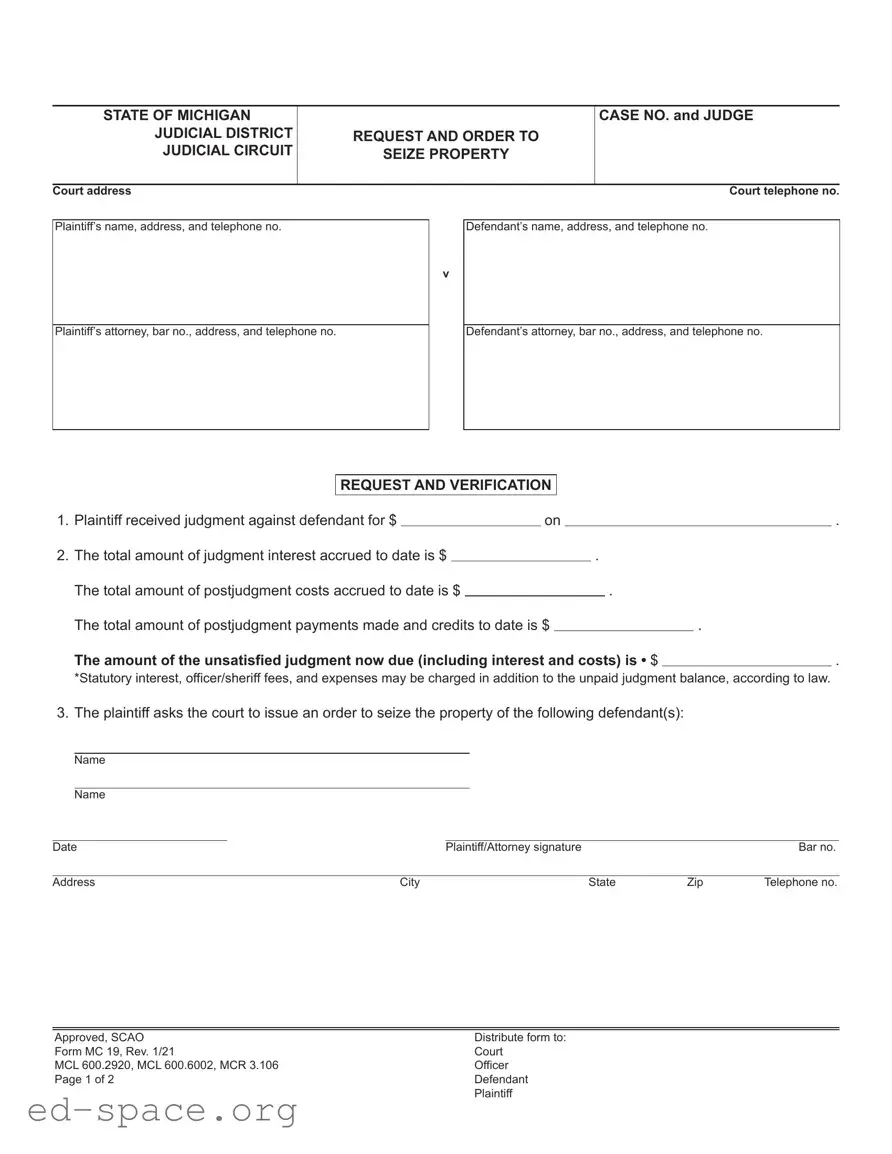
The Michigan MC 19 form serves as a crucial document in the process of property seizure related to court judgments. This form is utilized when a plaintiff has obtained a judgment against a defendant and seeks to recover the owed amount through the seizure of the defendant's property. It includes essential details such as the case number, the names and contact information of both the plaintiff and the defendant, and a breakdown of the judgment amount, including accrued interest and costs. The plaintiff must verify the total unsatisfied judgment, which may include additional statutory fees and expenses. The form also outlines the responsibilities of the sheriff or authorized court officer, directing them to seize and sell the defendant's personal or real property, should it be necessary to satisfy the plaintiff's claim. The document emphasizes the requirement for the officer to provide receipts and inventory lists to the defendant, ensuring transparency throughout the process. Additionally, it stipulates the timeline for service and return of the order, highlighting the importance of adhering to legal protocols. Understanding the Michigan MC 19 form is essential for both plaintiffs and defendants navigating the complexities of post-judgment property seizure.

STATE OF MICHIGAN JUDICIAL DISTRICT JUDICIAL CIRCUIT
Court address
REQUEST AND ORDER TO
SEIZE PROPERTY
CASE NO. and JUDGE
Court telephone no.
Plaintiff’s name, address, and telephone no.
Defendant’s name, address, and telephone no.
v
Plaintiff’s attorney, bar no., address, and telephone no.
Defendant’s attorney, bar no., address, and telephone no.
|
|
REQUEST AND VERIFICATION |
|
|
|
|
|
|
|
|||||
1. |
Plaintiff received judgment against defendant for $ |
|
on |
|
|
|
|
|
. |
|||||
2. |
The total amount of judgment interest accrued to date is $ |
|
|
|
|
|
. |
|
|
|
|
|||
|
The total amount of postjudgment costs accrued to date is $ |
|
|
|
|
|
. |
|
|
|
||||
|
The total amount of postjudgment payments made and credits to date is $ |
|
|
|
|
|
. |
|
||||||
|
The amount of the unsatisfied judgment now due (including interest and costs) is • $ |
|
|
. |
||||||||||
*Statutory interest, officer/sheriff fees, and expenses may be charged in addition to the unpaid judgment balance, according to law.
3. The plaintiff asks the court to issue an order to seize the property of the following defendant(s):
Name
Name
Date |
|
Plaintiff/Attorney signature |
Bar no. |
|
Address |
City |
State |
Zip |
Telephone no. |
Approved, SCAO |
Distribute form to: |
Form MC 19, Rev. 1/21 |
Court |
MCL 600.2920, MCL 600.6002, MCR 3.106 |
Officer |
Page 1 of 2 |
Defendant |
|
Plaintiff |

Request and Order to Seize Property (1/21) |
Case No. |
Page 2 of 2 |
|
ORDER
TO ANY SHERIFF, DEPUTY SHERIFF, OR AUTHORIZED COURT OFFICER - YOU ARE ORDERED TO:
1.Seize and sell, according to law, any of the personal property (as determined by the officer) of defendant(s) named above in the Request and Verification that is not exempt from seizure, as will be sufficient to satisfy the plaintiff’s demand, costs, and any statutory fees and expenses. Personal property may include, but is not limited to motor vehicles or money, wherever located.
2.If sufficient personal property of defendant(s) cannot be found within your jurisdiction, seize and sell any of the real property of defendant(s) not exempt from seizure, as will be sufficient to satisfy plaintiff’s demand, costs, and any statutory fees and expenses.
3.Collect from the sale of the property enough money to pay all of your statutory fees and statutory expenses.
4. Deposit proceeds of sale with the court plaintiff after deducting statutory fees and statutory expenses.
5. Claim and Delivery Only: Seize the property described in the attached judgment for claim and delivery and deliver to the plaintiff(s); or if the property is not found in the possession of the defendant(s), levy the value of it.
6.You must endorse the month, day, year, and hour that you receive this order, and that time is the effective date of this order. You must return this order not less than 20 days, nor more than 90 days, from the effective date. If you have begun to serve this order on or before the return date, you may complete the service and return after the return date.
7.You may not continue collecting on this order after the return date except as indicated in item 6.
8. Order to be served by |
|
|
|
. |
Authorized court officer/Deputy sheriff |
||||
|
|
|
|
|
Judge signature and date
ENDORSEMENT: I certify that I received this order on |
|
|
. |
Date and time |
|||
|
|
|
|
|
|
Authorized court officer/Deputy sheriff |
|
TO THE DEFENDANT: The person taking property must provide you with a receipt of all money paid by you and an inventory of the property taken. You may send the plaintiff a request to review postjudgment costs and fees.
| Fact Name | Description |
|---|---|
| Form Purpose | The Michigan MC 19 form is used to request and order the seizure of property from a defendant to satisfy a court judgment. |
| Judgment Requirement | The plaintiff must have received a judgment against the defendant, specifying the amount owed, including interest and costs. |
| Property Seizure Scope | The order allows for the seizure of personal property, such as motor vehicles or money, as well as real property if sufficient personal property is not available. |
| Return Timeline | The order must be returned within 20 to 90 days from the effective date, which is the date the order is received by the officer. |
| Governing Laws | The MC 19 form is governed by Michigan Compiled Laws (MCL) 600.2920, MCL 600.6002, and Michigan Court Rules (MCR) 3.106. |
Filling out the Michigan MC 19 form requires attention to detail and accuracy. After completing the form, it will need to be submitted to the appropriate court for processing. Ensure all information is correct to avoid delays in the seizure process.
What is the Michigan MC 19 form used for?
The Michigan MC 19 form is a legal document utilized in the process of seizing property to satisfy a judgment. When a plaintiff has obtained a judgment against a defendant, this form serves as a request to the court for an order allowing the seizure of the defendant's property. The form details the judgment amount, accrued interest, and any costs associated with post-judgment proceedings. It is essential for initiating the enforcement of a court's decision regarding unpaid debts.
Who can file the Michigan MC 19 form?
The plaintiff, or their attorney, is the individual who files the Michigan MC 19 form. This person must have previously secured a judgment against the defendant in a court of law. The form requires the plaintiff’s signature and bar number if represented by an attorney, along with pertinent contact information. It is important that the plaintiff provides accurate details regarding the judgment and the defendant to facilitate the seizure process.
What information is required on the Michigan MC 19 form?
The form requires specific information, including the case number, court address, and contact details for both the plaintiff and the defendant. Additionally, it must include the amount of the judgment, accrued interest, post-judgment costs, and any payments made by the defendant. The plaintiff must also specify the property to be seized, including the names and dates of birth of the defendants, if available. This information is crucial for the court to issue an accurate order for seizure.
What happens after the Michigan MC 19 form is filed?
Once the Michigan MC 19 form is filed, the court will review the request and, if approved, issue an order directing law enforcement to seize the specified property. The order will instruct the sheriff or authorized officer on how to proceed with the seizure, including whether to take personal or real property. The officer must then execute the order, sell the property, and return the proceeds to the court, deducting any statutory fees and expenses.
Are there any exemptions from property seizure under the Michigan MC 19 form?
Yes, certain types of property may be exempt from seizure under Michigan law. Common exemptions include essential household items, tools of a trade, and certain amounts of personal property or income. The law aims to protect individuals from losing necessary assets that are vital for their livelihood. The sheriff or authorized officer is responsible for determining which items can be seized based on these exemptions.
What should defendants expect if their property is seized?
Defendants should be aware that if their property is seized, they are entitled to receive a receipt for any payments made and an inventory of the property taken. This process ensures transparency and provides a record of the transaction. Defendants may also have the opportunity to contest the seizure or seek relief through the court, depending on the circumstances surrounding the judgment and the seizure process.
Incomplete Information: Many individuals fail to provide all required details, such as the full names and addresses of both the plaintiff and defendant. Missing this information can delay the process.
Incorrect Amounts: People often miscalculate the total amount due, including judgment interest and postjudgment costs. This can lead to complications and possible rejections of the form.
Signature Issues: Not signing the form or using an incorrect signature can invalidate the request. It's essential to ensure that the signature matches the name of the plaintiff or attorney.
Failure to Follow Instructions: Some applicants overlook specific instructions regarding the submission timeline or the requirement to return the order within a certain period. Ignoring these details can result in the dismissal of the request.
The Michigan MC 19 form is a crucial document used in the process of seizing property to satisfy a judgment. However, several other forms and documents often accompany it to ensure a smooth legal process. Below is a list of these documents, each described briefly to help you understand their purpose and relevance.
Understanding these accompanying documents can significantly aid in navigating the legal process related to the Michigan MC 19 form. Each document plays a vital role in ensuring that both the plaintiff's rights and the defendant's protections are upheld throughout the seizure process.
When filling out the Michigan MC 19 form, keep the following tips in mind:
Following these guidelines will help ensure that your form is processed smoothly and efficiently.
Understanding the Michigan MC 19 form can be challenging, and several misconceptions often arise regarding its purpose and use. Here are nine common misconceptions, along with clarifications for each.
By addressing these misconceptions, individuals can better understand the Michigan MC 19 form and its implications in the property seizure process.
Filling out and using the Michigan MC 19 form is a critical step in the process of seizing property to satisfy a judgment. Here are some key takeaways to keep in mind: