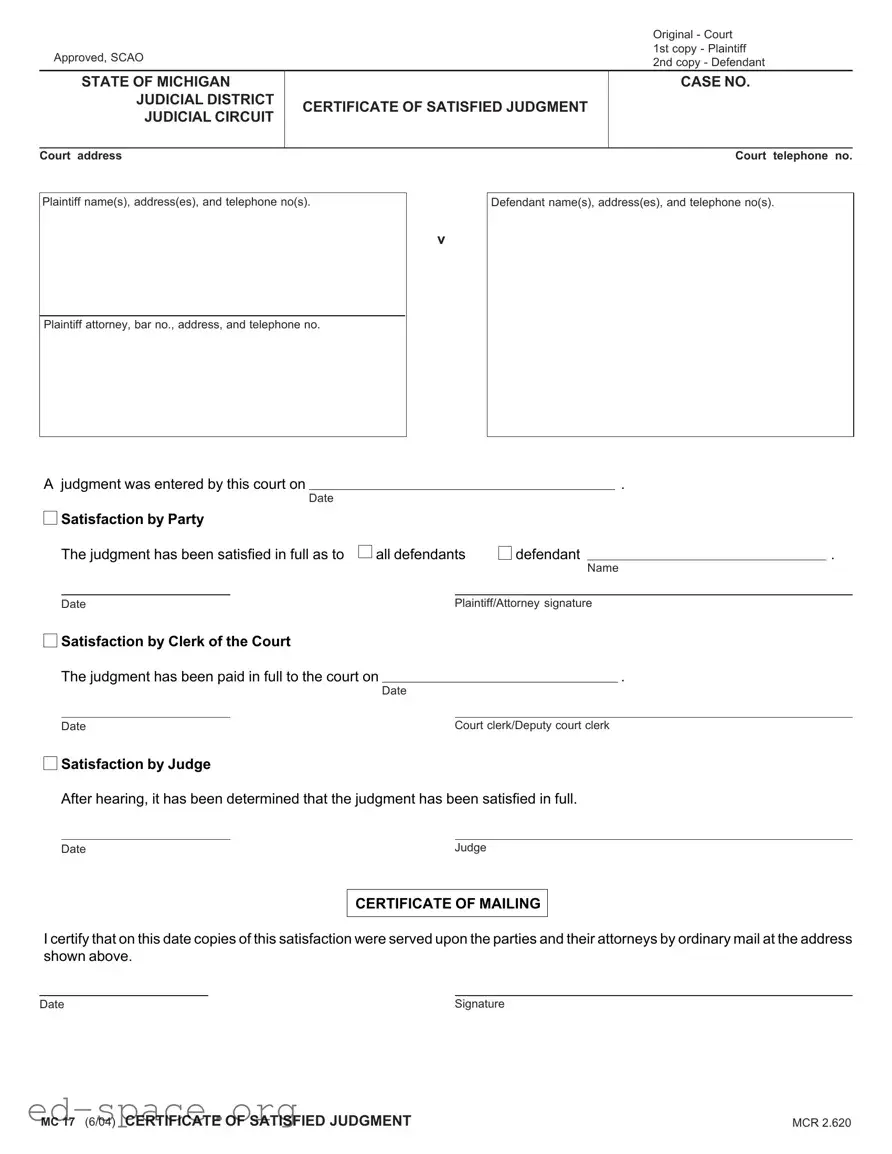
The Michigan MC 17 form plays a crucial role in the judicial process by providing a standardized method for certifying that a judgment has been satisfied. This form is essential for both plaintiffs and defendants, as it confirms the completion of financial obligations resulting from a court ruling. It includes key information such as the case number, the names and addresses of the parties involved, and the details of the judgment itself. The form has sections for satisfaction by the party, clerk, and judge, allowing for multiple methods of confirming that the judgment has been fulfilled. Additionally, it ensures that all relevant parties are notified through a certificate of mailing, which verifies that copies of the satisfaction were sent to the involved parties and their attorneys. Understanding the MC 17 form is vital for navigating the legal landscape in Michigan, as it helps ensure that all parties are on the same page regarding the status of a judgment.
|
Original - Court |
|
Approved, SCAO |
1st copy - Plaintiff |
|
2nd copy - Defendant |
||
|
STATE OF MICHIGAN JUDICIAL DISTRICT JUDICIAL CIRCUIT
CERTIFICATE OF SATISFIED JUDGMENT
CASE NO.
Court address
Plaintiff name(s), address(es), and telephone no(s).
Plaintiff attorney, bar no., address, and telephone no.
A judgment was entered by this court on
Date
v
Court telephone no.
Defendant name(s), address(es), and telephone no(s).
.
Satisfaction by Party
The judgment has been satisfied in full as to |
all defendants |
defendant |
|
. |
|
|
Name |
|
|
|
Date |
|
Plaintiff/Attorney signature |
Satisfaction by Clerk of the Court |
|
|
|
|
The judgment has been paid in full to the court on |
|
. |
||
|
|
Date |
||
|
|
|
|
|
Date |
|
Court clerk/Deputy court clerk |
||
Satisfaction by Judge |
|
|
|
|
After hearing, it has been determined that the judgment has been satisfied in full.
Date |
Judge |
CERTIFICATE OF MAILING
I certify that on this date copies of this satisfaction were served upon the parties and their attorneys by ordinary mail at the address shown above.
Date |
Signature |
MC 17 (6/04) CERTIFICATE OF SATISFIED JUDGMENT |
MCR 2.620 |
| Fact Name | Fact Details |
|---|---|
| Form Title | Certificate of Satisfied Judgment |
| Form Number | MC 17 |
| Governing Law | MCR 2.620 |
| Purpose | This form is used to confirm that a judgment has been satisfied in full. |
| Parties Involved | The form requires information about the plaintiff and defendant. |
| Filing Requirements | The form must be filed with the court that issued the original judgment. |
| Signature Requirement | The plaintiff or their attorney must sign the form to certify satisfaction. |
| Clerk's Role | The court clerk must also sign to confirm that the judgment has been paid in full. |
| Judicial Confirmation | A judge may also confirm that the judgment has been satisfied after a hearing. |
| Mailing Certification | The form includes a section to certify that copies were mailed to all parties. |
After completing the Michigan MC 17 form, it will be submitted to the court. Ensure that all necessary copies are made for the involved parties. This document serves to confirm that a judgment has been satisfied, which is an important step in the legal process.
What is the Michigan MC 17 form?
The Michigan MC 17 form, also known as the Certificate of Satisfied Judgment, is a legal document used to indicate that a judgment entered by the court has been fully satisfied. This form is crucial for both plaintiffs and defendants as it serves as official proof that the financial obligations imposed by the judgment have been met. The MC 17 form is typically filed with the court and includes information about the case, such as the names of the parties involved, the case number, and the details of the judgment satisfaction.
Who needs to file the MC 17 form?
What information is required on the MC 17 form?
The MC 17 form requires several key pieces of information. This includes the names and addresses of both the plaintiff and defendant, the case number, and the date the judgment was entered. Additionally, the form must indicate whether the satisfaction of judgment is being reported by the party, the clerk of the court, or the judge. Signatures from the relevant parties, including the plaintiff or their attorney, as well as the court clerk or judge, are also necessary to validate the form.
How does filing the MC 17 form affect the parties involved?
Filing the MC 17 form has significant implications for both parties. For the plaintiff, it confirms that they have received the payment owed to them, effectively closing the case. For the defendant, it serves as a formal declaration that they have fulfilled their financial obligations, protecting them from any future claims related to the same judgment. This form is an important step in ensuring that both parties can move forward without lingering legal issues.
What happens if the MC 17 form is not filed?
If the MC 17 form is not filed, the judgment may remain on record as unsatisfied. This can have various negative consequences, including ongoing legal liabilities for the defendant and potential difficulties for the plaintiff in enforcing the judgment. Without the official documentation of satisfaction, both parties may face complications in future legal matters or financial dealings. Therefore, it is crucial to file the MC 17 form promptly after the judgment has been satisfied.
Incomplete Information: Failing to provide all required details, such as the plaintiff’s or defendant’s name, address, or case number, can lead to delays or rejection of the form.
Incorrect Dates: Entering the wrong date for when the judgment was entered or when it was satisfied can create confusion and affect the validity of the form.
Missing Signatures: Not signing the form where indicated, whether by the plaintiff or the court clerk, will render it incomplete.
Improper Mailing Certificate: Failing to include the certificate of mailing or incorrectly stating the date copies were sent can lead to issues with proper notification.
Wrong Court Information: Providing incorrect judicial district or circuit information can result in the form being filed in the wrong location, causing delays.
Failure to Notify All Parties: Not ensuring that all parties involved in the case are notified of the satisfaction can lead to disputes or further legal complications.
Using Outdated Forms: Submitting an outdated version of the MC 17 form may result in rejection, as courts often require the most current forms.
Not Keeping Copies: Failing to retain copies of the completed form for personal records can create problems if proof of satisfaction is needed in the future.
The Michigan MC 17 form, known as the Certificate of Satisfied Judgment, plays a crucial role in the legal process by confirming that a judgment has been fully paid or satisfied. However, several other forms and documents are often utilized alongside the MC 17 to facilitate various aspects of legal proceedings. Below is a list of these documents, each serving a specific purpose in the judicial system.
Understanding these forms and documents is essential for anyone navigating the legal system in Michigan. Each serves a specific function, contributing to the overall process of justice and ensuring that all parties have the opportunity to address their legal matters effectively.
The Michigan MC 17 form, known as the Certificate of Satisfied Judgment, is an important document in the legal process. It signifies that a judgment has been fully satisfied. There are several other documents that serve similar purposes in various legal contexts. Here are five documents that are comparable to the MC 17 form:
Understanding these documents can help you navigate the legal landscape with confidence. Each serves a unique purpose but ultimately contributes to the clarity and resolution of legal obligations.
Filling out the Michigan MC 17 form requires attention to detail and accuracy. Here are four important things to keep in mind:
By following these guidelines, you can help ensure that your submission is processed smoothly and efficiently.
Misconceptions about the Michigan MC 17 form can lead to confusion and potential legal issues. Here are nine common misconceptions:
Understanding these misconceptions can help ensure that the process of satisfying a judgment is handled correctly and efficiently.
When dealing with the Michigan MC 17 form, it is important to understand its purpose and how to complete it properly. This form is used to certify that a judgment has been satisfied. Here are some key takeaways to keep in mind:
By following these guidelines, you can navigate the process of using the Michigan MC 17 form with confidence. Ensuring accuracy and compliance will help facilitate a smoother resolution for all parties involved.