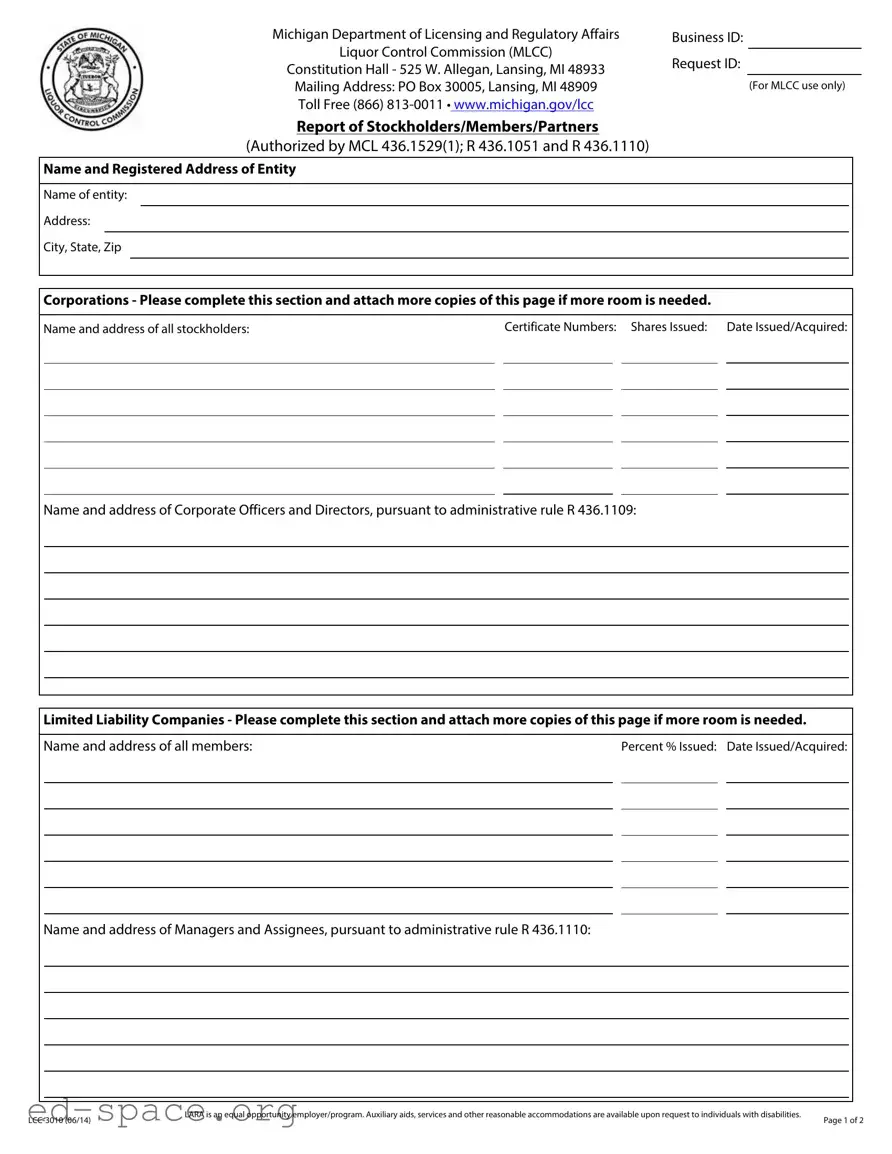
When navigating the world of liquor licensing in Michigan, understanding the Michigan LCC 3010 form is essential for businesses involved in the sale of alcoholic beverages. This form, formally known as the Report of Stockholders/Members/Partners, serves as a critical document that provides the Michigan Liquor Control Commission (MLCC) with detailed information about the ownership structure of a business. It is required under specific administrative rules and state laws, ensuring transparency and compliance within the industry. The form captures essential data, including the names and addresses of stockholders, members, or partners, as well as the percentage of shares or interests they hold. Additionally, it requires details about corporate officers, directors, and managers, allowing the MLCC to assess the qualifications and backgrounds of those involved in the business. Completing this form accurately is not just a formality; it is a legal obligation that carries significant weight, as any inaccuracies could lead to serious repercussions. Ultimately, the LCC 3010 form is a cornerstone of the licensing process, playing a pivotal role in maintaining the integrity of Michigan's liquor industry.

Michigan Department of Licensing and Regulatory Affairs
Liquor Control Commission (MLCC)
Constitution Hall - 525 W. Allegan, Lansing, MI 48933 Mailing Address: PO Box 30005, Lansing, MI 48909 Toll Free (866)
Report of Stockholders/Members/Partners
(Authorized by MCL 436.1529(1); R 436.1051 and R 436.1110)
Business ID:
Request ID:
(For MLCC use only)
Name and Registered Address of Entity
Name of entity:
Address:
City, State, Zip
Corporations - Please complete this section and attach more copies of this page if more room is needed.
Name and address of all stockholders: |
|
Certificate Numbers: Shares Issued: Date Issued/Acquired: |
||||
|
|
|
|
|
|
|
|
|
|
|
|
|
|
|
|
|
|
|
|
|
|
|
|
|
|
|
|
|
|
|
|
|
|
|
|
|
|
|
|
|
|
Name and address of Corporate Officers and Directors, pursuant to administrative rule R 436.1109:
Limited Liability Companies - Please complete this section and attach more copies of this page if more room is needed.
Name and address of all members: |
|
Percent % Issued: Date Issued/Acquired: |
||
|
|
|
|
|
|
|
|
|
|
|
|
|
|
|
|
|
|
|
|
|
|
|
|
|
|
|
|
|
|
Name and address of Managers and Assignees, pursuant to administrative rule R 436.1110:
LARA is an equal opportunity employer/program. Auxiliary aids, services and other reasonable accommodations are available upon request to individuals with disabilities. |
Page 1 of 2 |
|
|

Michigan Department of Licensing and Regulatory Affairs
Liquor Control Commission (MLCC)
Constitution Hall - 525 W. Allegan, Lansing, MI 48933 Mailing Address: PO Box 30005, Lansing, MI 48909 Toll Free (866)
Report of Stockholders/Members/Partners
(Authorized by MCL 436.1529(1); R 436.1051 and R 436.1110)
Business ID:
Request ID:
(For MLCC use only)
Limited Partnerships - Please complete this section and attach more copies of this page if more room is needed.
Name and address of all partners: |
|
Percent % Issued: Date Issued/Acquired: |
||
|
|
|
|
|
|
|
|
|
|
|
|
|
|
|
|
|
|
|
|
|
|
|
|
|
|
|
|
|
|
Name and address of Managers, pursuant to administrative rule R 436.1111:
Signature of Applicant:
I certify that the information contained in this form is true and accurate to the best of my knowledge and belief. I agree to comply with all requirements of the Michigan Liquor Control Code and Administrative Rules. I also understand that providing false or fraudulent information is a violation of the Liquor Control Code pursuant to MCL 436.2003.
Date |
Print name of applicant/licensee and title |
Signature of applicant/licensee |
LARA is an equal opportunity employer/program. Auxiliary aids, services and other reasonable accommodations are available upon request to individuals with disabilities. |
Page 2 of 2 |
|
|
| Fact Name | Description |
|---|---|
| Purpose | The Michigan LCC 3010 form serves as a report of stockholders, members, or partners for entities applying for or maintaining a liquor license. |
| Governing Laws | This form is authorized by the Michigan Liquor Control Code, specifically MCL 436.1529(1), along with administrative rules R 436.1051 and R 436.1110. |
| Submission Requirements | Applicants must provide detailed information about stockholders, members, or partners, including their names, addresses, and shares or ownership percentages. |
| Compliance Statement | The form requires a signature from the applicant, certifying that the information provided is accurate and acknowledging compliance with the Michigan Liquor Control Code. |
Filling out the Michigan LCC 3010 form is an essential step in reporting the necessary information about stockholders, members, or partners in your business. Once the form is completed, it will need to be submitted to the Michigan Liquor Control Commission. Follow these steps carefully to ensure all required information is accurately provided.
What is the Michigan LCC 3010 form?
The Michigan LCC 3010 form is a report that must be submitted to the Michigan Liquor Control Commission (MLCC). This form provides essential information about the stockholders, members, or partners of a business involved in the sale or distribution of alcoholic beverages. It is required under specific Michigan laws and administrative rules to ensure transparency and compliance within the liquor industry.
Who needs to complete the LCC 3010 form?
Any business entity that holds a liquor license in Michigan must complete the LCC 3010 form. This includes corporations, limited liability companies (LLCs), and limited partnerships. Each entity type has specific sections on the form that must be filled out, detailing the ownership structure and key individuals associated with the business.
What information is required on the form?
The form requires various details, including the name and registered address of the entity, the names and addresses of all stockholders, members, or partners, and the percentage of ownership each holds. Additionally, it asks for information about corporate officers, directors, managers, and assignees, depending on the type of entity. If there is not enough space on the form, additional copies can be attached.
How do I submit the LCC 3010 form?
The completed LCC 3010 form can be submitted to the Michigan Liquor Control Commission by mail. The mailing address is provided on the form: PO Box 30005, Lansing, MI 48909. It’s essential to ensure that the form is filled out accurately and signed by the applicant or licensee before submission.
Is there a deadline for submitting the LCC 3010 form?
While the form does not specify a strict deadline, it is crucial to submit it promptly after any changes in ownership or structure occur within the business. Keeping the MLCC informed of any updates helps maintain compliance with Michigan's liquor laws and regulations.
What happens if I provide false information on the form?
Providing false or fraudulent information on the LCC 3010 form is a serious violation of the Michigan Liquor Control Code. Such actions can lead to severe penalties, including fines, suspension, or revocation of the liquor license. It is vital to ensure that all information submitted is accurate and truthful.
Can I get help filling out the LCC 3010 form?
If you need assistance with the LCC 3010 form, you can contact the Michigan Liquor Control Commission directly. They offer support and guidance for individuals and businesses navigating the liquor licensing process. Additionally, consulting with a legal expert familiar with liquor laws may also be beneficial.
Where can I find more information about the MLCC and liquor licensing?
More information about the Michigan Liquor Control Commission and the liquor licensing process can be found on their official website at www.michigan.gov/lcc. This site offers resources, guidelines, and contact information for further inquiries regarding liquor control in Michigan.
Missing Information: One common mistake is leaving out essential details. Ensure that every section is filled out completely. If a section doesn’t apply, indicate that clearly rather than leaving it blank.
Incorrect Business ID: Double-check your Business ID. Using an incorrect or outdated ID can lead to delays or rejections of your application.
Inaccurate Stockholder Information: Providing incorrect names or addresses of stockholders, members, or partners can cause significant issues. Verify that all information is accurate and up-to-date.
Signature Errors: Failing to sign the form or not having the correct person sign can result in the form being deemed invalid. Make sure the applicant's signature matches the printed name and title.
Improper Attachments: Not including required attachments, such as additional pages for stockholders or partners, can hinder the processing of your form. Always check the guidelines for what needs to be attached.
Ignoring Deadlines: Submitting the form late can lead to penalties or denial of your application. Be mindful of any deadlines associated with the filing.
The Michigan LCC 3010 form is a crucial document for businesses involved in the sale of alcoholic beverages. It provides essential information about the ownership structure of the entity applying for a liquor license. Along with this form, several other documents are commonly required to ensure compliance with state regulations. Below is a list of these documents, each serving a specific purpose in the application process.
Each of these documents plays a vital role in the licensing process, ensuring that all relevant information is accurately reported and that the applicant meets the necessary legal requirements. Understanding these documents can help streamline the application process and promote compliance with Michigan's liquor laws.
The Michigan LCC 3010 form is a key document for reporting stockholders, members, and partners in various business entities. Here are eight documents that share similarities with the LCC 3010 form:
When filling out the Michigan LCC 3010 form, attention to detail is crucial. Here are nine important dos and don'ts to keep in mind:
By following these guidelines, you can help ensure a smoother application process.
Misconceptions about the Michigan LCC 3010 form can lead to confusion and potential compliance issues for businesses. Understanding these misconceptions is crucial for anyone involved in the liquor industry in Michigan. Below are some common misunderstandings:
This is incorrect. The LCC 3010 form is applicable to various business structures, including corporations, limited liability companies (LLCs), and limited partnerships. Each type of entity has specific sections to complete, ensuring that all stakeholders are properly reported.
While the owner or applicant must sign the form, it is essential to ensure that all relevant parties, such as officers, directors, or managers, are accurately listed. This comprehensive approach helps maintain transparency and compliance.
This is a significant oversight. If there are any changes in stockholders, members, or partners, the form must be updated and resubmitted. Failure to do so can lead to legal complications and affect licensing status.
This is misleading. Regardless of the size of the business, if it is involved in the liquor industry, completing the LCC 3010 form is a legal requirement. Compliance is not optional and is critical for maintaining operational legitimacy.
In reality, the information submitted on the LCC 3010 form is subject to review by the Michigan Liquor Control Commission. Transparency is vital, and any discrepancies can lead to investigations or penalties.
This is incorrect. The LCC 3010 form must be accompanied by the necessary documentation, such as details of all stockholders or members. Incomplete submissions can delay processing and may result in rejection.
Addressing these misconceptions is essential for anyone navigating the complexities of liquor licensing in Michigan. Ensuring accurate and timely submission of the LCC 3010 form can prevent legal issues and foster a compliant business environment.
When filling out and using the Michigan LCC 3010 form, keep the following key points in mind: