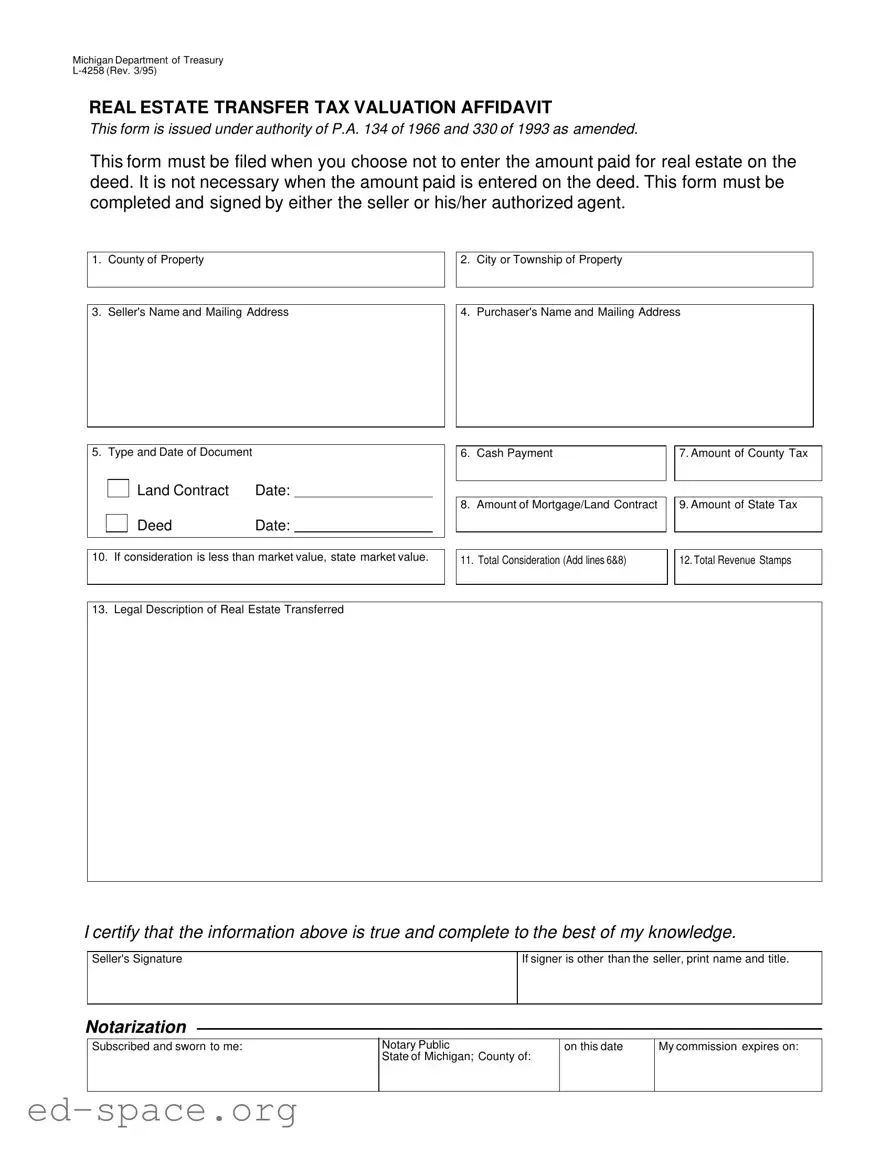
The Michigan L 4258 form, also known as the Real Estate Transfer Tax Valuation Affidavit, plays a crucial role in real estate transactions within the state. When a seller opts not to disclose the sale amount on the deed, this form becomes necessary. It serves as a declaration of the property's value and ensures compliance with state tax regulations. The form must be filled out by either the seller or an authorized agent, capturing essential details such as the county and city of the property, names and addresses of both the seller and purchaser, and the type and date of the document involved in the transaction. Additionally, it requires information on cash payments, mortgage amounts, and the total consideration for the property. If the sale price is less than the market value, the seller must provide that market value as well. The form concludes with a certification statement that the information is accurate, requiring the seller's signature and notarization to validate the submission. This form is vital for ensuring that all parties involved in the transaction fulfill their tax obligations and maintain transparency in real estate dealings.
Michigan Department of Treasury
REAL ESTATE TRANSFER TAX VALUATION AFFIDAVIT
This form is issued under authority of P.A. 134 of 1966 and 330 of 1993 as amended.
This form must be filed when you choose not to enter the amount paid for real estate on the deed. It is not necessary when the amount paid is entered on the deed. This form must be completed and signed by either the seller or his/her authorized agent.
1. County of Property
3. Seller's Name and Mailing Address
2. City or Township of Property
4. Purchaser's Name and Mailing Address
5. Type and Date of Document
Land Contract |
Date: |
DeedDate:
10. If consideration is less than market value, state market value.
6. Cash Payment
$
8. Amount of Mortgage/Land Contract
$
11. Total Consideration (Add lines 6&8)
7.Amount of County Tax
9.Amount of State Tax
12. Total Revenue Stamps
13. Legal Description of Real Estate Transferred
I certify that the information above is true and complete to the best of my knowledge.
Seller's Signature
If signer is other than the seller, print name and title.
NOTARIZATION
Subscribed and sworn to me:
Notary Public
State of Michigan; County of:
on this date
My commission expires on:
| Fact Name | Details |
|---|---|
| Governing Laws | This form is issued under P.A. 134 of 1966 and P.A. 330 of 1993, as amended. |
| Purpose | The L-4258 form must be filed when the amount paid for real estate is not entered on the deed. |
| Who Completes the Form | Either the seller or an authorized agent must complete and sign the form. |
| Required Information | Information about the property, seller, purchaser, and financial details must be provided. |
| Market Value Disclosure | If the consideration is less than market value, the market value must be stated. |
| Notarization Requirement | The form requires notarization to validate the information provided. |
| Filing Deadline | Submit the form at the time of the property transfer to ensure compliance. |
Filling out the Michigan L 4258 form is an essential step when opting not to include the amount paid for real estate on the deed. This form must be completed accurately to ensure compliance with state regulations.
What is the Michigan L 4258 form?
The Michigan L 4258 form, also known as the Real Estate Transfer Tax Valuation Affidavit, is a document required by the Michigan Department of Treasury. It is used when the seller chooses not to disclose the sale price of real estate on the deed. Instead, this form provides the necessary valuation information to assess the appropriate transfer taxes. It helps ensure compliance with state laws regarding real estate transactions.
When do I need to file the L 4258 form?
You must file the L 4258 form if you decide not to enter the amount paid for real estate on the deed. If you do include the sale price on the deed, then this form is not necessary. It’s important to complete and submit the L 4258 to avoid any potential issues with tax assessments or legal requirements.
Who is responsible for completing the form?
The form must be completed and signed by either the seller or an authorized agent acting on behalf of the seller. This ensures that the information provided is accurate and reflects the seller's knowledge of the transaction.
What information do I need to provide on the form?
When filling out the L 4258 form, you’ll need to provide several key pieces of information. This includes the county and city or township where the property is located, the names and mailing addresses of both the seller and purchaser, the type and date of the document (such as a deed or land contract), and financial details such as cash payment, mortgage amount, and total consideration. Additionally, if the consideration is less than the market value, you must state the market value.
Is notarization required for the L 4258 form?
Yes, notarization is required. The seller or authorized agent must sign the form in front of a notary public. This adds a layer of authenticity and helps ensure that the information provided is truthful and complete. The notary will also provide their information, including their commission expiration date, on the form.
What happens if I do not file the L 4258 form when required?
If you fail to file the L 4258 form when it is necessary, you may face penalties or complications during the property transfer process. This could lead to issues with tax assessments or potential legal disputes. To avoid these problems, it is crucial to understand when the form is needed and to complete it accurately.
Where can I obtain the Michigan L 4258 form?
The L 4258 form can be obtained from the Michigan Department of Treasury's website or through your local county clerk's office. It is often available in both physical and digital formats, making it easy to access and complete for your real estate transaction.
Failing to include the County of Property. This information is crucial for processing the form correctly.
Not providing the City or Township of Property. This detail helps identify the location of the real estate.
Leaving out the Seller's Name and Mailing Address. This information is necessary for communication and record-keeping.
Omitting the Purchaser's Name and Mailing Address. This can lead to delays in the transfer process.
Incorrectly filling in the Type and Date of Document. Ensure the dates are accurate to avoid complications.
Not stating the market value if the consideration is less than it. This is important for tax purposes.
Forgetting to calculate the Total Consideration by adding the cash payment and the amount of mortgage/land contract. This total is vital for tax calculations.
Neglecting to sign the form. The seller or authorized agent must sign to validate the information provided.
The Michigan L-4258 form serves a specific purpose in the realm of real estate transactions. However, several other documents are often utilized alongside it to ensure compliance and facilitate the transfer process. Below is a list of these essential forms and documents.
Each of these documents plays a vital role in the real estate transaction process. Ensuring that they are correctly completed and filed can help prevent legal issues and facilitate a smooth transfer of property ownership.
When filling out the Michigan L 4258 form, there are several important dos and don'ts to keep in mind. This will help ensure that your submission is accurate and accepted without delays.
By following these guidelines, you can help ensure that your Michigan L 4258 form is processed smoothly and efficiently.
Understanding the Michigan L 4258 form can be challenging. Here are nine common misconceptions about this form, along with clarifications to help clear up any confusion.
By addressing these misconceptions, individuals can better navigate the requirements of the Michigan L 4258 form and ensure compliance with state regulations.
When filling out and using the Michigan L 4258 form, keep these key takeaways in mind:
Completing this form accurately is crucial for a smooth real estate transaction in Michigan.