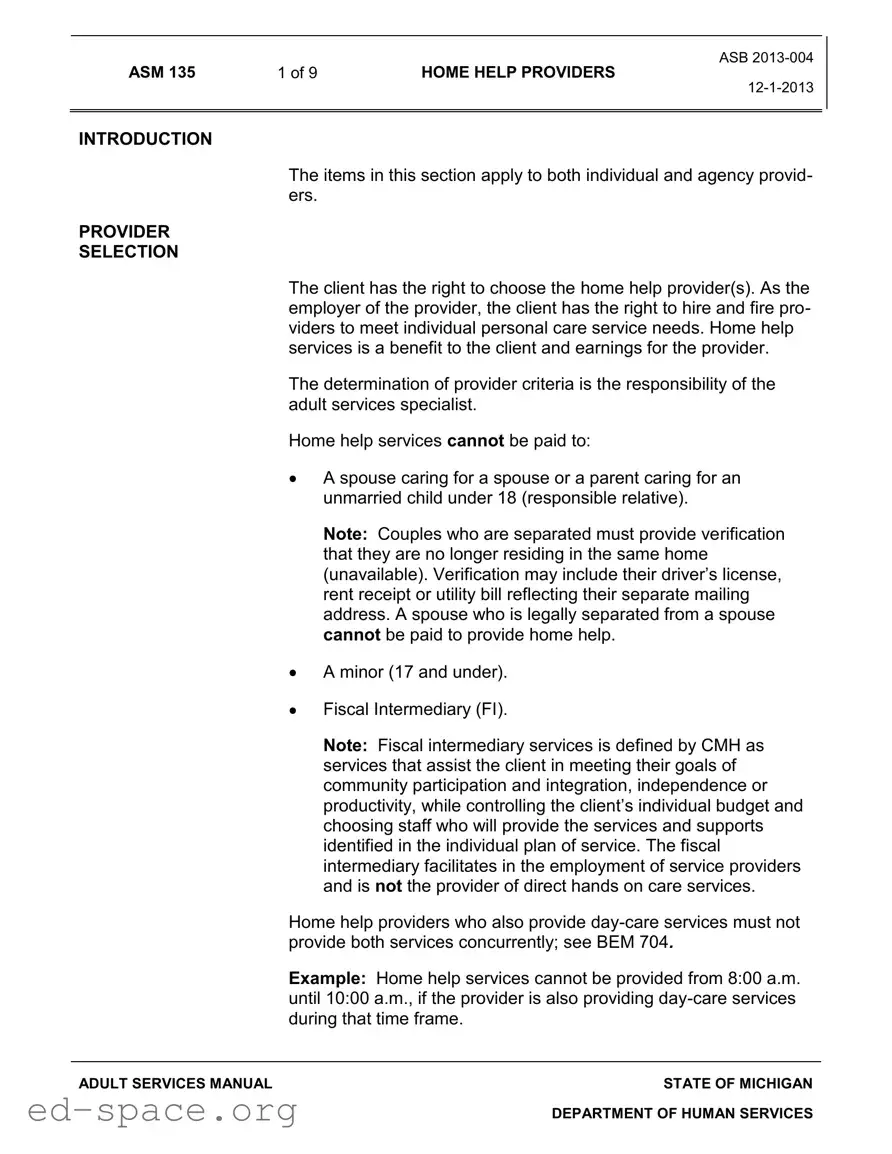
The Michigan Gov Homehelp form plays a crucial role in facilitating home help services for individuals in need of personal care. This form allows clients to select their home help providers, whether individuals or agencies, empowering them to hire and fire based on their specific care needs. It is essential for clients to understand that they are the employers of these providers, not the state. The form outlines important criteria that potential providers must meet, such as being at least 18 years old, having the ability to follow instructions, and maintaining adequate physical health. Additionally, the form emphasizes the necessity of a face-to-face interview between the client and provider, ensuring a mutual understanding of the services to be rendered. Home help services cannot be provided by certain relatives, such as spouses or parents of minors, which is a significant aspect of the guidelines. Clients and providers must also adhere to specific reporting requirements, including notifying the adult services specialist of any changes in care or hospitalization. Furthermore, accurate record-keeping is mandated through the Personal Care Services Provider Log, which both parties must complete and submit quarterly. By clarifying the roles, responsibilities, and expectations of both clients and providers, the Michigan Gov Homehelp form aims to create a supportive framework for delivering essential care services.

|
|
ASB |
ASM 135 |
1 of 9 |
HOME HELP PROVIDERS |
INTRODUCTION
The items in this section apply to both individual and agency provid- ers.
PROVIDER
SELECTION
The client has the right to choose the home help provider(s). As the employer of the provider, the client has the right to hire and fire pro- viders to meet individual personal care service needs. Home help services is a benefit to the client and earnings for the provider.
The determination of provider criteria is the responsibility of the adult services specialist.
Home help services cannot be paid to:
A spouse caring for a spouse or a parent caring for an unmarried child under 18 (responsible relative).
Note: Couples who are separated must provide verification
that they are no longer residing in the same home
(unavailable). Verification may include their driver’s license, rent receipt or utility bill reflecting their separate mailing address. A spouse who is legally separated from a spouse cannot be paid to provide home help.
A minor (17 and under).
Fiscal Intermediary (FI).
Note: Fiscal intermediary services is defined by CMH as services that assist the client in meeting their goals of
community participation and integration, independence or productivity, while controlling the client’s individual budget and
choosing staff who will provide the services and supports identified in the individual plan of service. The fiscal intermediary facilitates in the employment of service providers and is not the provider of direct hands on care services.
Home help providers who also provide
Example: Home help services cannot be provided from 8:00 a.m. until 10:00 a.m., if the provider is also providing
ADULT SERVICES MANUAL |
STATE OF MICHIGAN |
DEPARTMENT OF HUMAN SERVICES

|
|
ASB |
ASM 135 |
2 of 9 |
HOME HELP PROVIDERS |
PROVIDER
CRITERIA
Determine the provider's ability to meet the following minimum cri- teria in a
Age
The provider must be 18 years and older.
Ability
To follow instructions and home help program procedures.
To perform the services required.
To handle emergencies.
Physical Health
The provider’s health must be adequate to perform the needed ser- vices.
Knowledge
The provider must know when to seek assistance from appropriate sources in the event of an emergency.
Personal
Qualities
The provider must be dependable and able to meet job demands.
Training
The provider must be willing to participate in available training pro- grams if necessary.
Home help payment may be terminated if the provider fails to meet any of the provider criteria.
PROVIDER
INTERVIEW
An initial
Explain the following points to the client and the provider during the initial interview:
ADULT SERVICES MANUAL |
STATE OF MICHIGAN |
DEPARTMENT OF HUMAN SERVICES

ASB
ASM 135 |
3 of 9 |
HOME HELP PROVIDERS |
The provider is employed by the client not the State of
Michigan.
As the employer, the client has the right to hire and fire the provider.
A provider who receives public assistance must report all income received as a home help provider to their family independence specialist or eligibility specialist.
The client and provider are responsible for notifying the adult services specialist within 10 business days of any change in providers or hours of care.
The provider and/or client is responsible for notifying the adult services specialist within 10 business days if the client is hospitalized.
Note: Home help services cannot be paid the day a client is admitted into the hospital but can be paid the day of discharge.
The provider must keep a log of the services provided on the
on a quarterly basis. The log must be signed by both the provider and client or the client’s representative.
All earned income must be reported to the IRS; see
www.irs.gov.
No federal, state or city income taxes are withheld from the warrant.
Parents who are caring for an adult child do not have FICA withheld.
Note: Parents who wish to have FICA withheld must be assigned in ASCAP as other relative in the Provider Assignment screen.
All individual providers will receive a
Department of Community Health.
Provider must display a valid picture identification card and social security card.
ADULT SERVICES MANUAL |
STATE OF MICHIGAN |
DEPARTMENT OF HUMAN SERVICES

ASB
ASM 135 |
4 of 9 |
HOME HELP PROVIDERS |
The client and provider must sign the
Note: Providers determined to be a business/agency are exempt from signing the
All providers must sign a
Provider Agreement, before payments are authorized.
Note: Providers are required to complete and sign the agreement only once. If there is a signature date on Bridges/ASCAP provider screen, another
PROVIDER
ENROLLMENT
All home help providers must be enrolled in Bridges by a designee at the local county DHS office prior to authorizing payment. Once a provider is enrolled, Bridges will assign the provider a seven digit identification number. The adult services specialist must allow 24 hours from the time of enrollment for Bridges to interface with
ASCAP.
Instructions for enrolling a provider on Bridges are found on the Office of Training and Staff Development home page. Instruc- tions on assigning a provider in ASCAP are in the ASCAP User Guide located on the adult services home page.
PERSONAL CARE SERVICES PROVIDER LOG
Each individual provider must keep a log of home help services delivered. The DHS- 721 is used for this purpose.
Tasks on the provider logs are automatically marked with an X when printed from ASCAP based on the client’s home help
functional assessment.
The provider must indicate what services were provided and on which days of the month.
ADULT SERVICES MANUAL |
STATE OF MICHIGAN |
DEPARTMENT OF HUMAN SERVICES

ASB
ASM 135 |
5 of 9 |
HOME HELP PROVIDERS |
The client and the provider must sign the log when it is completed to verify that the services approved for payment were delivered.
The log must be submitted to the local office quarterly. Provider logs must be received within 10 business days after the last service date on the log. Failure to do so will result in suspension of payment.
The adult services specialist must initial and date the log upon receipt, demonstrating review of the log.
Retain the log in the client’s case record.
A separate log is required for each provider.
Incomplete logs must be returned to the client/provider for completion.
Agency/business providers have the option of submitting monthly invoices in lieu of the
The service (s) provided, and
The date(s) of service.
See ASM 136, Agency Providers.
HOME HELP STATEMENT OF EMPLOYMENT
The purpose of the
An employment statement must be signed by each provider who renders service to a client.
The statement of employment does the following:
Confirms an understanding of the personal care services provided, how often services are provided, and wages to be paid.
ADULT SERVICES MANUAL |
STATE OF MICHIGAN |
DEPARTMENT OF HUMAN SERVICES

ASB
ASM 135 |
6 of 9 |
HOME HELP PROVIDERS |
Requires positive identification of the provider by means of a picture ID and social security card.
Documents an understanding by both parties that the client, not the State of Michigan, is the employer of the provider.
Stipulates that the client must report any changes in the work schedule to the adult services specialist.
Instructs the provider to repay the State of Michigan for services they did not provide.
Informs the provider that a
Informs a provider receiving public assistance that this employment must be reported to the Department of Human Services
Requires the client and provider must sign the
Distribution of Employment Statement
The adult services specialist will make two copies of the completed and signed form and distribute as follows:
Give one copy to the client.
Give one copy to the provider.
Place the original form in the client’s case record.
MEDICAL ASSISTANCE HOME HELP PROVIDER AGREEMENT
Federal regulations require that all providers of Medicaid covered services complete and sign a provider agreement. This agreement states providers will abide by Medicaid policies in providing services to program clients and in receiving payment from the program. In order to meet this requirement, the Michigan Department of Community Health (MDCH) developed the MSA- 4678, Medical Assistance Home Help Provider Agreement.
ADULT SERVICES MANUAL |
STATE OF MICHIGAN |
DEPARTMENT OF HUMAN SERVICES

ASB
ASM 135 |
7 of 9 |
HOME HELP PROVIDERS |
All home help services providers must have a completed and signed
Procedure
The adult services specialist will furnish a copy of the
Before forwarding the
Assign Provider Tab.
Send the
Provider Enrollment Lewis Cass Building 3rd Floor
320 S. Walnut
Lansing, Michigan 48913
MDCH Provider Enrollment scans the provider agreements and files them under the provider identification numbers.
Locating MSA-
4678 Signature
Date in ASCAP
To locate the
Select Client.
Select the HIS $ icon.
Click on the Provider/TimeTask/Service Plan button. Highlight the provider.
Locate the 4678 Date field. This is a read only field, reflecting what is in Bridges.
ADULT SERVICES MANUAL |
STATE OF MICHIGAN |
DEPARTMENT OF HUMAN SERVICES

ASB
ASM 135 |
8 of 9 |
HOME HELP PROVIDERS |
If there is a date in the signature date field, a
Note: The signature date can also be found in ASCAP under the Client’s for Provider tab. Access this screen by clicking on the utilities menu and selecting Client’s for Provider. Search by the
provider name or identification number and click on the provider name. The provider information is displayed on the detail screen, including the
LOCAL OFFICE
INDIVIDUAL HOME
HELP PROVIDER
HOURLY RATE
Each local DHS office has an established individual home help pro- vider rate. Specialists must not authorize above or below the estab- lished rate.
Cases with hourly rates above the established county rate must be substantiated by an approval letter
PROVIDER
INCOME
VERIFICATION
Requests received by the local office for verification of provider income or employment should be forwarded to MDCH at:
Michigan Department of Community Health
Long Term Care Services Policy Section
Capital Commons Building, 6th Floor
P.O. Box 30479
Lansing, Michigan 48909
OR
FAX to
ADULT SERVICES MANUAL |
STATE OF MICHIGAN |
DEPARTMENT OF HUMAN SERVICES

|
|
ASB |
ASM 135 |
9 of 9 |
HOME HELP PROVIDERS |
JOINT POLICY
DEVELOPMENT
The Adult Services Manual (ASM) policy has been developed jointly by the Michigan Department of Community Health (MDCH) and the Department of Human Services (DHS)
ADULT SERVICES MANUAL |
STATE OF MICHIGAN |
DEPARTMENT OF HUMAN SERVICES
| Fact Name | Fact Description |
|---|---|
| Provider Selection | Clients have the right to choose their home help providers and can hire or fire them as needed. |
| Eligibility Restrictions | Home help services cannot be paid to spouses caring for each other or parents caring for unmarried children under 18. |
| Provider Criteria | Providers must be at least 18 years old and able to follow instructions, handle emergencies, and perform required services. |
| Provider Interview | An initial face-to-face interview is required between the client and the provider, along with a six-month review. |
| Service Logs | Providers must keep a log of services provided using the DHS-721 form, which must be submitted quarterly. |
| Employment Statement | Both the client and provider must sign the MSA-4676 form before payments can be authorized. |
| Enrollment Requirement | All home help providers must be enrolled in the Bridges system by a local county DHS office before receiving payment. |
| IRS Reporting | All income earned by providers must be reported to the IRS, and no taxes will be withheld from payments. |
Filling out the Michigan Gov Homehelp form is an important step in securing home help services. This process ensures that both clients and providers understand their roles and responsibilities. Follow these steps carefully to complete the form correctly.
What is the Michigan Gov Homehelp form?
The Michigan Gov Homehelp form is a document used to facilitate the enrollment of home help providers who assist clients with personal care services. It outlines the responsibilities and requirements for both clients and providers involved in the home help program.
Who can choose a home help provider?
Clients have the right to select their home help provider. As the employer, the client can hire or terminate the provider based on their individual needs for personal care services.
Are there any restrictions on who can be a home help provider?
Yes, certain individuals cannot be paid to provide home help services. This includes spouses caring for spouses, parents caring for unmarried children under 18, minors under 18, and fiscal intermediaries. Additionally, providers who also offer daycare services cannot provide both services at the same time.
What criteria must a home help provider meet?
A home help provider must be at least 18 years old, able to follow instructions, perform required services, handle emergencies, and maintain adequate physical health. They should also possess the knowledge to seek assistance in emergencies and demonstrate dependability and a willingness to participate in training programs if necessary.
What is the process for a provider interview?
An initial face-to-face interview is required between the client and the provider. This interview is crucial for establishing the relationship and ensuring both parties understand their roles. A follow-up contact is also necessary at the six-month review to confirm that services are being provided as agreed.
What documentation is needed for home help services?
Both the client and provider must sign the MSA-4676, Home Help Services Statement of Employment, and the MSA-4678, Home Help Services Provider Agreement before payments can be authorized. Providers must also maintain a log of services delivered using the DHS-721 form, which must be submitted quarterly.
What happens if a provider fails to meet the criteria?
If a provider does not meet the established criteria, payment for home help services may be terminated. It is essential for providers to maintain compliance with the requirements to continue receiving payment for their services.
How is the payment process managed for home help providers?
Home help providers must be enrolled in the Bridges system by a local county DHS office before payment can be authorized. Once enrolled, providers receive a unique identification number. Payments are contingent upon the submission of accurate service logs or invoices, which must be submitted in a timely manner.
Failing to provide accurate personal information. Ensure that all names, addresses, and contact details are correct.
Not verifying the eligibility of the provider. Remember, providers must be at least 18 years old and cannot be responsible relatives.
Ignoring the requirement for a face-to-face interview. This step is crucial for establishing the working relationship.
Neglecting to report changes in circumstances. Notify the adult services specialist within 10 business days of any changes in providers or hours of care.
Forgetting to keep a log of services. Use the DHS-721 log to document services provided and submit it quarterly.
Not signing required forms. Both the client and provider must sign the MSA-4676 and MSA-4678 before payments can be authorized.
Submitting incomplete logs. Ensure that all logs are filled out completely to avoid delays in payment.
Overlooking the need for valid identification. Providers must display a valid picture ID and social security card.
Failing to understand tax implications. All income must be reported to the IRS, and providers should be aware of their tax responsibilities.
Not allowing adequate time for enrollment processing. After enrollment, allow 24 hours for the system to update before expecting payment authorization.
The Michigan Gov Homehelp form is an essential document for individuals seeking assistance with home help services. Along with this form, several other documents are frequently required to ensure proper enrollment and compliance with state regulations. Below is a list of these forms and documents, each accompanied by a brief description.
These documents collectively support the process of securing home help services, ensuring that both clients and providers understand their rights and responsibilities. Proper completion and submission of each form are vital for maintaining compliance and receiving timely assistance.
The Michigan Gov Homehelp form serves as an essential document in the context of home help services. Several other documents share similarities in purpose and structure. Below is a list of five such documents, each highlighting their similarities with the Homehelp form.
When filling out the Michigan Gov Homehelp form, it's essential to follow specific guidelines to ensure a smooth process. Here are ten things to do and avoid:
Understanding the Michigan Gov Homehelp form can be challenging, and several misconceptions may arise. Here are ten common misunderstandings along with clarifications:
By addressing these misconceptions, clients and providers can better navigate the Homehelp program and ensure that they comply with all necessary requirements.
When filling out and using the Michigan Gov Homehelp form, it is essential to understand several key points to ensure a smooth process. Here are five important takeaways:
By keeping these points in mind, clients and providers can navigate the Homehelp form process more effectively, ensuring that necessary services are delivered without unnecessary delays.