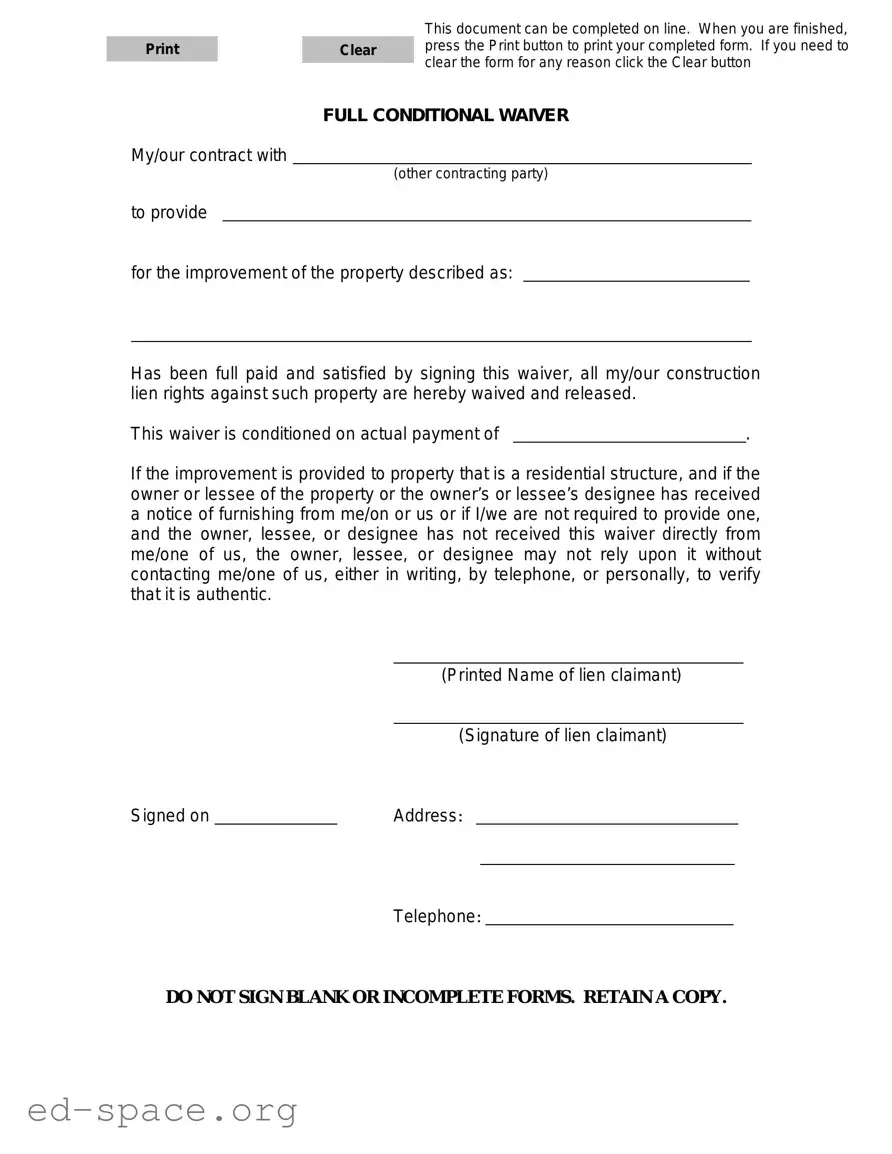
The Michigan Full Conditional Waiver form is an essential document in the realm of construction and property improvement. It serves as a formal acknowledgment that a contractor or subcontractor has received full payment for their services related to a specific property. By signing this waiver, the individual relinquishes any construction lien rights they may have against the property in question, provided that the payment has indeed been made. This form is designed with user-friendliness in mind, allowing individuals to complete it online before printing. After filling it out, one can easily print the finalized document by clicking the Print button, ensuring a clear and professional presentation. Additionally, should there be a need to start over, the Clear button offers a straightforward solution. Importantly, the waiver is conditional, meaning it only takes effect upon actual payment. For residential properties, the form includes specific provisions regarding notice of furnishing, emphasizing the need for proper communication between parties. If the property owner or their designee has not received the waiver directly from the contractor, they must verify its authenticity before relying on it. This verification process helps prevent misunderstandings and protects the rights of all parties involved. Therefore, it is crucial to ensure that the form is complete and accurate, as signing a blank or incomplete document can lead to complications. Retaining a copy of the signed waiver is also advisable for future reference.

|
|
|
This document can be completed on line. When you are finished, |
|
Clear |
press the Print button to print your completed form. If you need to |
|
|
|
|
clear the form for any reason click the Clear button |
|
|
|
FULL CONDITIONAL WAIVER
My/our contract with
(other contracting party)
to provide
for the improvement of the property described as:
Has been full paid and satisfied by signing this waiver, all my/our construction lien rights against such property are hereby waived and released.
This waiver is conditioned on actual payment of |
|
. |
If the improvement is provided to property that is a residential structure, and if the owner or lessee of the property or the owner’s or lessee’s designee has received a notice of furnishing from me/on or us or if I/we are not required to provide one, and the owner, lessee, or designee has not received this waiver directly from me/one of us, the owner, lessee, or designee may not rely upon it without contacting me/one of us, either in writing, by telephone, or personally, to verify that it is authentic.
(Printed Name of lien claimant)
(Signature of lien claimant)
Signed on |
|
Address: |
Telephone:
DO NOT SIGN BLANK OR INCOMPLETE FORMS. RETAIN A COPY.
| Fact Name | Fact Description |
|---|---|
| Completion Method | This form can be completed online, allowing for convenience and efficiency. |
| Printing Instructions | After filling out the form, users should press the "Print" button to obtain a hard copy. |
| Clear Functionality | The "Clear" button allows users to reset the form if they need to start over. |
| Waiver Conditions | This waiver is conditioned on actual payment being made for the improvement of the property. |
| Notice Requirement | If the property is residential, certain notice requirements must be met for the waiver to be valid. |
| Legal Compliance | This form is governed by Michigan law, specifically regarding construction lien rights. |
Completing the Michigan Full Conditional Waiver form is a straightforward process that ensures all necessary information is accurately captured. After filling out the form, you will be able to print it for your records. Be sure to review all details before finalizing your submission.
Remember to keep a copy of the signed form for your records, and do not sign any blank or incomplete forms.
What is the Michigan Full Conditional Waiver form?
The Michigan Full Conditional Waiver form is a legal document used in construction contracts. It serves to waive and release construction lien rights against a property once payment has been made. This waiver is conditional, meaning it only takes effect upon actual payment being received.
How do I complete the form?
You can fill out the Michigan Full Conditional Waiver form online. Once you have entered all the necessary information, simply press the "Print" button to print your completed form. If you need to start over, click the "Clear" button to reset the form.
What should I include in the form?
Make sure to include the name of the other contracting party and a description of the property involved. You also need to provide your printed name, signature, address, and telephone number. Ensure that all fields are completed before signing.
What does it mean to waive construction lien rights?
Waiving construction lien rights means that you are giving up your legal right to file a lien against the property for unpaid work or materials. This waiver protects the property owner from future claims related to the work performed, provided that payment has been made.
Is the waiver valid if the property owner hasn’t received it directly from me?
No, the waiver may not be considered valid if the property owner, lessee, or their designee has not received it directly from you. To ensure authenticity, they should contact you to verify the waiver.
What happens if I sign a blank or incomplete form?
Signing a blank or incomplete form can lead to legal complications. It’s crucial to fill out all necessary information before signing to avoid any misunderstandings or disputes later on. Always retain a copy for your records.
Can I use this waiver for residential properties?
Yes, the Michigan Full Conditional Waiver can be used for residential properties. However, if the owner or lessee has received a notice of furnishing from you, it is important that they receive the waiver directly from you to ensure its validity.
Not Completing the Form Online: Many people overlook the option to fill out the Michigan Full Conditional Waiver form online. This can lead to errors that are easily avoidable.
Failing to Print Clearly: After completing the form, it is crucial to press the Print Clear button. Neglecting this step may result in an unclear document that could be rejected.
Incomplete Information: Leaving sections blank can invalidate the waiver. Ensure all required fields, including the contracting party's name and property description, are filled out completely.
Incorrect Payment Amount: The waiver is conditional upon actual payment. Not specifying the correct payment amount can lead to misunderstandings and potential legal issues.
Not Providing a Notice of Furnishing: If required, failing to provide a notice of furnishing can impact the validity of the waiver. Be aware of your obligations in this regard.
Signing Blank Forms: Signing a blank or incomplete form can lead to serious consequences. Always ensure the form is fully completed before signing.
Not Retaining a Copy: After submitting the waiver, it is essential to keep a copy for your records. This can be important for future reference or disputes.
Failure to Verify Authenticity: If you are a property owner or lessee, do not rely on a waiver unless you have verified its authenticity directly with the lien claimant.
The Michigan Full Conditional Waiver form is an important document in construction and property improvement projects. It helps protect both contractors and property owners by clearly outlining payment conditions. Alongside this form, several other documents may be necessary to ensure clarity and legal protection. Below are some common forms and documents often used in conjunction with the Michigan Full Conditional Waiver.
Using these documents in conjunction with the Michigan Full Conditional Waiver can help ensure that all parties involved in a construction project understand their rights and obligations. Proper documentation is key to avoiding disputes and ensuring a smooth process from start to finish.
The Michigan Full Conditional Waiver form serves a specific purpose in the realm of construction and property improvement. Several other documents share similarities in function and intent. Below is a list of ten such documents, each accompanied by a brief explanation of how they relate to the Michigan Full Conditional Waiver form.
Understanding these documents can help ensure clarity and protection for all parties involved in property improvement projects.
When filling out the Michigan Full Conditional Waiver form, it is important to follow specific guidelines to ensure accuracy and compliance. Below is a list of things you should and shouldn't do:
Misconception 1: The form guarantees payment.
Many individuals mistakenly believe that signing the Michigan Full Conditional Waiver guarantees they will receive payment for their work. In reality, this waiver is conditional upon actual payment being made. If payment is not received, the waiver does not hold any value.
Misconception 2: The waiver can be relied upon without verification.
Some assume that once the waiver is signed, it can be taken at face value. However, if the property owner or lessee has not received the waiver directly from the lien claimant, they should verify its authenticity before relying on it. This step is crucial to ensure that all parties are protected.
Misconception 3: The form can be signed if incomplete.
There is a common belief that it is acceptable to sign a blank or incomplete form. This is a dangerous assumption. Signing an incomplete form can lead to misunderstandings and potential legal issues. Always ensure that all necessary information is filled out completely before signing.
Misconception 4: The waiver is unnecessary if a notice of furnishing was not provided.
Some may think that if a notice of furnishing was not required, then the waiver is irrelevant. This is not the case. Even if a notice is not needed, the waiver still serves an important purpose in protecting the rights of all parties involved in the construction project.
Filling out the Michigan Full Conditional Waiver form is an important process for anyone involved in property improvement contracts. Here are key takeaways to keep in mind:
Understanding these points can help ensure that the waiver is used correctly and effectively in your construction transactions.