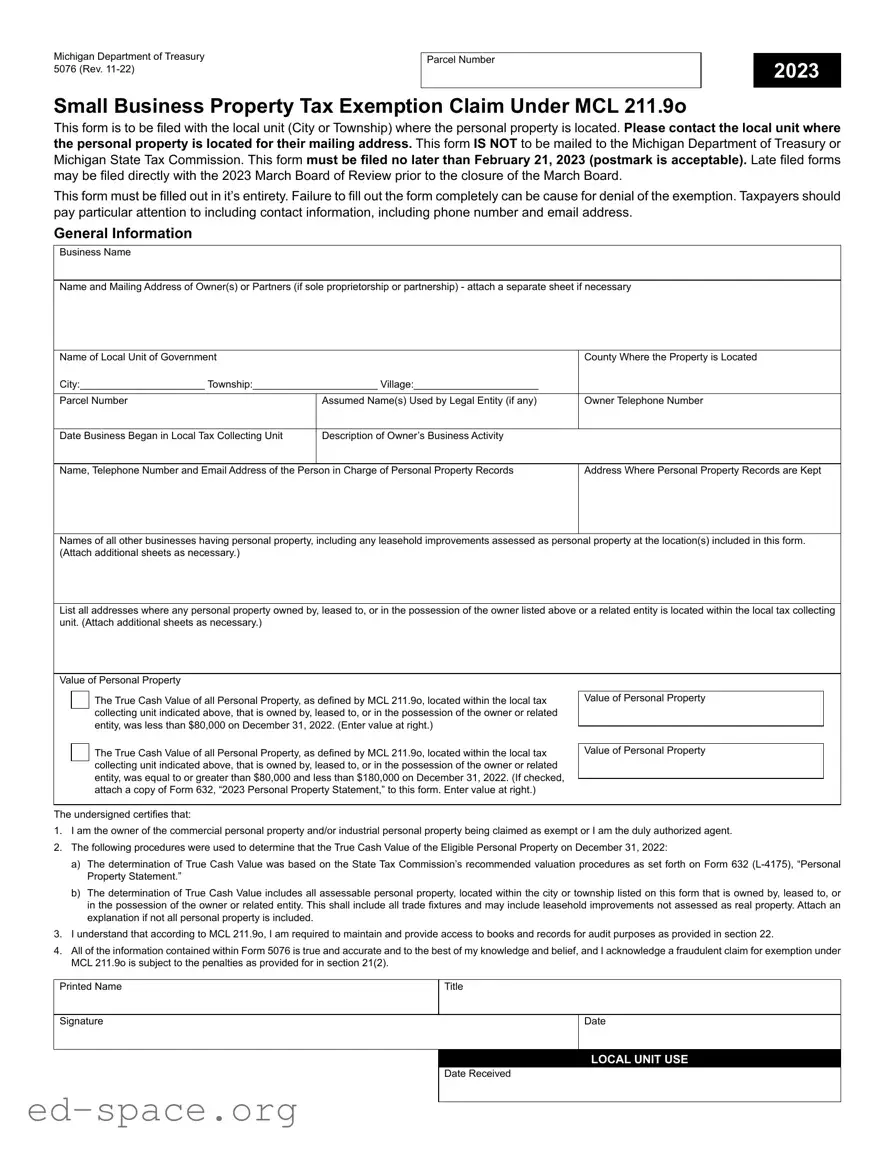
The Michigan Exemption form, officially known as the Michigan Department of Treasury 5076, is an essential document for small business owners seeking relief from personal property taxes. This form is specifically designed for claiming the Small Business Property Tax Exemption under MCL 211.9o, which allows eligible businesses to exempt personal property valued at less than $80,000. It’s crucial to file this form with the local city or township where the property is located, rather than sending it to the Michigan Department of Treasury. The deadline for submission is February 22, 2022, and late submissions can still be considered if filed before the March Board of Review closes. Completing the form accurately is vital; any omissions can lead to denial of the exemption. The form requests detailed information about the business, including ownership details, contact information, and a description of business activities. Additionally, it requires the owner to certify that the claimed personal property meets the exemption criteria. Maintaining accurate records is also essential, as the owner must be prepared for potential audits. Understanding the requirements and processes associated with the Michigan Exemption form can significantly ease the tax burden on small businesses, making it a valuable tool for financial management.
Michigan Department of Treasury 5076 (Rev.
Parcel Number
2023
Small Business Property Tax Exemption Claim Under MCL 211.9o
This form is to be filed with the local unit (City or Township) where the personal property is located. Please contact the local unit where the personal property is located for their mailing address. This form IS NOT to be mailed to the Michigan Department of Treasury or
Michigan State Tax Commission. This form must be filed no later than February 21, 2023 (postmark is acceptable). Late filed forms may be filed directly with the 2023 March Board of Review prior to the closure of the March Board.
This form must be filled out in it’s entirety. Failure to fill out the form completely can be cause for denial of the exemption. Taxpayers should pay particular attention to including contact information, including phone number and email address.
General Information
Business Name
Name and Mailing Address of Owner(s) or Partners (if sole proprietorship or partnership) - attach a separate sheet if necessary
Name of Local Unit of Government |
|
County Where the Property is Located |
City:______________________ Township:______________________ Village:______________________ |
|
|
|
|
|
Parcel Number |
Assumed Name(s) Used by Legal Entity (if any) |
Owner Telephone Number |
Date Business Began in Local Tax Collecting Unit
Description of Owner’s Business Activity
Name, Telephone Number and Email Address of the Person in Charge of Personal Property Records
Address Where Personal Property Records are Kept
Names of all other businesses having personal property, including any leasehold improvements assessed as personal property at the location(s) included in this form. (Attach additional sheets as necessary.)
List all addresses where any personal property owned by, leased to, or in the possession of the owner listed above or a related entity is located within the local tax collecting unit. (Attach additional sheets as necessary.)
Value of Personal Property
The True Cash Value of all Personal Property, as defined by MCL 211.9o, located within the local tax collecting unit indicated above, that is owned by, leased to, or in the possession of the owner or related entity, was less than $80,000 on December 31, 2022. (Enter value at right.)
Value of Personal Property
The True Cash Value of all Personal Property, as defined by MCL 211.9o, located within the local tax |
Value of Personal Property |
collecting unit indicated above, that is owned by, leased to, or in the possession of the owner or related |
|
entity, was equal to or greater than $80,000 and less than $180,000 on December 31, 2022. (If checked, |
|
|
|
attach a copy of Form 632, “2023 Personal Property Statement,” to this form. Enter value at right.) |
|
The undersigned certifies that:
1.I am the owner of the commercial personal property and/or industrial personal property being claimed as exempt or I am the duly authorized agent.
2.The following procedures were used to determine that the True Cash Value of the Eligible Personal Property on December 31, 2022:
a)The determination of True Cash Value was based on the State Tax Commission’s recommended valuation procedures as set forth on Form 632
b)The determination of True Cash Value includes all assessable personal property, located within the city or township listed on this form that is owned by, leased to, or in the possession of the owner or related entity. This shall include all trade fixtures and may include leasehold improvements not assessed as real property. Attach an explanation if not all personal property is included.
3.I understand that according to MCL 211.9o, I am required to maintain and provide access to books and records for audit purposes as provided in section 22.
4.All of the information contained within Form 5076 is true and accurate and to the best of my knowledge and belief, and I acknowledge a fraudulent claim for exemption under MCL 211.9o is subject to the penalties as provided for in section 21(2).
Printed Name
Title
Signature
Date
LOCAL UNIT USE
Date Received
5076, Page 2
Instructions for Small Business Property Tax Exemption Claim Under
MCL 211.9o (Form 5076)
MCL 211.9o provides for a personal property tax exemption for “eligible personal property.” This is commonly referred to as the
Small Business Taxpayer Exemption. MCL 211.9o defines “eligible personal property” as meeting all of the following criteria:
•The personal property must be classified as industrial personal property or commercial personal property as defined in MCL 211.34c or would be classified as industrial personal property or commercial personal property if not exempt and
•The combined true cash value of all industrial personal property and commercial personal property owned by, leased by or in the possession of the owner or a related entity claiming the exemption is less than $180,000 in the local tax collecting unit and
•The property is not leased to or used by a person that previously owned the property or a person that, directly or indirectly controls, is controlled by, or under common control with the person that previously owned the property.
Personal Property Valued Less than $80,000
In order to claim an exemption for personal property valued less than $80,000, this form must be filed with the local unit (City or Township) where the personal property is located no later than February 21, 2023 (postmark is acceptable). This form IS NOT to be mailed to the Michigan Department of Treasury or the Michigan State Tax Commission. Please contact the local unit where the personal property is located for their mailing address. Late filed forms may be filed directly with the local unit March Board of Review prior to the closure of the March Board of Review. Taxpayers must contact the local unit directly to determine the March Board of Review dates.
Taxpayers must appear in person or have a representative appear on their behalf in order to late file with the March Board of Review.
Once the exemption is granted for personal property valued at less than $80,000, the taxpayer will continue to receive the exemption until they no longer qualify for the exemption. Once they no longer qualify, the taxpayer is required to file a rescission form and a personal property statement no later than February 20th of the year that the property is no longer eligible. Failure to file the rescission form will result in significant penalty and interest as prescribed in MCL 211.9o.
This form will exempt property owned only by the entity filing the form. If personal property is leased to or used by an entity other than the property’s owner, the owner of that personal property must file the form for that property, not the lessee or the user. The owner may file the form and claim the exemption only if the True Cash Value of all of the commercial or industrial personal property located within the local tax collecting unit that is owned by, leased to, or in the possession of the owner or a related entity was less than $80,000 on December 31, 2022.
This form must be filled out in it’s entirety. Failure to fill out the form completely can be cause for denial of the exemption. Taxpayers should pay particular attention to including contact information, including phone number and email address.
Once an exemption is granted for personal property valued at less than $80,000, taxpayers are not required to file a “Personal Property Statement” (Form 632) in the year they are claiming the exemption.
Personal Property Valued Greater than or Equal to $80,000 but Less than $180,000
In order to claim an exemption for personal property valued at $80,000 or more but less than $180,000, this form along Form 632 Personal Property Statement must be filed ANNUALLY with the local unit (City or Township) where the personal property is located no later than February 20 of each year (postmark is acceptable). If February 20 is a Saturday, Sunday, or legal holiday, this form and accompanying personal property statement must be filed the next day that is not a Saturday, Sunday, or legal holiday of that year. This form IS NOT to be mailed to the Michigan Department of Treasury or the Michigan State Tax Commission. Please contact the local unit where the personal property is located for their mailing address. Late filed forms may be filed directly with the local unit March Board of Review prior to the closure of the March Board of Review. Taxpayers must contact the local unit directly to determine the March Board of Review dates.
NOTICE: Questions regarding this form should be directed to the assessor of the city or township where the personal property is located. This form is issued under the authority of Public Act 206 of 1893. Additional detailed information on the Small Business Taxpayer Personal Property Exemption can be found on the State Tax Commission website at www.michigan.gov/ statetaxcommission.
| Fact Name | Details |
|---|---|
| Form Purpose | This form is used to claim the Small Business Property Tax Exemption for eligible personal property in Michigan. |
| Filing Deadline | The form must be submitted to the local unit of government by February 22, 2022. A postmark is acceptable. |
| Governing Law | This form is governed by Michigan Compiled Laws (MCL) 211.9o, which outlines the criteria for the exemption. |
| Consequences of Incomplete Submission | Failure to fill out the form completely can lead to denial of the exemption, so thoroughness is essential. |
After obtaining the Michigan Exemption form, it is essential to complete it accurately and submit it to the appropriate local unit. Ensure that all required information is provided to avoid any delays or denial of the exemption.
After completing the form, ensure that it is submitted to the appropriate local unit by the deadline. Be aware that late submissions may have different requirements and procedures. It is advisable to keep a copy of the submitted form for your records.
What is the Michigan Exemption form?
The Michigan Exemption form, specifically Form 5076, is used to claim a personal property tax exemption for small businesses. This exemption applies to eligible personal property, which includes industrial and commercial personal property with a true cash value of less than $80,000. The form must be submitted to the local unit of government where the property is located, not to the Michigan Department of Treasury.
Who is eligible to file the Michigan Exemption form?
To be eligible, a business must own or lease personal property that qualifies as industrial or commercial personal property. Additionally, the combined true cash value of all such property owned or leased by the business or related entities must be less than $80,000 as of December 31, 2021. The property must not be leased to or used by a person who previously owned it or is under common control with the previous owner.
When is the deadline to submit the form?
The completed form must be submitted to the local unit of government by February 22, 2022. A postmark is acceptable. If the form is submitted late, it may still be filed with the March Board of Review before it closes. It's essential to check with the local unit for specific dates and procedures regarding late submissions.
What happens if the form is not filled out completely?
Failure to complete the form in its entirety can lead to denial of the exemption. It is crucial to provide all required information, including contact details, and to ensure that all sections are filled out accurately. Missing information may result in processing delays or rejection of the claim.
What should I do if my business no longer qualifies for the exemption?
If a business no longer meets the eligibility criteria for the exemption, the owner must file a rescission form and a personal property statement by February 20 of the year the property becomes ineligible. Not filing this rescission form can lead to penalties and interest on any additional taxes owed.
Can I file the form if my property is leased to another entity?
No, the owner of the personal property must file the exemption form. If the property is leased to or used by another entity, that entity cannot claim the exemption. The exemption can only be claimed by the owner of the property, provided they meet the eligibility requirements.
Do I need to file a Personal Property Statement if I file this form?
No, businesses that file Form 5076 are not required to submit a Personal Property Statement (Form 632) for the year in which they claim the exemption. This simplifies the process for eligible small businesses, allowing them to focus on the exemption claim without additional paperwork.
Where can I find more information about the Michigan Exemption form?
For further details, taxpayers can visit the State Tax Commission's website at www.michigan.gov/statetaxcommission. Additionally, questions can be directed to the assessor of the city or township where the personal property is located for specific guidance and assistance.
Incomplete Information: One of the most common mistakes is failing to fill out the form completely. Each section must be addressed, including the business name, owner details, and property descriptions. Incomplete forms can lead to denial of the exemption.
Missing Contact Information: Taxpayers often overlook the importance of including accurate contact information. Ensure that the phone number and email address of the person in charge of personal property records are clearly provided. This information is vital for any follow-up communication.
Incorrect Filing Location: Many individuals mistakenly send the form to the Michigan Department of Treasury or the Michigan State Tax Commission. This form must be filed directly with the local unit where the property is located. Confirm the correct mailing address with the local unit.
Late Submission: The deadline for filing this form is February 22, 2022. Late submissions can still be filed with the March Board of Review, but taxpayers must appear in person or have a representative present. Missing this deadline can jeopardize the exemption.
Failure to Verify True Cash Value: Taxpayers must accurately determine and report the True Cash Value of all personal property. If the value exceeds $80,000 as of December 31, 2021, the exemption will not apply. Ensure that the valuation procedures are followed correctly.
The Michigan Exemption form is a crucial document for small businesses seeking a property tax exemption. However, several other forms and documents may accompany it to ensure compliance and facilitate the exemption process. Below is a list of commonly used documents that may be relevant.
These documents collectively support the Michigan Exemption form and help ensure that businesses can successfully navigate the exemption process. Proper preparation and submission of all necessary paperwork can significantly impact the outcome of the exemption claim.
The Michigan Exemption form shares similarities with several other important documents used in various tax and exemption contexts. Here’s a breakdown of eight such documents:
When filling out the Michigan Exemption form, there are several important steps to follow and pitfalls to avoid. Here’s a list of what you should and shouldn’t do:
Following these guidelines will help ensure a smoother process when claiming your exemption.
Misconceptions about the Michigan Exemption form can lead to confusion among business owners. Here are six common misconceptions, along with clarifications:
This is incorrect. The Michigan Exemption form must be submitted to the local unit (City or Township) where the personal property is located, not to the state treasury.
In fact, late forms can be filed directly with the local unit's March Board of Review before its closure. It is essential to check the specific dates for each local unit.
This is false. The exemption is specifically designed for small businesses with a True Cash Value of eligible personal property under $80,000.
Not necessarily. The form requires an explanation if not all personal property is included. Only eligible personal property should be reported.
This is misleading. The exemption continues only as long as the business meets the eligibility criteria. If the business no longer qualifies, a rescission form must be filed.
This is only true for the year in which the exemption is claimed. In subsequent years, businesses may still need to file a Personal Property Statement if they do not claim the exemption.
Filing the Michigan Exemption form requires careful attention to detail. Here are key takeaways to ensure a smooth process:
By following these guidelines, you can navigate the Michigan Exemption form process more effectively and avoid potential pitfalls.