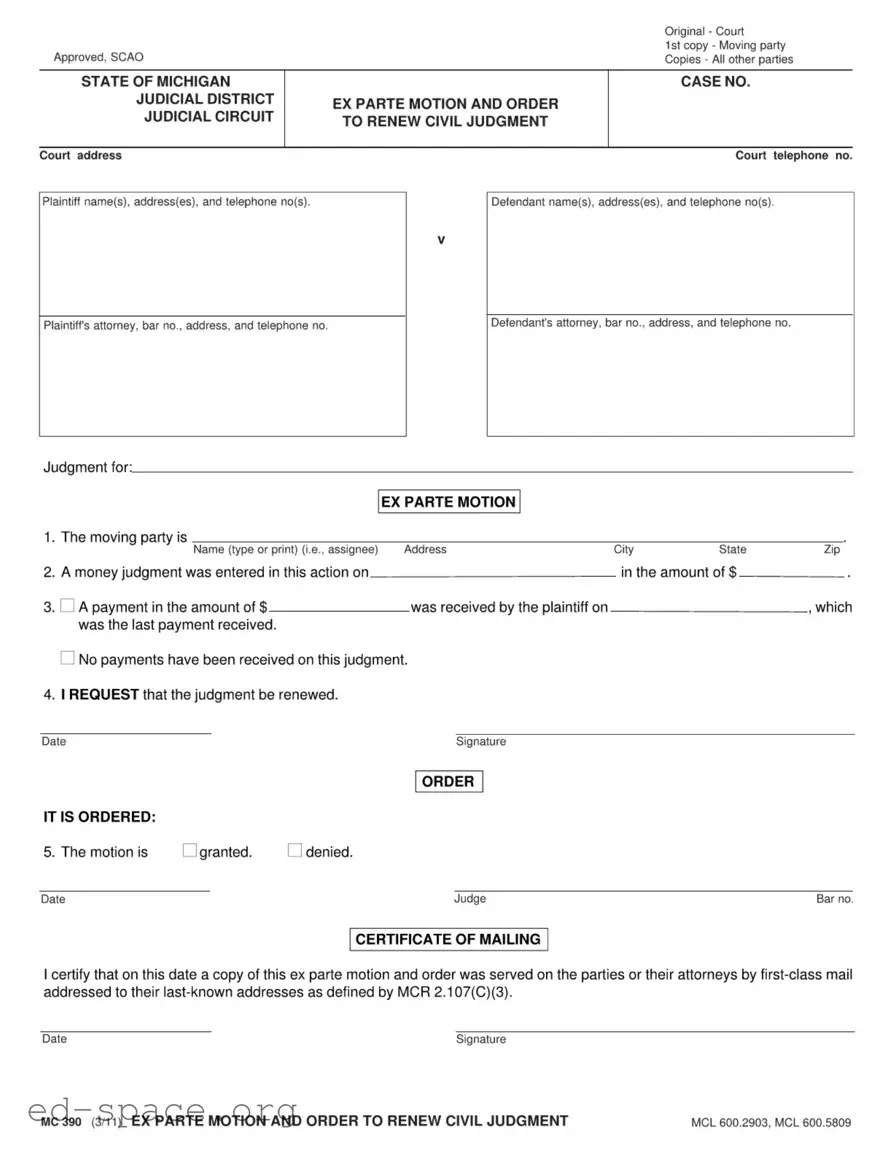
The Michigan Ex Parte form serves a crucial role in the legal process, particularly when it comes to renewing civil judgments. This form is used by a moving party to request the court's permission to renew a previously entered money judgment. The process begins with the identification of the plaintiff and defendant, including their contact information. The moving party must provide details about the original judgment, including the date it was entered and the last payment received. This information is essential for the court to assess the status of the judgment. The form also includes a request for renewal, specifying the amount to be renewed, and culminates in a signature from the moving party. Once the motion is filed, the court will issue an order indicating whether the motion has been granted or denied. The form concludes with a certificate of mailing, ensuring that all parties involved are notified of the motion and its outcome. This structured approach helps streamline the renewal process, ensuring that all necessary information is presented clearly and concisely.
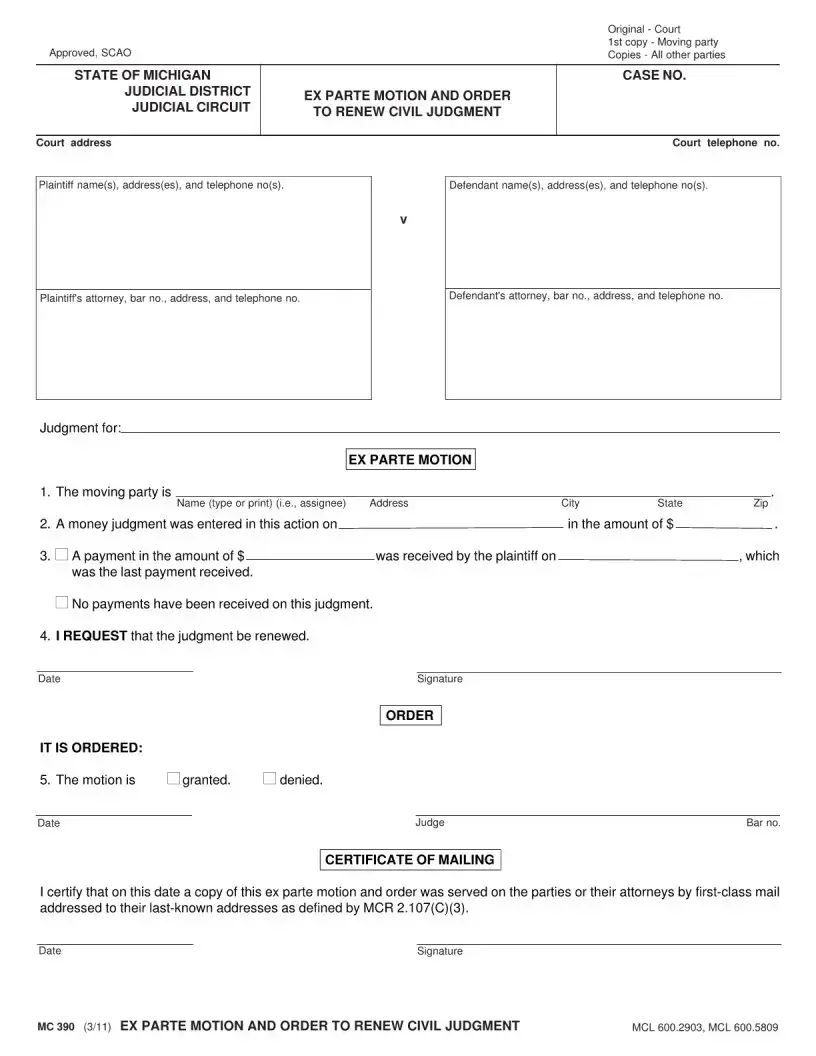
| Fact Name | Fact Description |
|---|---|
| Form Purpose | The Michigan Ex Parte form is used to request the renewal of a civil judgment without a hearing. |
| Governing Laws | This form is governed by MCL 600.2903 and MCL 600.5809, which outline the procedures for renewing civil judgments. |
| Filing Requirements | The moving party must complete the form and file it with the appropriate court in Michigan. |
| Notification Process | Upon filing, the moving party must serve a copy of the motion and order to all other parties involved. |
| Payment Information | The form requires the moving party to provide details about the last payment received on the judgment. |
| Signature Requirement | The moving party must sign the form to certify that the information provided is accurate and complete. |
| Judicial Discretion | The judge has the authority to grant or deny the motion based on the information presented. |
| Certificate of Mailing | A certificate of mailing is included to confirm that all parties have been notified of the motion. |
| Form Updates | The current version of the form is MC 390, with the last update noted as March 2011. |
Filling out the Michigan Ex Parte form involves providing specific information regarding a civil judgment that you wish to renew. After completing the form, it must be submitted to the appropriate court along with any required copies for the involved parties.
What is the Michigan Ex Parte form?
The Michigan Ex Parte form is a legal document used to request the renewal of a civil judgment without requiring a hearing or the presence of the other party. This form is particularly useful when a creditor wants to extend the validity of a judgment that has not been fully satisfied. By filing this motion, the moving party can efficiently seek a court order to renew their judgment, ensuring they can continue to collect the owed amount.
Who can file an Ex Parte motion in Michigan?
Any party that has obtained a money judgment in a civil case can file an Ex Parte motion to renew that judgment. This typically includes creditors or their assignees. If you are the original plaintiff or have taken over the rights to collect the judgment, you have the ability to file this motion.
What information is required on the form?
The form requires several key pieces of information. You need to provide the names and addresses of both the plaintiff and defendant, the case number, the original judgment amount, and the date of the last payment received. Additionally, you must specify the amount you are requesting to renew the judgment for. Accurate and complete information is essential to avoid delays in processing your request.
How does the Ex Parte process work?
Once you complete the Ex Parte motion and file it with the court, the judge will review your request. Because this is an Ex Parte motion, the judge may grant or deny the renewal without requiring the other party to be present. If granted, the court will issue an order to renew the judgment, which you must then serve to the other party or their attorney.
Is there a fee associated with filing the Ex Parte motion?
Yes, there is typically a filing fee associated with submitting the Ex Parte motion to renew a civil judgment. The exact fee can vary by court, so it’s a good idea to check with your local court for the current fee schedule. If you cannot afford the fee, you may be able to request a fee waiver based on your financial situation.
What happens if the motion is denied?
If the judge denies your Ex Parte motion, you will receive a notification explaining the reason for the denial. Depending on the situation, you may have the option to address the issues raised by the court and refile the motion or explore other legal avenues for collecting the judgment. Understanding the reasons for denial can help you strengthen your case for future attempts.
How long is a renewed judgment valid?
A renewed judgment in Michigan is typically valid for an additional ten years from the date of renewal. This gives the creditor a fresh opportunity to collect the owed amount. However, it’s important to keep track of the renewal date and any payments made to ensure compliance with the law.
What should I do after the motion is granted?
Once your Ex Parte motion is granted, you will receive an official court order. It’s crucial to serve this order to the other party or their attorney, as required by law. This ensures that they are aware of the renewed judgment. Additionally, keep a copy of the order for your records, as it serves as proof of the renewed judgment and can be used in future collection efforts.
Incomplete Information: One common mistake is failing to provide all required details. The form asks for specific information about the plaintiff and defendant, including names, addresses, and contact numbers. Omitting any of these details can delay the process or lead to rejection of the form.
Incorrect Payment Amount: Another frequent error involves misreporting the payment history. It's essential to accurately state the amount of the last payment received. If this figure is incorrect, it may affect the renewal of the judgment.
Missing Signatures: Signatures are vital for the form's validity. If the moving party does not sign the motion or if the judge's signature is absent, the court may not accept the document. Always double-check that all necessary signatures are present before submission.
Failure to Serve Properly: Proper service of the motion to all parties is crucial. The form requires certification that copies were sent to the parties or their attorneys. Neglecting this step can result in procedural issues and may lead to the motion being denied.
The Michigan Ex Parte form is often used in legal proceedings to renew a civil judgment. However, several other forms and documents accompany it throughout the process. Understanding these documents can help individuals navigate the legal system more effectively.
Each of these documents plays a critical role in the legal process surrounding the Michigan Ex Parte form. Familiarity with them can empower individuals to advocate for their rights and navigate the complexities of the legal system with greater confidence.
When filling out the Michigan Ex Parte form, there are several important considerations to keep in mind. Here are five things you should and shouldn't do:
Understanding the Michigan Ex Parte form is essential for anyone involved in legal proceedings. However, several misconceptions can lead to confusion. Here are nine common misconceptions about the Michigan Ex Parte form:
Being aware of these misconceptions can help individuals navigate the legal system more effectively and avoid potential pitfalls when dealing with Ex Parte motions in Michigan.
Understanding the Michigan Ex Parte form is crucial for anyone looking to renew a civil judgment. This form streamlines the process and allows for efficient handling of the renewal.
When filling out the form, ensure that all parties involved, including the plaintiff and defendant, are accurately listed with their names, addresses, and contact information. This ensures proper communication and compliance with legal requirements.
The date of the original judgment and the amount of the last payment received must be clearly indicated. This information is vital for establishing the timeline of the judgment and any payments made.
Check the box indicating whether the motion is granted or denied once the judge has made a decision. This is a crucial step that formalizes the outcome of the motion.
After submitting the form, it is essential to certify mailing to all parties involved. This demonstrates that everyone has been informed about the motion and complies with legal notification requirements.
Keep a copy of the completed form for your records. This will be helpful in case any disputes arise regarding the renewal of the judgment in the future.