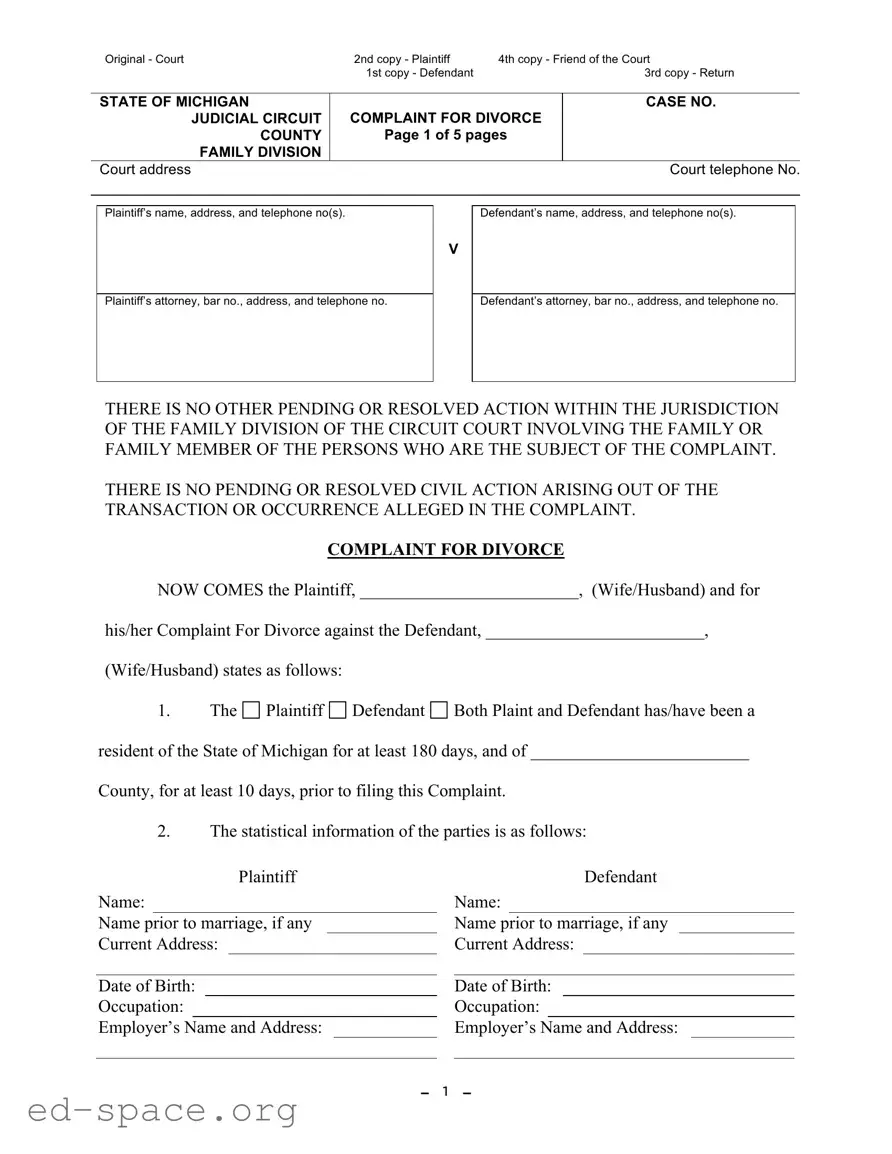
Filing for divorce can be a challenging and emotional process, and in Michigan, the Complaint for Divorce form serves as the starting point for this legal journey. This document is essential for anyone looking to dissolve their marriage, as it outlines key information about both spouses, including their names, addresses, and contact details. It also requires the plaintiff to confirm their residency in Michigan, providing essential jurisdictional details. The form addresses important aspects of the marriage, such as the date of marriage, separation, and any minor children involved. Additionally, it includes provisions for property division and custody arrangements, ensuring that all parties are aware of their rights and responsibilities. With sections dedicated to the breakdown of the marriage and requests for relief, the Complaint for Divorce form sets the stage for the legal proceedings that follow. Completing this form accurately is crucial, as it lays the groundwork for the divorce process and helps facilitate a smoother transition for all involved.

Original - Court |
2nd copy - Plaintiff |
4th copy - Friend of the Court |
|
1st copy - Defendant |
3rd copy - Return |
STATE OF MICHIGAN JUDICIAL CIRCUIT
COUNTY FAMILY DIVISION
COMPLAINT FOR DIVORCE
Page 1 of 5 pages
CASE NO.
Court address |
Court telephone No. |
Plaintiff’s name, address, and telephone no(s).
V
Defendant’s name, address, and telephone no(s).
Plaintiff’s attorney, bar no., address, and telephone no.
Defendant’s attorney, bar no., address, and telephone no.
THERE IS NO OTHER PENDING OR RESOLVED ACTION WITHIN THE JURISDICTION OF THE FAMILY DIVISION OF THE CIRCUIT COURT INVOLVING THE FAMILY OR FAMILY MEMBER OF THE PERSONS WHO ARE THE SUBJECT OF THE COMPLAINT.
THERE IS NO PENDING OR RESOLVED CIVIL ACTION ARISING OUT OF THE TRANSACTION OR OCCURRENCE ALLEGED IN THE COMPLAINT.
COMPLAINT FOR DIVORCE
NOW COMES the Plaintiff, _________________________, (Wife/Husband) and for
his/her Complaint For Divorce against the Defendant, _________________________,
(Wife/Husband) states as follows:
1.The Plaintiff Defendant Both Plaint and Defendant has/have been a resident of the State of Michigan for at least 180 days, and of _________________________
County, for at least 10 days, prior to filing this Complaint.
2.The statistical information of the parties is as follows:
Plaintiff
Name:
Name prior to marriage, if any Current Address:
Date of Birth:
Occupation:
Employer’s Name and Address:
Defendant
Name:
Name prior to marriage, if any Current Address:
Date of Birth:
Occupation:
Employer’s Name and Address:
- 1 -

STATE OF MICHIGAN |
COMPLAINT FOR DIVORCE |
CASE NO. |
JUDICIAL CIRCUIT |
|
|
COUNTY |
Page 2 of 5 pages |
|
FAMILY DIVISION |
|
|
Court address |
|
Court telephone no. |
|
|
|
Plaintiff
V
Defendant
3.On the ______ day of __________, the Plaintiff, _________________________, was legally married to the Defendant, _________________________, in the County of
_______________. The Wife’s maiden name was _________________________.
4.The Plaintiff, _________________________, and the Defendant,
_________________________, lived and
5.The parties have do not have property to be divided.
6.There are _______ minor children of said marriage:
Name |
|
Date of Birth |
|
Social Security Number |
|
|
|
|
|
|
|
|
|
|
|
|
|
|
|
|
|
|
|
|
7.Pursuant to MCL 722.1209, Plaintiff states:
a.The children presently reside with _________________________ at
_________________________ and for the last five years have resided with
_________________________ at _________________________.
b.I have have not participated as a party or witness or in another capacity, in another child custody proceeding concerning the children.
c.I know do not know of a proceeding that could affect the current child custody proceeding, including a proceeding for enforcement or a
COMPLAINT FOR DIVORCE
CASE NO.
- 2 -

STATE OF MICHIGAN |
|
|
|
JUDICIAL CIRCUIT |
Page 3 of |
5 pages |
|
COUNTY |
|
||
|
|
|
|
FAMILY DIVISION |
|
|
|
Court address |
|
|
Court telephone no. |
|
|
|
|
Plaintiff
V
Defendant
proceeding relating to domestic violence, a protective order, termination of parental rights, or adoption.
d.I know do not know of any person who is not a party to this child custody proceeding and has physical custody of the children or claims rights of legal custody or physical custody of , or parenting time with, the children.
8.There has been a breakdown in the marriage relationship to the extent that the objects of matrimony have been destroyed, and there remains no reasonable likelihood that the parties' marriage can be preserved.
9.The parties own and possess, jointly and individually, miscellaneous household effects, household goods, furniture, fixtures, motor vehicles, real and personal property. The parties will execute a Property Settlement Agreement resolving all property and debt issues of the Parties, dispensing with the necessity of the Court making a division of the parties’ assets and debts.
10.All issues regarding the care and custody of the parties’ minor children, including issues of support and visitation, will be resolved by the Separation and Property Settlement Agreement to be executed by the parties.
WHEREFORE, the Plaintiff prays that:
A.The marriage between the Plaintiff and the Defendant be dissolved and that a divorce from the bonds of matrimony be adjudged, according to the statute in such case made
-3 -

STATE OF MICHIGAN |
COMPLAINT FOR DIVORCE |
CASE NO. |
JUDICIAL CIRCUIT |
|
|
COUNTY |
Page 4 of 5 pages |
|
FAMILY DIVISION |
|
|
Court address |
|
Court telephone no. |
|
|
|
Plaintiff
V
Defendant
and provided;
B.That the Property Settlement Agreement be approved by the Court;
C.
or
That wife be restored her maiden name of ________________,
No restoration of name is requested;
D.The Plaintiff be granted such other or further relief as this Court may deem just
and equitable.
Dated: ____________________ |
____________________________________ |
|
Plaintiff Signature |
|
Address |
|
City, State Zip |
|
Phone |
|
|
|
|
Plaintiff |
|
|
|
|
|
|
Defendant |
||||
Name: |
|
|
Name: |
||||||||||||
Name |
prior to marriage, if any |
|
|
Name |
prior to marriage, if any |
||||||||||
Current Address: |
|
|
|
|
|
Current Address: |
|
|
|
||||||
|
|
|
|
|
|
|
|
|
|
||||||
Date of Birth: |
|
Date of Birth: |
|||||||||||||
Occupation: |
|
|
|
|
Occupation: |
|
|
||||||||
Employer’s |
Name and Address: |
|
|
Employer’s |
Name and Address: |
||||||||||
|
|
|
|
|
|
|
|
|
|
|
|
|
|
|
|
- 4 -

STATE OF MICHIGAN |
COMPLAINT FOR DIVORCE |
CASE NO. |
JUDICIAL CIRCUIT |
|
|
COUNTY |
Page 5 of 5 pages |
|
FAMILY DIVISION |
|
|
Court address |
|
Court telephone no. |
|
|
|
Plaintiff
V
Defendant
STATE OF MICHIGAN |
) |
|
)ss. |
County of ____________________ |
) |
On this ______ day of _________________________, 20______, before me, a Notary
Public, in and for said County, personally appeared _________________________, to me known
to be the same person described in and who executed the foregoing Complaint for Divorce and who acknowledged the same to be his/her free act and deed, and that the same is true on his/her knowledge, except to those matters therein stated to be on information and belief, and he/she believes the same to be true.
_____________________________
Notary Public
My Commission Expires: ____________________
- 5 -
| Fact Name | Fact Description |
|---|---|
| Governing Law | The Michigan Complaint for Divorce is governed by the Michigan Compiled Laws (MCL) 552.6 and MCL 722.1209. |
| Residency Requirement | At least one party must have been a resident of Michigan for at least 180 days prior to filing. |
| County Residency | The Plaintiff must have lived in the county where the complaint is filed for at least 10 days. |
| Copies Required | The form requires multiple copies: original for the court, one for the Plaintiff, one for the Defendant, one for the Friend of the Court, and one for return. |
| Children Information | Parties must disclose information about any minor children, including their names and dates of birth. |
| Property Settlement | The form allows for a Property Settlement Agreement to resolve property and debt issues without court intervention. |
| Notarization | The Complaint must be notarized to verify the identity of the Plaintiff and the authenticity of the document. |
| Grounds for Divorce | The form states that the marriage has broken down and cannot be preserved, which is a common ground for divorce in Michigan. |
After completing the Michigan Complaint Divorce form, you will need to file it with the appropriate court. Make sure to keep copies for yourself and provide the necessary copies to the defendant and the Friend of the Court. Be prepared for any follow-up actions, such as court appearances or additional documentation.
What is the Michigan Complaint Divorce form?
The Michigan Complaint Divorce form is a legal document that initiates the divorce process in the state of Michigan. It outlines the details of the marriage, including the names of both spouses, their addresses, and the reasons for the divorce. The form is filed with the court to formally request the dissolution of the marriage. It is essential for both parties to complete the necessary information accurately to ensure a smooth process.
Who can file the Complaint for Divorce?
Either spouse can file the Complaint for Divorce, provided that they meet certain residency requirements. At least one spouse must have lived in Michigan for a minimum of 180 days and in the county where the complaint is filed for at least 10 days before submitting the form. This residency requirement is important for the court to have jurisdiction over the case.
What information do I need to provide on the form?
The form requires several key pieces of information. You will need to include your name, address, and contact details, as well as those of your spouse. Additionally, you must provide details about your marriage, such as the date and location of the marriage, and any children involved. Information about property and debts may also be necessary if applicable. It is important to fill out the form completely and accurately.
What happens after I file the Complaint for Divorce?
Once you file the Complaint for Divorce with the court, your spouse will be served with a copy of the complaint. They will then have a specific period to respond. If both parties agree on the terms of the divorce, including child custody and property division, the process may proceed more smoothly. If there are disputes, a court hearing may be scheduled to resolve those issues.
Can I change my name after the divorce?
Yes, you can request to restore your maiden name as part of the divorce proceedings. If you wish to change your name, you must indicate this in the Complaint for Divorce. The court will consider your request and may grant it as part of the final divorce decree. If you choose not to restore your maiden name, you can simply keep your married name.
Failing to provide complete and accurate personal information. This includes the names, addresses, and contact details of both the Plaintiff and Defendant. Missing or incorrect information can delay the process.
Not specifying the correct residency requirements. The form requires that both parties have been residents of Michigan for at least 180 days and of the specific county for at least 10 days before filing. Ignoring this can lead to dismissal.
Inaccurately stating the marriage details. It's crucial to provide the correct date and place of marriage, as well as the wife's maiden name. Errors here can complicate the case.
Neglecting to disclose all minor children. The form requires a complete list of all children from the marriage, including their names, dates of birth, and Social Security numbers. Omitting any child can create legal issues.
Misunderstanding property division. Parties must clarify whether they have property to divide. Stating "do not have property" when they do can lead to disputes later.
Failing to address child custody and support issues. The form must detail current living arrangements for the children and any prior custody proceedings. Incomplete information can affect custody decisions.
Not signing the form properly. Both parties must sign the complaint, and the signature should be notarized. An unsigned or improperly notarized document is invalid.
Leaving out the Property Settlement Agreement. If there are property and debt issues, the form should indicate that a Property Settlement Agreement will be executed. Failing to mention this can confuse the court.
Ignoring the option for name restoration. If the wife wishes to restore her maiden name, this must be explicitly stated. Not addressing this can prevent her from reclaiming her name.
Failing to make copies of the completed form. It's essential to keep copies of the complaint for personal records and for the other party. Not doing so can lead to confusion or disputes about what was filed.
The Michigan Complaint Divorce form is often accompanied by several other forms and documents that are essential for the divorce process. Each of these documents serves a specific purpose and helps facilitate the legal proceedings. Below is a list of commonly used forms along with brief descriptions of their functions.
These documents are integral to the divorce process in Michigan. Proper completion and submission of each form can help ensure a smoother and more efficient legal experience.
When filling out the Michigan Complaint Divorce form, there are important things to keep in mind. Here’s a list of what you should and shouldn’t do:
Completing this form accurately and thoroughly is crucial for your divorce process. Take your time and ensure that everything is correct before submitting it.
This form can be used by couples without children. The presence of children does not affect the ability to file for divorce using this form.
Filing the form is just the beginning of the divorce process. The time it takes to finalize a divorce can vary greatly depending on various factors, including court schedules and any disputes between the parties.
While having legal representation can be beneficial, it is not a requirement. Individuals can file the form on their own if they choose to do so.
Alimony and child support are determined based on various factors and are not guaranteed simply by filing the Complaint for Divorce.
The Complaint for Divorce is a statewide form and can be used in any county in Michigan, provided the residency requirements are met.
While filing the form initiates the divorce process, it is possible to withdraw the Complaint before the divorce is finalized, depending on the circumstances.
Filling out the Michigan Complaint Divorce form can feel overwhelming, but understanding a few key points can make the process smoother. Here are some important takeaways:
By keeping these points in mind, you can approach the process with confidence and clarity.