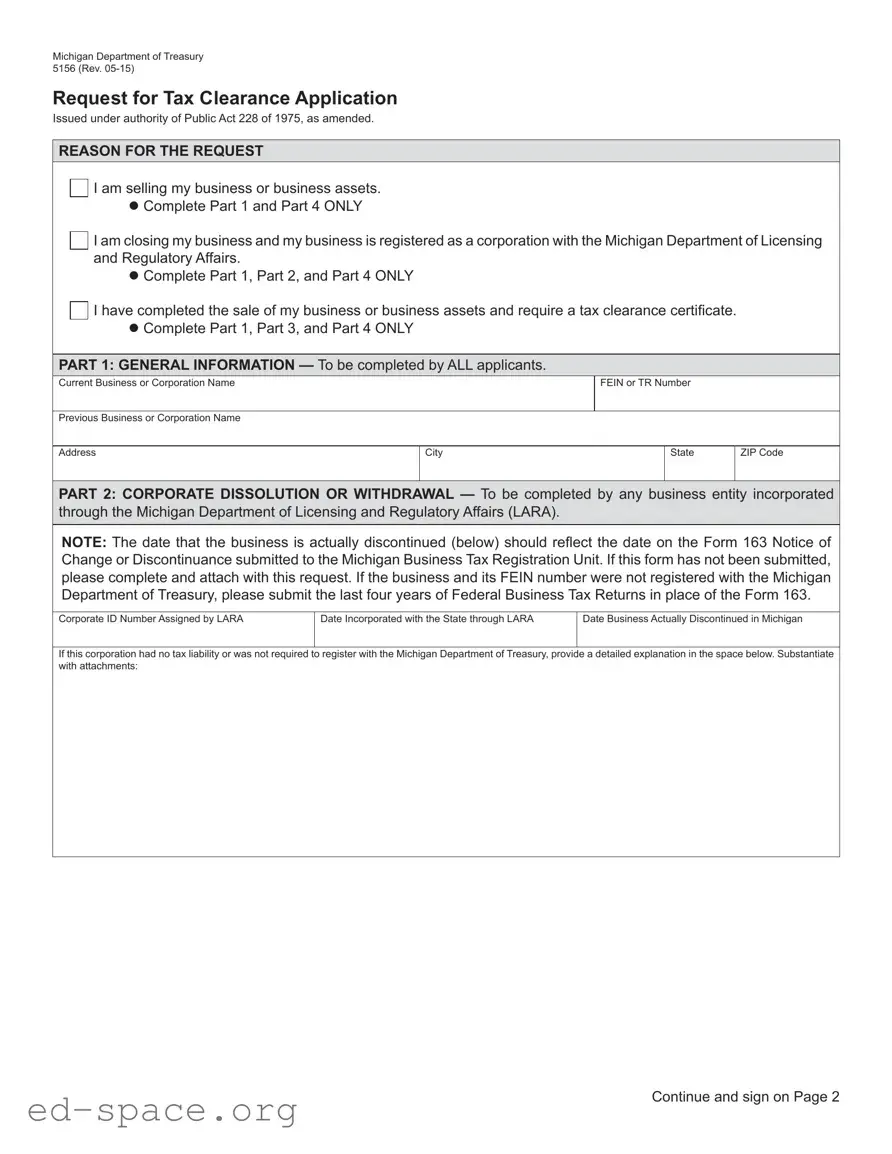
The Michigan 5156 form, officially titled the Request for Tax Clearance Application, is an essential document for business owners in Michigan who are selling their business or business assets, closing their operations, or seeking a tax clearance certificate after a sale has been completed. Issued under the authority of Public Act 228 of 1975, this form outlines specific sections that must be completed depending on the reason for the request. Part 1 gathers general information about the business, including its current and previous names, address, and identification numbers. If a corporation is involved, Part 2 addresses corporate dissolution or withdrawal, requiring details such as the date of incorporation and the date the business actually ceased operations. For those who have sold their business or assets, Part 3 must be completed, capturing information about the sale and any escrow arrangements. Finally, Part 4 includes a certification section where the applicant affirms the truthfulness of the information provided and can authorize a third party to receive tax clearance information. Understanding the requirements and processes outlined in the Michigan 5156 form is crucial for ensuring compliance with state tax regulations and facilitating a smooth transition during business sales or closures.
Michigan Department of Treasury 5156 (Rev.
Request for Tax Clearance Application
Issued under authority of Public Act 228 of 1975, as amended.
ReAson foR The RequesT
I am selling my business or business assets. l Complete Part 1 and Part 4 ONLY
I am closing my business and my business is registered as a corporation with the Michigan Department of Licensing and Regulatory Affairs.
l Complete Part 1, Part 2, and Part 4 ONLY
I have completed the sale of my business or business assets and require a tax clearance certiicate. l Complete Part 1, Part 3, and Part 4 ONLY
PART 1: GeneRAl InfoRmATIon — To be completed by ALL applicants.
Current Business or Corporation Name
FEIN or TR Number
Previous Business or Corporation Name
Address
City
State
ZIP Code
PART 2: CoRPoRATe DIssoluTIon oR WIThDRAWAl — To be completed by any business entity incorporated through the Michigan Department of Licensing and Regulatory Affairs (LARA).
noTe: The date that the business is actually discontinued (below) should relect the date on the Form 163 Notice of Change or Discontinuance submitted to the Michigan Business Tax Registration Unit. If this form has not been submitted, please complete and attach with this request. If the business and its FEIN number were not registered with the Michigan Department of Treasury, please submit the last four years of Federal Business Tax Returns in place of the Form 163.
Corporate ID Number Assigned by LARA |
Date Incorporated with the State through LARA |
Date Business Actually Discontinued in Michigan |
|
|
|
If this corporation had no tax liability or was not required to register with the Michigan Department of Treasury, provide a detailed explanation in the space below. Substantiate with attachments:
Continue and sign on Page 2
Form 5156, Page 2
PART 3: sAle of BusIness oR AsseTs — To be completed by any business (all types) that has sold all or part of the business prior to submitting this application.
ImPoRTAnT: This is a request by any business entity that has sold most of its assets, but the business shell will remain in place to continue iling tax returns (when due) until the business later determines whether it will ile a Certiicate of
Dissolution with the LARA Corporation Division.
Does the business operate under a trade name? |
Yes |
No |
|
|
|
|
|
||
|
|
|
|
|
If yes, list the name it is doing business as |
|
|
|
|
Will you continue business activity after clearance under this FEIN or TR number? |
Yes |
No |
|
|
If no, have you submitted a Notice of Change or Discontinuance (Form 163)? |
Yes |
No |
|
|
|
|
|
||
If yes, date of discontinuance reported on Form 163 |
|
|
|
|
|
|
|
||
If no, attach a completed Form 163 with this request. |
|
|
|
|
.........................................Date of sale of business or business assets to another entity |
|
|
|
|
Is money being held in escrow pending receipt of a tax clearance? |
Yes |
No |
|
|
If yes, how much is held in escrow? |
|
|
|
|
|
|
|
||
|
|
|
|
|
PuRChAseR InfoRmATIon |
|
|
|
|
Purchaser Business Name
Purchaser FEIN
Purchaser Address
City
State
ZIP Code
PART 4: CeRTIfICATIon AnD AuThoRIzATIon foR DIsClosuRe of InfoRmATIon
I declare under penalty of perjury that I am the owner, oficer, or member of the business for which tax clearance is requested and that the information entered is true.
Name (Print or Type)
Title
Signature
Date
Telephone Number
Address
City
State
ZIP Code
AuThoRIzATIon foR DIsClosuRe of TAx CleARAnCe InfoRmATIon (This is not a required section)
use this section to designate a third party to receive all tax clearance information for the business listed in Part 1.
The above signed authorizes the Michigan Department of Treasury, Tax Clearance Section, to release any and all tax information and outstanding balances due for the purpose of tax clearance to the individual(s) listed below. This authorization does not include signature power. This authorization is only valid for 90 days from the date of the signature above.
Name
Telephone Number
Fax Number
Address
City
State
ZIP Code

Instructions for form 5156,
Request for Tax Clearance
Part 1: General Information – All fIelDs In ThIs seCTIon musT Be ComPleTeD
NOTE: If you are selling a business but the sale has not occurred, the Michigan Department of Treasury (Treasury) will provide known or estimated tax liability for the purpose of
establishing a tax escrow. Once the sale is complete, submit a new request completing Part 1 and Part 3 to obtain a certiicate
for the release of the escrowed funds.
Current Business or Corporation Name: Enter the
legal business/corporation name. If the business is a sole proprietorship, enter the owner’s name here, with the last name
irst.
Federal Employer Identiication Number (FEIN) or Treasury Issued Account Number (TR): Enter the business’
Business Street Address/City/State/ZIP Code: Enter the
physical business address. (A PO Box is not acceptable in this ield.)
Part 2: Corporate Dissolution or Withdrawal
Complete this section if you are dissolving a domestic (Michigan) corporation or if you have a foreign corporation (incorporated outside Michigan) that is withdrawing from
Michigan. A corporation is any business entity that has iled
and incorporated with the Michigan Department of Licensing and Regulatory Affairs (LARA).
NOTE: A Tax Clearance Certiicate must be requested from
Treasury within 60 days of dissolution or withdrawal of business from Michigan.
Corporate Identiication Number: Enter the business’
Date Business Discontinued in Michigan: Enter the date
your business ceased operations in Michigan. This date should relect the date entered on the Notice of Change or
Discontinuance (Form 163). If you have failed to complete and submit Form 163 to the Registration Unit, you must complete and remit Form 163 with this application. In the event your business’ FEIN was never registered with Treasury, you must include the last four years of Federal Returns for the business in place of Form 163.
Date Incorporated with the State of Michigan through
LARA: Enter the date of incorporation. For additional
information, go to LARA’s Web site: www.michigan.gov/lara.
If the corporation had no tax liability or was not required to register with Treasury, provide a detailed explanation. In rare cases, a corporation may not have had any tax liability or may not have registered for taxes with the State of Michigan. If your business falls into this category, use the space provided
to explain why no taxes were due and registration was not required. Include dates of operation and the nature of the business. You must include attachments with your application to substantiate your position in order for it to be fully reviewed.
Part 3: sale of Business or Assets has occurred
Complete this section if your business or any of the assets have been sold.
NOTE: You must continue to ile all returns by their due date until you elect to ile a dissolution or withdrawal. A Tax Clearance Certiicate for Sale of Business and/or Business
Assets is required when a bulk sale or transfer is made under
the Uniform Commercial Code. A Tax Clearance Certiicate
for Sale of Business and/or Business Assets is granted after Treasury determines that all Sales, Use, Income Withholding, Cigarette, Motor Fuel, Single Business, Michigan Business,
and Corporate Income taxes have been paid for the period of operation. When a Tax Clearance Certiicate for Sale of
Business and/or Business Assets is issued, money held in escrow is released and the purchaser is relieved of successor liability. The seller agrees to keep all books and records of the business until they are released by Treasury. The seller is liable
for all taxes due from the operation of the business during the time speciied by Treasury.
Does the business operate under a trade name? If your business operates under any name other than the legal corporation name, check (with an “X”) yes in the appropriate box. On the next line, enter the trade name, assumed name, or doing business as name. If your business only operates under its legal corporation name, check (with an “X”) no.
Are you continuing business activity after clearance under this FEIN or TR number? If you plan to continue
to operate your business within the State of Michigan, check (with an “X”) yes in the appropriate box. If you do not plan to continue operating, check (with an “X”) no. If you have already
submitted a Form 163 to the Registration Unit, enter the discontinuance date listed on that form. If you have yet to ile
Form 163 with the Registration Unit, attach a completed Form 163 with this application.
NOTE: The following items should ONLY be illed out if the
sale has occurred, not before.
Date of Sale of Business or Business Assets to Another
Entity. Enter the date all or part of the business was sold.
Is money being held in escrow pending receipt of a Tax Clearance Certiicate? If money is being held in escrow from
the sale, check (with an “X”) yes and enter the amount being held.
Business Name, Street Address, and FEIN of Purchaser.
Enter purchaser’s legal name, address, and FEIN.

Part 4: Certiication and Authorization for Disclosure of Tax Clearance Information
NOTE: All ields directly under the Certiication must be completed. If authorizing the disclosure of information, all ields in that section must be completed as well.
This section must be completed for all requests. All requests must be submitted by an owner, oficer, or member of the business. By completing the Certiication, you are declaring
under penalty of perjury that all information entered is true.
Complete this section with your printed name, title, signature, daytime phone number, contact address, and the date in which the application was completed.
submitting form 5156
Complete and mail this form to:
Michigan Department of Treasury
Tax Clearance Section
P.O. Box 30778
Lansing, MI 48909
For additional information, call (517)
| Fact Name | Description |
|---|---|
| Purpose of the Form | The Michigan 5156 form is used to request a tax clearance certificate when selling or closing a business. |
| Governing Law | This form is issued under the authority of Public Act 228 of 1975, as amended. |
| Part Completion | Different parts of the form must be completed based on the reason for the request, such as selling assets or closing the business. |
| Submission Deadline | A Tax Clearance Certificate must be requested within 60 days of business dissolution or withdrawal from Michigan. |
| Contact Information | For questions, individuals can call the Michigan Department of Treasury at (517) 636-5260, Monday through Friday. |
After gathering the necessary information and ensuring you have the required documents, you can begin filling out the Michigan 5156 form. This process will require you to provide specific details about your business and the nature of your request. Follow the steps carefully to ensure your application is complete and accurate.
What is the purpose of the Michigan 5156 form?
The Michigan 5156 form, also known as the Request for Tax Clearance Application, is designed to facilitate the process of obtaining a tax clearance certificate. This certificate is often necessary when a business is being sold, closing down, or has recently sold its assets. It ensures that all tax obligations have been met before the transfer of ownership or dissolution is finalized. The form allows the Michigan Department of Treasury to verify that the business has paid all applicable taxes, thereby protecting both the seller and the buyer in the transaction.
Who needs to complete the Michigan 5156 form?
Any business owner or authorized representative who is selling their business, closing their business, or has sold business assets needs to complete this form. Depending on the situation, different parts of the form must be filled out. For instance, if a business is being sold, Parts 1 and 3 should be completed. If a corporation is dissolving, Parts 1, 2, and 4 are required. It is crucial to follow the correct instructions based on the specific circumstances surrounding the business.
What information is required in Part 1 of the form?
Part 1 of the Michigan 5156 form collects general information about the business. This includes the current business name, Federal Employer Identification Number (FEIN) or Treasury Account Number, previous business name (if applicable), and the business's physical address. It is important that all fields in this section are completed accurately to ensure proper processing of the request.
What should I include in Part 2 if my business is a corporation?
If your business is incorporated in Michigan and you are dissolving it, Part 2 must be completed. This section requires the Corporate Identification Number assigned by the Michigan Department of Licensing and Regulatory Affairs (LARA), the date of incorporation, and the date the business actually discontinued operations. If applicable, you should also provide a detailed explanation if the corporation had no tax liability or was not required to register with the Michigan Department of Treasury.
How do I complete Part 3 if I have sold my business or assets?
In Part 3, you must provide information about the sale of your business or its assets. This includes indicating whether the business operates under a trade name, the date of the sale, and whether any funds are being held in escrow pending the tax clearance. Additionally, you will need to provide details about the purchaser, including their business name and FEIN. This section is vital for ensuring that all tax obligations are settled before the transfer is finalized.
What is the significance of Part 4 on the form?
Part 4 serves as a certification and authorization for the disclosure of tax clearance information. This section must be completed by the business owner, officer, or member requesting the tax clearance. By signing this part, you declare under penalty of perjury that the information provided is accurate. If you wish to authorize a third party to receive tax clearance information, you can also complete the relevant fields in this section. This authorization is valid for 90 days from the date of signing.
How should I submit the Michigan 5156 form?
The completed Michigan 5156 form should be mailed to the Michigan Department of Treasury, Tax Clearance Section, at P.O. Box 30778, Lansing, MI 48909. It is advisable to ensure that all sections of the form are filled out accurately and completely before submission. If you have questions or need assistance, you can contact the department at (517) 636-5260 during business hours.
Incomplete Sections: Many individuals fail to complete all required sections of the form. Each part serves a specific purpose, and omitting information can delay the process significantly.
Incorrect Business Name: Entering the wrong legal business name can lead to confusion. It is essential to provide the exact name as registered with the Michigan Department of Licensing and Regulatory Affairs.
Missing FEIN or TR Number: Some applicants neglect to include their Federal Employer Identification Number (FEIN) or Treasury Account Number (TR). This number is crucial for processing the request.
Not Submitting Form 163: If applicable, failing to submit Form 163 along with the 5156 can result in the rejection of the application. This form is necessary for documenting business discontinuation.
Ignoring Escrow Details: When money is held in escrow, applicants often forget to indicate this on the form. Not disclosing this information can create complications in the clearance process.
Failure to Sign: Some applicants overlook the importance of signing the form. A signature is necessary to validate the information provided and confirm the applicant's authority.
Incorrect Dates: Providing incorrect dates, such as the date of business discontinuation or sale, can lead to misunderstandings and delays. Accuracy is vital in these details.
Not Providing Attachments: If the business had no tax liability, applicants sometimes forget to include the necessary explanations and attachments. This omission can hinder the review process.
When dealing with the Michigan 5156 form, there are several other documents that may be necessary to ensure a smooth process. Each of these forms serves a specific purpose and can help clarify your situation when requesting tax clearance. Below is a brief overview of four commonly used documents alongside the Michigan 5156 form.
Gathering these documents and understanding their purposes can significantly streamline the tax clearance process. By ensuring that all necessary paperwork is complete and accurate, you increase the likelihood of a timely and successful request. If you have any questions about these forms or need assistance, consider reaching out to a professional who can guide you through the process.
The Michigan 5156 form, used for requesting tax clearance, shares similarities with several other documents. Each serves a specific purpose in business transactions, particularly involving sales or closures. Below is a list of documents that are similar to the Michigan 5156 form:
When filling out the Michigan 5156 form, attention to detail is crucial. Below is a list of things you should and shouldn't do to ensure a smooth application process.
By following these guidelines, applicants can help ensure that their requests for tax clearance are processed efficiently and accurately.
Understanding the Michigan 5156 form is crucial for business owners navigating tax clearance. However, several misconceptions can lead to confusion. Below are seven common misconceptions about this form, along with clarifications.
Clarifying these misconceptions can help ensure that business owners comply with the necessary procedures and avoid potential pitfalls when dealing with tax clearance in Michigan.
When filling out and using the Michigan 5156 form, there are several important points to keep in mind. Here are key takeaways to ensure a smooth process:
Following these guidelines can help ensure that your request for tax clearance is processed efficiently and accurately.