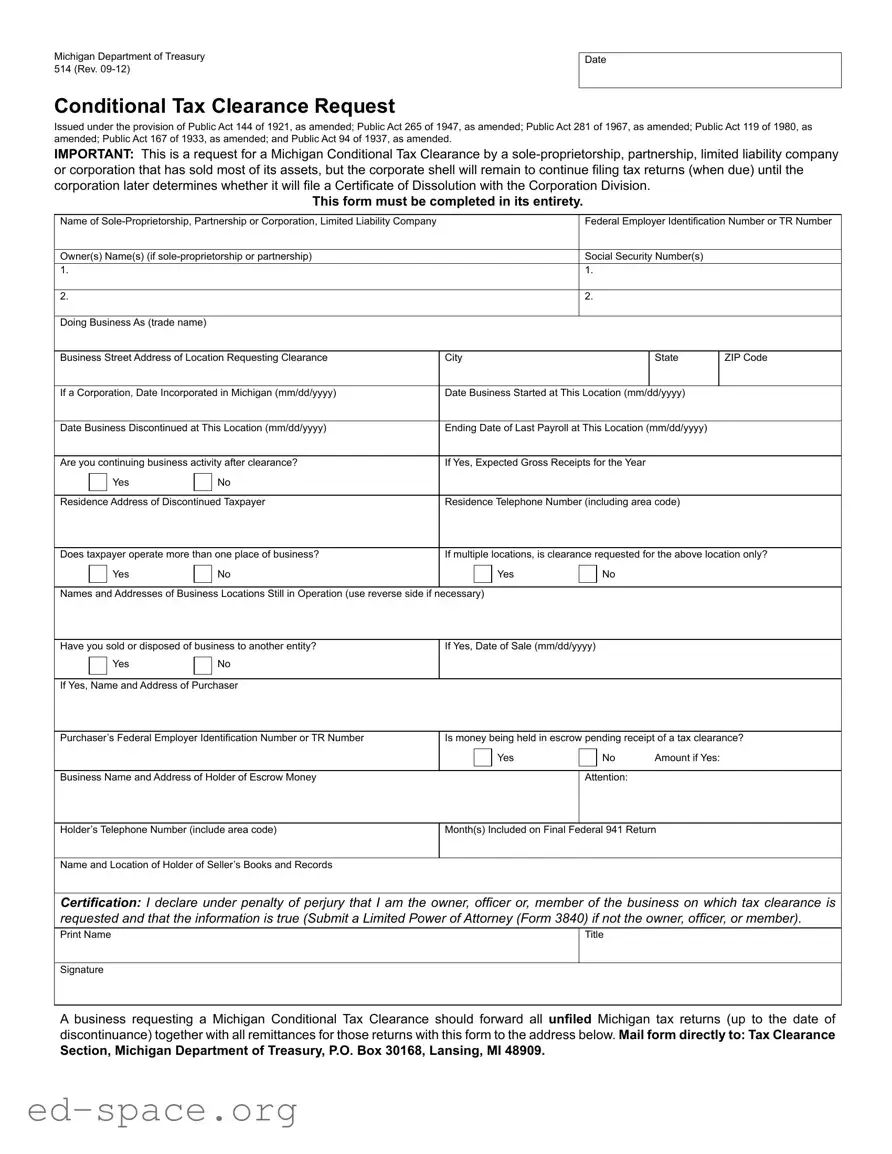
The Michigan 514 form is a crucial document for businesses navigating the complexities of asset sales and tax clearance. It serves as a request for a Conditional Tax Clearance, specifically designed for sole proprietorships, partnerships, limited liability companies, or corporations that have sold most of their assets while maintaining their corporate structure. This form is issued under several public acts, highlighting its legal significance. Completing the Michigan 514 requires detailed information about the business, including its name, federal identification number, and the owners’ names and social security numbers. Businesses must also provide their trade name, street address, and dates related to incorporation and business operations. One key aspect of the form is its inquiry into whether the business will continue operations after the clearance, which can impact tax obligations. Additionally, if there are multiple locations or if the business has been sold, these details must be disclosed. The form emphasizes the importance of accuracy, as it must be signed by the owner or an authorized representative, under penalty of perjury. By submitting this form along with any unfiled tax returns, businesses can ensure they are compliant and ready to move forward with their operations or dissolution processes.

Michigan Department of Treasury 514 (Rev.
Date
Conditional Tax Clearance Request
Issued under the provision of Public Act 144 of 1921, as amended; Public Act 265 of 1947, as amended; Public Act 281 of 1967, as amended; Public Act 119 of 1980, as amended; Public Act 167 of 1933, as amended; and Public Act 94 of 1937, as amended.
IMPORTANT: This is a request for a Michigan Conditional Tax Clearance by a
This form must be completed in its entirety.
Name of |
|
|
|
Federal Employer Identiication Number or TR Number |
||||||||
|
|
|
|
|
|
|||||||
Owner(s) Name(s) (if |
|
|
|
Social Security Number(s) |
|
|||||||
1. |
|
|
|
|
|
|
|
1. |
|
|
|
|
|
|
|
|
|
|
|
|
|
|
|
|
|
2. |
|
|
|
|
|
|
|
2. |
|
|
|
|
|
|
|
|
|
|
|
|
|
|
|
|
|
Doing Business As (trade name) |
|
|
|
|
|
|
|
|
|
|||
|
|
|
|
|
|
|
|
|
|
|
|
|
Business Street Address of Location Requesting Clearance |
City |
|
|
State |
|
ZIP Code |
||||||
|
|
|
|
|
|
|
|
|
|
|
|
|
If a Corporation, Date Incorporated in Michigan (mm/dd/yyyy) |
Date Business Started at This Location (mm/dd/yyyy) |
|
||||||||||
|
|
|
|
|
|
|
|
|
|
|
||
Date Business Discontinued at This Location (mm/dd/yyyy) |
Ending Date of Last Payroll at This Location (mm/dd/yyyy) |
|
||||||||||
|
|
|
|
|
|
|
|
|
|
|
|
|
Are you continuing business activity after clearance? |
If Yes, Expected Gross Receipts for the Year |
|
|
|
||||||||
|
|
Yes |
|
No |
|
|
|
|
|
|
|
|
|
|
|
|
|
|
|
|
|
|
|
||
|
|
|
|
|
|
|
|
|
|
|
||
|
|
|
|
|
|
|
||||||
Residence Address of Discontinued Taxpayer |
Residence Telephone Number (including area code) |
|
||||||||||
|
|
|
|
|
|
|||||||
Does taxpayer operate more than one place of business? |
If multiple locations, is clearance requested for the above location only? |
|||||||||||
|
|
|
|
|
|
|
|
|
|
|
|
|
|
|
Yes |
|
No |
|
|
Yes |
|
No |
|
|
|
|
|
|
|
|
|
|
|
|
|
|
|
|
|
|
|
|
|
|
|
|
|
||||
Names and Addresses of Business Locations Still in Operation (use reverse side if necessary) |
|
|
|
|
|
|||||||
|
|
|
|
|
||||||||
Have you sold or disposed of business to another entity? |
If Yes, Date of Sale (mm/dd/yyyy) |
|
|
|
||||||||
|
|
|
|
|
|
|
|
|
|
|
|
|
|
|
Yes |
|
No |
|
|
|
|
|
|
|
|
|
|
|
|
|
|
|
|
|
|
|
|
|
|
|
|
|
|
|
|
|
|
||||
If Yes, Name and Address of Purchaser |
|
|
|
|
|
|
|
|
||||
|
|
|||||||||||
Purchaser’s Federal Employer Identiication Number or TR Number |
Is money being held in escrow pending receipt of a tax clearance? |
|||||||||||
|
|
|
|
|
|
|
Yes |
|
No |
Amount if Yes: |
|
|
|
|
|
|
|
|
|
|
|
||||
|
|
|
|
|
|
|
|
|
||||
|
|
|
|
|
|
|
|
|||||
Business Name and Address of Holder of Escrow Money |
|
|
|
Attention: |
|
|
|
|||||
|
|
|
|
|||||||||
Holder’s Telephone Number (include area code) |
Month(s) Included on Final Federal 941 Return |
|
||||||||||
|
|
|
|
|
|
|
|
|
||||
Name and Location of Holder of Seller’s Books and Records |
|
|
|
|
|
|
|
|
||||
Certiication: I declare under penalty of perjury that I am the owner, oficer or, member of the business on which tax clearance is requested and that the information is true (Submit a Limited Power of Attorney (Form 3840) if not the owner, oficer, or member).
Print Name |
Title |
|
|
Signature |
|
A business requesting a Michigan Conditional Tax Clearance should forward all uniled Michigan tax returns (up to the date of discontinuance) together with all remittances for those returns with this form to the address below. Mail form directly to: Tax Clearance
Section, Michigan Department of Treasury, P.O. Box 30168, Lansing, MI 48909.
| Fact Name | Description |
|---|---|
| Governing Laws | The Michigan 514 form is issued under several laws, including Public Act 144 of 1921, Public Act 265 of 1947, Public Act 281 of 1967, Public Act 119 of 1980, Public Act 167 of 1933, and Public Act 94 of 1937, all of which have been amended. |
| Purpose | This form serves as a request for a Conditional Tax Clearance in Michigan for businesses that have sold most of their assets but wish to retain their corporate shell. |
| Eligible Entities | Eligible entities include sole proprietorships, partnerships, limited liability companies, and corporations. |
| Form Completion | The form must be completed in its entirety to be considered valid and processed. |
| Tax Returns | Businesses must submit all unfiled Michigan tax returns along with the form and any remittances for those returns. |
| Escrow Money | If money is held in escrow pending tax clearance, the form requires details about the escrow amount and the holder's information. |
| Signature Requirement | The form must be signed by the owner, officer, or member of the business, certifying the truthfulness of the information provided. |
| Mailing Address | Completed forms should be mailed to the Tax Clearance Section at the Michigan Department of Treasury, P.O. Box 30168, Lansing, MI 48909. |
| Business Continuation | The form inquires whether the business will continue operations after obtaining the tax clearance. |
Completing the Michigan 514 form is essential for businesses seeking a Conditional Tax Clearance. After filling out the form, it should be mailed to the Michigan Department of Treasury along with any unfiled tax returns and remittances. Follow the steps below to ensure the form is filled out correctly.
After completing the form, make sure to gather all unfiled Michigan tax returns and remittances. Mail everything to the Tax Clearance Section at the Michigan Department of Treasury.
What is the Michigan 514 form?
The Michigan 514 form is a Conditional Tax Clearance Request issued by the Michigan Department of Treasury. It is specifically designed for sole proprietorships, partnerships, limited liability companies, and corporations that have sold most of their assets but intend to remain in existence for tax filing purposes. This form is essential for businesses that need to obtain clearance regarding their tax obligations before proceeding with asset sales or other significant changes.
Who needs to complete the Michigan 514 form?
Any sole proprietorship, partnership, limited liability company, or corporation that has sold most of its assets and wishes to maintain its corporate status for tax purposes must complete this form. This includes businesses that have discontinued operations at a specific location but plan to continue filing tax returns until they decide on further actions, such as filing for dissolution.
What information is required on the form?
The form requires detailed information, including the name of the business, the Federal Employer Identification Number (EIN) or Tax Registration (TR) Number, and the names and Social Security Numbers of the owners if applicable. Additionally, it asks for the business's address, incorporation date, business start and discontinuation dates, payroll ending date, and whether the business will continue operations after clearance.
How do I submit the Michigan 514 form?
To submit the Michigan 514 form, you must complete it in its entirety and send it along with any unfiled Michigan tax returns and remittances to the Tax Clearance Section of the Michigan Department of Treasury. The mailing address is P.O. Box 30168, Lansing, MI 48909. Ensure that all required documents are included to avoid delays in processing.
What happens after I submit the form?
After submission, the Michigan Department of Treasury will review your request for tax clearance. They will assess your tax obligations and any outstanding liabilities. Once the review is complete, you will receive a conditional tax clearance or further instructions if additional information is needed.
Is there a fee associated with the Michigan 514 form?
There is no fee specifically associated with submitting the Michigan 514 form. However, any outstanding tax liabilities or fees related to unfiled tax returns must be resolved before a tax clearance can be granted.
What if my business has multiple locations?
If your business operates multiple locations, you can still request clearance for a specific location using the Michigan 514 form. You must indicate whether clearance is requested for the location listed on the form or for additional locations. It is important to provide accurate information for each location to ensure proper processing.
What should I do if I sold my business?
If you have sold your business, you must indicate this on the Michigan 514 form. You will need to provide the date of sale and the name and address of the purchaser. This information is crucial for the Department of Treasury to understand the transaction and any tax implications related to it.
Can I request an extension for filing the Michigan 514 form?
There is no formal extension process for filing the Michigan 514 form. It is important to submit the form and any associated tax returns as soon as possible to avoid complications with tax clearance. If you anticipate difficulties in meeting the deadline, it is advisable to contact the Michigan Department of Treasury for guidance on your specific situation.
Incomplete Information: Failing to fill out all required fields can lead to delays. Ensure that all sections, including the name of the business and the federal identification number, are completed accurately.
Incorrect Dates: Providing inaccurate dates for incorporation, business start, or discontinuation can result in complications. Double-check these dates for accuracy.
Missing Signatures: The form must be signed by an authorized individual. An unsigned form will not be processed, so it is crucial to ensure that the appropriate person signs the document.
Not Including Required Documentation: Failing to attach all necessary documents, such as unfiled tax returns or remittances, can lead to rejection of the request. Review the requirements carefully.
Incorrect Contact Information: Providing inaccurate or outdated contact information can hinder communication. Ensure that all contact details, including telephone numbers, are current and correct.
Ignoring Multiple Locations: If the business operates in multiple locations, it is essential to specify whether the clearance is requested for the listed location only. Misunderstanding this can lead to unnecessary complications.
The Michigan 514 form is a crucial document for businesses seeking a Conditional Tax Clearance in Michigan. Along with this form, several other documents may be necessary to ensure compliance and proper processing. Below is a list of these forms and a brief description of each.
Submitting the Michigan 514 form along with these additional documents can help streamline the process of obtaining a Conditional Tax Clearance. Ensuring all necessary paperwork is in order can prevent delays and facilitate a smoother transition for the business.
The Michigan 514 form serves a specific purpose related to tax clearance for businesses. Several other documents share similarities with it in terms of purpose, structure, or the information they require. Here is a list of nine such documents:
When filling out the Michigan 514 form, it's essential to follow specific guidelines to ensure accuracy and compliance. Here are four things you should and shouldn't do:
Here are five common misconceptions about the Michigan 514 form:
Filling out the Michigan 514 form can seem daunting, but understanding its key components can make the process smoother. Here are some important takeaways to keep in mind:
By keeping these points in mind, you can navigate the process of filling out the Michigan 514 form with confidence. Taking the time to ensure accuracy and completeness can save you time and potential headaches down the road.