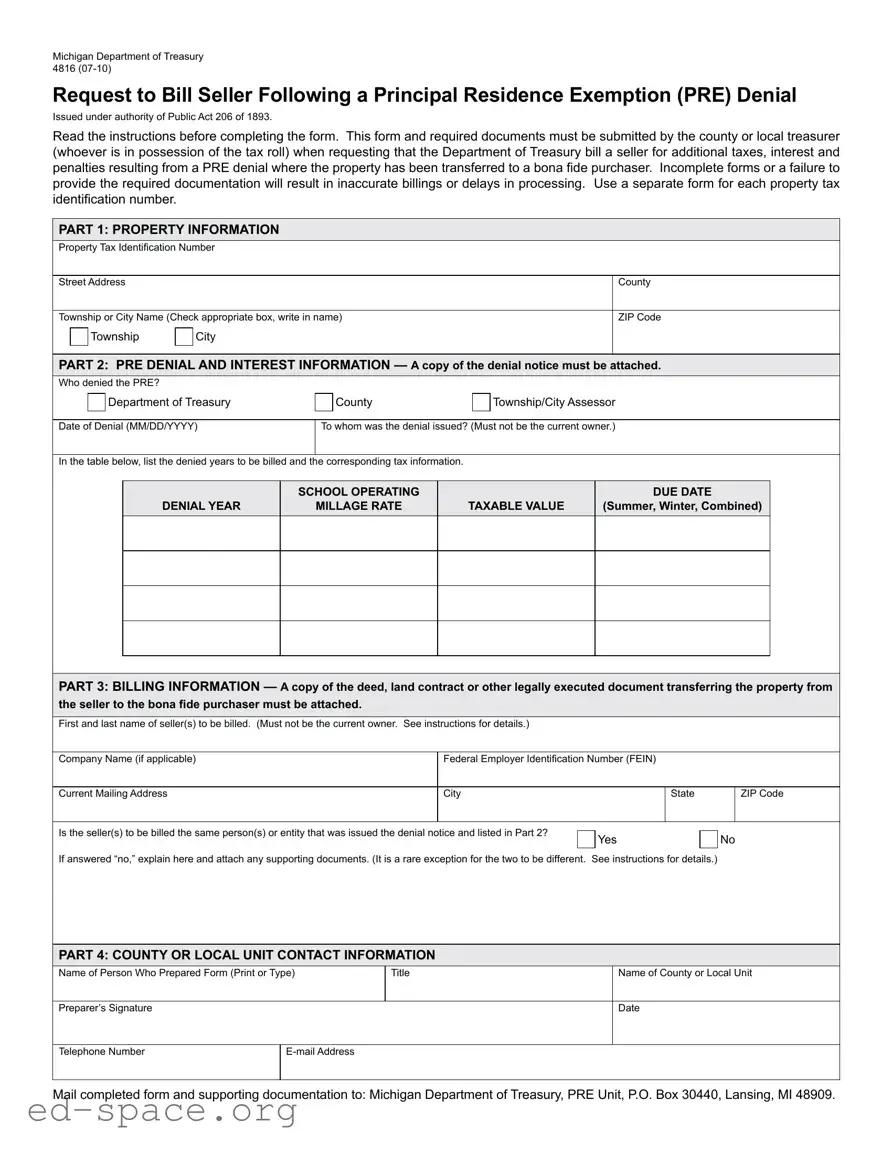
The Michigan 4816 form is an essential document for local treasurers and property sellers dealing with Principal Residence Exemption (PRE) denials. When a property is sold to a bona fide purchaser after a PRE denial, this form facilitates the billing of additional taxes, interest, and penalties to the seller. It is important to understand that the responsibility for these charges falls on the seller, not the new owner, provided the sale meets specific criteria. To ensure a smooth process, complete and accurate information must be submitted, including property details, the denial notice, and documentation of the property transfer. The form is divided into several parts, each requiring specific information such as the property tax identification number, the reasons for the PRE denial, and the seller's details. Incomplete submissions can lead to delays or errors, so attention to detail is crucial. Understanding the nuances of the 4816 form can help mitigate potential complications during property transactions in Michigan.
Michigan Department of Treasury 4816
Request to Bill Seller Following a Principal Residence Exemption (PRE) Denial
Issued under authority of Public Act 206 of 1893.
Read the instructions before completing the form. This form and required documents must be submitted by the county or local treasurer
(whoever is in possession of the tax roll) when requesting that the Department of Treasury bill a seller for additional taxes, interest and penalties resulting from a PRE denial where the property has been transferred to a bona ide purchaser. Incomplete forms or a failure to
provide the required documentation will result in inaccurate billings or delays in processing. Use a separate form for each property tax identiication number.
PART 1: PROPERTY INFORMATION
Property Tax Identiication Number
Street Address |
|
|
County |
||
|
|
||||
Township or City Name (Check appropriate box, write in name) |
ZIP Code |
||||
|
|
Township |
|
City |
|
|
|
|
|
||
|
|
|
|
|
|
|
|
|
|
|
|
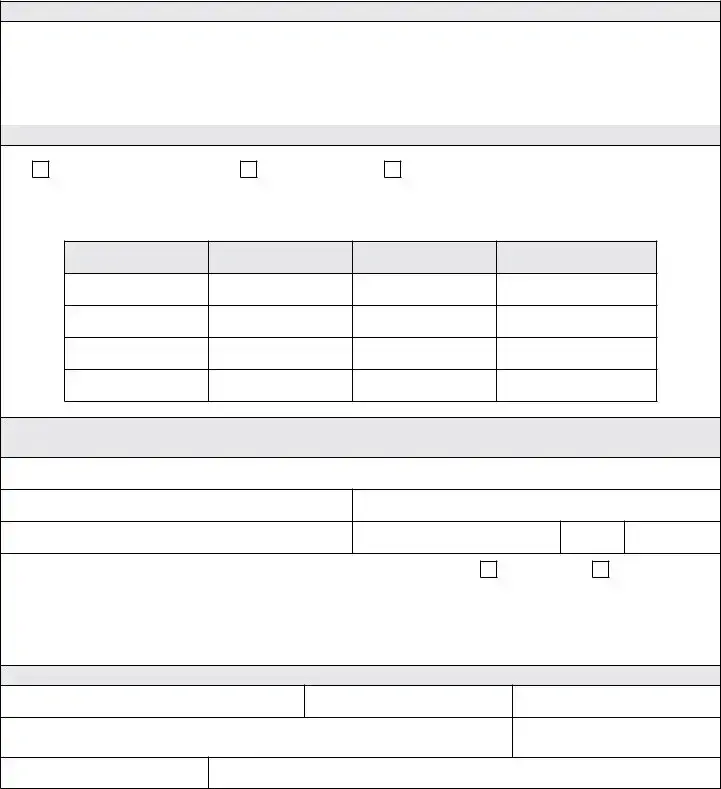
PART 2: PRE DENIAL AND INTEREST INFORMATION — A copy of the denial notice must be attached.
Who denied the PRE?
Department of Treasury
County
Township/City Assessor
Date of Denial (MM/DD/YYYY) |
To whom was the denial issued? (Must not be the current owner.) |
|
|
In the table below, list the denied years to be billed and the corresponding tax information.
DENIAL YEAR
SchOOL OPERATINg
MILLAgE RATE
TAxABLE vALuE
DuE DATE
(Summer, Winter, combined)
PART 3: BILLINg INFORMATION — A copy of the deed, land contract or other legally executed document transferring the property from the seller to the bona ide purchaser must be attached.
First and last name of seller(s) to be billed. (Must not be the current owner. See instructions for details.)
Company Name (if applicable)
Federal Employer Identiication Number (FEIN)
Current Mailing Address
City
State
ZIP Code
Is the seller(s) to be billed the same person(s) or entity that was issued the denial notice and listed in Part 2?
Yes
No
If answered “no,” explain here and attach any supporting documents. (It is a rare exception for the two to be different. See instructions for details.)
PART 4: cOuNTY OR LOcAL uNIT cONTAcT INFORMATION
Name of Person Who Prepared Form (Print or Type)
Title
Name of County or Local Unit
Preparer’s Signature
Date
Telephone Number
Mail completed form and supporting documentation to: Michigan Department of Treasury, PRE Unit, P.O. Box 30440, Lansing, MI 48909.
4816, Page 2
Instructions for Form 4816
Request to Bill Seller Following a Principal Residence Exemption (PRE) Denial
This form must be submitted by the county or local treasurer (whoever is in possession of the tax roll) when requesting that the
Department of Treasury (Department) bill a seller for additional taxes, interest and penalties resulting from a PRE denial where the property has been transferred to a bona ide purchaser. Speciically, Subsections 6, 8 and 11 of Michigan Compiled Laws 211.7cc state that “if the property has been transferred to a bona ide purchaser before additional taxes were billed to the seller as a result of the
denial of a claim for exemption, the taxes, interest, and penalties shall not be a lien on the property and shall not be billed to the bona
ide purchaser ….” The local tax collecting unit in possession of the tax roll then notiies the Department, which “shall then assess the
owner who claimed the exemption under this section for the tax, interest, and penalties accruing as a result of the denial of the claim for exemption ….” In other words, the seller (the person denied) is responsible for all additional taxes, interest and penalties due for
the years up to and including the year of the sale if the purchaser is a “bona ide purchaser.” The PRE is not removed in these bona ide purchaser situations.
A “bona ide purchaser” is one who purchases in good faith for valuable consideration. Therefore, a person who receives property
through an inheritance, foreclosure or one who receives property through a quit claim without valuable consideration, would not qualify as a bona ide purchaser. If the new owner is not a bona ide purchaser, the taxes are added back to the tax roll and the purchaser is responsible for the additional taxes, interest and penalties which become a lien on the property.
There are rare situations, however, where the person(s) or entity that was denied the PRE lost the property in a foreclosure or some other circumstance to an “acquiring entity,” which then subsequently sold the property to a bona ide purchaser. In these situations, the “acquiring entity” that sold the property would be responsible for the additional taxes, interest and penalties although the denial notice was issued to the prior owner. In these unusual circumstances, since the property was not acquired for valuable consideration, the transfer to the “acquiring entity” is not considered a bona ide purchase. As a result, the “acquiring entity” is responsible for the additional taxes, interest and penalties. If this rare situation occurs, explain in Part 3 the circumstances involved and attach any supporting documents. If the “acquiring entity” has not sold the property to a bona ide purchaser, the billing of additional taxes, interest and penalties must occur at the county or local unit level (whichever is in possession of the tax roll) since the transfer was not a bona ide purchase.
In order for the Department to process a request to bill the seller (the person or entity who was issued the denial notice) for additional taxes, interest and penalties in a bona ide purchaser situation, this form must be completed with the required documents attached. Upon
review of the completed form and supporting documents, the Department will process and issue a bill, which will include additional taxes and applicable interest and penalties, to the person(s) or entity listed in Part 3.
PART 1: PROPERTY INFORMATION
All of the information in Part 1 must be provided to the Department to process the request. Use a separate form for each property tax identiication number.
PART 2: PRE DENIAL INFORMATION
A copy of the PRE denial notice relating to the property in Part 1 must be submitted with this form. The date of the denial notice must be listed on the form along with the person(s) or entity that issued the denial notice. If the denial notice was issued to the current owner of
the property, the billing of additional taxes, interest and penalties must occur at the county or local unit level (whichever is in possession of the tax roll) and does not qualify as a bona ide purchaser situation. In addition, if the purchaser is not a “bona ide purchaser,” as described earlier, the billing also must occur at the county or local level.
For each year the PRE was denied, requiring the Department to bill the seller, list the school operating millage rate, taxable value, and the due date of the school operating taxes (summer, winter, or combined summer/winter).
PART 3: BILLINg INFORMATION
A copy of the deed, land contract or other legally executed document transferring the property from the seller to the bona ide purchaser must be submitted with this form. Each seller to be billed must be listed including a current mailing address (if the mailing address is available). If the seller is a company, the complete company name, address, and Federal Employer Identiication Number (FEIN), if available, must be provided.
PART 4: cOuNTY OR LOcAL uNIT cONTAcT INFORMATION
Complete the contact information in the event the Department has a question or needs clariication. The completed form and supporting documents must be mailed to the address at the bottom of the form. Failure to provide complete information or adequate supporting documentation will result in delays in processing.
If you have any questions, call the PRE Unit at (517)
| Fact Name | Description |
|---|---|
| Form Purpose | The Michigan 4816 form is used to request that the Department of Treasury bill a seller for additional taxes, interest, and penalties after a Principal Residence Exemption (PRE) denial. |
| Governing Law | This form is issued under the authority of Public Act 206 of 1893 and is governed by Subsections 6, 8, and 11 of Michigan Compiled Laws 211.7cc. |
| Submission Requirements | County or local treasurers must submit this form along with required documentation, including a copy of the PRE denial notice and a deed or land contract, to ensure proper billing. |
| Important Note | Failure to provide complete information or required documents may lead to inaccurate billings or delays in processing the request. |
Filling out the Michigan 4816 form is an important step if you need to request that the Department of Treasury bill a seller for additional taxes after a Principal Residence Exemption (PRE) denial. To ensure everything is processed smoothly, follow these steps carefully.
Once you have completed the form and gathered all necessary documents, mail everything to the Michigan Department of Treasury at the address provided at the bottom of the form. Make sure to double-check that all information is accurate and complete to avoid any delays in processing.
What is the Michigan 4816 form used for?
The Michigan 4816 form is a request to bill a seller for additional taxes, interest, and penalties following a Principal Residence Exemption (PRE) denial. This form is specifically used when a property has been transferred to a bona fide purchaser after the PRE has been denied. It is essential for local treasurers to complete this form accurately to ensure the seller is billed correctly for any tax liabilities resulting from the denial.
Who needs to submit the Michigan 4816 form?
The county or local treasurer, who is in possession of the tax roll, must submit the Michigan 4816 form. This submission is necessary when the Department of Treasury needs to bill the seller for any additional taxes, interest, and penalties due to a PRE denial. It's important to note that the form must be completed with all required documentation attached to avoid processing delays.
What information is required on the form?
The form requires several key pieces of information. In Part 1, you must provide the property tax identification number, street address, and details about the county and city. Part 2 focuses on the PRE denial information, requiring a copy of the denial notice and details about the denial, including the denial date and the issuer. Part 3 requires billing information about the seller, including their name, address, and any relevant documents like a deed or land contract. Finally, Part 4 collects contact information for the person who prepared the form, ensuring the Department can reach out if there are questions.
What happens if the form is incomplete?
If the Michigan 4816 form is incomplete or lacks the necessary supporting documentation, it may lead to inaccurate billing or delays in processing. This can cause complications for both the seller and the new property owner. It is crucial to ensure that all sections of the form are filled out correctly and that all required documents are attached before submission to avoid these issues.
What is a bona fide purchaser?
A bona fide purchaser is someone who buys property in good faith and for valuable consideration. This means that the buyer is not receiving the property as a gift or through inheritance, and they are paying a fair price for it. If a property is sold to a bona fide purchaser after a PRE denial, the seller remains responsible for any additional taxes, interest, and penalties. Understanding this term is vital, as it affects who is liable for the tax obligations following a PRE denial.
Not reading the instructions thoroughly. Understanding the requirements is crucial before filling out the form. Skipping this step can lead to mistakes that delay processing.
Failing to attach necessary documents. For example, forgetting to include a copy of the denial notice or the deed can result in an incomplete submission. Always double-check that all required documents are included.
Using the same form for multiple properties. Each property tax identification number requires a separate form. Be diligent about submitting individual forms to avoid confusion.
Incorrectly identifying the seller. It’s essential to ensure that the seller listed is the same person or entity that received the denial notice. If they differ, you must explain why and provide supporting documentation.
Leaving out important contact information. The form requires the name, title, and contact details of the person who prepared it. This information is vital for any follow-up questions from the Department of Treasury.
Not checking the accuracy of the information provided. Simple errors, such as incorrect dates or tax information, can lead to significant delays. Review everything carefully before submission.
When dealing with the Michigan 4816 form, there are several other forms and documents that may also be required or beneficial in the process of handling property tax matters, especially related to Principal Residence Exemption (PRE) denials. Understanding these documents can help streamline the process and ensure compliance with state regulations.
These forms and documents play a vital role in the management of property taxes and exemptions in Michigan. By being aware of them, property owners can navigate the complexities of tax regulations more effectively and ensure that they are meeting all necessary requirements.
The Michigan Department of Treasury Form 4816 is a specific document used to request billing for additional taxes following a Principal Residence Exemption (PRE) denial. Several other forms serve similar purposes in different contexts. Below is a list of nine documents that share similarities with the Michigan 4816 form, along with explanations of how they are alike.
When filling out the Michigan 4816 form, there are important guidelines to follow to ensure accuracy and efficiency. Here’s a list of things you should and shouldn’t do:
Following these guidelines will help ensure that your request is processed smoothly and without unnecessary delays.
Understanding the Michigan 4816 form is essential for those involved in property transactions, particularly regarding Principal Residence Exemption (PRE) denials. Here are six common misconceptions about this form:
Being aware of these misconceptions can help individuals navigate the complexities of the Michigan 4816 form more effectively. Proper understanding can lead to smoother transactions and avoid unnecessary complications.
Filling out the Michigan 4816 form requires careful attention to detail. Here are some key takeaways to keep in mind:
By following these guidelines, individuals can ensure that the Michigan 4816 form is filled out correctly and processed efficiently.