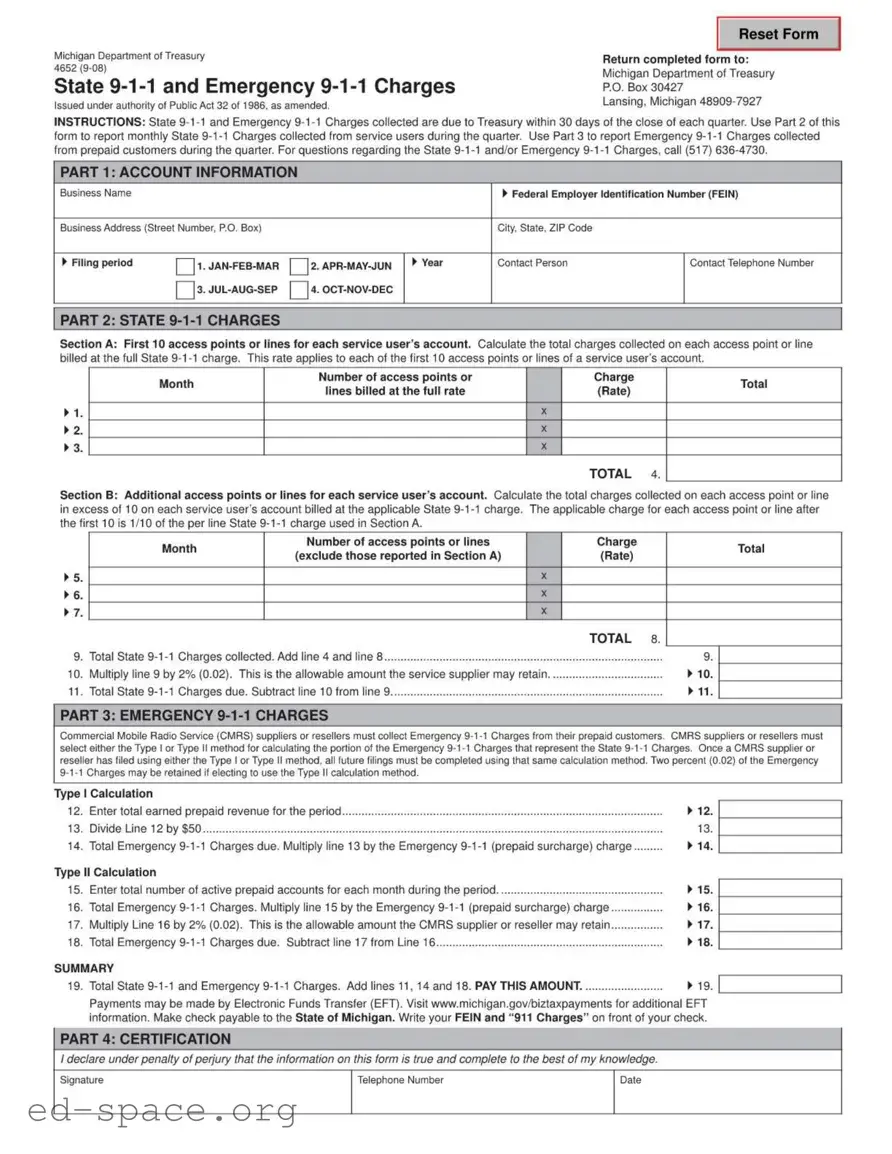
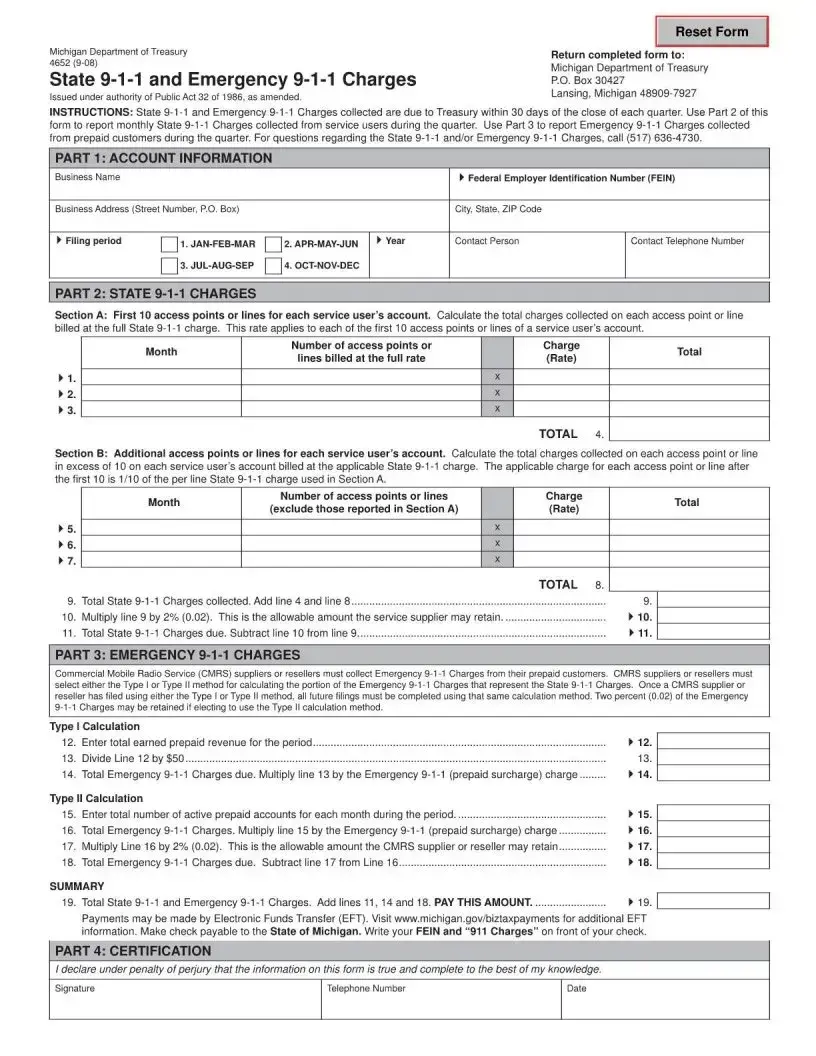
The Michigan 4652 form is a crucial document for businesses that collect State 9-1-1 and Emergency 9-1-1 charges. This form, issued by the Michigan Department of Treasury, is essential for ensuring compliance with Public Act 32 of 1986, which mandates the collection and remittance of these charges. Businesses must submit this form within 30 days after the end of each quarter, detailing the amounts collected from service users and prepaid customers. The form is divided into several sections, including account information, a breakdown of charges collected, and certification. In particular, Parts 2 and 3 focus on the reporting of State 9-1-1 charges and Emergency 9-1-1 charges, respectively. Businesses must accurately calculate the total charges based on the number of access points or lines billed, and they must choose between two calculation methods for Emergency 9-1-1 charges. Completing this form accurately is not just a regulatory requirement; it is vital for maintaining the integrity of emergency services funding in Michigan. Failure to comply can lead to penalties, making it imperative for businesses to understand and fulfill their obligations promptly.
| Fact Name | Fact Details |
|---|---|
| Form Purpose | The Michigan 4652 form is used to report State 9-1-1 and Emergency 9-1-1 Charges collected by service suppliers. |
| Governing Law | This form is issued under the authority of Public Act 32 of 1986, as amended. |
| Submission Deadline | Completed forms must be returned to the Michigan Department of Treasury within 30 days after the close of each quarter. |
| Contact Information | For questions regarding the charges, individuals can call (517) 636-4730. |
| Payment Method | Payments can be made via Electronic Funds Transfer (EFT) or by check payable to the State of Michigan. |
| Certification Requirement | The form requires a certification signature, confirming the information is true and complete under penalty of perjury. |
Completing the Michigan 4652 form is a straightforward process that requires careful attention to detail. This form is essential for reporting State and Emergency 9-1-1 charges collected during a specified period. After filling out the form, it must be submitted to the Michigan Department of Treasury for processing.
What is the Michigan 4652 form?
The Michigan 4652 form is used to report State 9-1-1 and Emergency 9-1-1 Charges collected by service suppliers. It is mandated by Public Act 32 of 1986 and must be submitted to the Michigan Department of Treasury within 30 days after the end of each quarter. This form helps ensure that the necessary funds are collected and allocated for emergency services in the state.
Who needs to fill out the Michigan 4652 form?
Businesses that provide telecommunication services and collect State 9-1-1 and Emergency 9-1-1 Charges from their customers are required to complete this form. This includes Commercial Mobile Radio Service (CMRS) suppliers and resellers who serve prepaid customers.
When is the Michigan 4652 form due?
The form must be submitted within 30 days of the close of each quarter. The quarters are divided as follows: January-March, April-June, July-September, and October-December. Timely submission is crucial to avoid potential penalties.
How do I report State 9-1-1 Charges on the form?
State 9-1-1 Charges are reported in Part 2 of the Michigan 4652 form. You will need to calculate the total charges collected for the first 10 access points or lines per service user’s account in Section A. For any additional access points or lines beyond 10, you will report those in Section B, using a different charge rate. Summing these totals will give you the overall State 9-1-1 Charges collected.
What are Emergency 9-1-1 Charges?
Emergency 9-1-1 Charges are fees collected from prepaid customers to fund emergency services. These charges must be reported separately in Part 3 of the form. CMRS suppliers or resellers can choose between two calculation methods to determine the amount due, which are detailed in the form's instructions.
Can I retain any portion of the collected charges?
Yes, service suppliers may retain a small percentage of the collected charges. For State 9-1-1 Charges, you can keep 2% of the total amount collected. If you are using the Type II calculation method for Emergency 9-1-1 Charges, you can also retain 2% of those charges.
What happens if I do not submit the form on time?
Failure to submit the Michigan 4652 form by the deadline may result in penalties. It is important to stay compliant to avoid any financial repercussions or issues with the Michigan Department of Treasury.
How should I make payments for the charges reported?
Payments for the reported charges can be made via Electronic Funds Transfer (EFT). For additional information on EFT, you can visit the Michigan Department of Treasury's website. Alternatively, you can send a check made out to the State of Michigan, ensuring to include your Federal Employer Identification Number (FEIN) and “911 Charges” on the front of the check.
Where do I send the completed Michigan 4652 form?
Once completed, the form should be mailed to the Michigan Department of Treasury at P.O. Box 30427, Lansing, Michigan 48909-7927. Ensuring that the form is correctly filled out and sent to the right address will help facilitate timely processing.
When completing the Michigan 4652 form, individuals often encounter several common mistakes that can lead to complications or delays. Here are ten such mistakes to be aware of:
By being aware of these common pitfalls, individuals can improve their accuracy and efficiency when filling out the Michigan 4652 form. Taking time to review each section carefully can help ensure compliance and facilitate timely processing of the report.
The Michigan 4652 form is essential for reporting State and Emergency 9-1-1 charges. However, several other forms and documents are often used in conjunction with it to ensure compliance and proper reporting. Below is a brief overview of these related documents.
Using these forms in conjunction with the Michigan 4652 can help ensure accurate reporting and compliance with state regulations. Understanding each document's purpose is essential for businesses involved in providing telecommunications services.
The Michigan 4652 form, which is used for reporting State and Emergency 9-1-1 Charges, shares similarities with several other documents used for tax and fee reporting. Below is a list of six documents that are comparable to the Michigan 4652 form, along with explanations of their similarities.
When filling out the Michigan 4652 form, it is important to follow specific guidelines to ensure accuracy and compliance. Here is a list of things to do and avoid:
Misconceptions about the Michigan 4652 form can lead to confusion and errors in reporting. Here are nine common misconceptions along with clarifications:
When filling out the Michigan 4652 form, keep these key points in mind: