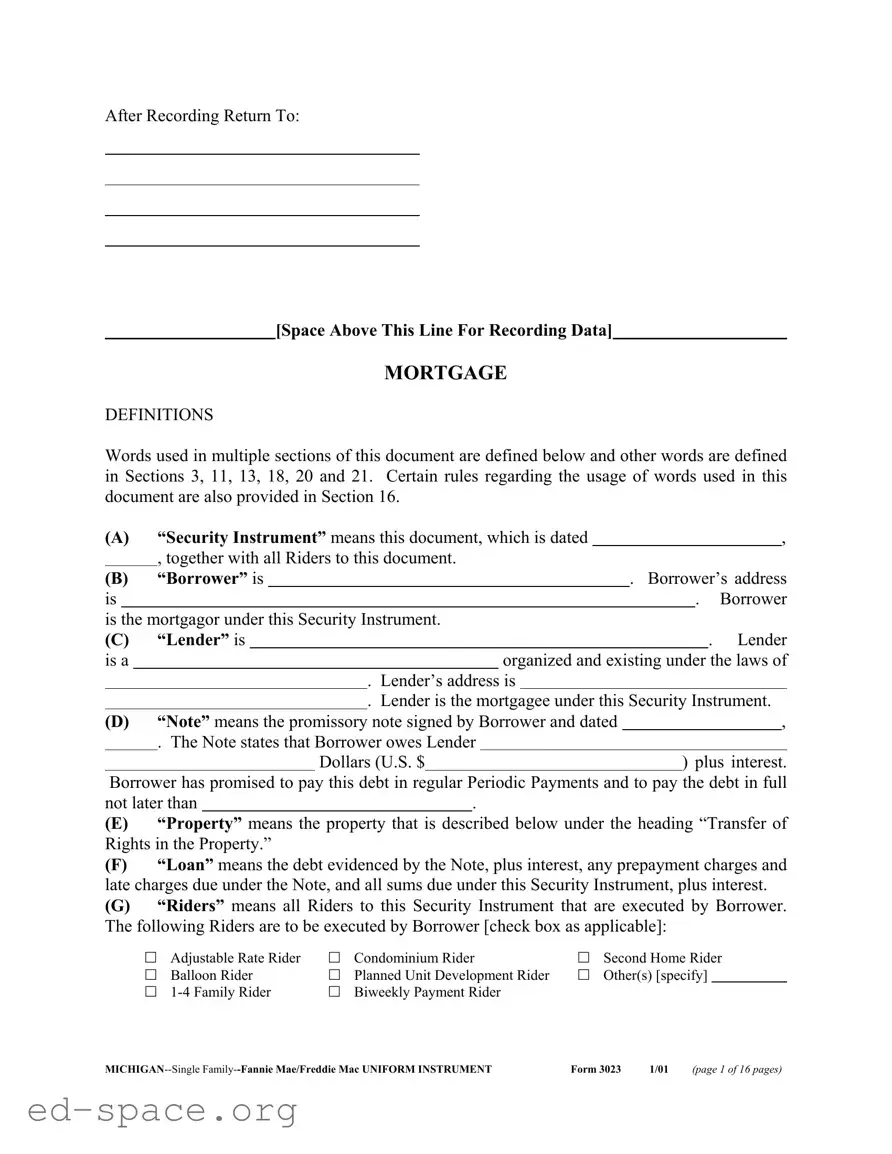
The Michigan 3023 form is a critical document in the realm of real estate transactions, particularly for single-family home mortgages. This form serves as a security instrument that outlines the relationship between the borrower and the lender, detailing the terms and conditions under which a loan is secured by the property. Among its key components, the form defines essential terms such as "Borrower," "Lender," and "Property," establishing clear roles and responsibilities for each party involved. It also specifies the financial obligations of the borrower, including the repayment of the principal and interest as indicated in the accompanying promissory note. The document highlights various riders that may be attached, such as adjustable-rate or balloon riders, which can modify the loan's terms based on specific circumstances. Furthermore, the Michigan 3023 form addresses escrow items, community association dues, and the implications of electronic funds transfers, ensuring that both parties are aware of their financial commitments. By incorporating uniform covenants that are consistent across jurisdictions, this form aims to simplify the mortgage process while providing legal protections for both borrowers and lenders. Understanding the nuances of the Michigan 3023 form is essential for anyone navigating the complexities of home financing in Michigan.
After Recording Return To:
[Space Above This Line For Recording Data]
MORTGAGE
DEFINITIONS
Words used in multiple sections of this document are defined below and other words are defined in Sections 3, 11, 13, 18, 20 and 21. Certain rules regarding the usage of words used in this document are also provided in Section 16.
(A) |
|
“Security Instrument” means this document, which is dated |
|
|
|
|
|
|
, |
||||||||||
|
|
|
, together with all Riders to this document. |
|
|
|
|
|
|
||||||||||
(B) |
|
“Borrower” is |
. Borrower’s address |
||||||||||||||||
is |
|
|
|
|
|
|
|
|
|
|
|
|
|
|
. |
|
Borrower |
||
is the mortgagor under this Security Instrument. |
|
|
|
|
|
|
|||||||||||||
(C) |
“Lender” is |
|
|
. |
Lender |
||||||||||||||
is a |
|
|
|
|
|
|
|
|
organized and existing under the laws of |
||||||||||
|
|
|
|
|
|
|
. Lender’s address is |
|
|
|
|
|
|
|
|||||
|
|
|
|
|
|
|
. Lender is the mortgagee under this Security Instrument. |
||||||||||||
(D) |
|
“Note” means the promissory note signed by Borrower and dated |
|
|
|
|
|
|
, |
||||||||||
|
|
|
. The Note states that Borrower owes Lender |
|
|
|
|
|
|
|
|||||||||
|
|
|
|
|
|
Dollars (U.S. $ |
|
|
) plus interest. |
||||||||||
Borrower has promised to pay this debt in regular Periodic Payments and to pay the debt in full
not later than |
|
. |
(E)“Property” means the property that is described below under the heading “Transfer of Rights in the Property.”
(F)“Loan” means the debt evidenced by the Note, plus interest, any prepayment charges and late charges due under the Note, and all sums due under this Security Instrument, plus interest.
(G)“Riders” means all Riders to this Security Instrument that are executed by Borrower. The following Riders are to be executed by Borrower [check box as applicable]:
! Adjustable Rate Rider |
! Condominium Rider |
! |
Second Home Rider |
|||
! |
Balloon Rider |
! |
Planned Unit Development Rider |
! |
Other(s) [specify] |
|
! |
! |
Biweekly Payment Rider |
|
|
|
|
Form 3023 |
1/01 |
(page 1 of 16 pages) |

(H)“Applicable Law” means all controlling applicable federal, state and local statutes, regulations, ordinances and administrative rules and orders (that have the effect of law) as well as all applicable final,
(I)“Community Association Dues, Fees, and Assessments” means all dues, fees, assessments and other charges that are imposed on Borrower or the Property by a condominium association, homeowners association or similar organization.
(J)“Electronic Funds Transfer” means any transfer of funds, other than a transaction originated by check, draft, or similar paper instrument, which is initiated through an electronic terminal, telephonic instrument, computer, or magnetic tape so as to order, instruct, or authorize a financial institution to debit or credit an account. Such term includes, but is not limited to,
(K)“Escrow Items” means those items that are described in Section 3.
(L)“Miscellaneous Proceeds” means any compensation, settlement, award of damages, or proceeds paid by any third party (other than insurance proceeds paid under the coverages described in Section 5) for: (i) damage to, or destruction of, the Property; (ii) condemnation or other taking of all or any part of the Property; (iii) conveyance in lieu of condemnation; or (iv) misrepresentations of, or omissions as to, the value and/or condition of the Property.
(M)“Mortgage Insurance” means insurance protecting Lender against the nonpayment of, or default on, the Loan.
(N)“Periodic Payment” means the regularly scheduled amount due for (i) principal and interest under the Note, plus (ii) any amounts under Section 3 of this Security Instrument.
(O)“RESPA” means the Real Estate Settlement Procedures Act (12 U.S.C. §2601 et seq.) and its implementing regulation, Regulation X (24 C.F.R. Part 3500), as they might be amended from time to time, or any additional or successor legislation or regulation that governs the same subject matter. As used in this Security Instrument, “RESPA” refers to all requirements and restrictions that are imposed in regard to a “federally related mortgage loan” even if the Loan does not qualify as a “federally related mortgage loan” under RESPA.
(P)“Successor in Interest of Borrower” means any party that has taken title to the Property, whether or not that party has assumed Borrower’s obligations under the Note and/or this Security Instrument.
TRANSFER OF RIGHTS IN THE PROPERTY
This Security Instrument secures to Lender: (i) the repayment of the Loan, and all renewals, extensions and modifications of the Note; and (ii) the performance of Borrower’s covenants and agreements under this Security Instrument and the Note. For this purpose, Borrower does hereby mortgage, warrant, grant and convey to Lender and Lender’s successors and assigns, with power of sale, the following described property located in the
[Type of Recording Jurisdiction]
of |
|
: |
[Name of Recording Jurisdiction]
Form 3023 |
1/01 |
(page 2 of 16 pages) |

which currently has the address of
|
|
|
[Street] |
|
, Michigan |
|
(“Property Address”): |
[City] |
[Zip Code] |
||
TOGETHER WITH all the improvements now or hereafter erected on the property, and all easements, appurtenances, and fixtures now or hereafter a part of the property. All replacements and additions shall also be covered by this Security Instrument. All of the foregoing is referred to in this Security Instrument as the “Property.”
BORROWER COVENANTS that Borrower is lawfully seised of the estate hereby conveyed and has the right to mortgage, grant and convey the Property and that the Property is unencumbered, except for encumbrances of record. Borrower warrants and will defend generally the title to the Property against all claims and demands, subject to any encumbrances of record.
THIS SECURITY INSTRUMENT combines uniform covenants for national use and
UNIFORM COVENANTS. Borrower and Lender covenant and agree as follows:
1.Payment of Principal, Interest, Escrow Items, Prepayment Charges, and Late Charges. Borrower shall pay when due the principal of, and interest on, the debt evidenced by the Note and any prepayment charges and late charges due under the Note. Borrower shall also pay funds for Escrow Items pursuant to Section 3. Payments due under the Note and this Security Instrument shall be made in U.S. currency. However, if any check or other instrument received by Lender as payment under the Note or this Security Instrument is returned to Lender unpaid, Lender may require that any or all subsequent payments due under the Note and this Security Instrument be made in one or more of the following forms, as selected by Lender: (a) cash; (b) money order; (c) certified check, bank check, treasurer’s check or cashier’s check, provided any such check is drawn upon an institution whose deposits are insured by a federal agency, instrumentality, or entity; or (d) Electronic Funds Transfer.
Payments are deemed received by Lender when received at the location designated in the Note or at such other location as may be designated by Lender in accordance with the notice provisions in Section 15. Lender may return any payment or partial payment if the payment or partial payments are insufficient to bring the Loan current. Lender may accept any payment or partial payment insufficient to bring the Loan current, without waiver of any rights hereunder or prejudice to its rights to refuse such payment or partial payments in the future, but Lender is not obligated to apply such payments at the time such payments are accepted. If each Periodic Payment is applied as of its scheduled due date, then Lender need not pay interest on unapplied funds. Lender may hold such unapplied funds until Borrower makes payment to bring the Loan current. If Borrower does not do so within a reasonable period of time, Lender shall either apply such funds or return them to Borrower. If not applied earlier, such funds will be applied to the outstanding principal balance under the Note immediately prior to foreclosure. No offset or claim which Borrower might have now or in
Form 3023 |
1/01 |
(page 3 of 16 pages) |
the future against Lender shall relieve Borrower from making payments due under the Note and this Security Instrument or performing the covenants and agreements secured by this Security Instrument.
2.Application of Payments or Proceeds. Except as otherwise described in this Section 2, all payments accepted and applied by Lender shall be applied in the following
order of priority: (a) interest due under the Note; (b) principal due under the Note;
(c)amounts due under Section 3. Such payments shall be applied to each Periodic Payment in the order in which it became due. Any remaining amounts shall be applied first to late charges, second to any other amounts due under this Security Instrument, and then to reduce the principal balance of the Note.
If Lender receives a payment from Borrower for a delinquent Periodic Payment which includes a sufficient amount to pay any late charge due, the payment may be applied to the delinquent payment and the late charge. If more than one Periodic Payment is outstanding, Lender may apply any payment received from Borrower to the repayment of the Periodic Payments if, and to the extent that, each payment can be paid in full. To the extent that any excess exists after the payment is applied to the full payment of one or more Periodic Payments, such excess may be applied to any late charges due. Voluntary prepayments shall be applied first to any prepayment charges and then as described in the Note.
Any application of payments, insurance proceeds, or Miscellaneous Proceeds to principal due under the Note shall not extend or postpone the due date, or change the amount, of the Periodic Payments.
3.Funds for Escrow Items. Borrower shall pay to Lender on the day Periodic Payments are due under the Note, until the Note is paid in full, a sum (the “Funds”) to provide for payment of amounts due for: (a) taxes and assessments and other items which can attain priority over this Security Instrument as a lien or encumbrance on the Property; (b) leasehold payments or ground rents on the Property, if any; (c) premiums for any and all insurance required by Lender under Section 5; and (d) Mortgage Insurance premiums, if any, or any sums payable by Borrower to Lender in lieu of the payment of Mortgage Insurance premiums in accordance with the provisions of Section 10. These items are called “Escrow Items.” At origination or at any time during the term of the Loan, Lender may require that Community Association Dues, Fees, and Assessments, if any, be escrowed by Borrower, and such dues, fees and assessments shall be an Escrow Item. Borrower shall promptly furnish to Lender all notices of amounts to be paid under this Section. Borrower shall pay Lender the Funds for Escrow Items unless Lender waives Borrower’s obligation to pay the Funds for any or all Escrow Items. Lender may waive Borrower’s obligation to pay to Lender Funds for any or all Escrow Items at any time. Any such waiver may only be in writing. In the event of such waiver, Borrower shall pay directly, when and where payable, the amounts due for any Escrow Items for which payment of Funds has been waived by Lender and, if Lender requires, shall furnish to Lender receipts evidencing such payment within such time period as Lender may require. Borrower’s obligation to make such payments and to provide receipts shall for all purposes be deemed to be a covenant and agreement contained in this Security Instrument, as the phrase “covenant and agreement” is used in Section 9. If Borrower is obligated to pay Escrow Items directly, pursuant to a waiver, and Borrower fails to pay the amount due for an Escrow Item, Lender may exercise its rights under Section 9 and pay such amount and Borrower shall then be obligated under Section 9 to repay to Lender any such amount. Lender may revoke the waiver as to any or all Escrow Items at any time by a notice
Form 3023 |
1/01 |
(page 4 of 16 pages) |
given in accordance with Section 15 and, upon such revocation, Borrower shall pay to Lender all Funds, and in such amounts, that are then required under this Section 3.
Lender may, at any time, collect and hold Funds in an amount (a) sufficient to permit Lender to apply the Funds at the time specified under RESPA, and (b) not to exceed the maximum amount a lender can require under RESPA. Lender shall estimate the amount of Funds due on the basis of current data and reasonable estimates of expenditures of future Escrow Items or otherwise in accordance with Applicable Law.
The Funds shall be held in an institution whose deposits are insured by a federal agency, instrumentality, or entity (including Lender, if Lender is an institution whose deposits are so insured) or in any Federal Home Loan Bank. Lender shall apply the Funds to pay the Escrow Items no later than the time specified under RESPA. Lender shall not charge Borrower for holding and applying the Funds, annually analyzing the escrow account, or verifying the Escrow Items, unless Lender pays Borrower interest on the Funds and Applicable Law permits Lender to make such a charge. Unless an agreement is made in writing or Applicable Law requires interest to be paid on the Funds, Lender shall not be required to pay Borrower any interest or earnings on the Funds. Borrower and Lender can agree in writing, however, that interest shall be paid on the Funds. Lender shall give to Borrower, without charge, an annual accounting of the Funds as required by RESPA.
If there is a surplus of Funds held in escrow, as defined under RESPA, Lender shall account to Borrower for the excess funds in accordance with RESPA. If there is a shortage of Funds held in escrow, as defined under RESPA, Lender shall notify Borrower as required by RESPA, and Borrower shall pay to Lender the amount necessary to make up the shortage in accordance with RESPA, but in no more than 12 monthly payments. If there is a deficiency of Funds held in escrow, as defined under RESPA, Lender shall notify Borrower as required by RESPA, and Borrower shall pay to Lender the amount necessary to make up the deficiency in accordance with RESPA, but in no more than 12 monthly payments.
Upon payment in full of all sums secured by this Security Instrument, Lender shall promptly refund to Borrower any Funds held by Lender.
4.Charges; Liens. Borrower shall pay all taxes, assessments, charges, fines, and impositions attributable to the Property which can attain priority over this Security Instrument, leasehold payments or ground rents on the Property, if any, and Community Association Dues, Fees, and Assessments, if any. To the extent that these items are Escrow Items, Borrower shall pay them in the manner provided in Section 3.
Borrower shall promptly discharge any lien which has priority over this Security Instrument unless Borrower: (a) agrees in writing to the payment of the obligation secured by the lien in a manner acceptable to Lender, but only so long as Borrower is performing such agreement; (b) contests the lien in good faith by, or defends against enforcement of the lien in, legal proceedings which in Lender’s opinion operate to prevent the enforcement of the lien while those proceedings are pending, but only until such proceedings are concluded; or (c) secures from the holder of the lien an agreement satisfactory to Lender subordinating the lien to this Security Instrument. If Lender determines that any part of the Property is subject to a lien which can attain priority over this Security Instrument, Lender may give Borrower a notice identifying the lien. Within 10 days of the date on which that notice is given, Borrower shall satisfy the lien or take one or more of the actions set forth above in this Section 4.
Form 3023 |
1/01 |
(page 5 of 16 pages) |
Lender may require Borrower to pay a
5.Property Insurance. Borrower shall keep the improvements now existing or hereafter erected on the Property insured against loss by fire, hazards included within the term “extended coverage,” and any other hazards including, but not limited to, earthquakes and floods, for which Lender requires insurance. This insurance shall be maintained in the amounts (including deductible levels) and for the periods that Lender requires. What Lender requires pursuant to the preceding sentences can change during the term of the Loan. The insurance carrier providing the insurance shall be chosen by Borrower subject to Lender’s right to disapprove Borrower’s choice, which right shall not be exercised unreasonably. Lender may require Borrower to pay, in connection with this Loan, either: (a) a
If Borrower fails to maintain any of the coverages described above, Lender may obtain insurance coverage, at Lender’s option and Borrower’s expense. Lender is under no obligation to purchase any particular type or amount of coverage. Therefore, such coverage shall cover Lender, but might or might not protect Borrower, Borrower’s equity in the Property, or the contents of the Property, against any risk, hazard or liability and might provide greater or lesser coverage than was previously in effect. Borrower acknowledges that the cost of the insurance coverage so obtained might significantly exceed the cost of insurance that Borrower could have obtained. Any amounts disbursed by Lender under this Section 5 shall become additional debt of Borrower secured by this Security Instrument. These amounts shall bear interest at the Note rate from the date of disbursement and shall be payable, with such interest, upon notice from Lender to Borrower requesting payment.
All insurance policies required by Lender and renewals of such policies shall be subject to Lender’s right to disapprove such policies, shall include a standard mortgage clause, and shall name Lender as mortgagee and/or as an additional loss payee. Lender shall have the right to hold the policies and renewal certificates. If Lender requires, Borrower shall promptly give to Lender all receipts of paid premiums and renewal notices. If Borrower obtains any form of insurance coverage, not otherwise required by Lender, for damage to, or destruction of, the Property, such policy shall include a standard mortgage clause and shall name Lender as mortgagee and/or as an additional loss payee.
In the event of loss, Borrower shall give prompt notice to the insurance carrier and Lender. Lender may make proof of loss if not made promptly by Borrower. Unless Lender and Borrower otherwise agree in writing, any insurance proceeds, whether or not the underlying insurance was required by Lender, shall be applied to restoration or repair of the Property, if the restoration or repair is economically feasible and Lender’s security is not lessened. During such repair and restoration period, Lender shall have the right to hold such insurance proceeds until Lender has had an opportunity to inspect such Property to ensure the work has been completed to Lender’s satisfaction, provided that such inspection shall be undertaken promptly. Lender may disburse proceeds for the repairs and restoration in a single payment or in a series of progress payments as the work is completed. Unless an
Form 3023 |
1/01 |
(page 6 of 16 pages) |
agreement is made in writing or Applicable Law requires interest to be paid on such insurance proceeds, Lender shall not be required to pay Borrower any interest or earnings on such proceeds. Fees for public adjusters, or other third parties, retained by Borrower shall not be paid out of the insurance proceeds and shall be the sole obligation of Borrower. If the restoration or repair is not economically feasible or Lender’s security would be lessened, the insurance proceeds shall be applied to the sums secured by this Security Instrument, whether or not then due, with the excess, if any, paid to Borrower. Such insurance proceeds shall be applied in the order provided for in Section 2.
If Borrower abandons the Property, Lender may file, negotiate and settle any available insurance claim and related matters. If Borrower does not respond within 30 days to a notice from Lender that the insurance carrier has offered to settle a claim, then Lender may negotiate and settle the claim. The
6.Occupancy. Borrower shall occupy, establish, and use the Property as Borrower’s principal residence within 60 days after the execution of this Security Instrument and shall continue to occupy the Property as Borrower’s principal residence for at least one year after the date of occupancy, unless Lender otherwise agrees in writing, which consent shall not be unreasonably withheld, or unless extenuating circumstances exist which are beyond Borrower’s control.
7.Preservation, Maintenance and Protection of the Property; Inspections. Borrower shall not destroy, damage or impair the Property, allow the Property to deteriorate or commit waste on the Property. Whether or not Borrower is residing in the Property, Borrower shall maintain the Property in order to prevent the Property from deteriorating or decreasing in value due to its condition. Unless it is determined pursuant to Section 5 that repair or restoration is not economically feasible, Borrower shall promptly repair the Property if damaged to avoid further deterioration or damage. If insurance or condemnation proceeds are paid in connection with damage to, or the taking of, the Property, Borrower shall be responsible for repairing or restoring the Property only if Lender has released proceeds for such purposes. Lender may disburse proceeds for the repairs and restoration in a single payment or in a series of progress payments as the work is completed. If the insurance or condemnation proceeds are not sufficient to repair or restore the Property, Borrower is not relieved of Borrower’s obligation for the completion of such repair or restoration.
Form 3023 |
1/01 |
(page 7 of 16 pages) |
Lender or its agent may make reasonable entries upon and inspections of the Property. If it has reasonable cause, Lender may inspect the interior of the improvements on the Property. Lender shall give Borrower notice at the time of or prior to such an interior inspection specifying such reasonable cause.
8.Borrower’s Loan Application. Borrower shall be in default if, during the Loan application process, Borrower or any persons or entities acting at the direction of Borrower or with Borrower’s knowledge or consent gave materially false, misleading, or inaccurate information or statements to Lender (or failed to provide Lender with material information) in connection with the Loan. Material representations include, but are not limited to, representations concerning Borrower’s occupancy of the Property as Borrower’s principal residence.
9.Protection of Lender’s Interest in the Property and Rights Under this Security Instrument. If (a) Borrower fails to perform the covenants and agreements contained in this Security Instrument, (b) there is a legal proceeding that might significantly affect Lender’s interest in the Property and/or rights under this Security Instrument (such as a proceeding in bankruptcy, probate, for condemnation or forfeiture, for enforcement of a lien which may attain priority over this Security Instrument or to enforce laws or regulations), or
(c)Borrower has abandoned the Property, then Lender may do and pay for whatever is reasonable or appropriate to protect Lender’s interest in the Property and rights under this Security Instrument, including protecting and/or assessing the value of the Property, and securing and/or repairing the Property. Lender’s actions can include, but are not limited to:
(a)paying any sums secured by a lien which has priority over this Security Instrument;
(b)appearing in court; and (c) paying reasonable attorneys’ fees to protect its interest in the Property and/or rights under this Security Instrument, including its secured position in a bankruptcy proceeding. Securing the Property includes, but is not limited to, entering the Property to make repairs, change locks, replace or board up doors and windows, drain water from pipes, eliminate building or other code violations or dangerous conditions, and have utilities turned on or off. Although Lender may take action under this Section 9, Lender does not have to do so and is not under any duty or obligation to do so. It is agreed that Lender incurs no liability for not taking any or all actions authorized under this Section 9.
Any amounts disbursed by Lender under this Section 9 shall become additional debt of Borrower secured by this Security Instrument. These amounts shall bear interest at the Note rate from the date of disbursement and shall be payable, with such interest, upon notice from Lender to Borrower requesting payment.
If this Security Instrument is on a leasehold, Borrower shall comply with all the provisions of the lease. If Borrower acquires fee title to the Property, the leasehold and the fee title shall not merge unless Lender agrees to the merger in writing.
10.Mortgage Insurance. If Lender required Mortgage Insurance as a condition of making the Loan, Borrower shall pay the premiums required to maintain the Mortgage Insurance in effect. If, for any reason, the Mortgage Insurance coverage required by Lender ceases to be available from the mortgage insurer that previously provided such insurance and Borrower was required to make separately designated payments toward the premiums for Mortgage Insurance, Borrower shall pay the premiums required to obtain coverage substantially equivalent to the Mortgage Insurance previously in effect, at a cost substantially equivalent to the cost to Borrower of the Mortgage Insurance previously in effect, from an alternate mortgage insurer selected by Lender. If substantially equivalent Mortgage Insurance
Form 3023 |
1/01 |
(page 8 of 16 pages) |
coverage is not available, Borrower shall continue to pay to Lender the amount of the separately designated payments that were due when the insurance coverage ceased to be in effect. Lender will accept, use and retain these payments as a
Mortgage Insurance reimburses Lender (or any entity that purchases the Note) for certain losses it may incur if Borrower does not repay the Loan as agreed. Borrower is not a party to the Mortgage Insurance.
Mortgage insurers evaluate their total risk on all such insurance in force from time to time, and may enter into agreements with other parties that share or modify their risk, or reduce losses. These agreements are on terms and conditions that are satisfactory to the mortgage insurer and the other party (or parties) to these agreements. These agreements may require the mortgage insurer to make payments using any source of funds that the mortgage insurer may have available (which may include funds obtained from Mortgage Insurance premiums).
As a result of these agreements, Lender, any purchaser of the Note, another insurer, any reinsurer, any other entity, or any affiliate of any of the foregoing, may receive (directly or indirectly) amounts that derive from (or might be characterized as) a portion of Borrower’s payments for Mortgage Insurance, in exchange for sharing or modifying the mortgage insurer’s risk, or reducing losses. If such agreement provides that an affiliate of Lender takes a share of the insurer’s risk in exchange for a share of the premiums paid to the insurer, the arrangement is often termed “captive reinsurance.” Further:
(a)Any such agreements will not affect the amounts that Borrower has agreed to pay for Mortgage Insurance, or any other terms of the Loan. Such agreements will not increase the amount Borrower will owe for Mortgage Insurance, and they will not entitle Borrower to any refund.
(b)Any such agreements will not affect the rights Borrower has - if any - with respect to the Mortgage Insurance under the Homeowners Protection Act of 1998 or any other law. These rights may include the right to receive certain disclosures, to request and obtain cancellation of the Mortgage Insurance, to have the Mortgage Insurance terminated automatically, and/or to receive a refund of any Mortgage Insurance premiums that were unearned at the time of such cancellation or termination.
Form 3023 |
1/01 |
(page 9 of 16 pages) |
11.Assignment of Miscellaneous Proceeds; Forfeiture. All Miscellaneous Proceeds are hereby assigned to and shall be paid to Lender.
If the Property is damaged, such Miscellaneous Proceeds shall be applied to restoration or repair of the Property, if the restoration or repair is economically feasible and Lender’s security is not lessened. During such repair and restoration period, Lender shall have the right to hold such Miscellaneous Proceeds until Lender has had an opportunity to inspect such Property to ensure the work has been completed to Lender’s satisfaction, provided that such inspection shall be undertaken promptly. Lender may pay for the repairs and restoration in a single disbursement or in a series of progress payments as the work is completed. Unless an agreement is made in writing or Applicable Law requires interest to be paid on such Miscellaneous Proceeds, Lender shall not be required to pay Borrower any interest or earnings on such Miscellaneous Proceeds. If the restoration or repair is not economically feasible or Lender’s security would be lessened, the Miscellaneous Proceeds shall be applied to the sums secured by this Security Instrument, whether or not then due, with the excess, if any, paid to Borrower. Such Miscellaneous Proceeds shall be applied in the order provided for in Section 2.
In the event of a total taking, destruction, or loss in value of the Property, the Miscellaneous Proceeds shall be applied to the sums secured by this Security Instrument, whether or not then due, with the excess, if any, paid to Borrower.
In the event of a partial taking, destruction, or loss in value of the Property in which the fair market value of the Property immediately before the partial taking, destruction, or loss in value is equal to or greater than the amount of the sums secured by this Security Instrument immediately before the partial taking, destruction, or loss in value, unless Borrower and Lender otherwise agree in writing, the sums secured by this Security Instrument shall be reduced by the amount of the Miscellaneous Proceeds multiplied by the following fraction: (a) the total amount of the sums secured immediately before the partial taking, destruction, or loss in value divided by (b) the fair market value of the Property immediately before the partial taking, destruction, or loss in value. Any balance shall be paid to Borrower.
In the event of a partial taking, destruction, or loss in value of the Property in which the fair market value of the Property immediately before the partial taking, destruction, or loss in value is less than the amount of the sums secured immediately before the partial taking, destruction, or loss in value, unless Borrower and Lender otherwise agree in writing, the Miscellaneous Proceeds shall be applied to the sums secured by this Security Instrument whether or not the sums are then due.
If the Property is abandoned by Borrower, or if, after notice by Lender to Borrower that the Opposing Party (as defined in the next sentence) offers to make an award to settle a claim for damages, Borrower fails to respond to Lender within 30 days after the date the notice is given, Lender is authorized to collect and apply the Miscellaneous Proceeds either to restoration or repair of the Property or to the sums secured by this Security Instrument, whether or not then due. “Opposing Party” means the third party that owes Borrower Miscellaneous Proceeds or the party against whom Borrower has a right of action in regard to Miscellaneous Proceeds.
Form 3023 |
1/01 (page 10 of 16 pages) |
| Fact Name | Details |
|---|---|
| Form Purpose | The Michigan 3023 form serves as a mortgage security instrument for single-family homes, detailing the rights and obligations of borrowers and lenders. |
| Governing Laws | This form is governed by Michigan state laws, including applicable federal regulations such as RESPA (Real Estate Settlement Procedures Act). |
| Key Definitions | Important terms such as "Borrower," "Lender," "Property," and "Loan" are clearly defined within the document to ensure understanding of all parties involved. |
| Escrow Items | Borrowers may be required to pay funds for escrow items, which cover taxes, insurance, and other charges related to the property. |
| Uniformity | The 3023 form combines uniform covenants for national use with specific provisions that may vary by jurisdiction, ensuring compliance across states. |
Completing the Michigan 3023 form requires careful attention to detail, as it serves as a legal document related to the mortgage agreement. To ensure accuracy, gather all necessary information beforehand. Once the form is filled out, it should be submitted as instructed, typically to the lender or relevant authority for processing.
What is the Michigan 3023 form?
The Michigan 3023 form is a legal document used in real estate transactions, specifically for mortgage agreements. It outlines the terms of the loan between the borrower and the lender, including the rights and responsibilities of both parties. This form is essential for securing the mortgage on a property and ensuring that all parties understand their obligations.
Who are the parties involved in the Michigan 3023 form?
The main parties involved in the Michigan 3023 form are the borrower and the lender. The borrower is the individual or entity taking out the loan, while the lender is the financial institution or organization providing the loan. Each party has specific rights and responsibilities outlined in the form.
What does the term "Security Instrument" refer to in the Michigan 3023 form?
The term "Security Instrument" refers to the Michigan 3023 form itself, along with any additional riders that may be attached to it. This document serves as a legal agreement that secures the loan by establishing the property as collateral for the debt.
What are "Riders" in the context of the Michigan 3023 form?
Riders are additional provisions or amendments that can be attached to the Michigan 3023 form. They address specific circumstances or conditions related to the loan. Examples include an Adjustable Rate Rider, a Condominium Rider, or a Balloon Rider. Borrowers can select the applicable riders by checking the appropriate boxes on the form.
What is meant by "Escrow Items" in the Michigan 3023 form?
Escrow Items are expenses related to the property that the borrower must pay, which may include property taxes, insurance premiums, and community association fees. The borrower pays these amounts to the lender, who holds them in escrow until they are due. This ensures that these important expenses are paid on time and helps protect the lender's investment.
What happens if a payment is returned unpaid?
If a payment made by the borrower is returned unpaid, the lender may require future payments to be made in different forms, such as cash or a certified check. This is to ensure that the lender receives the funds securely and promptly. The lender also retains the right to return any payment that does not bring the loan current.
How are payments applied according to the Michigan 3023 form?
Payments are applied in a specific order: first to any interest due, then to the principal amount, and finally to any other amounts due under the agreement. This structured approach helps ensure that all aspects of the loan are managed appropriately and that the borrower's payments are accurately reflected.
What is the role of the "Applicable Law" mentioned in the Michigan 3023 form?
"Applicable Law" refers to all relevant federal, state, and local laws that govern the mortgage agreement. This includes statutes, regulations, and judicial opinions that may impact the terms of the loan or the rights of the parties involved. It is crucial for both the borrower and lender to understand these laws to ensure compliance.
What should a borrower do if they cannot make a payment?
If a borrower anticipates difficulty in making a payment, it is advisable to contact the lender as soon as possible. Open communication may lead to options such as loan modification or temporary payment arrangements. Ignoring the situation could lead to penalties or foreclosure, so addressing it proactively is essential.
Failing to complete the Borrower and Lender sections accurately. It’s crucial to provide the correct names and addresses, as any discrepancies can lead to legal complications.
Not specifying the Property Address correctly. Ensure that the street address, city, and zip code are all filled in accurately to avoid issues with the title.
Overlooking the Loan Amount. It’s essential to state the exact dollar amount owed to the lender, including any interest rates or additional fees.
Neglecting to check applicable Riders. If certain conditions apply, such as adjustable rates or second home status, failing to check the appropriate boxes can create misunderstandings later.
Leaving out the Recording Jurisdiction. This detail is necessary for proper legal documentation and ensures the mortgage is enforceable.
Not signing or dating the form. Both the Borrower and Lender must sign and date the document to validate it legally.
Ignoring the Escrow Items section. It’s important to identify any escrow items that need to be accounted for, as this can affect future payments.
Failing to provide accurate Community Association Dues. If applicable, these must be disclosed to avoid unexpected financial burdens.
Not retaining a copy of the completed form. Keeping a copy for personal records is vital for future reference and to ensure that all parties have the same understanding of the agreement.
When dealing with the Michigan 3023 form, several other forms and documents may also be necessary to complete the mortgage process effectively. Each of these documents serves a specific purpose and ensures that all legal and financial obligations are clearly outlined and understood. Below is a list of commonly associated forms and their brief descriptions.
Understanding these forms and documents is crucial for anyone navigating the mortgage process in Michigan. Each plays a vital role in ensuring that the transaction is legally sound and that both the borrower and lender are protected throughout the loan's duration.
The Michigan 3023 form serves as a security instrument in a mortgage agreement. Several other documents share similarities with this form, particularly in their function and structure. Below are four documents that are comparable to the Michigan 3023 form:
When filling out the Michigan 3023 form, it’s important to follow specific guidelines to ensure accuracy and compliance. Here are some dos and don’ts to consider:
This form is used by all borrowers, regardless of whether they are first-time homebuyers or experienced property owners. It applies to any mortgage transaction in Michigan.
The Michigan 3023 form is a legally binding document once signed. It outlines the obligations of both the borrower and the lender, and failing to comply can lead to serious consequences.
Filling out the Michigan 3023 form is a requirement for securing a mortgage in Michigan. It is essential for both parties to understand their rights and responsibilities.
The Michigan 3023 form addresses various aspects of the mortgage, including interest rates, payment schedules, and additional fees. It provides a comprehensive overview of the loan agreement.
Escrow items are mandatory. Borrowers must set aside funds for taxes, insurance, and other fees as specified in the form. Ignoring these requirements can lead to financial penalties.
While the core terms of the loan are set in the form, certain conditions may allow for changes. Borrowers should review the form carefully to understand when modifications can occur.
The Michigan 3023 form protects both the lender and the borrower. It ensures that borrowers understand their obligations and provides them with legal rights regarding their property.
The Michigan 3023 form is specific to Michigan and may differ from forms used in other states. Each state has its own requirements and regulations regarding mortgage documentation.
While the form is binding, borrowers have the right to dispute any terms they believe are unfair or incorrect. Legal avenues are available for addressing grievances related to the mortgage agreement.
When filling out and using the Michigan 3023 form, keep these key takeaways in mind: