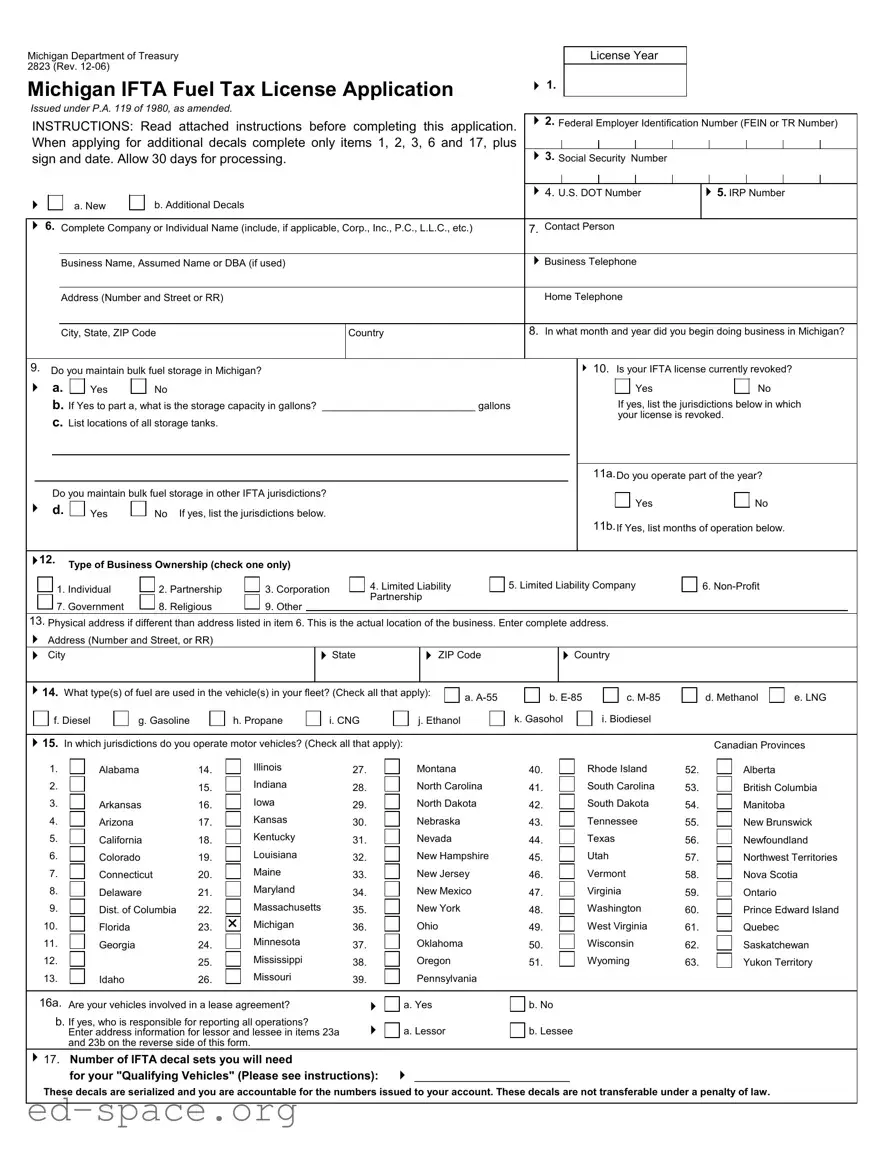
The Michigan 2823 form, officially known as the Michigan IFTA Fuel Tax License Application, serves as a crucial document for motor carriers operating in interstate commerce. This application is essential for those who wish to obtain an International Fuel Tax Agreement (IFTA) license and decals, which are mandatory for qualified motor vehicles traveling across state lines. The form requires detailed information about the applicant, including the business's legal name, contact details, and the types of fuel used in the vehicles. Additionally, it seeks specifics about operational jurisdictions and any bulk fuel storage maintained within Michigan. Applicants must also indicate their business structure, whether it be an individual, partnership, corporation, or another type of ownership. The form emphasizes the importance of compliance with tax reporting and record-keeping requirements, ensuring that all operations are transparent and accountable. By submitting the 2823 form, applicants agree to adhere to the stipulations of the IFTA, including timely tax payments and the maintenance of accurate records for audit purposes. This comprehensive application not only facilitates the licensing process but also helps streamline fuel tax reporting across multiple jurisdictions, making it a vital resource for businesses engaged in interstate transportation.
Michigan Department of Treasury 2823 (Rev.
Michigan IFTA Fuel Tax License Application |
1. |
|
License Year
Issued under P.A. 119 of 1980, as amended.
INSTRUCTIONS: Read attached instructions before completing this application. |
2. |
Federal Employer Identification Number (FEIN or TR Number) |
||||||||||||
|
|
|
|
|
|
|
|
|
|
|
||||
When applying for additional decals complete only items 1, 2, 3, 6 and 17, plus |
|
|
|
|
|
|
|
|
|
|
|
|
||
|
|
|
|
|
|
|
|
|
|
|
||||
sign and date. Allow 30 days for processing. |
3. |
Social Security Number |
|
|
|
|
|
|
||||||
|
|
|
|
|
|
|
|
|
||||||
|
|
|
|
|
|
|
|
|
|
|
|
|
|
|
|
|
|
|
4. |
U.S. DOT Number |
|
|
5. IRP Number |
||||||
|
a. New |
b. Additional Decals |
|
|
|
|
|
|
|
|
|
|
|
|
|
|
|
|
|
|
|
|
|
||||||
6. Complete Company or Individual Name (include, if applicable, Corp., Inc., P.C., L.L.C., etc.) |
7. Contact Person |
|
|
|
|
|
|
|||||||
|
|
|
|
|
|
|
|
|
||||||
|
Business Name, Assumed Name or DBA (if used) |
Business Telephone |
|
|
|
|
|
|
||||||
|
|
|
|
|
|
|
|
|
||||||
|
Address (Number and Street or RR) |
Home Telephone |
|
|
|
|
|
|
||||||
City, State, ZIP Code
Country
8.In what month and year did you begin doing business in Michigan?
9.Do you maintain bulk fuel storage in Michigan?
a. |
Yes |
No |
b.If Yes to part a, what is the storage capacity in gallons? ___________________________ gallons
c.List locations of all storage tanks.
Do you maintain bulk fuel storage in other IFTA jurisdictions?
d. |
|
Yes |
|
No If yes, list the jurisdictions below. |
|
|
10.Is your IFTA license currently revoked?
Yes |
No |
If yes, list the jurisdictions below in which your license is revoked.
11a.Do you operate part of the year?
Yes |
No |
11b.If Yes, list months of operation below.
12.Type of Business Ownership (check one only)
1. |
Individual |
|
2. |
Partnership |
|
3. |
Corporation |
|
|
||||||
7. |
Government |
|
8. |
Religious |
|
9. |
Other |
|
|
4.Limited Liability Partnership
5. Limited Liability Company
6.
13.Physical address if different than address listed in item 6. This is the actual location of the business. Enter complete address.
Address (Number and Street, or RR)
|
|
City |
|
|
|
|
|
|
|
|
|
|
State |
|
ZIP Code |
|
|
|
|
Country |
|
|
|
|
|
|
|
|
||||||||||||||
|
|
|
|
|
|
|
|
|
|
|
|
|
|
|
|
|
|
|
|
|
|
|
|
|
|
|||||||||||||||||
|
|
|
|
|
|
|
|
|
|
|
|
|
|
|
|
|
|
|
|
|
|
|
||||||||||||||||||||
|
14. What type(s) of fuel are used in the vehicle(s) in your fleet? (Check all that apply): |
|
|
a. |
|
|
b. |
|
|
|
c. |
|
|
d. Methanol |
|
|
e. LNG |
|||||||||||||||||||||||||
|
|
|
|
|
|
|
|
|
|
|
|
|
|
|
|
|
|
|
|
|
|
|
|
|
|
|
|
|
|
|
|
|||||||||||
|
|
f. Diesel |
|
|
g. Gasoline |
|
|
h. Propane |
|
|
|
i. CNG |
|
|
j. Ethanol |
|
|
k. Gasohol |
|
|
i. Biodiesel |
|
|
|
|
|
|
|
|
|||||||||||||
|
|
|
|
|
|
|
|
|
|
|
|
|
|
|
|
|
|
|
|
|
|
|||||||||||||||||||||
|
|
|
|
|
|
|
|
|
|
|
|
|
|
|
|
|
|
|
|
|
|
|
|
|
|
|
|
|
|
|
|
|
||||||||||
|
15. In which jurisdictions do you operate motor vehicles? (Check all that apply): |
|
|
|
|
|
|
|
|
|
|
|
|
|
|
|
|
|
|
Canadian Provinces |
||||||||||||||||||||||
|
1. |
|
|
Alabama |
14. |
|
Illinois |
27. |
|
|
|
Montana |
|
|
40. |
|
|
|
Rhode Island |
52. |
|
|
Alberta |
|
||||||||||||||||||
|
|
|
|
|
|
|
|
|
|
|
|
|
|
|
||||||||||||||||||||||||||||
|
2. |
|
|
|
|
|
15. |
|
Indiana |
28. |
|
|
|
North Carolina |
41. |
|
|
|
South Carolina |
53. |
|
|
British Columbia |
|||||||||||||||||||
|
|
|
|
|
|
|
|
|
|
|
|
|
|
|
||||||||||||||||||||||||||||
|
3. |
|
|
Arkansas |
16. |
|
Iowa |
29. |
|
|
|
North Dakota |
42. |
|
|
|
South Dakota |
54. |
|
|
Manitoba |
|
||||||||||||||||||||
|
|
|
|
|
|
|
|
|
|
|
|
|
||||||||||||||||||||||||||||||
|
4. |
|
|
Arizona |
17. |
|
Kansas |
30. |
|
|
|
Nebraska |
|
|
43. |
|
|
|
Tennessee |
55. |
|
|
New Brunswick |
|||||||||||||||||||
|
|
|
|
|
|
|
|
|
|
|
|
|
|
|||||||||||||||||||||||||||||
|
5. |
|
|
California |
18. |
|
Kentucky |
31. |
|
|
|
Nevada |
|
|
44. |
|
|
|
Texas |
56. |
|
|
Newfoundland |
|||||||||||||||||||
|
|
|
|
|
|
|
|
|
|
|
|
|
|
|||||||||||||||||||||||||||||
|
6. |
|
|
Colorado |
19. |
|
Louisiana |
32. |
|
|
|
New Hampshire |
45. |
|
|
|
Utah |
57. |
|
|
Northwest Territories |
|||||||||||||||||||||
|
|
|
|
|
|
|
|
|
|
|
|
|||||||||||||||||||||||||||||||
|
7. |
|
|
Connecticut |
20. |
|
Maine |
33. |
|
|
|
New Jersey |
46. |
|
|
|
Vermont |
58. |
|
|
Nova Scotia |
|||||||||||||||||||||
|
|
|
|
|
|
|
|
|
|
|
|
|||||||||||||||||||||||||||||||
|
8. |
|
|
Delaware |
21. |
|
Maryland |
34. |
|
|
|
New Mexico |
47. |
|
|
|
Virginia |
59. |
|
|
Ontario |
|
||||||||||||||||||||
|
|
|
|
|
|
|
|
|
|
|
|
|
||||||||||||||||||||||||||||||
|
9. |
|
|
Dist. of Columbia |
22. |
|
Massachusetts |
35. |
|
|
|
New York |
|
|
48. |
|
|
|
Washington |
60. |
|
|
Prince Edward Island |
|||||||||||||||||||
|
|
|
|
|
|
|
|
|
|
|
|
|
|
|||||||||||||||||||||||||||||
|
10. |
|
|
Florida |
23. |
|
Michigan |
36. |
|
|
|
Ohio |
|
|
49. |
|
|
|
West Virginia |
61. |
|
|
Quebec |
|
||||||||||||||||||
|
|
|
|
|
|
|
|
|
|
|
|
|
|
|
||||||||||||||||||||||||||||
|
11. |
|
|
Georgia |
24. |
|
Minnesota |
37. |
|
|
|
Oklahoma |
|
|
50. |
|
|
|
Wisconsin |
62. |
|
|
Saskatchewan |
|||||||||||||||||||
|
|
|
|
|
|
|
|
|
|
|
|
|
|
|||||||||||||||||||||||||||||
|
12. |
|
|
|
|
|
25. |
|
Mississippi |
38. |
|
|
|
Oregon |
|
|
51. |
|
|
|
Wyoming |
63. |
|
|
Yukon Territory |
|||||||||||||||||
|
|
|
|
|
|
|
|
|
|
|
|
|
|
|
|
|
||||||||||||||||||||||||||
|
13. |
|
|
Idaho |
26. |
|
Missouri |
39. |
|
|
|
Pennsylvania |
|
|
|
|
|
|
|
|
|
|
|
|
|
|
|
|
|
|
||||||||||||
16a. Are your vehicles involved in a lease agreement?
b. If yes, who is responsible for reporting all operations? Enter address information for lessor and lessee in items 23a and 23b on the reverse side of this form.
a. Yes
a. Lessor
b.No
b. Lessee
17. Number of IFTA decal sets you will need |
|
for your "Qualifying Vehicles" (Please see instructions): |
________________________ |
These decals are serialized and you are accountable for the numbers issued to your account. These decals are not transferable under a penalty of law.
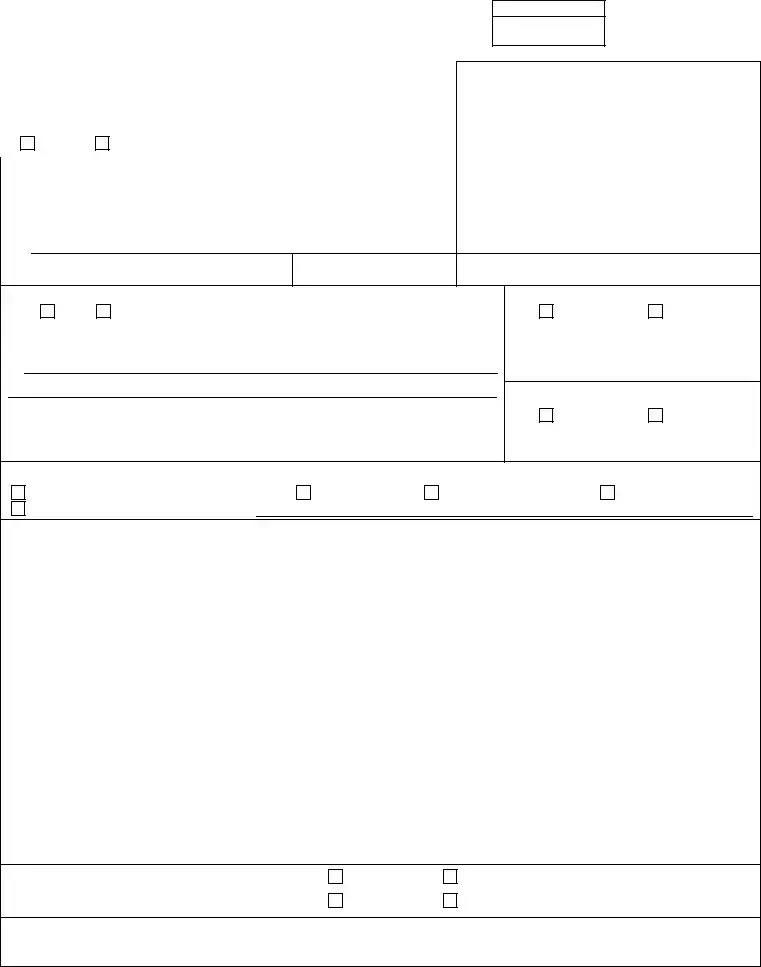
2823, Page 2
18. How many people will you employ who are subject to Michigan withholding?
19. Estimated annual Michigan gross receipts?
GROSS RECEIPTS are from (a) sales of inventory items, (b) rental or leases, (c) performance of services, interest, royalities, etc., to the extent they are derived from business activity.
20.Indicate IFTA jurisdictions in which you are currently licensed for IFTA (enter "none" if you have never been licensed for IFTA.)
21.Address where your records are available for audit purposes if different than address in item 6. Enter complete address.
Complete all information for each owner, partner, member or corporate officer. Attach a separate list if necessary.
22a. |
Name (Last, First, Middle, Jr./Sr./III) |
Home Telephone |
|
|
|
Business Title |
Date of Birth |
|
|
|
|
Residence Address (Number and Street or RR) |
Social Security Number |
|
|
|
|
City, State, ZIP |
Driver License/Michigan Identification |
|
|
|
|
22b. |
Name (Last, First, Middle, Jr./Sr./III) |
Home Telephone |
|
|
|
Business Title |
Date of Birth |
|
|
|
|
Residence Address (Number and Street or RR) |
Social Security Number |
|
|
|
|
City, State, ZIP |
Driver License/Michigan Identification |
|
|
|
|
Complete the following if your vehicles are involved in a lease agreement.
23a. Name of Lessor
23b. Name of Lessee
Address (Number and Street or RR)
Address (Number and Street or RR)
City, State, ZIP
City, State, ZIP
Telephone
Fax
Telephone
Fax
TERMS: The IFTA applicant agrees to comply with the timely reporting and payment of tax, record keeping, license display (copy in cab of each unit) and decal display requirements as specified in the International Fuel Tax Agreement. The applicant agrees to make their records available for audit in Michigan. If the applicant fails to do so, the applicant agrees to pay any costs incurred in obtaining and auditing their records. The applicant further agrees that Michigan may withhold any refunds due if the applicant is delinquent on payment of fuel taxes due any member jurisdiction. Failure to comply with any of the terms will be grounds for revocation of the license in all member jurisdictions.
The IFTA applicant further, specifically:
1.Agrees to maintain a record of fuel purchased and miles traveled within each jurisdiction by each vehicle, and
2.Agrees that Michigan may collect any delinquent taxes due under IFTA for IFTA member jurisdictions under authority of Michigan laws that provide for the collection of delinquent taxes.
3.Agrees to destroy all copies of licenses and decals and return unused decals to the Department in the event the
applicant discontinues business.
All applicants agree, under penalty of perjury, that the information given on this application is, to the best of his or her knowledge, true, accurate, and complete.
AUTHORIZATION
This form must be signed by an owner, partner, or corporate officer listed above or by an authorized agent. If signed by an authorized agent, a properly completed Power of Attorney Authorization (Form 151) must be attached to this application. A signature below indicates agreement to the above terms and other IFTA provisions.
Signature |
Date |
|
|
Print or Type Name and Title
NOTE: If you have delinquent IFTA returns your application will not be processed until the delinquent returns are filed and all tax due is paid.
Mail your application to:
Customer Contact Division – Special Taxes
Michigan Department of Treasury
P.O. Box 30474
Lansing, MI
If you have any questions, please contact the IFTA Section at

2823, Page 3
Instructions for Form 2823, International Fuel Tax
Agreement (IFTA) License Application
Complete this application only if you are a new Michigan IFTA applicant or if you are an IFTA licensee requesting additional fuel decals.
Renewal applications are
for processing this application.
New applicants must complete all sections of the IFTA application.
Applicants for additional decals need only complete lines 1, 2, 3, 6 and 17 plus sign and date the appli- cation.
GENERAL INFORMATION
IFTA credentials are required for all "Qualified Motor Vehicles" traveling in interstate commerce. A "Qualified Motor Vehicle" means a motor vehicle used, designed, or maintained for transportation of persons or property and:
1.having two axles and a gross vehicle weight or a registered gross vehicle weight exceeding 26,000 pounds;
2.having three or more axles regardless of weight;
or
3.used in combination when the weight of such combination exceeds 26,000 pounds gross vehicle weight or registered gross vehicle weight.
Exempt vehicles include recreational vehicles not used in any business endeavor and vehicles owned by the U.S. government.
IFTA requires motor carriers based in Michigan and operating qualifying vehicles in Michigan and at least one other IFTA jurisdiction to obtain a Michi- gan IFTA license and decals which will be honored in all IFTA jurisdictions. After licensing, the motor carrier will file with the State of Michigan one motor carrier fuel tax report which will reflect their operations in all IFTA jurisdictions. All states in the continental United States and most Canadian provinces are members of IFTA. The District of Columbia is not a member of IFTA.
Michigan is your base jurisdiction for IFTA licens- ing and reporting if you:
•Have an established place of business in Michi- gan from which motor carrier operations are performed;
•Maintain the operational control and operational records for qualified motor vehicles in Michigan or can make these records available in Michigan;
•Have one or more qualified motor vehicles based in Michigan for vehicle registration pur- poses (registered with the Michigan Secretary of State);
•Have one or more qualified motor vehicles which actually travel on Michigan roads; and
•Operate in at least one other IFTA jurisdiction.
If you have any questions, contact the IFTA Section at (517)
Line Instructions
Lines not listed here are explained on the form.
Line 1: Enter the license year for which you need IFTA credentials.
Line 2: Enter your federal employer identification number (FEIN) or your TR number issued by the Michigan Department of Treasury. If you do not have an FEIN or TR#, skip to Line 3.
Line 3: If you did not enter an FEIN on line 2, you must enter the Social Security number of a com- pany officer, owner or partner.
Line 4: Enter your United States Department of Transportation Number.
Line 5: If you are registered under the International Registration Plan (IRP), enter the number assigned to your company by the Michigan Secretary of State's Office.
Line 6: Enter the legal name and address of your business.

2823, Page 4
Line 7: Enter the name, business telephone and home telephone numbers of an individual in your organization we may contact if necessary. This person should be an officer, owner, partner or a representative with Power of Attorney.
Line 8: Enter the month and year you started operating qualifying vehicles in the State of Michi- gan.
Line 12: Check the box that best describes the ownership of your business.
Line 14: Explanation of certain fuel types are as follows:
Ethanol: Commonly called grain spirits or grain alcohol.
LNG: Liquified Natural Gas.
Methanol: Commonly called wood alcohol.
Biodiesel:A diesel fuel blend containing at least 5% biodiesel.
Indicate all fuel types consumed in your qualifying vehicles in the state of Michigan and any other IFTA jurisdictions in which you operate. Please check all that apply, even though that fuel type may not be regulated in the various jurisdictions in which you operate.
Line 15: Check the box to the left of every jurisdic- tion you will be operating in, even if that jurisdic- tion is not an IFTA member. All jurisdictions you check will appear on your IFTA return.
Line 16a: If you answer "Yes" be sure to complete the address information for the lessor and lessee on lines 23a and 23b.
Line 17: Enter the number of IFTA decal sets you will need for your fleet. Each of your power units which operate in two or more IFTA jurisdictions will need a decal set.
Lines 22a and 22b: Each new applicant must provide this information. Failure to provide the requested information may delay the processing of the application and the issuance of the license until such time as the information is received. Attach additional sheets if necessary. If information has changed since your original application you must update this information.
Lines 23a and 23b: If you answered "Yes" to question 16a, complete lines 23a and 23b.
Before you mail your application, review it care- fully, to ensure that it is complete. Allow 30 days for processing.
Once you are licensed as an IFTA carrier you are required to file quarterly IFTA tax returns. Returns are due on April 30th, July 31st, October 31st and January 31st.
A
Failure to file the required tax returns will be cause for revocation of your IFTA license.
If you have any questions, please write to:
Customer Contact Div., Special Taxes P. O. Box 30474
Lansing, MI
You may also reach us by phone at (517)
Michigan’s International Fuel Tax Agreement Information Manual (form 2838) is available on our Web site at www.michigan.gov/businesstaxes. Select the IFTA/Motor Carrier Taxes link. You may also obtain a copy by calling (517)
| Fact Name | Description |
|---|---|
| Form Purpose | The Michigan 2823 form is used to apply for an International Fuel Tax Agreement (IFTA) Fuel Tax License, allowing carriers to report fuel use across multiple jurisdictions. |
| Governing Law | This form is issued under Public Act 119 of 1980, as amended, which governs fuel tax licenses in Michigan. |
| Processing Time | Applicants should allow 30 days for processing after submitting the form to the Michigan Department of Treasury. |
| Required Information | Applicants must provide essential details such as the Federal Employer Identification Number (FEIN), U.S. DOT Number, and business ownership type. |
| Decal Requirements | Each qualifying vehicle operating in multiple jurisdictions requires a set of IFTA decals, which are serialized and non-transferable. |
| Audit Compliance | Applicants agree to make their records available for audit in Michigan and to maintain accurate records of fuel purchases and miles traveled. |
| Delinquent Returns | Applications will not be processed if the applicant has any delinquent IFTA returns. All taxes must be paid before processing. |
| Contact Information | For questions, applicants can contact the IFTA Section at (517) 636-4580 or visit the Michigan Department of Treasury website for more information. |
Completing the Michigan 2823 form is a necessary step for those seeking to apply for an IFTA Fuel Tax License. After filling out the form, it will need to be submitted to the Michigan Department of Treasury for processing. It’s important to ensure that all required sections are accurately completed to avoid any delays.
After completing all the necessary steps, review the form carefully for accuracy. Mail the application to the address provided on the form, and allow approximately 30 days for processing. Keep in mind that if there are any outstanding IFTA returns, the application will not be processed until those are resolved.
What is the Michigan 2823 form used for?
The Michigan 2823 form is the application for the International Fuel Tax Agreement (IFTA) Fuel Tax License. This license is required for motor carriers operating qualified vehicles in Michigan and at least one other IFTA jurisdiction. By completing this form, you can obtain the necessary credentials to report fuel taxes across multiple jurisdictions, ensuring compliance with state and federal regulations.
Who needs to complete the Michigan 2823 form?
Any motor carrier based in Michigan that operates qualifying vehicles in interstate commerce must complete this form. This includes businesses that maintain an established place of business in Michigan, have operational control over their vehicles, and travel in at least one other IFTA jurisdiction. If you are a new applicant or need additional decals, you must fill out this form.
How long does it take to process the application?
After submitting the Michigan 2823 form, you should allow 30 days for processing. It's crucial to ensure that all required information is accurately completed to avoid delays. If you have any outstanding IFTA returns or tax obligations, the processing of your application will be halted until those issues are resolved.
What information do I need to provide on the form?
The form requires various pieces of information, including your Federal Employer Identification Number (FEIN), Social Security Number, U.S. DOT Number, business name and address, and the type of fuel used in your vehicles. Additionally, you will need to indicate your business ownership type and provide details about your operations, such as the jurisdictions in which you operate and any bulk fuel storage you maintain.
What happens if I fail to file the required tax returns?
Failure to file the necessary quarterly IFTA tax returns can lead to the revocation of your IFTA license. It is essential to remain compliant with filing deadlines, which occur quarterly on April 30th, July 31st, October 31st, and January 31st. The Michigan Department of Treasury sends pre-identified returns each quarter, making it easier to stay on track.
How can I contact the Michigan Department of Treasury for assistance?
If you have questions or need assistance regarding the Michigan 2823 form or IFTA licensing, you can contact the IFTA Section at (517) 636-4580. For fax inquiries, use (517) 636-4593. If you are hearing or speech impaired, please call (517) 636-4999 (TTY). It is advisable to reach out promptly to ensure your application is processed without delays.
Failing to read the attached instructions before starting the application. This can lead to incomplete or incorrect submissions.
Incorrectly entering the Federal Employer Identification Number (FEIN) or TR Number. Ensure that this number is accurate to avoid delays.
Omitting the Social Security Number if no FEIN is provided. This information is necessary for processing.
Not providing a valid U.S. DOT Number. This number is essential for identification and compliance.
Failing to specify whether the application is for new decals or additional decals. This can lead to processing errors.
Neglecting to fill in the complete company or individual name. Missing this detail can result in application rejection.
Forgetting to include a contact person with their business and home telephone numbers. This information is crucial for communication.
Not indicating the month and year business operations began in Michigan. This date is important for licensing purposes.
Failing to disclose whether bulk fuel storage is maintained in Michigan. This can affect tax calculations and compliance.
Neglecting to sign and date the application. A missing signature can delay the processing of your application.
The Michigan Department of Treasury 2823 form is essential for obtaining an IFTA Fuel Tax License in Michigan. Alongside this form, several other documents are often required or helpful for completing the application process. Below is a list of these documents, each with a brief description.
Having these documents ready can streamline the application process for the Michigan IFTA Fuel Tax License. Ensuring all necessary paperwork is complete will help avoid delays and complications.
The Michigan 2823 form, which serves as the IFTA Fuel Tax License Application, shares similarities with several other important documents. Each of these documents plays a crucial role in various aspects of business operations, particularly in the transportation and fuel sectors. Below is a list of ten documents that are similar to the Michigan 2823 form, along with an explanation of how they relate:
Understanding these documents and their similarities to the Michigan 2823 form can help ensure that businesses remain compliant with various regulations and requirements. It is crucial to complete all necessary forms accurately and submit them on time to avoid potential penalties or delays in processing.
When filling out the Michigan 2823 form, it is crucial to adhere to specific guidelines to ensure a smooth application process. Here are eight important do's and don'ts to consider:
Understanding the Michigan 2823 form is crucial for anyone involved in interstate commerce with qualifying vehicles. However, several misconceptions can lead to confusion. Here are four common misunderstandings:
Filling out the Michigan 2823 form is a critical step for obtaining an IFTA Fuel Tax License. Understanding the requirements and processes involved can help ensure a smooth application experience.
Completing the Michigan 2823 form accurately is essential for maintaining compliance with fuel tax regulations. Review your application thoroughly before submission to prevent any processing delays.