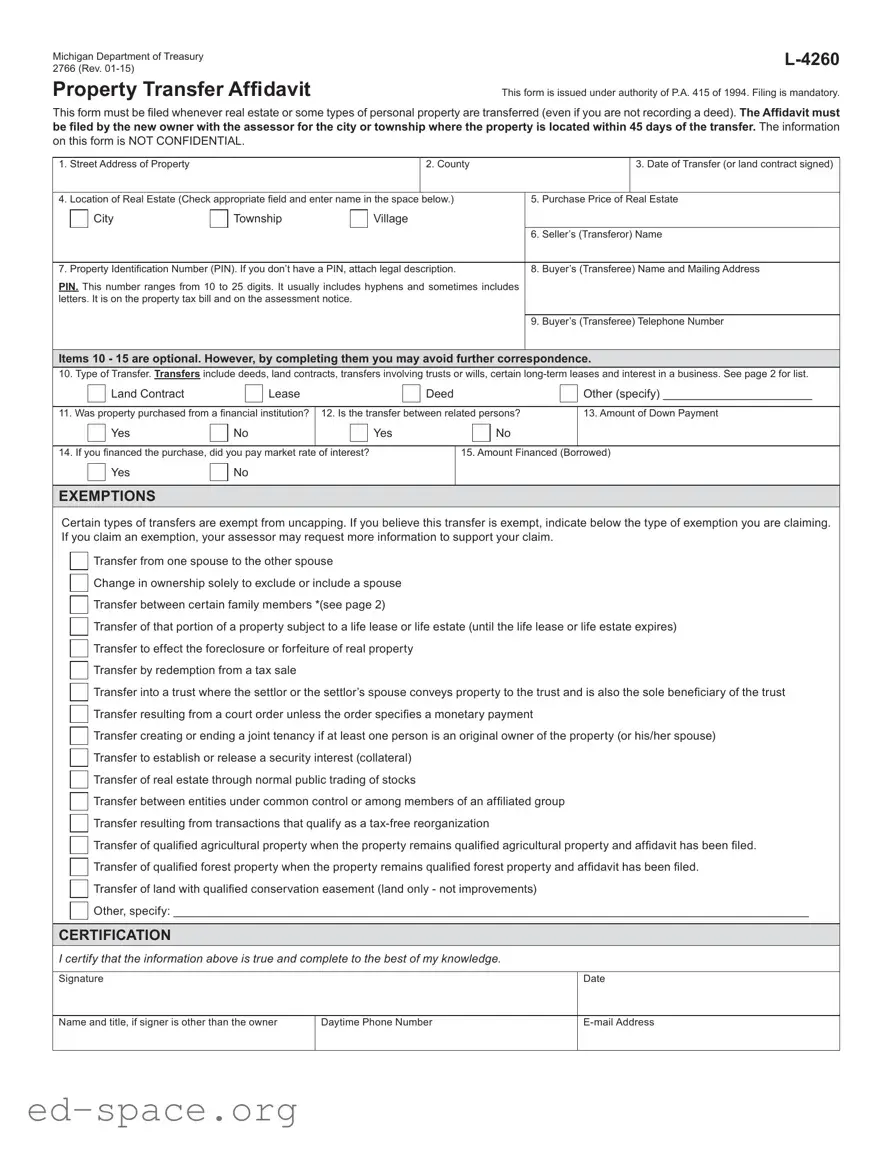
The Michigan 2766 form, officially known as the Property Transfer Affidavit, plays a crucial role in the real estate transaction process within the state. This form is required whenever real estate or certain types of personal property change hands, regardless of whether a deed is being recorded. New owners must file the affidavit with the local assessor's office within 45 days of the transfer. Key details included on the form are the property’s street address, county, date of transfer, purchase price, and the names of both the seller and buyer. Additionally, the form requires the Property Identification Number (PIN), which is essential for tax purposes. While some sections are optional, providing additional information can help streamline the process and reduce future correspondence with local authorities. The form also outlines various exemptions that may apply to certain transfers, such as those between family members or transfers involving trusts. Understanding the requirements and implications of the Michigan 2766 form is vital for anyone involved in real estate transactions in Michigan, as failing to file correctly can lead to penalties and complications in property tax assessments.

Michigan Department of Treasury |
|
2766 (Rev. |
|
Property Transfer Afidavit
This form is issued under authority of P.A. 415 of 1994. Filing is mandatory.
This form must be iled whenever real estate or some types of personal property are transferred (even if you are not recording a deed). The Afidavit must be iled by the new owner with the assessor for the city or township where the property is located within 45 days of the transfer. The information
on this form is NOT CONFIDENTIAL.
1. |
Street Address of Property |
|
|
|
|
2. County |
|
|
3. Date of Transfer (or land contract signed) |
|
|
|
|
|
|
|
|
|
|
|
|
4. |
Location of Real Estate (Check appropriate ield and enter name in the space |
below.) |
5. |
Purchase Price of Real Estate |
||||||
|
|
City |
|
Township |
|
Village |
|
|
|
|
|
|
|
|
|
|
|
||||
|
|
|
|
|
|
|
|
6. |
Seller’s (Transferor) Name |
|
|
|
|
|
|
|
|
|
|
|
|
7. |
Property Identiication Number (PIN). If you don’t have a PIN, attach legal description. |
8. |
Buyer’s (Transferee) Name and Mailing Address |
|||||||
PIN. This number ranges from 10 to 25 digits. It usually includes hyphens and sometimes includes |
|
|
|
|||||||
letters. It is on the property tax bill and on the assessment notice. |
|
|
|
|
|
|||||
|
|
|
|
|
|
|
|
|
|
|
|
|
|
|
|
|
|
|
9. |
Buyer’s (Transferee) Telephone Number |
|
|
|
|
|
|
|
|
|
|
|
|
Items 10 - 15 are optional. However, by completing them you may avoid further correspondence.
10.Type of Transfer. TRANSFERS include deeds, land contracts, transfers involving trusts or wills, certain
|
|
Land Contract |
|
|
|
Lease |
|
|
|
|
Deed |
|
Other (specify) _______________________ |
|||
|
|
|
|
|
|
|
|
|
|
|
||||||
|
|
|
|
|
||||||||||||
11. Was property purchased from a inancial institution? |
12. Is the transfer between related persons? |
|
13. Amount of Down Payment |
|||||||||||||
|
|
Yes |
|
No |
|
|
Yes |
|
|
|
|
No |
|
|
||
|
|
|
|
|
|
|
|
|
|
|
||||||
|
|
|
|
|
|
|
|
|
|
|
|
|
|
|
|
|
|
|
|
|
|
|
|||||||||||
14. If you inanced the purchase, did you pay market rate |
of interest? |
|
|
15. Amount Financed (Borrowed) |
||||||||||||
|
|
Yes |
|
No |
|
|
|
|
|
|
|
|
|
|
||
|
|
|
|
|
|
|
|
|
|
|
|
|
||||
|
|
|
|
|
|
|
|
|
|
|
|
|
|
|
|
|
|
|
|
|
|
|
|
|
|
|
|
|
|
|
|
|
|
EXEMPTIONS
Certain types of transfers are exempt from uncapping. If you believe this transfer is exempt, indicate below the type of exemption you are claiming. If you claim an exemption, your assessor may request more information to support your claim.
Transfer from one spouse to the other spouse
Change in ownership solely to exclude or include a spouse
Transfer between certain family members *(see page 2)
Transfer of that portion of a property subject to a life lease or life estate (until the life lease or life estate expires)
Transfer to effect the foreclosure or forfeiture of real property
Transfer by redemption from a tax sale
Transfer into a trust where the settlor or the settlor’s spouse conveys property to the trust and is also the sole beneiciary of the trust Transfer resulting from a court order unless the order speciies a monetary payment
Transfer creating or ending a joint tenancy if at least one person is an original owner of the property (or his/her spouse)
Transfer to establish or release a security interest (collateral)
Transfer of real estate through normal public trading of stocks
Transfer between entities under common control or among members of an afiliated group Transfer resulting from transactions that qualify as a
Transfer of qualiied agricultural property when the property remains qualiied agricultural property and afidavit has been iled. Transfer of qualiied forest property when the property remains qualiied forest property and afidavit has been iled.
Transfer of land with qualiied conservation easement (land only - not improvements)
Other, specify: __________________________________________________________________________________________________
CERTIFICATION
I certify that the information above is true and complete to the best of my knowledge.
Signature
Date
Name and title, if signer is other than the owner
Daytime Phone Number
2766, Page 2
Instructions:
This form must be iled when there is a transfer of real property or one of the following types of personal property:
•Buildings on leased land.
•Leasehold improvements, as deined in MCL Section 211.8(h).
•Leasehold estates, as deined in MCL Section 211.8(i) and (j).
Transfer of ownership means the conveyance of title to or a present interest in property, including the beneicial use of the property. For complete descriptions of qualifying transfers, please refer to MCL Section
Excerpts from Michigan Compiled Laws (MCL), Chapter 211
*Section 211.27a(7)(t): Beginning December 31, 2014, a transfer of residential real property if the transferee is the transferor’s or the transferor’s spouse’s mother, father, brother, sister, son, daughter, adopted son, adopted daughter, grandson, or granddaughter and the residential real property is not used for any commercial purpose following the conveyance. Upon request by the department of treasury or the assessor, the transferee shall furnish proof within 30 days that the transferee meets the requirements of this subparagraph. If a transferee fails to comply with a request by the department of treasury or assessor under this subparagraph, that transferee is subject to a ine of $200.00.
Section 211.27a(10): “... the buyer, grantee, or other transferee of the property shall notify the appropriate assessing ofice in the local unit of government in which the property is located of the transfer of ownership of the property within 45 days of the transfer of ownership, on a form prescribed by the state tax commission that states the parties to the transfer, the date of the transfer, the actual consideration for the transfer, and the property’s parcel identiication number or legal description.”
Section 211.27(5): “Except as otherwise provided in subsection (6), the purchase price paid in a transfer of property
is not the presumptive true cash value of the property transferred. In determining the true cash value of transferred property, an assessing oficer shall assess that property using the same valuation method used to value all other property of that same classiication in the assessing jurisdiction.”
Penalties:
Section 211.27b(1): “If the buyer, grantee, or other transferee in the immediately preceding transfer of ownership of property does not notify the appropriate assessing ofice as required by section 27a(10), the property’s taxable value shall be adjusted under section 27a(3) and all of the following shall be levied:
(a)Any additional taxes that would have been levied if the transfer of ownership had been recorded as required under this act from the date of transfer.
(b)Interest and penalty from the date the tax would have been originally levied.
(c)For property classiied under section 34c as either industrial real property or commercial real property, a penalty in the following amount:
(i)Except as otherwise provided in subparagraph (ii), if the sale price of the property transferred is $100,000,000.00 or less, $20.00 per day for each separate failure beginning after the 45 days have elapsed, up to a maximum of $1,000.00.
(ii)If the sale price of the property transferred is more than $100,000,000.00, $20,000.00 after the 45 days have elapsed.
(d)For real property other than real property classiied under section 34c as industrial real property or commercial real property, a penalty of $5.00 per day for each separate failure beginning after the 45 days have elapsed, up to a maximum of $200.00.
| Fact Name | Description |
|---|---|
| Form Purpose | The Michigan 2766 form is used to report the transfer of real estate or certain personal property. |
| Governing Law | This form is issued under the authority of Public Act 415 of 1994. |
| Filing Requirement | Filing the form is mandatory within 45 days of the property transfer. |
| Confidentiality | The information provided on the form is not confidential and may be accessible to the public. |
| Transfer Types | The form accommodates various types of transfers, including deeds, land contracts, and transfers involving trusts. |
| Optional Information | Items 10 to 15 on the form are optional but can help avoid further correspondence with the assessor. |
Completing the Michigan 2766 form is an important step when transferring real estate or certain personal property. After filling out the form, it must be submitted to the local assessor's office within 45 days of the property transfer. This ensures compliance with state regulations and helps avoid potential penalties.
What is the Michigan 2766 form?
The Michigan 2766 form, also known as the Property Transfer Affidavit, is a document required by the Michigan Department of Treasury. It must be filed whenever real estate or certain types of personal property are transferred. This includes situations where a deed is not being recorded. The form captures essential information about the transfer and must be submitted to the local assessor within 45 days of the transfer date.
Who is required to file the Michigan 2766 form?
The new owner of the property, also known as the transferee, is responsible for filing the Michigan 2766 form. If you have recently acquired property, it is your duty to complete and submit this form to the city or township assessor. Failure to do so may result in penalties.
What information is needed to complete the form?
To fill out the Michigan 2766 form, you will need to provide several key details. This includes the street address of the property, the county, the date of the transfer, the purchase price, and the names and contact information of both the seller and buyer. Additionally, if available, you should include the Property Identification Number (PIN) associated with the property.
What happens if I don’t file the form on time?
If you fail to file the Michigan 2766 form within the required 45-day period, your property’s taxable value may be adjusted. This can lead to additional taxes, interest, and penalties. The penalties can accumulate daily, so timely filing is crucial to avoid unnecessary costs.
Are there exemptions available when filing this form?
Yes, certain transfers may qualify for exemptions from uncapping. Common exemptions include transfers between spouses, transfers due to court orders, and transfers involving family members under specific conditions. If you believe your transfer qualifies for an exemption, be sure to indicate this on the form and be prepared to provide supporting documentation if requested by the assessor.
What types of transfers require this form?
The Michigan 2766 form is required for various types of transfers, including deeds, land contracts, and transfers involving trusts or wills. It also applies to leasehold estates and certain personal property like buildings on leased land. If you're unsure whether your transfer qualifies, it’s best to consult the instructions provided with the form or seek guidance from a professional.
Can I submit the form electronically?
Currently, the Michigan 2766 form must be submitted in a paper format to the local assessor's office. It is advisable to check with your local assessor for any specific submission guidelines or updates regarding electronic filing options, as processes may vary by jurisdiction.
What if I need assistance filling out the form?
If you need help completing the Michigan 2766 form, consider reaching out to a real estate professional or a legal expert. They can provide guidance on the required information and ensure that the form is filled out accurately. Additionally, local assessors' offices may offer resources or assistance for property owners needing help with the filing process.
Incomplete Information: Failing to provide all required details, such as the street address, county, or date of transfer, can lead to processing delays.
Incorrect Purchase Price: Entering an inaccurate purchase price can result in tax implications and potential penalties.
Missing Property Identification Number (PIN): Not including the PIN or failing to attach a legal description when the PIN is unavailable can complicate the transfer process.
Neglecting Optional Sections: Skipping optional items, such as the buyer's telephone number or type of transfer, may lead to unnecessary follow-up inquiries from the assessor.
Failure to Sign: Not signing the affidavit can render the form invalid, preventing proper processing of the transfer.
Incorrect Exemption Claims: Misunderstanding or incorrectly stating exemption types can result in the assessor requesting additional documentation.
Ignoring Filing Deadline: Submitting the form after the 45-day deadline can lead to penalties and interest on unpaid taxes.
Omitting Contact Information: Not providing a daytime phone number or email address can hinder communication with the assessor's office if questions arise.
The Michigan 2766 form, known as the Property Transfer Affidavit, is essential for reporting real estate transfers. Alongside this form, several other documents may be required to ensure compliance with local regulations. Below is a list of related forms and documents that are commonly used during property transactions in Michigan.
Each of these documents plays a significant role in the property transfer process. Ensuring that you have the correct forms can help prevent delays and complications during the transaction. Always consult with a professional if you have questions about specific requirements or procedures.
The Michigan 2766 form, known as the Property Transfer Affidavit, serves a critical function in the transfer of real estate and certain personal property. Several other documents share similarities with this form in terms of purpose and requirements. Here are five such documents:
When filling out the Michigan 2766 form, it's essential to be thorough and accurate. Here are some important dos and don'ts to keep in mind:
Misconceptions about the Michigan 2766 form can lead to confusion and potential penalties. Below are eight common misunderstandings along with clarifications.
The Michigan 2766 form is essential for property transfers. Here are key takeaways to keep in mind:
Understanding these points can help ensure compliance and avoid unnecessary complications during property transfers in Michigan.