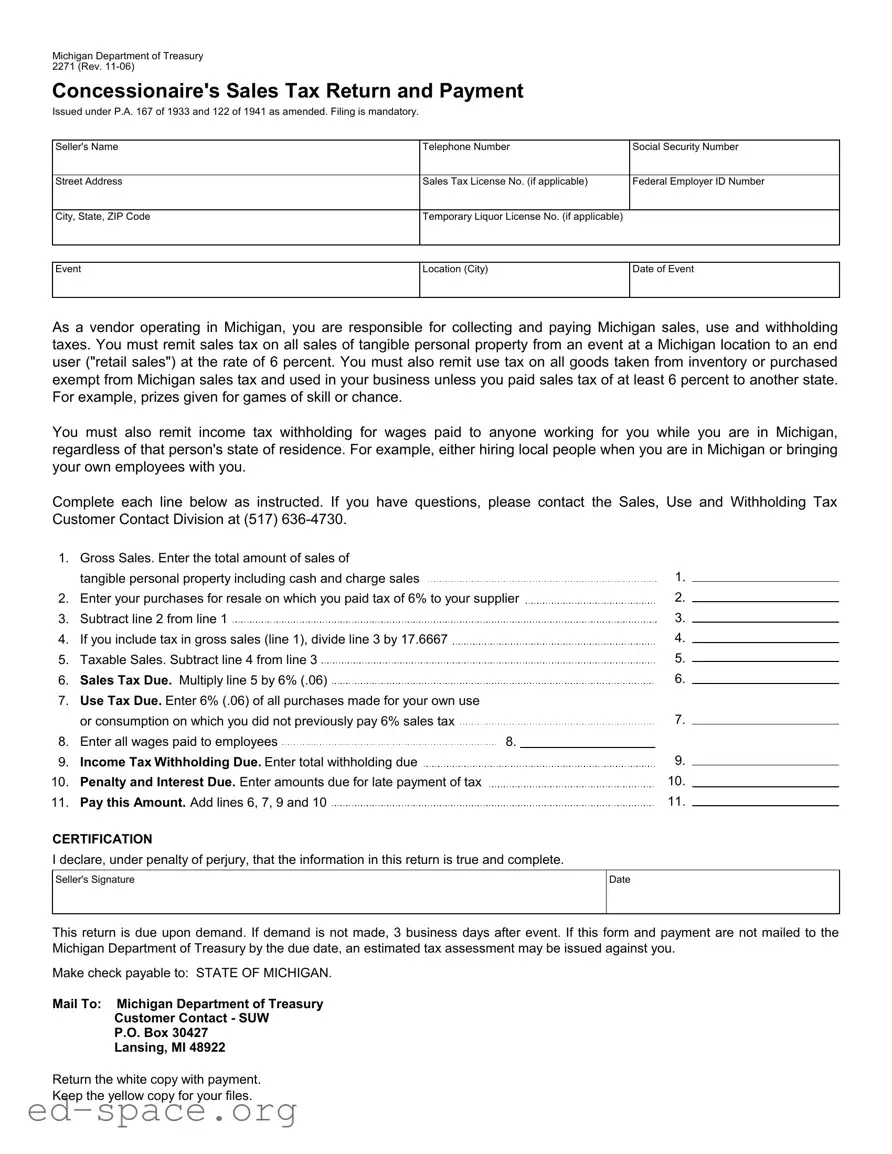
The Michigan Department of Treasury Form 2271, known as the Concessionaire's Sales Tax Return and Payment, plays a crucial role for vendors operating within the state. This form is mandatory for all sellers who engage in retail sales of tangible personal property at events in Michigan. It requires detailed information, including the seller's name, contact information, and relevant tax identification numbers. Vendors must report their gross sales, taxable sales, and calculate the sales tax due at a rate of 6 percent. Additionally, the form addresses use tax on goods taken from inventory for business use and mandates income tax withholding for wages paid to employees, regardless of their state of residence. Each section of the form must be completed accurately to ensure compliance with state tax laws. Failure to submit the form and payment by the deadline can result in penalties and interest charges. The form also includes a certification statement, affirming the truthfulness of the information provided, which must be signed and dated by the seller. Understanding the requirements and proper completion of Form 2271 is essential for vendors to avoid potential tax liabilities and ensure smooth operations during their events.

Michigan Department of Treasury 2271 (Rev.
Concessionaire's Sales Tax Return and Payment
Issued under P.A. 167 of 1933 and 122 of 1941 as amended. Filing is mandatory.
Seller's Name |
Telephone Number |
Social Security Number |
|
|
|
Street Address |
Sales Tax License No. (if applicable) |
Federal Employer ID Number |
|
|
|
City, State, ZIP Code |
Temporary Liquor License No. (if applicable) |
|
|
|
|
Event
Location (City)
Date of Event
As a vendor operating in Michigan, you are responsible for collecting and paying Michigan sales, use and withholding taxes. You must remit sales tax on all sales of tangible personal property from an event at a Michigan location to an end user ("retail sales") at the rate of 6 percent. You must also remit use tax on all goods taken from inventory or purchased exempt from Michigan sales tax and used in your business unless you paid sales tax of at least 6 percent to another state. For example, prizes given for games of skill or chance.
You must also remit income tax withholding for wages paid to anyone working for you while you are in Michigan, regardless of that person's state of residence. For example, either hiring local people when you are in Michigan or bringing your own employees with you.
Complete each line below as instructed. If you have questions, please contact the Sales, Use and Withholding Tax Customer Contact Division at (517)
1.Gross Sales. Enter the total amount of sales of
tangible personal property including cash and charge sales
2.Enter your purchases for resale on which you paid tax of 6% to your supplier
3.Subtract line 2 from line 1
4.If you include tax in gross sales (line 1), divide line 3 by 17.6667
5.Taxable Sales. Subtract line 4 from line 3
6.Sales Tax Due. Multiply line 5 by 6% (.06)
7.Use Tax Due. Enter 6% (.06) of all purchases made for your own use or consumption on which you did not previously pay 6% sales tax
8. Enter all wages paid to employees |
8. |
9.Income Tax Withholding Due. Enter total withholding due
10.Penalty and Interest Due. Enter amounts due for late payment of tax
11.Pay this Amount. Add lines 6, 7, 9 and 10
CERTIFICATION
I declare, under penalty of perjury, that the information in this return is true and complete.
1.
2.
3.
4.
5.
6.
7.
9.
10.
11.
Seller's Signature
Date
This return is due upon demand. If demand is not made, 3 business days after event. If this form and payment are not mailed to the Michigan Department of Treasury by the due date, an estimated tax assessment may be issued against you.
Make check payable to: STATE OF MICHIGAN.
Mail To: Michigan Department of Treasury
Customer Contact - SUW
P.O. Box 30427
Lansing, MI 48922
Return the white copy with payment.
Keep the yellow copy for your files.

Sales Tax Collection
Retailers are required to remit a 6% sales tax on their taxable retail sales to the State of Michigan. Effective January 1, 2006, a retailer must calculate the amount of sales tax to collect by using the following rounding formula.
To determine the amount of tax to remit, compute the tax to the third decimal place and round up to a whole cent when the third decimal place is greater than four, or down to a whole cent when the third decimal point is four or less.
How to Compute Withholding
To calculate tax amounts to withhold, employers may use a direct percentage computation (example shown below) or use the Michigan Income Tax Withholding Table. This table is found in Form 446, Michigan Income Tax Withholding Guide. Additional information regarding sales, use and withholding taxes, as well as Form 446 and the income tax withholding tables, is available by visiting the Michigan Treasury Web site www.michigan.gov/businesstaxes.
|
2007 |
2006 |
Payroll Period |
Allowance per Exemption |
Allowance per Exemption |
Per Day |
9.32 |
$9.04 |
Weekly |
65.38 |
$63.46 |
Withholding Formula
[Compensation - (allowance per exemption x number of exemptions)] x Calendar Year's Withholding Tax Rate. Example: An employee with 3 exemptions earns $600/week in 2007 - the 2007 withholding tax rate is 3.9%.
The Direct Percentage Calculation is:
[$600 - ($65.38 x 3)] x 3.9% = Amount to withhold [$600 - $196.14] x .039 = $15.75
How to Compute Penalty and Interest
If a return is not filed or tax is not paid within three days of your event, you must include penalty and interest with your payment. Penalty is 5% of the tax due. Penalty increases by an additional 5% per month or fraction thereof, after the second month, to a maximum of 25%. Interest is charged daily using the average prime rate, plus 1 percent.
You may refer to our Web site for current interest rate information, or help in calculating late payment fees.
www.michigan.gov/treasury
| Fact Name | Details |
|---|---|
| Form Purpose | The Michigan 2271 form is used for reporting sales tax and making payments related to concession sales. |
| Governing Laws | This form is issued under Public Acts 167 of 1933 and 122 of 1941, as amended. |
| Filing Requirement | Filing the Michigan 2271 form is mandatory for vendors operating in Michigan. |
| Sales Tax Rate | Vendors must collect and remit a sales tax of 6% on all retail sales of tangible personal property. |
| Income Tax Withholding | Employers must withhold income tax for wages paid to employees working in Michigan. |
| Late Payment Penalties | Failure to file or pay taxes on time incurs penalties of 5% of the tax due, increasing monthly up to 25%. |
After gathering the necessary information, you can proceed to fill out the Michigan 2271 form. Follow these steps carefully to ensure accurate completion.
Once the form is completed, it should be mailed to the Michigan Department of Treasury. Make sure to send it along with your payment by the due date to avoid any penalties or interest charges.
What is the Michigan 2271 form?
The Michigan 2271 form, also known as the Concessionaire's Sales Tax Return and Payment, is a mandatory document issued by the Michigan Department of Treasury. It is required for vendors operating in Michigan to report and pay sales, use, and withholding taxes on sales of tangible personal property made at events within the state. This form ensures compliance with state tax laws and helps maintain accurate tax records.
Who needs to file the Michigan 2271 form?
Any vendor or concessionaire selling tangible personal property at events in Michigan must file the Michigan 2271 form. This includes individuals or businesses that sell items directly to consumers, whether at fairs, festivals, or other events. If you collect sales tax from customers, you are required to report and remit those taxes using this form.
What information is required to complete the form?
The form requires various details, including the seller's name, contact information, Social Security number, and sales tax license number, if applicable. You will also need to provide information about gross sales, purchases for resale, taxable sales, and wages paid to employees. Accurate reporting of these figures is essential to ensure compliance and avoid penalties.
What is the sales tax rate applied in Michigan?
The sales tax rate in Michigan is 6 percent. This rate applies to all retail sales of tangible personal property made by vendors during events. It is important to calculate the correct amount of sales tax to collect from customers and report on the Michigan 2271 form to avoid discrepancies and potential penalties.
What happens if the form is not filed on time?
If the Michigan 2271 form is not filed by the due date, which is typically three business days after the event, an estimated tax assessment may be issued against the vendor. Additionally, late filings may incur penalties and interest. The penalty starts at 5 percent of the tax due and can increase by an additional 5 percent per month, up to a maximum of 25 percent. Interest is charged daily based on the average prime rate plus one percent.
How do I calculate the sales tax due on my sales?
To calculate the sales tax due, first determine your taxable sales by subtracting any purchases for resale from your gross sales. Then, multiply the taxable sales amount by 6 percent. If you include tax in your gross sales, you will need to use a specific formula to adjust your calculations. It’s important to ensure accuracy to avoid underpayment or overpayment of taxes.
Where should I send the completed form and payment?
Once you have completed the Michigan 2271 form, you should mail it along with your payment to the Michigan Department of Treasury. The address is: Customer Contact - SUW, P.O. Box 30427, Lansing, MI 48922. Ensure that you send the white copy of the form with your payment and keep the yellow copy for your records.
Where can I find additional resources or assistance regarding the Michigan 2271 form?
For more information about the Michigan 2271 form, sales tax, and other related topics, you can visit the Michigan Treasury website at www.michigan.gov/businesstaxes. If you have specific questions or need assistance, you can also contact the Sales, Use and Withholding Tax Customer Contact Division at (517) 636-4730 for further support.
Missing Information: Failing to fill in all required fields, such as the Seller's Name or Sales Tax License Number, can lead to processing delays.
Incorrect Calculations: Errors in calculating gross sales or taxable sales can result in underpayment or overpayment of taxes.
Neglecting to Sign: Forgetting to sign the form means it will not be considered valid, potentially leading to penalties.
Wrong Tax Rate: Using an incorrect tax rate can cause discrepancies. Always use the current rate of 6% for Michigan sales tax.
Not Keeping Copies: Failing to retain a copy of the submitted form can create issues if questions arise later.
Late Submission: Sending the form after the due date can result in penalties and interest. Timely submission is crucial.
Ignoring Instructions: Not following the instructions for each line can lead to mistakes. Always read the guidelines carefully before completing the form.
When engaging in business activities in Michigan, particularly as a vendor, it is essential to be aware of various forms and documents that may accompany the Michigan 2271 form. Each of these documents serves a specific purpose in ensuring compliance with state tax regulations and facilitating smooth business operations. Below is a list of commonly used forms that are often associated with the Michigan 2271 form.
Understanding these additional forms and documents can help vendors navigate the complexities of tax compliance in Michigan. Each form plays a vital role in ensuring that businesses operate legally and efficiently, thereby minimizing the risk of penalties or issues with tax authorities. It is advisable to consult with a tax professional or legal advisor to ensure full compliance with all applicable laws and regulations.
The Michigan 2271 form is a specific document used for reporting sales tax for concessionaires. Several other documents serve similar purposes in various contexts. Here are five documents that share similarities with the Michigan 2271 form:
When filling out the Michigan 2271 form, it is important to follow certain guidelines to ensure accuracy and compliance. Here are four things you should do and should not do:
Misconceptions about the Michigan 2271 form can lead to confusion and potential compliance issues. Here are seven common misconceptions, along with clarifications:
Understanding these misconceptions is crucial for compliance and successful operation as a vendor in Michigan. Ensure that you are informed and prepared to meet all requirements associated with the Michigan 2271 form.
Filing is Mandatory: Completing the Michigan 2271 form is not optional. All vendors operating in Michigan must file this return to comply with state tax laws.
Accurate Information is Crucial: Ensure that all personal and business details, such as your name, address, and tax identification numbers, are filled out correctly. Errors can lead to delays or penalties.
Sales Tax Rate: The sales tax rate in Michigan is 6%. This applies to all sales of tangible personal property made at events within the state.
Calculating Taxable Sales: You must subtract any purchases made for resale from your gross sales to determine your taxable sales. This calculation is essential for accurate tax reporting.
Income Tax Withholding: If you pay wages to employees while in Michigan, you are responsible for withholding state income tax from their paychecks, regardless of where the employees are from.
Late Payment Consequences: If the form and payment are not submitted by the due date, you may incur penalties and interest. The penalty starts at 5% of the tax due and can increase over time.
Keep Copies: After submitting the form, retain the yellow copy for your records. This will serve as proof of your filing and payment.