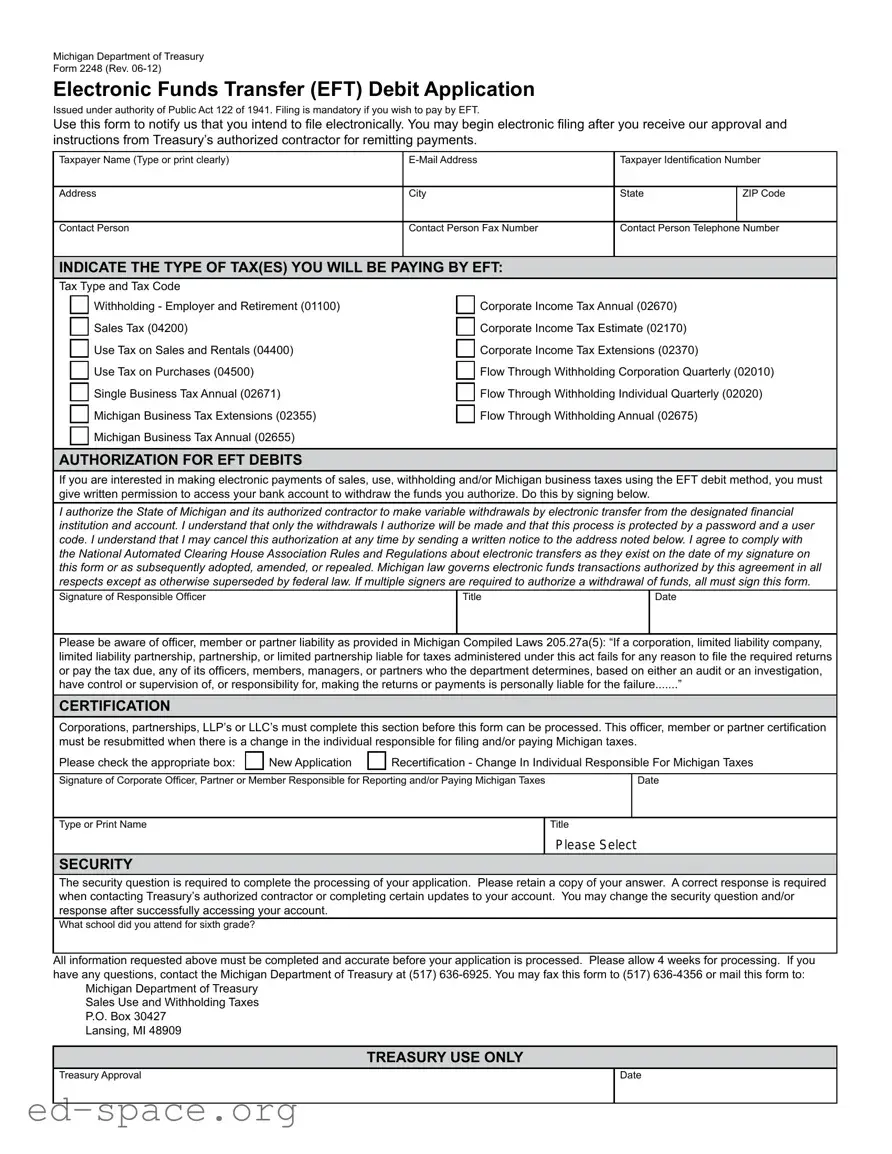
The Michigan 2248 form is an essential document for taxpayers wishing to pay their taxes electronically through the Electronic Funds Transfer (EFT) system. This form, issued by the Michigan Department of Treasury, serves as a notification that the taxpayer intends to file electronically and is required to initiate the EFT payment process. By completing this form, taxpayers provide important information such as their name, identification number, and contact details, while also indicating the specific types of taxes they plan to pay electronically, including sales tax, use tax, and various business taxes. It is crucial to understand that filing this form is mandatory for those opting to pay by EFT, and approval must be obtained from the Treasury’s authorized contractor before electronic filing can commence. The form also includes an authorization section, where taxpayers grant permission for the state to withdraw funds directly from their bank accounts, ensuring that only authorized transactions take place. Additionally, the form addresses officer liability, requiring corporate officers or partners to certify their responsibility for tax payments. As a final note, completing the Michigan 2248 form accurately and submitting it in a timely manner is vital, as processing may take up to four weeks, and any errors could delay the ability to make electronic payments.
Michigan Department of Treasury
Form 2248 (Rev.
Electronic Funds Transfer (EFT) Debit Application
Issued under authority of Public Act 122 of 1941. Filing is mandatory if you wish to pay by EFT.
Use this form to notify us that you intend to file electronically. You may begin electronic filing after you receive our approval and
instructions from Treasury’s authorized contractor for remitting payments.
Taxpayer Name (Type or print clearly)
Taxpayer Identification Number
Address
City
State
ZIP Code
Contact Person
Contact Person Fax Number
Contact Person Telephone Number
INDICATE THE TYPE OF TAX(ES) YOU WILL BE PAYING BY EFT:
Tax Type and Tax Code
Withholding - Employer and Retirement (01100)
Sales Tax (04200)
Use Tax on Sales and Rentals (04400)
Use Tax on Purchases (04500)
Single Business Tax Annual (02671)
Michigan Business Tax Extensions (02355)
Michigan Business Tax Annual (02655)
Corporate Income Tax Annual (02670)
Corporate Income Tax Estimate (02170)
Corporate Income Tax Extensions (02370)
Flow Through Withholding Corporation Quarterly (02010)
Flow Through Withholding Individual Quarterly (02020)
Flow Through Withholding Annual (02675)
AUTHORIZATION FOR EFT DEBITS
If you are interested in making electronic payments of sales, use, withholding and/or Michigan business taxes using the EFT debit method, you must give written permission to access your bank account to withdraw the funds you authorize. Do this by signing below.
I authorize the State of Michigan and its authorized contractor to make variable withdrawals by electronic transfer from the designated financial institution and account. I understand that only the withdrawals I authorize will be made and that this process is protected by a password and a user code. I understand that I may cancel this authorization at any time by sending a written notice to the address noted below. I agree to comply with the National Automated Clearing House Association Rules and Regulations about electronic transfers as they exist on the date of my signature on this form or as subsequently adopted, amended, or repealed. Michigan law governs electronic funds transactions authorized by this agreement in all respects except as otherwise superseded by federal law. If multiple signers are required to authorize a withdrawal of funds, all must sign this form.
Signature of Responsible Officer
Title
Date
Please be aware of officer, member or partner liability as provided in Michigan Compiled Laws 205.27a(5): “If a corporation, limited liability company, limited liability partnership, partnership, or limited partnership liable for taxes administered under this act fails for any reason to file the required returns or pay the tax due, any of its officers, members, managers, or partners who the department determines, based on either an audit or an investigation,
have control or supervision of, or responsibility for, making the returns or payments is personally liable for the failure |
” |
CERTIFICATION
Corporations, partnerships, LLP’s or LLC’s must complete this section before this form can be processed. This officer, member or partner certification must be resubmitted when there is a change in the individual responsible for filing and/or paying Michigan taxes.
Please check the appropriate box:
New Application
Recertification - Change In Individual Responsible For Michigan Taxes
Signature of Corporate Officer, Partner or Member Responsible for Reporting and/or Paying Michigan Taxes
Date
Type or Print Name
SECURITY
Title
Please Select
The security question is required to complete the processing of your application. Please retain a copy of your answer. A correct response is required when contacting Treasury’s authorized contractor or completing certain updates to your account. You may change the security question and/or
response after successfully accessing your account.
What school did you attend for sixth grade?
All information requested above must be completed and accurate before your application is processed. Please allow 4 weeks for processing. If you have any questions, contact the Michigan Department of Treasury at (517)
Michigan Department of Treasury
Sales Use and Withholding Taxes
P.O. Box 30427
Lansing, MI 48909
TREASURY USE ONLY
Treasury Approval
Date
| Fact Name | Description |
|---|---|
| Form Purpose | The Michigan 2248 form is used for Electronic Funds Transfer (EFT) Debit Application, allowing taxpayers to notify the Department of Treasury about their intention to file electronically. |
| Mandatory Filing | Filing this form is mandatory for taxpayers who wish to make payments via EFT. Approval and instructions must be received from the Treasury's authorized contractor before electronic filing can begin. |
| Governing Law | This form is issued under the authority of Public Act 122 of 1941. Michigan law governs all electronic funds transactions authorized by this agreement, except where federal law supersedes. |
| Liability Notice | Officers, members, or partners may be personally liable for any failure to file returns or pay taxes as outlined in Michigan Compiled Laws 205.27a(5). |
Filling out the Michigan 2248 form is a crucial step for those who wish to make electronic payments of certain taxes. After submitting the form, you will await approval and instructions from the Michigan Department of Treasury's authorized contractor. This process ensures that you can efficiently manage your tax payments electronically.
After submission, allow up to four weeks for processing. If you have questions during this period, you can reach out to the Michigan Department of Treasury for assistance.
What is the Michigan 2248 form?
The Michigan 2248 form is an application used to authorize electronic funds transfer (EFT) debit payments for various taxes. It is mandatory for taxpayers who wish to pay their taxes electronically. By filling out this form, you notify the Michigan Department of Treasury of your intent to file electronically.
Who needs to fill out the Michigan 2248 form?
What types of taxes can I pay using the Michigan 2248 form?
The form covers a variety of tax types, including employer withholding, sales tax, use tax on sales and rentals, single business tax, and corporate income tax, among others. You will need to indicate the specific tax type you intend to pay electronically when filling out the form.
What happens after I submit the Michigan 2248 form?
Once you submit the form, the Michigan Department of Treasury will review it. You will receive approval and further instructions from the Treasury’s authorized contractor. Only after receiving this approval can you begin making electronic payments.
Can I cancel my authorization for EFT debits?
Yes, you can cancel your authorization at any time. To do this, you must send a written notice to the address provided on the form. It’s important to ensure that you follow the proper procedure to avoid any issues with your tax payments.
What is the significance of the certification section on the form?
The certification section must be completed by corporations, partnerships, limited liability companies, and limited liability partnerships. This ensures that the individual responsible for filing and paying taxes is officially recognized. If there is a change in this individual, a new certification must be submitted.
How long does it take to process the Michigan 2248 form?
Processing the Michigan 2248 form typically takes about four weeks. It’s important to submit all required information accurately to avoid delays in processing. If you have questions during this time, you can reach out to the Michigan Department of Treasury for assistance.
What security measures are in place for electronic transfers?
The form includes security measures to protect your bank account information. You will need to create a security question and answer, which you must keep confidential. This information will be required for account updates or when contacting the Treasury’s authorized contractor.
How can I submit the Michigan 2248 form?
You can submit the Michigan 2248 form by faxing it to (517) 636-4356 or mailing it to the Michigan Department of Treasury at the address specified on the form. Make sure to keep a copy for your records.
Illegible handwriting: When filling out the form, it is crucial to type or print clearly. If the information is hard to read, it may lead to processing delays.
Incorrect taxpayer identification number: Ensure that the Taxpayer Identification Number (TIN) is accurate. An incorrect TIN can result in issues with payment processing and compliance.
Missing contact information: Providing a complete contact person’s information, including phone number and fax number, is essential. Missing details can hinder communication regarding your application.
Not indicating the correct tax type: Clearly specify the type of tax you will be paying by EFT. Failing to select the appropriate tax type can cause confusion and delays.
Authorization signature errors: All required signatures must be included. If multiple signers are needed, ensure that everyone signs the form. Missing signatures can lead to rejection of the application.
Ignoring security question requirements: The security question must be completed accurately. This information is vital for account access and updates.
Failure to check for updates: If there are changes in the individual responsible for filing or paying taxes, a new certification must be submitted. Neglecting this can result in compliance issues.
Not allowing sufficient processing time: The form requires up to four weeks for processing. Submitting the form close to payment deadlines can create unnecessary stress.
Inadequate retention of copies: Always keep a copy of the completed form and your answers to the security questions. This is important for future reference and verification.
The Michigan 2248 form is essential for taxpayers who wish to make electronic payments for various taxes. Along with this form, several other documents may be necessary to ensure compliance and facilitate the electronic funds transfer process. Below is a list of forms commonly used in conjunction with the Michigan 2248 form.
These forms help streamline the process of tax reporting and payments in Michigan. Ensuring that all necessary documents are completed and submitted can help avoid delays and potential issues with the Michigan Department of Treasury.
When filling out the Michigan 2248 form, it is essential to follow specific guidelines to ensure accurate processing. Here are five things you should and shouldn't do:
Misconceptions about the Michigan 2248 form can lead to confusion and delays in processing. Here are some common misunderstandings:
Here are some key takeaways about filling out and using the Michigan 2248 form: