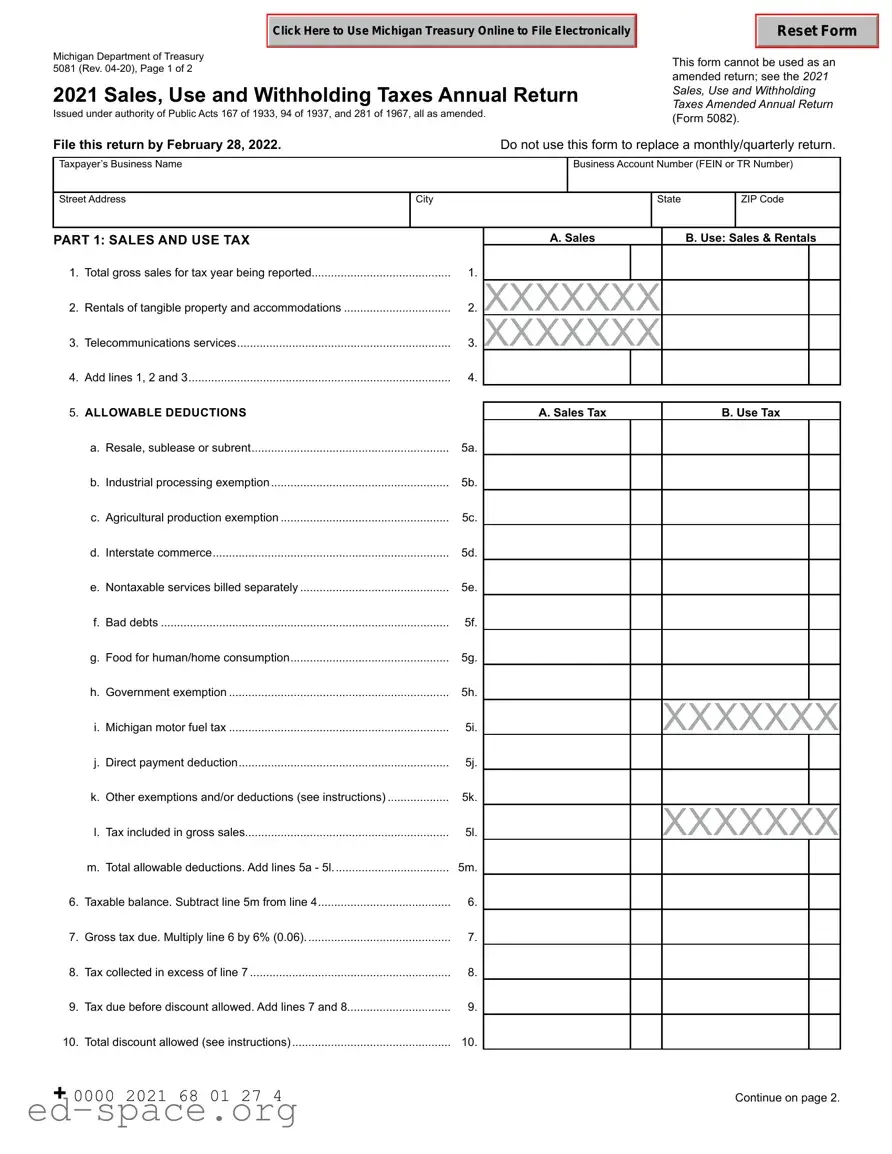
The Michigan 165 form, formally known as the 2021 Sales, Use, and Withholding Taxes Annual Return (Form 5081), serves as a crucial document for businesses operating within the state. It allows taxpayers to report their sales, use, and withholding taxes for the previous year. This form must be filed by February 28 of the following year, ensuring that all relevant tax obligations are met in a timely manner. It is important to note that this form cannot be used for amended returns; businesses must utilize Form 5082 for that purpose. The form is divided into several parts, each addressing different tax categories. Part 1 focuses on sales and use tax, where businesses report their total gross sales, allowable deductions, and the resulting taxable balance. Part 2 covers the use tax on items purchased for business or personal use, while Part 3 pertains to withholding tax, detailing gross payroll and income tax withheld. Finally, Part 4 summarizes the total tax due and any payments made, allowing for the calculation of refunds or balances owed. Completing this form accurately is essential, as errors or omissions can lead to penalties and interest. Filing electronically through Michigan Treasury Online is encouraged for efficiency and ease, ensuring that businesses stay compliant with state tax regulations.
Click Here to Use Michigan Treasury Online to File Electronically
Michigan Department of Treasury
5081 (Rev.
2021 Sales, Use and Withholding Taxes Annual Return
Issued under authority of Public Acts 167 of 1933, 94 of 1937, and 281 of 1967, all as amended.
Reset Form
This form cannot be used as an amended return; see the 2021
Sales, Use and Withholding
Taxes Amended Annual Return (Form 5082).
File this return by February 28, 2022. |
Do not use this form to replace a monthly/quarterly return. |
Taxpayer’s Business Name
Business Account Number (FEIN or TR Number)
Street Address
City
State
ZIP Code
PART 1: SALES AND USE TAX
1.Total gross sales for tax year being reported...........................................
2.Rentals of tangible property and accommodations .................................
3.Telecommunications services..................................................................
4.Add lines 1, 2 and 3.................................................................................
A. Sales |
B. Use: Sales & Rentals |
1.
2. XXXXXXX
3. XXXXXXX
4.
5.ALLOWABLE DEDUCTIONS
|
a. Resale, sublease or subrent |
5a. |
|
b. Industrial processing exemption |
5b. |
|
c. Agricultural production exemption |
5c. |
|
d. Interstate commerce |
5d. |
|
e. Nontaxable services billed separately |
5e. |
|
f. Bad debts |
5f. |
|
g. Food for human/home consumption |
5g. |
|
h. Government exemption |
5h. |
|
i. Michigan motor fuel tax |
5i. |
|
j. Direct payment deduction |
5j. |
|
k. Other exemptions and/or deductions (see instructions) |
5k. |
|
l. Tax included in gross sales |
5l. |
|
m. Total allowable deductions. Add lines 5a - 5l |
5m. |
6. |
Taxable balance. Subtract line 5m from line 4 |
6. |
7. |
Gross tax due. Multiply line 6 by 6% (0.06) |
7. |
8. |
Tax collected in excess of line 7 |
8. |
9. |
Tax due before discount allowed. Add lines 7 and 8 |
9. |
10. |
Total discount allowed (see instructions) |
10. |
A. Sales Tax |
B. Use Tax |
XXXXXXX
XXXXXXX
+ 0000 2021 68 01 27 4 |
Continue on page 2. |
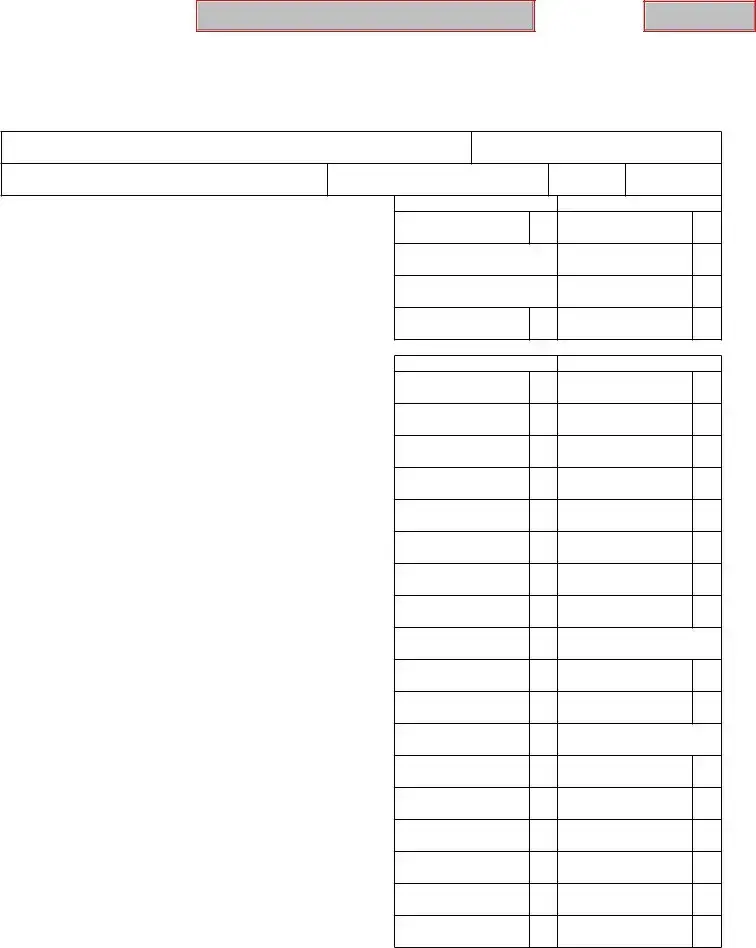
2021 Form 5081, Page 2 of 2 |
|
|
|
|
|
|||
Taxpayer’s Business Name |
|
Business Account Number |
||||||
|
|
|
|
|
|
|
|
|
|
|
|
|
A. Sales Tax |
|
B. Use Tax |
||
11. |
Total tax due. Subtract line 10 from line 9 |
|
11. |
|
|
|
|
|
12. |
.....................Tax payments and credits in current year (after discounts) |
12. |
|
|
|
|
|
|
PART 2: USE TAX ON ITEMS PURCHASED FOR BUSINESS OR PERSONAL USE |
|
|
|
|||||
|
|
|
||||||
13. |
Purchases for which no tax was paid or inventory purchased or withdrawn for business or personal use.... |
13. |
|
|
||||
14. |
.....................................................................Total use tax on purchases due. Multiply Line 13 by 6% (0.06) |
|
|
14. |
|
|
||
15. |
..........................................................................Use tax paid on purchases and withdrawals in current year |
|
|
15. |
|
|
||
PART 3: WITHHOLDING TAX |
|
|
|
|
|
|
|
|
|
|
|
|
|
|
|
||
16. |
Gross Michigan payroll, pension and other taxable compensation |
|
|
16. |
|
|
||
17. |
Total number of |
|
17. |
|
|
|
|
|
18. |
........................................................................Total Michigan income tax withheld per |
|
|
18. |
|
|
||
19. |
..............................................................Total Michigan income tax withholding paid during current tax year |
|
|
19. |
|
|
||
PART 4: SUMMARY |
|
|
|
|
|
|
|
|
|
|
|
|
|
|
|
||
20. |
Total sales, use and withholding tax due. Add lines 11A, 11B, 14 and 18 |
|
|
20. |
|
|
||
21. |
.....................................................Total sales, use and withholding tax paid. Add lines 12A, 12B, 15 and 19 |
|
|
21. |
|
|
||
22. |
...........................................If line 21 is greater than line 20, enter the difference here. If not, skip to line 25 |
|
|
|||||
23. |
............................................................................Amount of line 22 to be credited forward to a future period |
|
|
23. |
|
|
||
24. |
REFUND. Subtract line 23 from line 22 |
|
|
|
|
24. |
|
|
25. |
If line 21 is less than 20, enter balance due |
|
|
|
|
25. |
|
|
26. |
.................................................................................Penalty for late filing or late payment (see instructions) |
|
|
26. |
|
|
||
27. |
Interest for late payment (see instructions) |
|
|
|
|
27. |
|
|
28. |
TOTAL PAYMENT DUE. Add lines 25, 26 and 27 |
|
|
|
|
28. |
|
|
PART 5: SIGNATURE (All information below is required.)
Taxpayer Certification. I declare under penalty of perjury that the information in this |
Preparer Certification. I declare under penalty of perjury that this |
|||||
return and attachments is true and complete to the best of my knowledge. |
return is based on all information of which I have any knowledge. |
|||||
|
|
|
|
|
|
|
|
|
|
|
|
Preparer’s Signature |
|
|
|
By checking this box, I authorize Treasury to discuss my return with my preparer. |
|
|
||
|
|
|
|
|||
|
|
|
|
|
||
|
|
|
|
|
|
|
Signature of Taxpayer or Official Representative (must be Owner, Officer, Member, |
Preparer’s Business Address |
|
||||
Manager, or Partner) |
|
|
|
|
||
|
|
|
|
|
|
|
Print Taxpayer or Official Representative’s Name |
|
Date |
|
|
||
|
|
|
|
|
|
|
Title |
Telephone |
Number |
Preparer’s Identification Number |
Preparer’s Telephone Number |
||
|
|
|
|
|
|
|
File and pay this return for free on Michigan Treasury Online at mto.treasury.michigan.gov.
Alternatively, make check payable to “State of Michigan.” Write the account number, “SUW Annual” and tax year on the check. Send the return and payment due to: Michigan Department of Treasury, P.O. Box 30401, Lansing, MI
+ 0000 2021 68 02 27 2

2021 Form 5081, Page 3
Instructions for 2021 Sales, Use and
Withholding Taxes Annual Return (Form 5081)
Form 5081 is available for submission electronically using Michigan Treasury Online (MTO) at mto.treasury.michigan.gov or by using approved tax preparation software. Most taxpayers will have the option to file the Annual EZ form, reducing the amount of fields needed to complete. Go to MTO to see if you qualify.
NOTE: The address field on this form is required to be completed but will not be used to replace an existing valid address for the purpose of correspondence or refunds. Update address and other registration information using MTO at mto.treasury.michigan.gov or mail a Notice of Change or Discontinuance (Form 163).
IMPORTANT: This is a return for sales tax, use tax and/ or withholding tax. If the taxpayer inserts a zero on or leaves blank any line reporting sales tax, use tax or withholding tax, the taxpayer is certifying that no tax is owed for that tax type. Only enter figures for taxes the business is registered and/or liable for. If it is determined that tax is owed the taxpayer will be liable for the deficiency as well as penalty and interest.
PART 1: SALES AND USE TAX
Lines 1 through 3: For information about determining whether a person has nexus with Michigan, see Revenue Administrative Bulletins (RABs)
16.Please also visit www.michigan.gov/remotesellers for guidance, including FAQs.
Line 1A: SALES TAX - Total Gross Sales for the Tax
Year: This line should be used by sellers with nexus to report sales of tangible personal property where ownership transfers in Michigan. This includes sellers with nexus through physical presence or economic presence (remote sales).
Enter total sales, including cash, credit and installment transactions, of tangible personal property. Include any costs incurred before ownership of the property is transferred to the buyer, including installation, shipping, handling, and delivery charges. Dealers do not reduce sales reported here by any
Providers of nontaxable services (that do not involve the sale or lease of tangible personal property) should not report those sales.
Line 1B: USE TAX - Total Sales for the Tax Year: This line should be used by:
•Sellers with nexus to report sales of tangible personal property sourced to Michigan, for which ownership transfers outside Michigan, or
•Remote sellers without nexus who voluntarily collect Michigan tax.
Enter total sales, including cash, credit, and installment transactions, of tangible personal property.
Line 2B: USE TAX - Rentals of Tangible Personal Property and Accommodations.
•Lessors of tangible personal property: Lessors that have made a valid election under MCL 205.95(4) and MAC R 205.132(1) should report receipts from rentals of that tangible personal property under the election.
•Persons providing accommodations: This includes but is not limited to total hotel, motel, and vacation home rentals, and assessments imposed under the Convention and Tourism Act, the Convention Facility Development Act, the Regional Tourism Marketing Act, and the Community Convention or Tourism Marketing Act.
Line 3B: USE TAX - Telecommunications Services. Enter gross income from telecommunications services.
Line
Line 5a: Resale, Sublease or Subrent. Enter resale, sublease or subrent exemption claims.
Line 5b: Industrial Processing Exemption. The sale or lease of tangible personal property ultimately used in industrial processing by an industrial processor is exempt. Industrial processing is the activity of converting or conditioning tangible personal property by changing its form, composition, quality, combination, or character. In general, all of the following must be met:
•Property must be used in producing a product for ultimate sale at retail,
•Property must be sold or leased to an industrial processor, including a person that performs industrial processing on behalf of another industrial processor or performs industrial processing on property that will be incorporated into a product for ultimate sale at retail, and
•Activity starts when property begins moving from raw materials storage to begin industrial processing and ends when finished goods first come to rest in finished goods inventory.
If property is used for both an exempt and a taxable purpose, the property is only exempt to the extent that it is used for an exempt purpose. In such cases, the exemption is limited to the percentage of exempt use to total use determined by a reasonable formula or method approved (but not required to be
Line 5c: Agricultural Production Exemption. Property must be directly or indirectly used in agricultural production. Generally, the following
(i) Tangible personal property sold or leased to a person
2021 Form 5081, Page 4
engaged in a business enterprise that uses or consumes the property for either:
•Tilling, planting, draining, caring for, maintaining, or harvesting things of the soil, or
•Breeding, raising, or caring for livestock, poultry, or horticultural products.
(ii)To the extent that the property is affixed to and made a structural part of real estate for others and used for an exempt purpose in (i), tangible personal property sold to a contractor that is one of the following:
•Agricultural land tile
•Subsurface irrigation pipe
•Portable grain bins
•Grain drying equipment and its fuel or energy source However, the following sales from (i) or (ii) are not exempt:
•Food, fuel, clothing, or similar property for personal living or human consumption, or
•Property permanently affixed to and becoming a structural part of real estate unless it is agricultural land tile, subsurface irrigation pipe, a portable grain bin, or grain drying equipment. Certain property that can be disassembled and reassembled may be exempt.
Some specific types of exempt property and exempt uses of property are clarified in the statute. If property is used for both an exempt and a taxable purpose, the property is only exempt to the extent that it is used for an exempt purpose. In such cases, the exemption is limited to the percentage of exempt use to total use determined by a reasonable formula or method approved (but not required to be
Line 5d: Interstate Commerce. Enter sales made in interstate commerce. To claim such a deduction, the property must be delivered by the business to the
Line 5e: Nontaxable Services Billed Separately. Enter charges for nontaxable services billed separately, such as repair or maintenance, if these charges were included in gross receipts on line 1. Costs, such as delivery or installation charges, that are incurred before the completion of the transfer of ownership of taxable property are included in the tax base and may not be subtracted.
Line 5f: Bad Debts. Bad debts may be eligible for a deduction if the following criteria are met:
•The debts are charged off as uncollectible on business books and records at the time the debts become worthless
•The debts are deducted on the return for the period during which the bad debts are written off as uncollectible
•The debts are or would be eligible to be deducted for federal income tax purposes.
A bad debt deduction may be claimed by a
Line 5g: Food for Human/Home Consumption. Enter the total of retail sales of
Line 5h: Government Exemption. Direct sales to the United States government or the state of Michigan or its political subdivisions are exempt.
Line 5i: Michigan Motor Fuel Tax. Motor fuel retailers may deduct the Michigan motor fuel taxes that were included in gross sales on line 1 and paid to the State or the distributor.
Line 5j: Direct Payment Deduction. Enter sales made to purchasers that claimed direct pay exemption from sales and use taxes. With the exemption claim, the purchaser must include the following statement: “Authorized to pay use tax on purchases of tangible personal property directly to the State of Michigan under Account Number [listing either the Federal Employer Identification Number or the Michigan Treasury Registration Number]. If using Michigan Sales and Use Tax Certificate of Exemption (Form 3372), check the box in Section 3 for “Other” and include the above statement as the explanation. MCL 205.98.
Line 5k: Other Exemptions and/or Deductions. Identify exemptions or deductions not covered in items 5a through 5j on this line. Examples of exemptions or deductions are:
•Allowable
Taxes paid to Secretary of State are not reported here. Instead, they are reported on the Vehicle Dealer Supplemental Schedule (Form 5086,
•Credit for the core charge attributable to a recycling fee, deposit, or disposal fee for a motor vehicle or recreational vehicle part or battery if the recycling fee, deposit, or disposal fee is separately stated on the invoice, bill of sale, or similar document given to the purchaser.
•Direct sales, not for resale, to certain nonprofit agencies, churches, schools, hospitals, and homes for the care of children and the aged, to the extent the property is used to carry out the nonprofit purpose of the organization. For sales to certain nonprofit agencies, the exemption is limited based on the sales price of property used to raise funds or obtain resources. All sales must be paid for directly from the funds of the exempt organization to qualify.
•Assessments imposed under the Convention and Tourism Act, the Convention Facility Development Act, the

2021 Form 5081, Page 5
Regional Tourism Marketing Act, or the Community Convention or Tourism Marketing Act. Hotels and motels may deduct the assessments included in gross sales and rentals if use tax on the assessments was not charged to the customers.
•Credits allowed to customers for sales tax originally paid on merchandise voluntarily returned, provided the return is made within the time period for returns stated in the taxpayer’s refund policy or 180 days after the initial sale, whichever is earlier. Repossessions are not allowable deductions.
•Sales to contractors of materials which will become part of a finished structure for a qualified exempt nonprofit hospital, qualified exempt nonprofit housing entity or church sanctuary, or materials to be affixed to and made a structural part of real estate located in another state. The purchaser will provide a Michigan Sales and Use Tax Contractor Eligibility Statement (Form 3520). See RAB
•Vehicle sales to
•Qualified nonprofit organizations with aggregate sales in the calendar year of less than $25,000 may exempt the first $10,000 of sales for fundraising purposes. Separately, veterans organizations exempt under IRC 501(c)(19) may exempt sales for the purpose of raising funds for the benefit of an active duty service member or veteran, up to $25,000 per event.
Line 5l: Tax Included in Gross Sales. Complete this line only if you have tax included in your gross sales. Subtract line 5m from line 4, then divide by 17.6667 and enter the amount.
Line 8: If more tax was collected than the amount on line 7, enter the difference.
Line 10: Total Discount Allowed for Timely Payments.
•Annual filers: Enter $72 if the tax due on line 9 is $108 or more. If tax due is less than $108, calculate the discount by multiplying line 9 by 2/3 (0.6667).
•Accelerated/Monthly/Quarterly filers: Enter total discounts allowed for the year.
Line 12: Enter total payments plus credits from 2021 Fuel Supplier and Wholesaler Prepaid Sales Tax Schedule (Form 5083), 2021 Fuel Retailer Supplemental Schedule (Form 5085), and 2021 Vehicle Dealer Supplemental Schedule (Form 5086), if applicable, made for the current tax year.
Note: all prepaid sales tax schedules are
PART 2: USE TAX ON ITEMS PURCHASED FOR BUSINESS OR PERSONAL USE
Line 13: Unless a specific exemption applies enter purchases for which no sales or use tax was paid, including property withdrawn for business or personal use. See Michigan Use Tax Act, 1937 PA 94, for information on various exemptions. For questions contact Michigan Department of
Treasury at
PART 3: WITHHOLDING TAX
Line 17: Enter the number of your
Line 18: Enter the total Michigan income tax withheld for the return year.
Line 19: Enter the total Michigan income tax withholding previously paid for the return year. (Do not include penalty and interest.)
PART 4: SUMMARY
Line 24: Enter the amount of overpayment from line 22 to be refunded. Refunds will not be made in amounts of less than $1.
Line 25: If line 21 (tax paid) is less than line 20 (tax due), enter the additional tax due. Pay any amount greater than or equal to $1.
Line 28: Total Payment Due. Add lines 25, 26 and 27. Make check payable to “State of Michigan.” Write the account number, “SUW Annual” and the tax year on the check. Do not pay if the amount due is less than $1.
How to Compute Penalty and Interest
If the return is filed after February 28 and no tax is due, compute penalty at $10 per day up to a maximum of $400. If the return is filed with additional tax due, include penalty and interest with the payment. Penalty is 5% of the tax due and increases by an additional 5% per month or fraction thereof, after the second month, to a maximum of 25%. Interest is charged daily using the average prime rate, plus 1 percent.
Refer to www.michigan.gov/taxes for current interest rate information or help in calculating late payment fees.
PART 5: SIGNATURE
REMINDER: Taxpayers must sign and date returns. Preparers must provide a Preparer Taxpayer Identification Number (PTIN), FEIN or Social Security Number (SSN), as well as a business name, business address and phone number.
Annual Return Reporting
All taxpayers are encouraged to file the annual return electronically using Michigan Treasury Online (MTO). Visit mto.treasury.michigan.gov for more information. Taxpayers with 250 or more employees must file their withholding return electronically. Do not include wage statements with your mailed annual return.
1099 and Wage Statement Reporting
Due Date. State copies of wage statements are due to the Department of Treasury on or before January 31. Late filing is subject to penalty as provided by the Revenue Act. Pursuant to the Income Tax Act of 1967, Treasury is unable to grant an extension of this filing.

2021 Form 5081, Page 6
1099 Reporting: Forms with Withholding. Taxpayers who withheld Michigan income tax on a 1099 form (1099- MISC,
1099 Reporting: Forms without Withholding. Michigan participates in the combined federal/state 1099 filing program. Taxpayers who electronically filed 1099 forms using the IRS Filing Information Returns Electronically (FIRE) system should not send copies to Treasury. Taxpayers who did not electronically file 1099 forms through the IRS FIRE system should only send copies of the
Filing Options. All taxpayers are encouraged to file state copies of wage statements electronically using Michigan Treasury Online (MTO). On MTO, you can submit wage statements for a particular business you have connected to via Tax Services or you can utilize Guest Services to send a copy of the IRS EFW2 file for one or multiple businesses.
For all MTO upload options, you will receive a confirmation of your submission. Visit mto.treasury.michigan.gov for more information. Alternatively, taxpayers can mail wage statements to: Michigan Department of Treasury Lansing, MI 48930. Do not include a copy of the annual return with wage statement mailing.
Magnetic Media. Treasury offers Magnetic Media filing to all taxpayers reporting wage statements to Michigan. You can send Magnetic Media by mail or electronically through MTO. Taxpayers with 250 or more employees must use MTO to electronically submit wage statements. For more information, refer to Transmittal for Magnetic Media Reporting of
Tax Assistance
For assistance, call
| Fact Name | Description |
|---|---|
| Form Purpose | The Michigan 165 form is used to report annual sales, use, and withholding taxes for businesses operating in Michigan. |
| Filing Deadline | This form must be filed by February 28, 2022, for the tax year 2021. |
| Governing Laws | The form is issued under Public Acts 167 of 1933, 94 of 1937, and 281 of 1967, all as amended. |
| Amended Returns | This form cannot be used as an amended return. For amendments, use the 2021 Sales, Use and Withholding Taxes Amended Annual Return (Form 5082). |
| Electronic Filing | Taxpayers can file electronically using Michigan Treasury Online, which simplifies the process and may reduce required fields. |
Completing the Michigan 165 form requires careful attention to detail. This form is essential for reporting sales, use, and withholding taxes for your business. After filling out the form, you will submit it to the Michigan Department of Treasury, along with any payment due. It's important to ensure all information is accurate to avoid any penalties or issues with your tax filing.
What is the Michigan 165 form and when is it due?
The Michigan 165 form, officially known as the 2021 Sales, Use and Withholding Taxes Annual Return (Form 5081), is used by businesses to report their sales, use, and withholding taxes for the tax year. It must be filed by February 28, 2022. This form cannot be used to amend a previous return, and it should not replace any monthly or quarterly returns that may have been filed.
Who needs to file the Michigan 165 form?
How do I calculate the taxes owed on the Michigan 165 form?
What happens if I miss the filing deadline for the Michigan 165 form?
Missing Required Information: Failing to fill in essential fields, such as the business name, account number, or address, can lead to processing delays or rejections.
Incorrect Tax Calculations: Errors in calculating total sales, deductions, or taxes due can result in underpayment or overpayment, leading to penalties or loss of refunds.
Neglecting Allowable Deductions: Overlooking eligible deductions can inflate taxable amounts. Ensure all applicable exemptions are claimed, supported by proper documentation.
Using the Wrong Form: Submitting the Michigan 165 form instead of the amended return (Form 5082) can cause significant issues. Ensure the correct form is used for amendments.
Not Signing the Return: A common oversight is failing to sign and date the return. Without a signature, the form is considered incomplete and may not be processed.
Late Submission: Filing after the deadline of February 28 can incur penalties. Timely submission is crucial to avoid additional fees.
Ignoring Electronic Filing Options: Many taxpayers miss the opportunity to file electronically through Michigan Treasury Online, which can simplify the process and reduce errors.
The Michigan 165 form, officially known as the Sales, Use, and Withholding Taxes Annual Return (Form 5081), is an essential document for businesses operating in Michigan. It allows taxpayers to report their sales, use, and withholding tax obligations. However, several other forms and documents are often used in conjunction with the Michigan 165 form to ensure compliance with state tax regulations. Below is a list of these related documents, each serving a specific purpose.
Utilizing these forms in conjunction with the Michigan 165 form ensures that businesses remain compliant with state tax laws. Each document plays a vital role in the overall tax reporting and payment process, helping to prevent issues related to underreporting or miscalculations. Understanding the purpose of each form can streamline the filing process and facilitate accurate tax compliance.
When filling out the Michigan 165 form, there are important guidelines to follow. Here’s a list of things you should and shouldn’t do:
Understanding the Michigan 165 form can be challenging, and there are several misconceptions that can lead to confusion. Here’s a breakdown of nine common misunderstandings:
By clearing up these misconceptions, businesses can better navigate the requirements of the Michigan 165 form and ensure compliance with state tax laws.
Here are some important points to keep in mind when filling out and using the Michigan 165 form:
Following these guidelines can help ensure that your filing process goes smoothly and that you remain compliant with Michigan tax regulations.