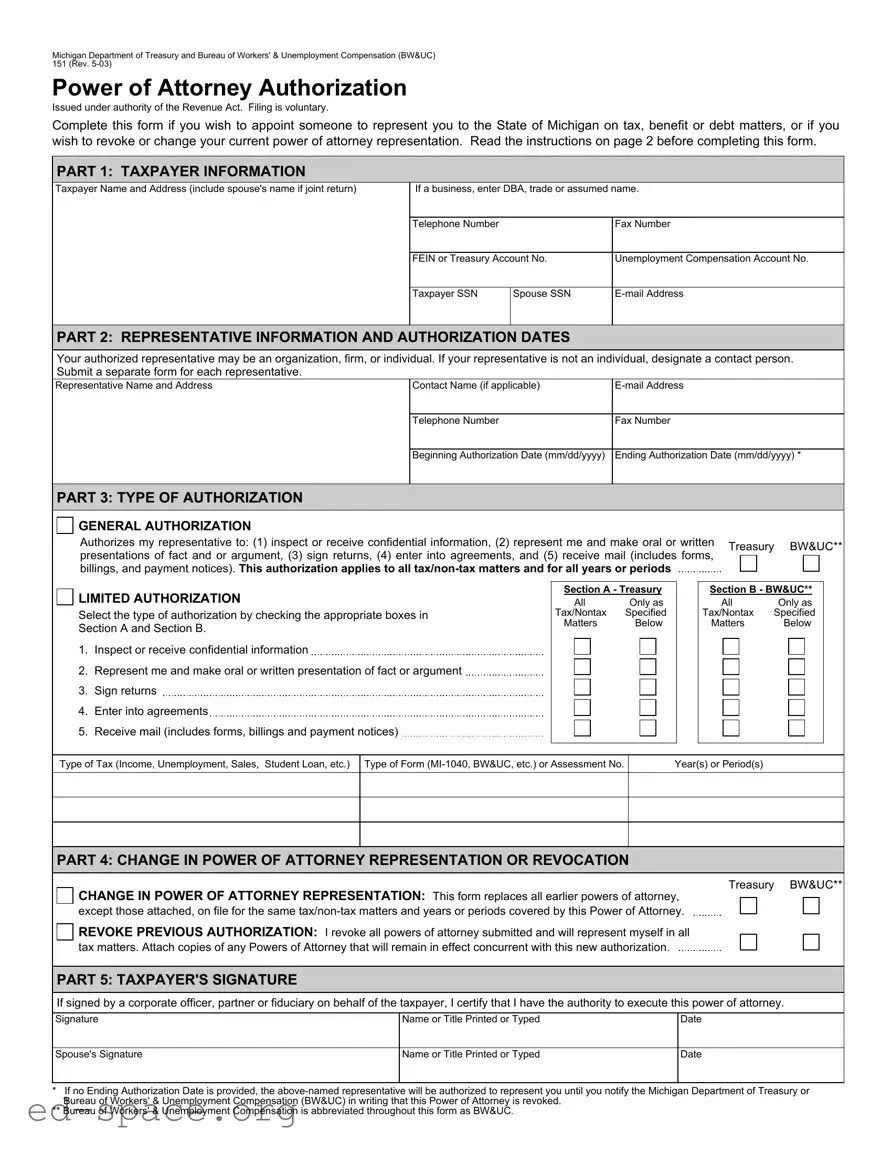
The Michigan 151 form is an essential document for anyone looking to appoint a representative for tax, benefit, or debt matters in the state of Michigan. This form, issued by the Michigan Department of Treasury and the Bureau of Workers' & Unemployment Compensation, allows individuals or businesses to designate someone to act on their behalf. Whether you need help navigating tax issues or managing unemployment benefits, this form provides the necessary framework to authorize a representative to inspect confidential information, make presentations, sign returns, and receive important communications. It’s also important to note that completing this form is voluntary, but failing to do so may restrict your representative’s ability to discuss your tax matters with the state. The 151 form includes several key sections, such as taxpayer information, representative details, types of authorization, and provisions for changing or revoking previous powers of attorney. By understanding these components, taxpayers can ensure they are effectively represented in their dealings with the state, making the process smoother and less stressful.

Michigan Department of Treasury and Bureau of Workers' & Unemployment Compensation (BW&UC) 151 (Rev.
Power of Attorney Authorization
Issued under authority of the Revenue Act. Filing is voluntary.
Complete this form if you wish to appoint someone to represent you to the State of Michigan on tax, benefit or debt matters, or if you wish to revoke or change your current power of attorney representation. Read the instructions on page 2 before completing this form.
PART 1: TAXPAYER INFORMATION
Taxpayer Name and Address (include spouse's name if joint return) |
If a business, enter DBA, trade or assumed name. |
||
|
|
|
|
|
Telephone Number |
|
Fax Number |
|
|
|
|
|
FEIN or Treasury Account No. |
Unemployment Compensation Account No. |
|
|
|
|
|
|
Taxpayer SSN |
Spouse SSN |
|
|
|
|
|
PART 2: REPRESENTATIVE INFORMATION AND AUTHORIZATION DATES
Your authorized representative may be an organization, firm, or individual. If your representative is not an individual, designate a contact person. Submit a separate form for each representative.
Representative Name and Address |
Contact Name (if applicable) |
|
|
|
|
|
Telephone Number |
Fax Number |
|
|
|
|
Beginning Authorization Date (mm/dd/yyyy) |
Ending Authorization Date (mm/dd/yyyy) * |
|
|
|
PART 3: TYPE OF AUTHORIZATION
GENERAL AUTHORIZATION
Authorizes my representative to: (1) inspect or receive confidential information, (2) represent me and make oral or written Treasury BW&UC** presentations of fact and or argument, (3) sign returns, (4) enter into agreements, and (5) receive mail (includes forms,
billings, and payment notices). This authorization applies to all
|
|
LIMITED AUTHORIZATION |
Section A - Treasury |
|
Section B - BW&UC** |
|
||||||||||||||
|
|
|
|
|||||||||||||||||
|
|
|
All |
|
Only as |
|
All |
Only as |
|
|||||||||||
|
|
|
|
|
|
|
|
|
||||||||||||
|
|
Select the type of authorization by checking the appropriate boxes in |
Tax/Nontax |
Specified |
|
Tax/Nontax |
Specified |
|
||||||||||||
|
|
Section A and Section B. |
Matters |
|
Below |
|
Matters |
Below |
|
|||||||||||
|
|
|
|
|
|
|
|
|
|
|
|
|
|
|
|
|
|
|||
|
1. |
Inspect or receive confidential information |
|
|
|
|
|
|
|
|
|
|
|
|
|
|
|
|
||
|
|
|
|
|
|
|
|
|
|
|
|
|
|
|
|
|
||||
|
2. |
Represent me and make oral or written presentation of fact or argument |
|
|
|
|
|
|
|
|
|
|
|
|
|
|
|
|
||
|
|
|
|
|
|
|
|
|
|
|
|
|
|
|
|
|
||||
|
3. |
Sign returns |
|
|
|
|
|
|
|
|
|
|
|
|
|
|
|
|
||
|
|
|
|
|
|
|
|
|
|
|
|
|
|
|
|
|
||||
|
4. |
Enter into agreements |
|
|
|
|
|
|
|
|
|
|
|
|
|
|
|
|
||
|
|
|
|
|
|
|
|
|
|
|
|
|
|
|
|
|
||||
|
5. |
Receive mail (includes forms, billings and payment notices) |
|
|
|
|
|
|
|
|
|
|
|
|
|
|
|
|
||
|
|
|
|
|
|
|
|
|
|
|
|
|
|
|
|
|
||||
|
|
|
|
|
|
|
|
|
|
|
|
|
|
|
|
|
|
|
|
|
|
|
|
|
|
|
|
|
|
|
|
|
|
|
|||||||
|
Type of Tax (Income, Unemployment, Sales, Student Loan, etc.) |
Type of Form |
No. |
|
|
|
|
Year(s) or Period(s) |
|
|
|
|
||||||||
|
|
|
|
|
|
|
|
|
|
|
|
|
|
|
|
|
|
|
|
|
|
|
|
|
|
|
|
|
|
|
|
|
|
|
|
|
|
|
|
|
|
|
|
|
|
|
|
|
|
|
|
|
|
|
|
|
|
|
|
|
|
|
|
|
|
|
|
|
|
|
|
|
|
|
|
|
|
|
|
|
|
|
|
PART 4: CHANGE IN POWER OF ATTORNEY REPRESENTATION OR REVOCATION
Treasury BW&UC**
CHANGE IN POWER OF ATTORNEY REPRESENTATION: This form replaces all earlier powers of attorney, except those attached, on file for the same
REVOKE PREVIOUS AUTHORIZATION: I revoke all powers of attorney submitted and will represent myself in all tax matters. Attach copies of any Powers of Attorney that will remain in effect concurrent with this new authorization.
PART 5: TAXPAYER'S SIGNATURE
If signed by a corporate officer, partner or fiduciary on behalf of the taxpayer, I certify that I have the authority to execute this power of attorney.
Signature |
Name or Title Printed or Typed |
Date |
|
|
|
Spouse's Signature |
Name or Title Printed or Typed |
Date |
|
|
|
*If no Ending Authorization Date is provided, the
** Bureau of Workers' & Unemployment Compensation is abbreviated throughout this form as BW&UC.

Instructions for Power of Attorney Authorization (Form 151)
Complete and file a Power of Attorney Authorization (Form 151) if you wish to appoint an individual, firm, or organization as your representative in tax or debt matters before the State of Michigan. Failure to complete this form will prohibit Treasury or the Bureau of Workers’ & Unemployment Compensation (BW&UC) from discussing or releasing your tax return/tax return information with or to another person including your spouse.
PART 1: TAXPAYER INFORMATION
Enter the taxpayer’s name, address, telephone number, fax number, and
PART 2: REPRESENTATIVE INFORMATION AND AUTHORIZATION DATES
You must submit a separate form for each representative. Enter the authorized representative’s telephone number, fax number, and
PART 3: TYPE OF AUTHORIZATION
Check the GeneralAuthorization box to allow your representative to act on your behalf to do all of the following: (1) inspect and receive confidential information, (2) represent you and make oral or written presentations of act and/or argument, (3) sign returns,
(4)enter into agreements, and (5) receive all (includes forms, billings, and payment notices. This authorization applies to all
You may restrict your representative’s authorization to act on your behalf by checking the Limited Authorization box, and checking the appropriate boxes in Section A and/or B. To limit the authorization for specific tax matters, check the appropriate “Only as Specified Below” boxes, and indicate the type of tax, type of form, and years/periods for which you are granting authorization in the space provided.
Check this box if your representative is authorized to:
1.Inspect or receive confidential information
2.Represent you and make oral or written presentation of fact or argument.
3.Sign tax returns.
4.Enter into agreements (such as payment plans).
5.Receive mail.
PART 4: CHANGE IN POWER OF ATTORNEY REPRESENTATION OR REVOCATION
Unless otherwise specified, this Power of Attorney Authorization replaces or revokes any previous power of attorney authorizations on file with the Michigan Department of Treasury or the Bureau of Worker’s & Unemployment Compensation for the same tax matters identified on this form.
You must identify any previous authorizations that are to remain in effect, and attach a copy of the authorizations to this form when filed.
PART 5: TAXPAYER SIGNATURE
You and your spouse, if a joint return, must sign and date the form.
FILING
Except as noted below, mail this form to the Registration Section. Treasury will forward your form to BW&UC.
Customer Contact Center
Registration Section
Michigan Department of Treasury
P.O. Box 30477
Lansing, MI
If the Michigan Accounts Receivable Collection System (MARCS) has requested you to file this form, mail your completed form and any attachments to:
MARCS
P.O. Box 30158
Lansing, MI
If a district office representative has requested you to file this form, mail it to that representative.
If the Treasury Collection Division has requested you to file this form, mail it to:
Collection Division
Michigan Department of Treasury
P.O. Box 30199
Lansing, MI 48909
If BW&UC has asked you to file this form, mail it to:
BW&UC Tax Office
P.O. Box 8068
Royal Oak, MI
Or fax to:
If you are an individual taxpayer (not representing a business), mail this form to:
Customer Contact Center Individual Correspondence Section Michigan Department of Treasury Lansing, MI 48922
| Fact Name | Details |
|---|---|
| Form Purpose | This form allows taxpayers to appoint a representative for tax, benefit, or debt matters in Michigan. |
| Governing Law | Issued under the authority of the Revenue Act. |
| Voluntary Filing | Completing this form is voluntary and not mandatory for all taxpayers. |
| Authorization Types | Taxpayers can grant general or limited authorization to their representatives. |
| Change of Representation | This form can revoke previous powers of attorney or change representation. |
| Filing Instructions | Submit the form to the Michigan Department of Treasury or specific departments as directed. |
Filling out the Michigan 151 form is an important step in designating someone to represent you in tax or debt matters. Once completed, you’ll be able to submit the form to the appropriate Michigan authority. Here’s how to fill it out step-by-step.
After completing the form, ensure you send it to the correct address based on your situation. This will help ensure that your representative can act on your behalf without any issues.
What is the Michigan 151 form?
The Michigan 151 form is a Power of Attorney Authorization issued by the Michigan Department of Treasury and the Bureau of Workers' & Unemployment Compensation (BW&UC). It allows individuals to appoint a representative to handle tax, benefit, or debt matters on their behalf. Filing this form is voluntary.
Who can I appoint as my representative using the Michigan 151 form?
You can appoint an individual, organization, or firm as your representative. If your representative is not an individual, you should designate a contact person who can communicate on their behalf.
What information do I need to provide on the form?
You will need to provide your name, address, telephone number, and email address. If applicable, include your spouse’s information if you are filing a joint return. Additionally, you must provide your Social Security number, federal employer identification number (FEIN), or other relevant account numbers.
What types of authorization can I grant my representative?
You can grant either a general or limited authorization. A general authorization allows your representative to inspect confidential information, represent you, sign returns, enter into agreements, and receive mail. A limited authorization restricts their actions to specific tax matters or time periods as you designate.
How do I revoke a previous Power of Attorney using this form?
The Michigan 151 form allows you to revoke previous authorizations. By completing this form, you replace all earlier powers of attorney for the same tax matters unless you specify otherwise. You must also attach copies of any powers of attorney that will remain in effect.
Do I need to sign the form?
Yes, both you and your spouse (if applicable) must sign and date the form. If a corporate officer or fiduciary is signing on behalf of the taxpayer, they must certify their authority to do so.
Where should I send the completed Michigan 151 form?
Mail the form to the Registration Section of the Michigan Department of Treasury, or to the specific address indicated if requested by the Michigan Accounts Receivable Collection System (MARCS) or another division. If you are an individual taxpayer, send it to the Individual Correspondence Section.
What happens if I do not file the Michigan 151 form?
If you do not file the Michigan 151 form, the Michigan Department of Treasury and BW&UC cannot discuss or release your tax return information to anyone, including your spouse. This could hinder your ability to get assistance with your tax matters.
Is there a deadline for submitting the Michigan 151 form?
There is no specific deadline for submitting the form, but it should be filed as soon as you wish to appoint a representative or change your current representation. If you do not provide an ending authorization date, your representative will remain authorized until you revoke it in writing.
Incomplete Taxpayer Information: Failing to provide all required details such as the taxpayer's name, address, and Social Security number can lead to processing delays. Ensure that all fields in Part 1 are filled out accurately.
Missing Authorization Dates: Not specifying the beginning and ending authorization dates in Part 2 can result in confusion about the validity of the power of attorney. Always include these dates to clarify the duration of representation.
Incorrect Representative Information: Providing inaccurate details about the representative, such as the name or contact information, may hinder communication. Double-check all entries to ensure they are correct.
Neglecting to Sign the Form: Forgetting to sign the form can invalidate the authorization. Both the taxpayer and, if applicable, the spouse must sign in Part 5. Ensure that all necessary signatures are present before submission.
Not Attaching Required Documents: Failing to attach copies of any previous powers of attorney that will remain in effect can lead to misunderstandings. If applicable, include these documents with the submission to avoid complications.
The Michigan 151 form is a Power of Attorney Authorization that allows individuals or businesses to appoint a representative to handle tax, benefit, or debt matters with the State of Michigan. Along with this form, several other documents may be necessary to ensure proper representation and compliance with state regulations. Below is a list of these documents, each described briefly.
Understanding these forms and documents is crucial for effective communication and representation in tax matters. Ensuring that all necessary paperwork is completed accurately can streamline the process and help avoid potential complications with the State of Michigan.
When filling out the Michigan 151 form, it’s important to follow some guidelines to ensure your submission is correct and effective. Here’s a list of things you should and shouldn’t do:
Understanding the Michigan 151 form is crucial for anyone needing to appoint a representative for tax or debt matters. However, several misconceptions can lead to confusion. Here are four common misunderstandings:
Clarifying these misconceptions can help individuals navigate the process more effectively and ensure their rights and interests are properly represented.
Key Takeaways for Using the Michigan 151 Form