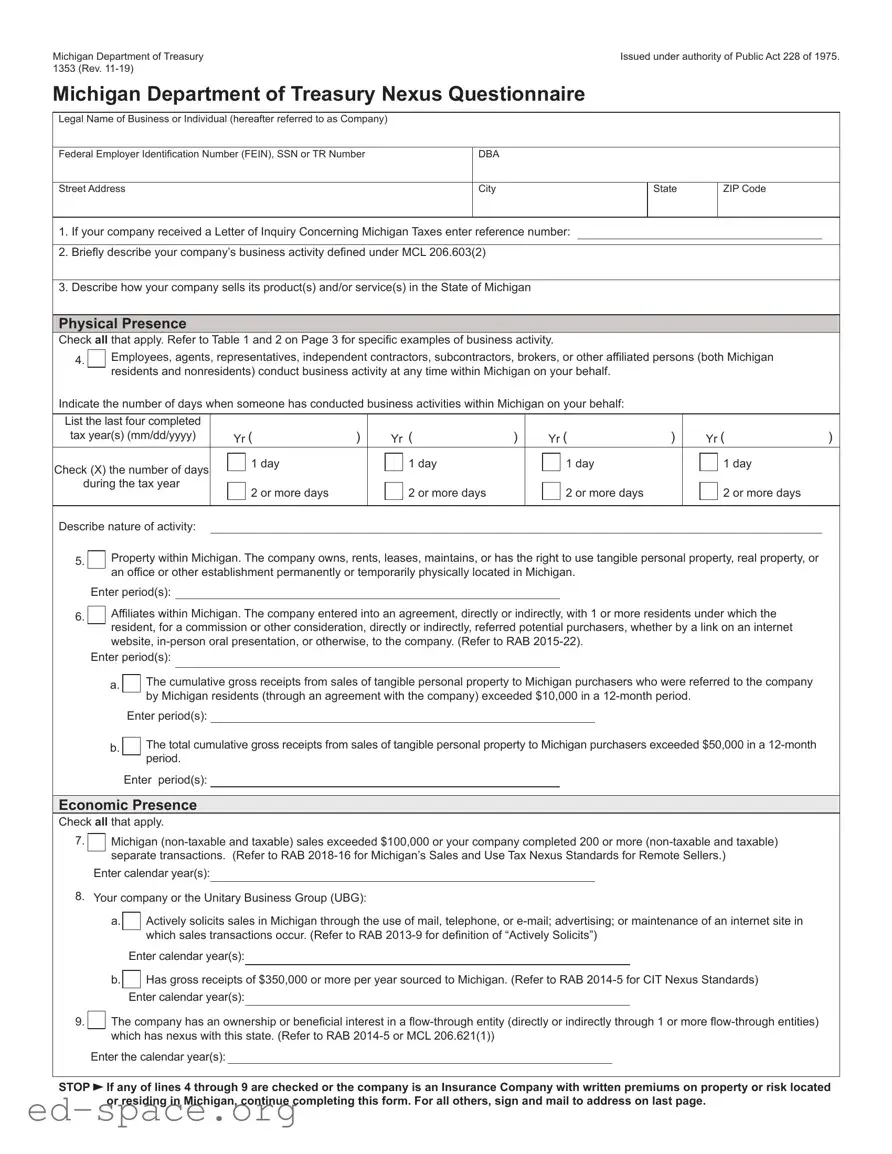
The Michigan 1353 form, officially known as the Nexus Questionnaire, plays a crucial role for businesses operating in or engaging with the state of Michigan. Issued by the Michigan Department of Treasury, this form helps determine whether a company has established a nexus, or a significant presence, in the state that would require it to comply with Michigan tax laws. It collects essential information about the business, including its legal name, federal identification number, and details about its operations within Michigan. Key sections of the form inquire about the company’s physical presence in the state, such as whether it owns or leases property, employs agents, or conducts sales activities. Additionally, it addresses economic presence by assessing sales volume and transaction frequency. The form also prompts businesses to disclose their activities over the past four tax years, ensuring a comprehensive understanding of their operations in Michigan. By filling out the Michigan 1353 form accurately, companies can clarify their tax obligations and avoid potential penalties for non-compliance.
Michigan Department of Treasury |
|
|
|
|
|
|
|
|
|
|
|
|
|
|
Issued under authority of Public Act 228 of 1975. |
||||||||||||
1353 (Rev. |
|
|
|
|
|
|
|
|
|
|
|
|
|
|
|
|
|
|
|
|
|
||||||
Michigan Department of Treasury Nexus Questionnaire |
|
|
|
|
|
||||||||||||||||||||||
|
|
|
|
|
|
|
|
|
|
|
|
|
|
|
|
|
|
|
|
|
|
|
|
|
|
|
|
Legal Name of Business or Individual (hereafter referred to as Company) |
|
|
|
|
|
|
|
|
|
|
|
|
|
|
|
|
|||||||||||
|
|
|
|
|
|
|
|
|
|
|
|
|
|
|
|
|
|
|
|
|
|
|
|
|
|
|
|
Federal Employer Identification Number (FEIN), SSN or TR Number |
|
|
DBA |
|
|
|
|
|
|
|
|
|
|
|
|
|
|||||||||||
|
|
|
|
|
|
|
|
|
|
|
|
|
|
|
|
|
|
|
|
|
|
|
|
|
|
||
Street Address |
|
|
|
|
|
|
|
City |
|
|
|
|
|
|
|
|
State |
|
ZIP Code |
|
|||||||
|
|
|
|
|
|
|
|
|
|
|
|
|
|
|
|
|
|
|
|
|
|
||||||
1. If your company received a Letter of Inquiry Concerning Michigan Taxes enter reference number: |
|
|
|
|
|
||||||||||||||||||||||
|
|
|
|
|
|
|
|
|
|
|
|
|
|
|
|
|
|
|
|
|
|
|
|||||
2. Briefly describe your company’s business activity defined under MCL 206.603(2) |
|
|
|
|
|
|
|
|
|
|
|
|
|
||||||||||||||
|
|
|
|
|
|
|
|
|
|
|
|
|
|
|
|
|
|
|
|
|
|
|
|
|
|||
3. Describe how your company sells its product(s) and/or service(s) in the State of Michigan |
|
|
|
|
|
|
|
|
|
|
|
||||||||||||||||
|
|
|
|
|
|
|
|
|
|
|
|
|
|
|
|
|
|
|
|
|
|
|
|
|
|
|
|
Physical Presence |
|
|
|
|
|
|
|
|
|
|
|
|
|
|
|
|
|
|
|
|
|
||||||
Check all that apply. Refer to Table 1 and 2 on Page 3 for specific examples of business activity. |
|
|
|
|
|
||||||||||||||||||||||
4. |
|
Employees, agents, representatives, independent contractors, subcontractors, brokers, or other affiliated persons (both Michigan |
|
||||||||||||||||||||||||
|
|
residents and nonresidents) conduct business activity at any time within Michigan on your behalf. |
|
|
|
|
|
||||||||||||||||||||
Indicate the number of days when someone has conducted business activities within Michigan on your behalf: |
|
|
|
|
|
||||||||||||||||||||||
|
|
|
|
|
|
|
|
|
|
|
|
|
|
|
|
|
|
|
|
|
|
||||||
List the last four completed |
|
|
|
|
|
|
|
|
|
|
|
|
|
|
|
|
|
|
|
|
|
|
|||||
tax year(s) (mm/dd/yyyy) |
|
Yr ( |
) |
|
|
Yr ( |
) |
|
Yr ( |
) |
|
Yr ( |
) |
||||||||||||||
|
|
|
|
|
|
|
|
|
|
|
|
|
|
|
|
|
|
|
|
|
|
|
|
|
|||
Check (X) the number of days |
|
|
1 day |
|
|
|
|
1 day |
|
|
|
1 day |
|
|
|
1 day |
|
||||||||||
|
|
|
|
|
|
|
|
|
|
|
|
|
|||||||||||||||
|
|
|
|
|
|
|
|
|
|
|
|
|
|
|
|
|
|
|
|
|
|
||||||
during the tax year |
|
|
2 or more days |
|
|
|
|
2 or more days |
|
|
|
2 or more days |
|
|
|
2 or more days |
|
||||||||||
|
|
|
|
|
|
|
|
|
|
|
|
||||||||||||||||
|
|
|
|
|
|
|
|
|
|
|
|
|
|
|
|
|
|
|
|||||||||
|
|
|
|
|
|
|
|
|
|
|
|
|
|
|
|
|
|
|
|
|
|
|
|||||
Describe nature of activity: |
|
|
|
|
|
|
|
|
|
|
|
|
|
|
|
|
|
|
|
|
|
|
|||||
5. |
|
Property within Michigan. The company owns, rents, leases, maintains, or has the right to use tangible personal property, real property, or |
|
||||||||||||||||||||||||
|
|
||||||||||||||||||||||||||
|
|
an office or other establishment permanently or temporarily physically located in Michigan. |
|
|
|
|
|
||||||||||||||||||||
|
|
|
|
|
|
|
|||||||||||||||||||||
|
Enter period(s): |
|
|
|
|
|
|
|
|
|
|
|
|
|
|
|
|
|
|
|
|
|
|
||||
6. |
|
Affiliates within Michigan. The company entered into an agreement, directly or indirectly, with 1 or more residents under which the |
|
||||||||||||||||||||||||
|
|
||||||||||||||||||||||||||
|
|
resident, for a commission or other consideration, directly or indirectly, referred potential purchasers, whether by a link on an internet |
|
||||||||||||||||||||||||
|
|
|
|||||||||||||||||||||||||
|
|
website, |
|
|
|
|
|
||||||||||||||||||||
|
Enter period(s): |
|
|
|
|
|
|
|
|
|
|
|
|
|
|
|
|
|
|
|
|
|
|||||
|
|
|
|
|
|
|
|
|
|
|
|
|
|
|
|
|
|
|
|
|
|||||||
|
|
a. |
|
The cumulative gross receipts from sales of tangible personal property to Michigan purchasers who were referred to the company |
|
||||||||||||||||||||||
|
|
|
|
||||||||||||||||||||||||
|
|
|
by Michigan residents (through an agreement with the company) exceeded $10,000 in a |
|
|
|
|||||||||||||||||||||
|
|
|
|
|
|
|
|||||||||||||||||||||
|
|
|
Enter period(s): |
|
|
|
|
|
|
|
|
|
|
|
|
|
|
|
|
|
|
|
|
|
|
||
|
|
b. |
|
The total cumulative gross receipts from sales of tangible personal property to Michigan purchasers exceeded $50,000 in a |
|
||||||||||||||||||||||
|
|
|
|
||||||||||||||||||||||||
|
|
|
|
period. |
|
|
|
|
|
|
|
|
|
|
|
|
|
|
|
|
|
|
|
|
|
||
|
|
|
Enter period(s): |
|
|
|
|
|
|
|
|
|
|
|
|
|
|
|
|
|
|
|
|
|
|||
|
|
|
|
|
|
|
|
|
|
|
|
|
|
|
|
|
|
|
|
|
|
|
|
|
|
|
|
Economic Presence |
|
|
|
|
|
|
|
|
|
|
|
|
|
|
|
|
|
|
|
|
|
||||||
Check all that apply. |
|
|
|
|
|
|
|
|
|
|
|
|
|
|
|
|
|
|
|
|
|
||||||
7. |
|
Michigan |
|
||||||||||||||||||||||||
|
|
||||||||||||||||||||||||||
|
|
separate transactions. (Refer to RAB |
|
||||||||||||||||||||||||
|
|
|
|||||||||||||||||||||||||
|
Enter calendar year(s): |
|
|
|
|
|
|
|
|
|
|
|
|
|
|
|
|
|
|
|
|
|
|||||
|
|
|
|
|
|
|
|
|
|
|
|
|
|
|
|
|
|
|
|
|
|||||||
8. Your company or the Unitary Business Group (UBG): |
|
|
|
|
|
|
|
|
|
|
|
|
|
|
|
|
|||||||||||
|
|
a. |
|
Actively solicits sales in Michigan through the use of mail, telephone, or |
|
||||||||||||||||||||||
|
|
|
|
||||||||||||||||||||||||
|
|
|
|
which sales transactions occur. (Refer to RAB |
|
|
|
|
|
||||||||||||||||||
|
|
|
|
|
|
|
|
|
|||||||||||||||||||
|
|
|
Enter calendar year(s): |
|
|
|
|
|
|
|
|
|
|
|
|
|
|
|
|
|
|
|
|
||||
|
|
b. |
|
Has gross receipts of $350,000 or more per year sourced to Michigan. (Refer to RAB |
|
||||||||||||||||||||||
|
|
|
|
||||||||||||||||||||||||
|
|
|
Enter calendar year(s): |
|
|
|
|
|
|
|
|
|
|
|
|
|
|
|
|
|
|
|
|||||
|
|
|
|
|
|
|
|
|
|
|
|
|
|
|
|
|
|
|
|
|
|||||||
9. |
|
The company has an ownership or beneficial interest in a |
|
||||||||||||||||||||||||
|
|
||||||||||||||||||||||||||
|
|
which has nexus with this state. (Refer to RAB |
|
|
|
|
|
|
|
|
|
|
|
|
|
||||||||||||
|
Enter the calendar year(s): |
|
|
|
|
|
|
|
|
|
|
|
|
|
|
|
|
|
|
|
|
|
|||||
|
|
|
|
|
|
|
|
|
|
|
|
|
|
|
|
|
|
|
|
|
|
|
|
|
|
|
|
STOP If any of lines 4 through 9 are checked or the company is an Insurance Company with written premiums on property or risk located or residing in Michigan, continue completing this form. For all others, sign and mail to address on last page.

1353, Page 2
10.Check all that apply to your business activity:
Sale of property. |
|
|
Indicate type of property: |
Real |
Tangible Personal |
Rental Property (whether property is real, personal, tangible or intangible)
Intangible
Performance of Services
Financial Institution (Refer to MCL 206.651)
Insurance Company (Refer to MCL 206.607)
Protected Activities (PL
11.Indicate which activities below (if any) the Company’s employees, agents, representatives, independent contractors, brokers or other affiliated persons (both Michigan residents and nonresidents) conducted within Michigan for the last four completed tax years.
Solicit sales to purchasers in this state whether sales are wholesale, retail, or otherwise. (Solicitation means any speech or conduct that explicitly or implicitly invites an order, and ancillary activities that neither explicitly or implicitly invites an order.)
Maintain samples that are not sold or provided for other consideration, attend trade shows where no sales are made/orders taken, provide highly
technical presentations to solicit a sale (not after a sale has been made)
Deliver goods using vehicles owned, leased, used or maintained by the company
Enter period(s):
Additional comments:
Unprotected Activities (PL
12.Indicate which activities below (if any) the Company’s employees, agents, representatives, independent contractors, brokers or other affiliated persons (both Michigan residents and nonresidents) conducted within Michigan for the last four completed tax years.
Provide any services within Michigan, including but not limited to, consulting services, entertainment services, rental services, professional services, or transportation services provided as a transportation company (transport through, into, or from Michigan)
Maintain, occupy, own, lease or use an office, distribution facility, warehouse, or similar place of business in Michigan to facilitate the sale or
delivery of tangible personal property or maintain a market in Michigan
Provide customers with any kind of technical assistance or service including, engineering assistance, design service, quality control, product inspections, or similar services beyond the purpose of soliciting a sale
Sale of intangible property within Michigan
Assemble, install, or supervise installation at or after shipment or delivery
Make repairs or provide maintenance or service to property sold or to be sold to Michigan customers
Conduct training courses, seminars, or similar events for
Solicit, negotiate, or enter into franchising, licensing or similar agreements
Attend and/or participate at a trade show at which sales are solicited or made
Maintain a sample or display room in excess of 14 days or carry samples for sale, exchange or distribution in any manner for consideration or
other value
Consign stock of goods or other tangible personal property to any person in Michigan for sale
Pick up damaged goods using vehicles owned, leased, used, or maintained by the company
Enter period(s):
Additional Comments:
13. Do the Company’s employees approve or accept purchase orders or perform credit checks or authorize credit, while physically present in Michigan?
No
Yes, enter period(s):
14. The company has filed the following Michigan taxes: |
|
|
||
|
|
None |
|
Sales Tax |
|
|
|
||
|
|
Corporate Income Tax |
|
Use Tax on Sales/Rentals |
|
|
|
||
Individual or Composite Individual Income Tax, under SSN/FEIN:
Payroll Withholding
Use Tax on Purchases
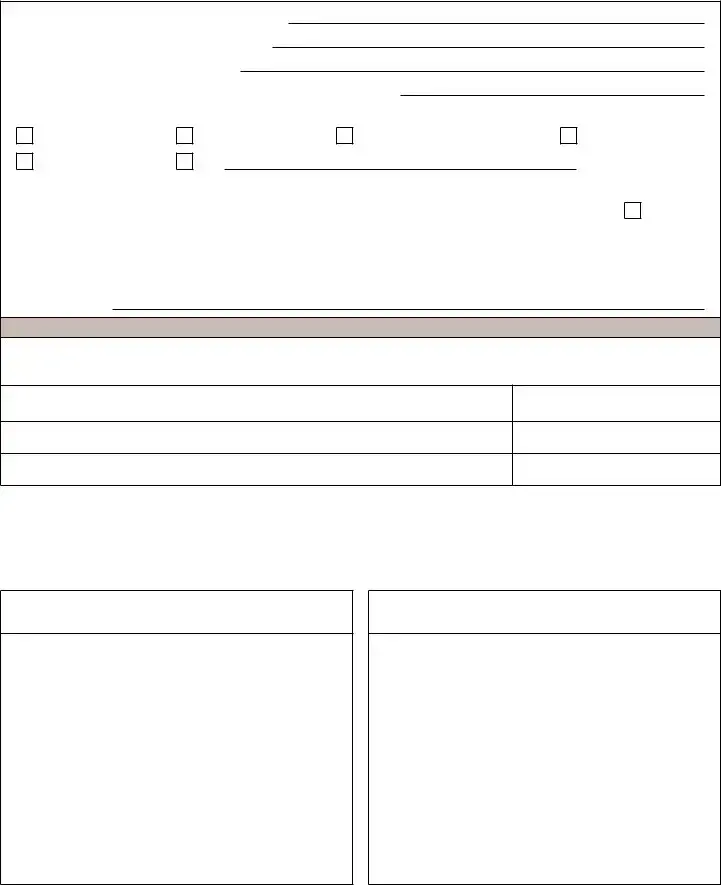
1353, Page 3
15.What is the company’s State of Incorporation/Formation?
16.What is the company’s State of Domicile/Residence?
17.When was the company incorporated/formed?
18.When did the company’s business begin (if different than incorporation/formed)?
19.Organization Type (check one)
Individual
Limited Liability Company
Other:
Partnership
20. |
Federal Tax Return Type (check one) |
|
|
|
|
|
|
|
|||||
|
|
|
1040, Schedule C or E |
|
1120S, |
|
1065, Partnership |
|
1120, Corporation |
||||
|
|
|
|
|
|
||||||||
|
|
|
Form |
|
Other Form |
|
|
|
|
|
|
|
|
|
|
|
|
|
|
|
|
|
|
|
|||
|
|
|
None, related entity files. Check Return Type of related entity above and list FEIN: |
|
|
|
|
||||||
|
|
|
|
|
|
||||||||
21. |
If your company is a member of a UBG, enter the Designated Member FEIN. (Refer to RAB |
||||||||||||
Designated Member.) |
|
|
|
|
|
|
|
|
|
|
|||
1041, Fiduciary
Certification
I declare, under penalty of perjury, that the information provided in this questionnaire and any attachments is, to the best of my knowledge, true,
correct and complete (If prepared by a person other than an officer, partner or owner of the business, this declaration is based on all information of
which you have knowledge).
Preparer’s Signature
Date
Print or Type Name and Title
Telephone Number
Mailing Address (if different than address on Page 1)
Email Address
Mail To:
For U.S. Mail (Including Certified/Registered)
Michigan Department of Treasury
Discovery and Tax Enforcement Division
PO Box 30140
Lansing MI 48909
Table 1
Business Activities Which Create Nexus
•Inspect dealer inventories, review customer displays and shelving or replace stale product
•Provide transportation services or provide shipping information and/or coordinate deliveries
•Conduct seminars
•Perform managerial or research activities, or lease employment or personnel services
•Meet with customers to determine user satisfaction, or maintain display room or sample
•Pick up or replace damaged, defective or returned property, or repossess property
•Sell additional service contracts
•Perform computer data processing
•Provide private investigation, protection, patrol, watchman or armored car services
•Perform other types of services than those listed
•Secure deposits for sale
For Courier Delivery Service
Michigan Department of Treasury
Discovery and Tax Enforcement Division
7285 Parsons Drive
Dimondale MI 48821
Table 2
Real and Tangible Personal Property Held in Michigan
Which Create Nexus
•Repair shop, parts department or warehouse
•Office equipment or fixtures of any kind
•Employment office or purchasing office
•Mobile office, meeting place for directors, or
•Retail outlet
•Motor store(s) (trucks with driver sales person)
•Motor vehicles of any kind
•Telephone answering service
•Stock of goods (including consignment)
•Tools and dies at suppliers
•Real property or fixtures to real property of any kind
For a more complete explanation of Michigan’s Sales, Use, and Corporate Income Tax nexus standards, refer to Treasury’s Web site: www.michigan.gov/taxes.
| Fact Name | Detail |
|---|---|
| Issuing Authority | The Michigan 1353 form is issued by the Michigan Department of Treasury. |
| Governing Law | This form is issued under the authority of Public Act 228 of 1975. |
| Purpose | The form serves as a Nexus Questionnaire to determine tax obligations in Michigan. |
| Identification Information | Businesses must provide their legal name, Federal Employer Identification Number (FEIN), or Social Security Number (SSN). |
| Business Activity Description | Companies are required to briefly describe their business activities as defined under MCL 206.603(2). |
| Physical Presence Criteria | Companies must check all applicable boxes regarding their physical presence in Michigan, including employees and agents conducting business. |
| Economic Presence Criteria | Businesses must indicate if their sales exceed $100,000 or if they completed 200 or more transactions in Michigan. |
| Flow-Through Entities | The form requires disclosure of any ownership interest in flow-through entities with nexus in Michigan. |
| Submission Instructions | After completing the form, companies must sign and mail it to the specified address for the Michigan Department of Treasury. |
Filling out the Michigan 1353 form is an important step for businesses seeking to clarify their tax obligations in the state. After completing the form, you will need to submit it to the Michigan Department of Treasury, along with any required documentation. Ensure that all information is accurate and complete before sending it off.
Once completed, mail the form to the appropriate address provided at the end of the document. Make sure to keep a copy for your records.
What is the Michigan 1353 form?
The Michigan 1353 form, also known as the Nexus Questionnaire, is a document issued by the Michigan Department of Treasury. It is used to determine whether a business has established a tax presence, or "nexus," in Michigan. The form collects information about the business activities, sales, and property owned or used by the company within the state. This information helps the state assess tax obligations related to sales, corporate income, and other taxes.
Who needs to fill out the Michigan 1353 form?
What information is required on the Michigan 1353 form?
The form requires several key pieces of information, including the legal name of the business, Federal Employer Identification Number (FEIN), and a description of business activities. Companies must also detail how they sell products or services in Michigan, including any physical presence or economic activities conducted within the state. Additionally, the form asks about property owned or used in Michigan, as well as any agreements with Michigan residents that may affect tax obligations.
What happens if a company does not complete the Michigan 1353 form?
Where should the completed Michigan 1353 form be sent?
The completed Michigan 1353 form should be mailed to the Michigan Department of Treasury. For U.S. mail, including certified or registered mail, send it to the following address: Discovery and Tax Enforcement Division, PO Box 30140, Lansing, MI 48909. If using courier delivery services, the address is 7285 Parsons Drive, Dimondale, MI 48821. Ensure that the form is sent to the correct address to avoid delays in processing.
Incomplete Business Information: Many individuals fail to provide the full legal name of the business or individual, which can lead to processing delays. Ensure that the name matches the official registration documents.
Incorrect Identification Numbers: Entering an incorrect Federal Employer Identification Number (FEIN), Social Security Number (SSN), or Taxpayer Registration (TR) Number is a common mistake. Double-check these numbers for accuracy.
Missing Reference Number: If a Letter of Inquiry Concerning Michigan Taxes was received, neglecting to enter the reference number can result in confusion. This number is essential for the processing of the form.
Failure to Check All Relevant Activities: Some applicants do not check all applicable boxes regarding business activities conducted in Michigan. It is important to review the instructions and ensure all relevant activities are included.
Inaccurate Reporting of Days Conducted Business: Providing incorrect information about the number of days business activities occurred in Michigan can lead to significant issues. Be precise in reporting this information.
Omitting Signature and Date: Failing to sign and date the form is a critical error. The declaration is necessary to validate the information provided, and without it, the form cannot be processed.
The Michigan 1353 form, also known as the Nexus Questionnaire, is essential for businesses operating in Michigan to determine their tax obligations. Along with this form, several other documents may be required to provide a comprehensive view of the business's activities and tax status. Below is a list of additional forms and documents that are often used in conjunction with the Michigan 1353 form.
Understanding the various forms and documents associated with the Michigan 1353 form is critical for businesses to maintain compliance with state tax laws. Timely submission of these documents can help avoid penalties and ensure smooth operations within Michigan's regulatory framework.
When filling out the Michigan 1353 form, it is essential to approach the task with care and attention to detail. Below is a list of recommendations to guide you through the process.
Here are ten misconceptions about the Michigan 1353 form, along with explanations to clarify each point.
This form applies to all businesses, regardless of size. Even small businesses must complete it if they have nexus in Michigan.
Filing the form does not automatically mean a business will owe taxes. It simply assesses whether nexus exists.
Businesses outside Michigan can still have nexus through sales, employees, or other activities within the state.
Online sellers must file if they meet certain criteria, such as sales thresholds or transaction counts in Michigan.
Businesses must complete the form annually or whenever their circumstances change to reflect their current activities.
Filing inaccurate information can lead to penalties or audits. It is crucial to provide truthful and complete details.
Different types of businesses may have unique requirements or sections to complete based on their activities.
Even without a Letter of Inquiry, businesses must file if they meet nexus criteria established by Michigan law.
While it is related to taxes, the form also helps the state assess business activities and compliance with Michigan laws.
The form can be complex and may require detailed information about business activities, making it time-consuming to complete accurately.
Filling out the Michigan 1353 form can seem daunting, but understanding its key components can simplify the process. Here are seven important takeaways: