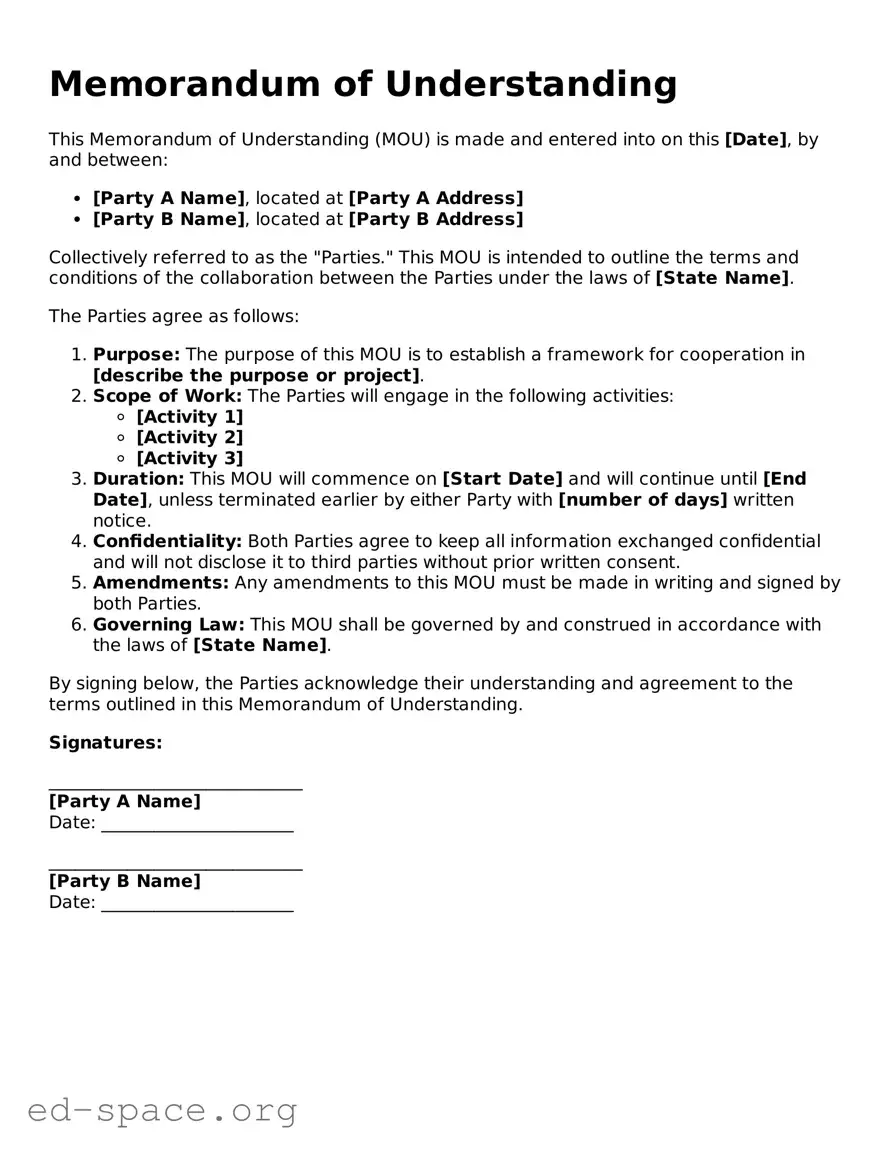
The Memorandum of Understanding (MOU) serves as a vital tool for organizations and individuals looking to establish a clear framework for collaboration. This document outlines the intentions and expectations of all parties involved, paving the way for a smoother partnership. An MOU typically includes key elements such as the purpose of the agreement, the roles and responsibilities of each party, and the timeline for the collaboration. It may also touch on confidentiality clauses and dispute resolution mechanisms, ensuring that all parties are aligned in their objectives. While not legally binding, an MOU reflects a serious commitment to work together, fostering trust and transparency. Whether used in business, education, or community projects, this form helps to clarify intentions and create a solid foundation for future interactions.
Memorandum of Understanding
This Memorandum of Understanding (MOU) is made and entered into on this [Date], by and between:
Collectively referred to as the "Parties." This MOU is intended to outline the terms and conditions of the collaboration between the Parties under the laws of [State Name].
The Parties agree as follows:
By signing below, the Parties acknowledge their understanding and agreement to the terms outlined in this Memorandum of Understanding.
Signatures:
_____________________________
[Party A Name]
Date: ______________________
_____________________________
[Party B Name]
Date: ______________________
| Fact Name | Description |
|---|---|
| Definition | A Memorandum of Understanding (MOU) is a formal agreement between two or more parties outlining their intentions and expectations. |
| Purpose | MOUs are often used to establish a mutual understanding and cooperation on specific projects or initiatives without creating legally binding obligations. |
| State-Specific Forms | In some states, MOUs may be governed by specific laws. For example, in California, the Uniform Commercial Code (UCC) may apply, while in Texas, the Texas Business and Commerce Code may be relevant. |
| Common Uses | Organizations frequently use MOUs in various contexts, such as partnerships, collaborations, and joint ventures, to clarify roles and responsibilities. |
After obtaining the Memorandum of Understanding (MOU) form, you will need to complete it accurately to ensure clarity between the involved parties. Follow these steps to fill out the form effectively.
What is a Memorandum of Understanding (MOU)?
A Memorandum of Understanding (MOU) is a formal agreement between two or more parties. It outlines the intentions and expectations of the parties involved regarding a specific project or partnership. While an MOU is not legally binding, it serves as a valuable tool for clarifying roles, responsibilities, and objectives, helping to prevent misunderstandings in the future.
When should I use an MOU?
An MOU is particularly useful in situations where parties wish to collaborate but do not want to enter into a legally binding contract. Common scenarios include partnerships between organizations, joint ventures, or cooperative agreements. If you want to establish a clear understanding of each party's contributions and expectations, an MOU can provide a solid foundation for your collaboration.
What should be included in an MOU?
An effective MOU typically includes several key components: the purpose of the agreement, the roles and responsibilities of each party, the duration of the agreement, and any specific terms or conditions that must be met. Additionally, it may outline how disputes will be resolved and any confidentiality requirements. The more detailed the MOU, the better it can serve its purpose in guiding the relationship between the parties.
Is an MOU legally binding?
Generally, an MOU is not legally binding, but it can carry weight in negotiations and discussions. The intent behind the MOU is crucial; if the language suggests that the parties intend to create a binding agreement, it may be treated as such by a court. Therefore, it is essential to be clear about the non-binding nature of the MOU if that is the intention.
How do I create an MOU?
Creating an MOU involves a few straightforward steps. First, identify the parties involved and outline the purpose of the agreement. Next, discuss and agree on the roles and responsibilities of each party. Draft the document, ensuring clarity and detail in every section. Finally, have all parties review the MOU and sign it to indicate their agreement. While legal assistance is not always necessary, consulting with a professional can help ensure that the MOU meets all necessary requirements.
Can an MOU be modified after it is signed?
Yes, an MOU can be modified after it is signed, provided all parties agree to the changes. It is important to document any modifications in writing, ideally as an addendum to the original MOU. This helps maintain clarity and ensures that all parties are on the same page regarding the updated terms. Communication is key; always discuss any proposed changes openly and collaboratively.
Incomplete Information: One common mistake is leaving sections of the form blank. Each party involved should ensure that all relevant details are filled out completely. This includes names, addresses, and specific terms of the agreement.
Ambiguous Language: Using vague terms can lead to misunderstandings. It’s important to define key terms clearly. This will help all parties understand their rights and obligations under the agreement.
Not Specifying the Duration: Failing to include the duration of the agreement can create confusion. Parties should clearly state how long the terms will be in effect and any conditions for renewal or termination.
Ignoring Legal Compliance: Some individuals overlook the need to ensure that the agreement complies with applicable laws. It is essential to consider local regulations and any industry-specific requirements to avoid potential legal issues.
Failure to Review: Skipping the review process is a mistake that can lead to serious issues later. All parties should carefully read the document before signing. This ensures that everyone agrees with the terms and conditions outlined in the Memorandum of Understanding.
A Memorandum of Understanding (MOU) serves as an important tool in establishing mutual agreements between parties. While the MOU outlines the intentions and expectations, several other documents often accompany it to ensure clarity and provide a comprehensive framework for the partnership. Below are five common forms and documents that are frequently used alongside an MOU.
In conclusion, while the Memorandum of Understanding lays the groundwork for collaboration, these accompanying documents help clarify roles, protect sensitive information, and establish expectations. By utilizing these forms, parties can foster stronger relationships and ensure a smoother path toward achieving their shared objectives.
A Memorandum of Understanding (MOU) serves as a formal agreement between parties, outlining their intentions and responsibilities. Several other documents share similarities with an MOU in terms of purpose and structure. The following list highlights ten such documents:
When filling out a Memorandum of Understanding (MOU) form, it’s essential to follow certain guidelines to ensure clarity and effectiveness. Here’s a list of things to do and avoid:
Memorandums of Understanding (MOUs) are often misunderstood. Here are six common misconceptions about MOUs, along with clarifications to help you better understand this important document.
MOUs are legally binding contracts. Many people believe that an MOU is the same as a contract. In reality, while MOUs outline intentions and agreements between parties, they are generally not legally enforceable unless explicitly stated otherwise.
MOUs are only used in business settings. While MOUs are common in business, they are also frequently used in non-profit organizations, government agreements, and even personal arrangements. Their flexibility makes them suitable for various contexts.
All MOUs must be detailed and lengthy. Some think that an effective MOU must be complex and lengthy. However, the best MOUs are often clear and concise, focusing on the essential terms and intentions of the parties involved.
MOUs can only be created by lawyers. This misconception suggests that only legal professionals can draft an MOU. In truth, anyone can create an MOU. However, it is wise to seek legal advice to ensure clarity and protect your interests.
MOUs do not require signatures. Some people believe that an MOU is valid without signatures. However, for an MOU to be recognized and taken seriously, it should be signed by all parties involved, indicating their agreement to the terms.
MOUs are permanent agreements. Many assume that once an MOU is signed, it cannot be changed or terminated. In fact, MOUs can be modified or dissolved by mutual consent, allowing for flexibility as circumstances evolve.
Understanding these misconceptions can help you navigate the use of MOUs more effectively. Being informed empowers you to create agreements that truly reflect the intentions of all parties involved.
When filling out and using the Memorandum of Understanding (MOU) form, it is important to consider the following key takeaways: