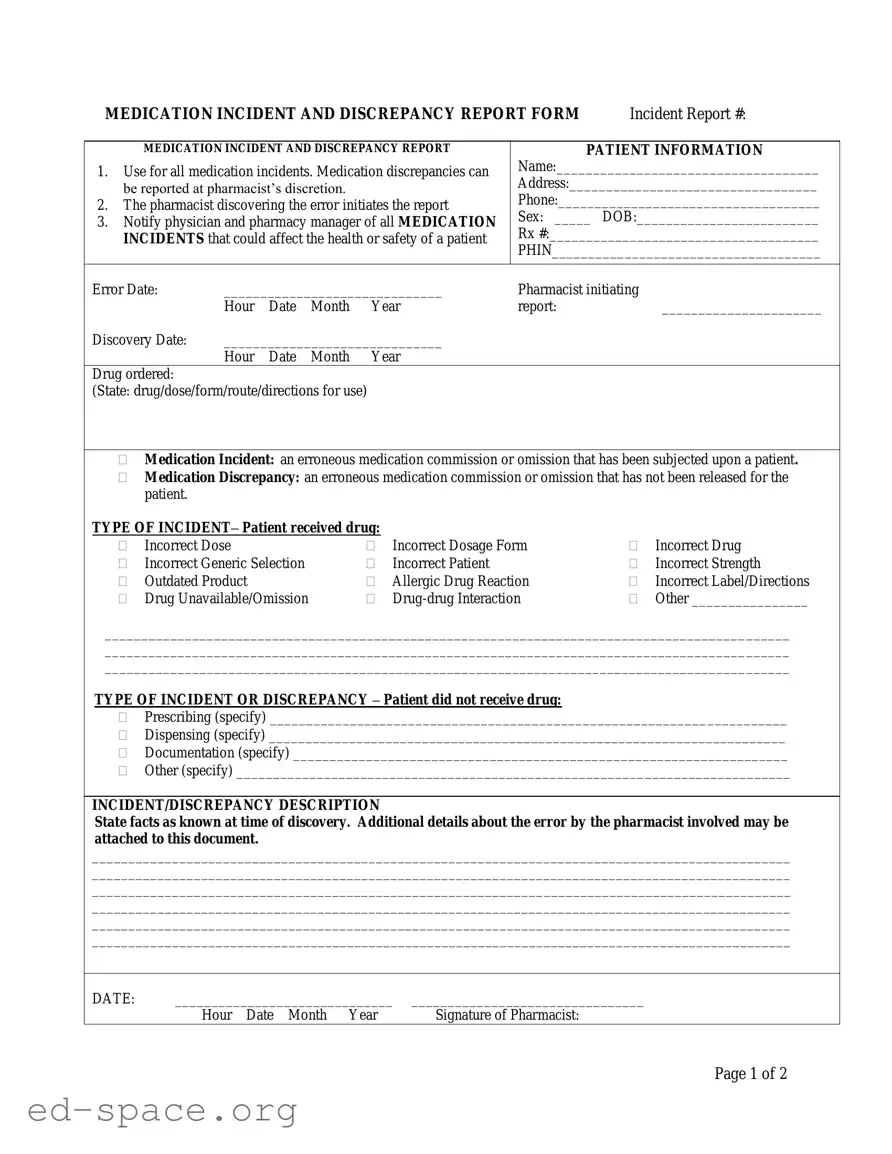
Medication errors can have serious implications for patient safety, making it essential for healthcare professionals to have a clear process for reporting and addressing these incidents. The Medication Error form serves as a vital tool in this effort. It allows pharmacists to document any medication incidents or discrepancies that occur, ensuring that all relevant details are captured. Initiated by the pharmacist who discovers the error, the form requires timely notification of both the physician and pharmacy manager for any incidents that may impact patient health. Key sections of the form include patient information, a detailed description of the incident or discrepancy, and contributing factors that may have led to the error. Additionally, the form outlines the severity of the incident and the outcome of any investigations conducted. By providing a structured format for reporting, this form helps to promote accountability and improve medication safety practices within the healthcare system.

MEDICATION INCIDENT AND DISCREPANCY REPORT FORM |
Incident Report #: |
MEDICATION INCIDENT AND DISCREPANCY REPORT
1.Use for all medication incidents. Medication discrepancies can be reported at pharmacist’s discretion.
2.The pharmacist discovering the error initiates the report
3.Notify physician and pharmacy manager of all MEDICATION INCIDENTS that could affect the health or safety of a patient
PATIENT INFORMATION
Name:____________________________________
Address:__________________________________
Phone:____________________________________
Sex: _____ DOB:_________________________
Rx #:_____________________________________
PHIN_____________________________________
Error Date: |
______________________________ |
Pharmacist initiating |
|
|||
|
Hour |
Date |
Month |
Year |
report: |
______________________ |
Discovery Date: |
______________________________ |
|
|
|||
|
Hour |
Date |
Month |
Year |
|
|
Drug ordered: |
|
|
|
|
|
|
(State: drug/dose/form/route/directions for use) |
|
|
|
|||
Medication Incident: an erroneous medication commission or omission that has been subjected upon a patient.
Medication Discrepancy: an erroneous medication commission or omission that has not been released for the patient.
TYPE OF INCIDENT– Patient received drug: |
|
|
|
||
|
Incorrect Dose |
|
Incorrect Dosage Form |
|
Incorrect Drug |
|
Incorrect Generic Selection |
|
Incorrect Patient |
|
Incorrect Strength |
|
Outdated Product |
|
Allergic Drug Reaction |
|
Incorrect Label/Directions |
|
Drug Unavailable/Omission |
|
|
Other ________________ |
|
______________________________________________________________________________________________
______________________________________________________________________________________________
______________________________________________________________________________________________
TYPE OF INCIDENT OR DISCREPANCY – Patient did not receive drug:
Prescribing (specify) _______________________________________________________________________
Dispensing (specify) _______________________________________________________________________
Documentation (specify) ____________________________________________________________________
Other (specify) ____________________________________________________________________________
INCIDENT/DISCREPANCY DESCRIPTION
State facts as known at time of discovery. Additional details about the error by the pharmacist involved may be attached to this document.
________________________________________________________________________________________________
________________________________________________________________________________________________
________________________________________________________________________________________________
________________________________________________________________________________________________
________________________________________________________________________________________________
________________________________________________________________________________________________
DATE: |
______________________________ |
________________________________ |
|
Hour Date Month Year |
Signature of Pharmacist: |
Page 1 of 2

CONTRIBUTING FACTORS
(To be completed by pharmacist responsible)
|
Improper patient identification |
Misread/misinterpreted drug order (include verbal orders) |
|
|
Incorrect transcription |
|
Drug unavailable |
Lack of patient counselling |
|
Other |
|
|
DATE: |
______________________________ |
__________________ |
|
|
||||
|
|
Hour Date Month Year |
Signature |
|
|
|
|||
|
NOTIFICATION – Complete the following information according to Standards of Practice. |
||||||||
1. |
Patient notified: |
|
|
|
|
|
|
|
|
|
|
|
___________________________ |
|
|||||
|
|
|
Hour |
Date |
Month |
Year |
|||
2. |
Physician notified: ____ |
______________________________ |
|
||||||
|
|
Yes/No |
Hour |
Date |
Month |
Year |
|||
|
|
|
|
|
|
|
|
|
|
|
SEVERITY |
|
|
|
|
|
|
|
|
|
|
None |
|
No change in patient’s condition: no medical intervention |
|||||
|
|
Minor |
|
|
|
required |
|
|
|
|
|
Major |
|
Produces a temporary systemic or localized response: does |
|||||
|
|
|
|
|
|
not cause ongoing complications |
|||
|
|
|
|
Requires immediate medical intervention |
|||||
|
OUTCOME OF INVESTIGATION |
|
|
|
|
|
|
|
|
|
|
|
|
|
|
|
|
|
|
|
|
|
|
|
|
|
|
||
|
Problem Identification |
|
|
|
Action |
|
|
|
|
|
|
Lack of knowledge |
|
|
Education provided |
||||
|
|
Performance problem |
|
|
Policy/procedure changed |
||||
|
|
Administration problem |
|
|
System changed |
|
|
||
|
|
Other |
|
|
Individual awareness |
||||
|
|
|
|
|
Group awareness |
||||
|
|
|
|
|
Other |
|
|
|
|
|
|
|
|
|
|||||
|
RESOLUTION OF PROBLEM THAT RESULTED IN THE ERROR BEING MADE: |
||||||||
|
|
|
|
|
|
|
|
||
|
Signature: |
Date: |
Signature: |
Date: |
|||||
|
(Pharmacist filling out the form) |
|
|
|
(Pharmacy Manager) |
||||
PHARMACY USE ONLY
Page 2 of 2
| Fact Name | Details |
|---|---|
| Purpose | This form is used for reporting all medication incidents and discrepancies. |
| Initiation | The pharmacist who discovers the error is responsible for initiating the report. |
| Notification Requirement | All medication incidents that could affect patient health must be reported to the physician and pharmacy manager. |
| Patient Information | Essential patient details, such as name, address, phone number, sex, and date of birth, must be included. |
| Types of Incidents | Incidents can include incorrect dose, incorrect drug, allergic reactions, and more. |
| Severity Levels | Severity of the incident is categorized from none to requiring immediate medical intervention. |
| Contributing Factors | Factors like improper patient identification or misinterpreted drug orders should be documented. |
| State-Specific Laws | Forms must comply with state-specific laws regarding medication error reporting, such as the Pharmacy Practice Act. |
After completing the Medication Error form, it will be reviewed by the pharmacy manager and appropriate actions will be taken based on the findings. This process ensures that any errors are addressed and measures are put in place to prevent future incidents.
What is the purpose of the Medication Error form?
The Medication Error form is designed to report any incidents or discrepancies related to medication. This includes both medication incidents, where a patient has received the wrong medication or dosage, and medication discrepancies, where an error occurred but the medication was not yet administered to the patient. The form helps ensure patient safety and allows for proper documentation and follow-up.
Who should initiate the Medication Error report?
The pharmacist who discovers the medication error is responsible for initiating the report. This ensures that the person with the most knowledge of the incident provides accurate information for the report.
What should be included in the incident description?
The incident description should include all known facts at the time of discovery. It is important to provide detailed information about the error, including what happened, how it happened, and any immediate actions taken. Additional details can be attached to the form if necessary.
What steps should be taken after a medication incident is reported?
After a medication incident is reported, the pharmacist must notify both the physician and the pharmacy manager. This notification is crucial for ensuring that the patient’s health and safety are prioritized and that appropriate follow-up actions can be taken.
What types of incidents can be reported using this form?
The form can be used to report various types of medication incidents, including incorrect doses, incorrect drugs, allergic reactions, and drug-drug interactions, among others. It can also document discrepancies, such as prescribing or dispensing errors.
What information is required for patient notification?
When notifying the patient about a medication incident, the report must include the date and time of notification. This ensures that there is a clear record of communication regarding the incident and any potential impacts on the patient’s health.
How is the severity of the incident assessed?
The severity of the incident is assessed based on the impact on the patient’s condition. The form includes categories ranging from no change in condition to incidents requiring immediate medical intervention. This assessment helps determine the necessary follow-up actions and educational needs.
Failing to provide complete patient information, including name, address, phone number, sex, and date of birth. Incomplete data can hinder proper follow-up and resolution.
Not specifying the error date and discovery date accurately. These dates are crucial for tracking the timeline of the incident.
Neglecting to clearly state the type of incident. It is essential to identify whether the patient received the drug incorrectly or did not receive it at all.
Using vague language in the incident/discrepancy description. Providing clear and detailed information is vital for understanding the context and circumstances of the error.
Omitting the contributing factors that led to the incident. Identifying these factors can help prevent future occurrences.
Failing to notify the physician and pharmacy manager as required. Timely notification is critical for patient safety and appropriate medical response.
Not indicating the severity of the incident. This classification helps in assessing the impact on the patient and determining the necessary actions.
Forgetting to document the resolution of the problem that led to the error. This information is important for accountability and improvement of practices.
Neglecting to sign and date the form. The signatures of both the pharmacist and pharmacy manager validate the report and ensure accountability.
Not attaching any additional details or documentation that may provide further context. Supplementary information can be crucial for a comprehensive understanding of the incident.
When dealing with medication errors, several other forms and documents may be necessary to ensure proper reporting, tracking, and resolution. Each of these documents serves a unique purpose and helps maintain patient safety and quality of care. Below is a list of commonly used forms alongside the Medication Error form.
Utilizing these forms and documents in conjunction with the Medication Error form can significantly enhance the safety and quality of patient care. Proper documentation and follow-up not only address immediate concerns but also contribute to long-term improvements in healthcare practices.
When filling out the Medication Error form, it is crucial to ensure accuracy and clarity. Here are nine important guidelines to follow:
Misconception 1: The Medication Error form is only for serious incidents.
In reality, this form can be used for all medication incidents, regardless of their severity. It is important to report any discrepancies, as even minor errors can provide valuable insights for improving patient safety.
Misconception 2: Only pharmacists can initiate a Medication Error report.
While the pharmacist discovering the error does initiate the report, any healthcare professional who witnesses or is aware of a medication incident can contribute to the reporting process. Collaboration is key to ensuring patient safety.
Misconception 3: Reporting a medication error will lead to punishment.
It is crucial to understand that the purpose of the Medication Error form is to improve safety and prevent future incidents. The focus is on learning and enhancing practices, not on assigning blame.
Misconception 4: The form is only relevant to the pharmacy team.
This form is significant for the entire healthcare team. Notifying the physician and pharmacy manager about medication incidents is essential, as it impacts patient care and safety across all departments.
Misconception 5: All medication discrepancies are the same.
Medication discrepancies can vary widely. They can involve incorrect dosages, wrong drugs, or even issues related to patient documentation. Each type of incident requires specific attention and reporting to address the underlying causes effectively.
Filling out and using the Medication Error form is essential for maintaining patient safety and improving pharmacy practices. Here are key takeaways to consider:
Using this form effectively contributes to a safer medication management process and enhances communication within the healthcare team.