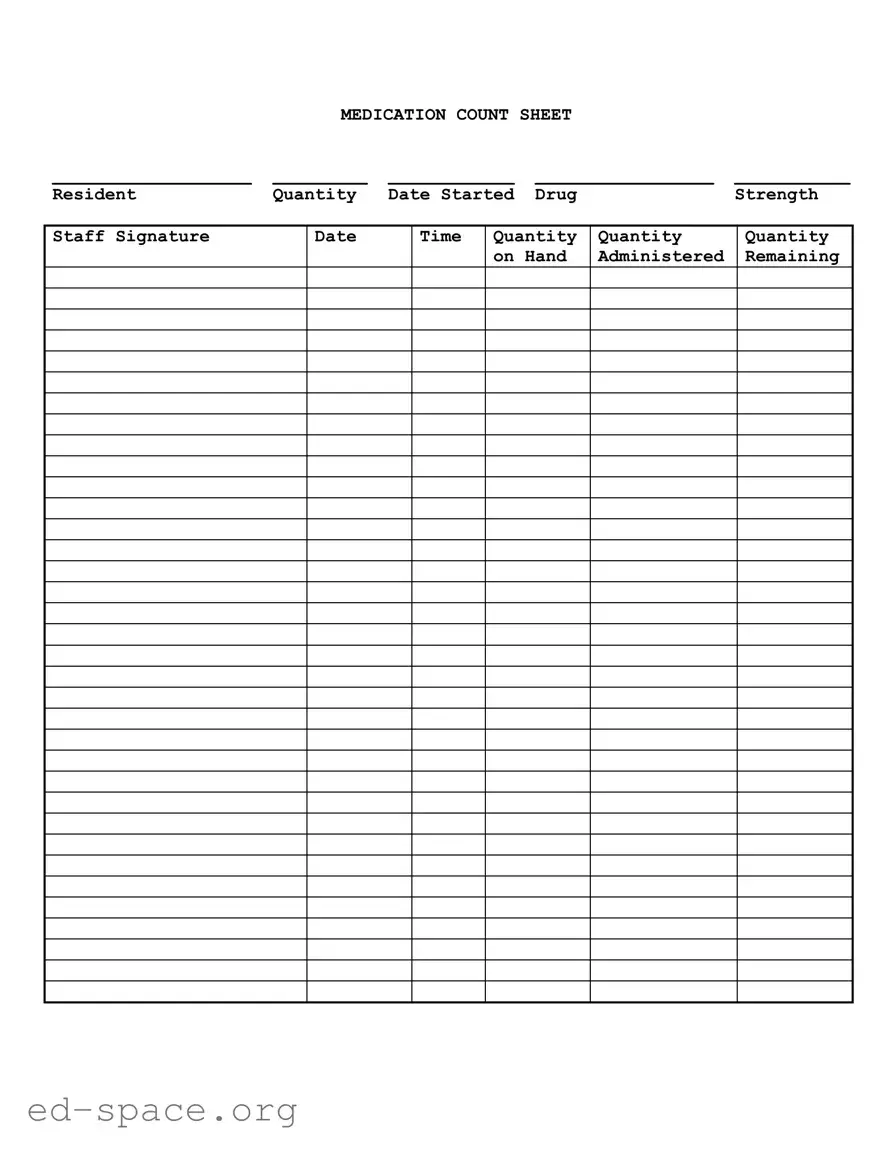
The Medication Count Sheet is an essential tool used in healthcare settings to track medication administration for residents. This form helps ensure accurate record-keeping and accountability in managing medications. Each sheet includes key sections such as the resident's name, the quantity of medication, and the date it was started. It also specifies the drug's strength, which is crucial for proper dosing. Staff members are required to sign the sheet, providing an additional layer of verification. Furthermore, the form captures the date and time of administration, along with the quantities administered and remaining on hand. By organizing this information clearly, the Medication Count Sheet promotes safety and efficiency in medication management, allowing healthcare providers to monitor and respond to residents' needs effectively.

|
MEDICATION COUNT SHEET |
|
||
___________________ |
_________ |
____________ |
_________________ |
___________ |
Resident |
Quantity |
Date Started |
Drug |
Strength |
Staff Signature
Date
Time
Quantity |
Quantity |
Quantity |
on Hand |
Administered |
Remaining |
|
|
|
| Fact Name | Description |
|---|---|
| Purpose | The Medication Count Sheet is used to track the quantity of medications administered to residents in a healthcare facility. |
| Resident Information | The form includes fields for the resident's name, ensuring accurate record-keeping for each individual. |
| Date Started | This section allows staff to document when the medication regimen began, which is crucial for monitoring treatment effectiveness. |
| Drug Strength | The sheet requires the entry of the drug's strength, providing clarity on the dosage being administered. |
| Staff Signature | A signature from the administering staff is necessary to validate the administration of medication and maintain accountability. |
| Quantity Tracking | Staff must record the quantity on hand, administered, and remaining to ensure proper inventory management and prevent medication errors. |
| Governing Laws | In many states, such as California, the use of medication count sheets is governed by regulations under the California Code of Regulations, Title 22, which outlines medication management in healthcare facilities. |
Completing the Medication Count Sheet form is essential for maintaining accurate records of medication administration. This process ensures that all medications are accounted for, which is crucial for both patient safety and compliance with regulatory standards. Below are the steps to fill out this form effectively.
What is the purpose of the Medication Count Sheet?
The Medication Count Sheet is designed to track the administration and inventory of medications for residents. It helps ensure that the correct dosage is given at the right times and provides a clear record of what medications are on hand, what has been administered, and what remains. This accountability is crucial for both patient safety and regulatory compliance.
What information is required on the Medication Count Sheet?
Each Medication Count Sheet must include the resident's name, the quantity of medication, the date the medication was started, the drug's strength, and the signatures of the staff administering the medication. Additionally, it should document the date and time of administration, as well as the quantities administered and remaining. This comprehensive information helps maintain an accurate record of medication usage.
How often should the Medication Count Sheet be updated?
The Medication Count Sheet should be updated every time medication is administered or when there is a change in the quantity on hand. Regular updates ensure that the records reflect the current status of medications, which is essential for effective management and oversight.
Who is responsible for filling out the Medication Count Sheet?
The responsibility for filling out the Medication Count Sheet typically falls to the staff members who administer the medications. This includes nurses and other healthcare professionals. Each staff member must ensure that the information is accurate and complete to maintain accountability and safety.
What should be done if there is a discrepancy in the Medication Count Sheet?
If a discrepancy is found—such as a difference between the expected quantity and the actual quantity on hand—it is crucial to investigate immediately. Staff should recount the medications and verify the records. If the discrepancy cannot be resolved, it may need to be reported to a supervisor or the appropriate regulatory body, depending on the facility's policies.
Can the Medication Count Sheet be used for multiple residents?
No, each Medication Count Sheet should be specific to an individual resident. This practice ensures that all medication records are clear and organized, making it easier to track each resident's medication history and avoid potential mix-ups.
How should the Medication Count Sheet be stored?
After completion, the Medication Count Sheet should be stored securely in a designated area, such as a medication administration record file. It is essential to maintain confidentiality and protect sensitive health information. Access should be limited to authorized personnel only.
What happens if the Medication Count Sheet is lost or damaged?
If the Medication Count Sheet is lost or damaged, it is important to report the incident to a supervisor immediately. A new sheet should be started, and efforts should be made to reconstruct the lost information as accurately as possible. Documentation of the loss should also be maintained for accountability.
Failing to complete all required fields. Each section of the Medication Count Sheet is important. Missing information can lead to confusion and potential medication errors.
Not recording the correct date and time. Accurate timestamps are essential for tracking medication administration. Inaccuracies can cause discrepancies in medication management.
Using inconsistent terminology. When documenting medication names or strengths, consistency is key. Variations can create misunderstandings among staff members.
Neglecting to update the quantity on hand. After administering medication, it’s crucial to adjust the count. Failing to do so can lead to over- or under-dosing.
Forgetting to initial or sign the sheet. Staff signatures are a vital part of accountability. Without them, it’s unclear who administered the medication.
Not double-checking calculations. When counting remaining medication, errors can easily occur. A quick review can prevent significant issues down the line.
Overlooking staff training on the form. Ensuring that all staff members understand how to fill out the Medication Count Sheet properly is essential for maintaining safety and compliance.
The Medication Count Sheet is an essential document used to track medication inventory and administration in healthcare settings. Along with this form, several other documents are often utilized to ensure proper medication management and compliance. Below is a list of related forms that support effective medication administration and monitoring.
These forms work together to create a comprehensive system for managing medications safely and effectively. Proper use of these documents can help prevent errors and ensure that residents receive the best possible care.
The Medication Count Sheet form is an important document in healthcare settings, particularly in managing medication for residents. There are several other documents that share similarities with the Medication Count Sheet. Here is a list of those documents:
When filling out the Medication Count Sheet form, it is essential to follow specific guidelines to ensure accuracy and compliance. Below is a list of dos and don'ts to consider:
The Medication Count Sheet form is an important tool in healthcare settings, yet several misconceptions exist about its use and purpose. Below are some common misunderstandings:
Filling out and using the Medication Count Sheet form is crucial for accurate medication management. Here are some key takeaways to keep in mind: