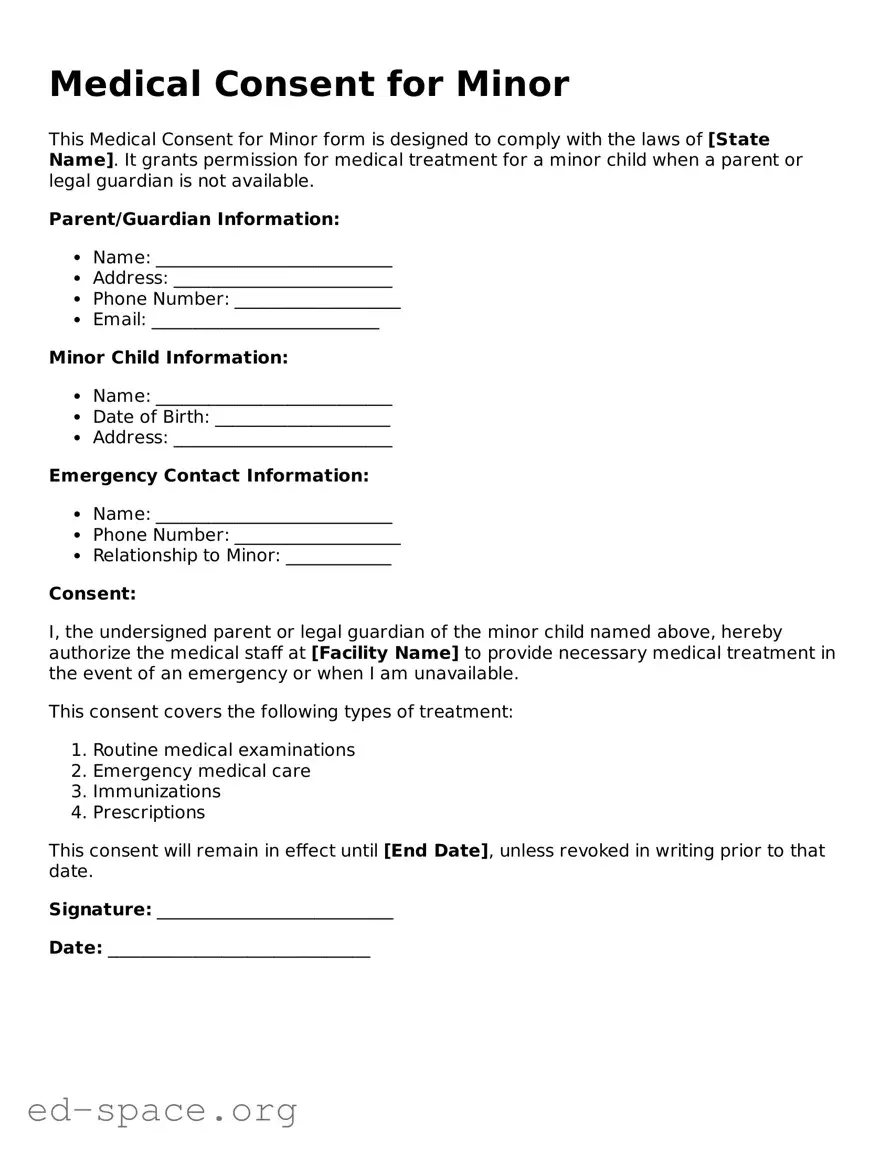
When it comes to the health and well-being of children, parents and guardians often face the important task of making medical decisions on their behalf. The Medical Consent for Minor form plays a crucial role in this process, serving as a legal document that grants healthcare providers the authority to treat a minor in the absence of their parent or legal guardian. This form typically includes essential information such as the minor's name, date of birth, and the specific medical treatments or procedures that are authorized. Additionally, it may outline any limitations on the consent, ensuring that parents maintain control over their child’s healthcare decisions. By signing this form, guardians can provide necessary consent for routine medical care, emergency treatments, and even specialized procedures, all while ensuring that their child's health needs are met promptly. Understanding the importance and implications of this form can empower caregivers to make informed choices, ultimately safeguarding the well-being of their loved ones.
Medical Consent for Minor
This Medical Consent for Minor form is designed to comply with the laws of [State Name]. It grants permission for medical treatment for a minor child when a parent or legal guardian is not available.
Parent/Guardian Information:
Minor Child Information:
Emergency Contact Information:
Consent:
I, the undersigned parent or legal guardian of the minor child named above, hereby authorize the medical staff at [Facility Name] to provide necessary medical treatment in the event of an emergency or when I am unavailable.
This consent covers the following types of treatment:
This consent will remain in effect until [End Date], unless revoked in writing prior to that date.
Signature: ___________________________
Date: ______________________________
| Fact Name | Description |
|---|---|
| Purpose | The Medical Consent for Minor form allows a parent or guardian to authorize medical treatment for a minor child. |
| Legal Requirement | Most states require parental consent for medical procedures performed on minors. |
| Governing Laws | In California, for example, the Family Code Section 6910 governs medical consent for minors. |
| Who Can Sign | Only a parent or legal guardian can sign this form on behalf of the minor. |
| Emergency Situations | In emergencies, healthcare providers may proceed with treatment even without consent. |
| Duration | The consent is typically valid for a specific period or until revoked. |
| Revocation | A parent or guardian can revoke consent at any time, but must do so in writing. |
| Specific Treatments | The form may specify certain treatments or procedures for which consent is granted. |
| Confidentiality | Medical information regarding the minor remains confidential, even with consent. |
| State Variations | Each state has its own version of the form, reflecting local laws and requirements. |
Completing the Medical Consent for Minor form is an important step in ensuring that a child receives necessary medical care when a parent or guardian cannot be present. This form allows designated individuals to make medical decisions on behalf of the minor. Follow these steps carefully to fill out the form accurately.
After completing the form, ensure that copies are provided to all relevant parties, including the authorized individuals and the healthcare provider. Keeping a copy for personal records is also advisable.
What is a Medical Consent for Minor form?
The Medical Consent for Minor form is a legal document that allows a parent or guardian to give permission for medical treatment for a child under the age of 18. This form is essential in situations where the parent or guardian cannot be present to provide consent in person.
Who needs to sign the Medical Consent for Minor form?
The form must be signed by a parent or legal guardian of the minor. If both parents are available, it is advisable for both to sign. In cases where a guardian is responsible for the child, that individual must sign the form to ensure proper authorization for medical care.
When is the Medical Consent for Minor form required?
This form is typically required in emergency situations, school field trips, or any instance where medical treatment may be necessary, and the parent or guardian is not available to provide immediate consent. It is also useful for camps, sports activities, or other events where medical care might be needed.
What information is included in the Medical Consent for Minor form?
The form generally includes the child's name, date of birth, and medical history, as well as the names and contact information of the parent or guardian. It may also require details about any allergies, current medications, and specific medical conditions that healthcare providers should be aware of.
Can the Medical Consent for Minor form be revoked?
Yes, a parent or guardian can revoke the consent at any time. This can be done by notifying the healthcare provider in writing. It is important to communicate this change clearly to ensure that the child’s medical care is managed according to the latest instructions.
Is the Medical Consent for Minor form valid in all states?
While the Medical Consent for Minor form is generally recognized across the United States, specific requirements can vary by state. It is advisable to check local laws to ensure compliance and validity of the form in the relevant jurisdiction.
What happens if a Medical Consent for Minor form is not provided?
If a Medical Consent for Minor form is not available, healthcare providers may face challenges in administering treatment. In emergencies, they may proceed with necessary care, but without consent, non-emergency treatments may be delayed until authorization is obtained.
How long is the Medical Consent for Minor form valid?
The validity of the Medical Consent for Minor form can vary. Typically, it remains in effect until the child turns 18 or until the parent or guardian revokes it. Some forms may specify a duration, especially for specific events like camps or trips.
Where can I obtain a Medical Consent for Minor form?
Medical Consent for Minor forms can often be obtained from healthcare providers, schools, or online resources. It is important to ensure that the form used meets all legal requirements and includes all necessary information for effective medical care.
Incomplete Information: Many individuals fail to fill out all required fields. This can lead to delays in treatment or complications in emergency situations. Ensure that every section is thoroughly completed.
Incorrect Signatures: Parents or guardians sometimes forget to sign the form or use the wrong signature. It is essential that the person providing consent is the legal guardian and that they sign where indicated.
Outdated Information: Some people use old forms that do not reflect current laws or medical practices. Always check that you are using the most recent version of the consent form.
Failure to Specify Limitations: Not indicating any specific limitations or conditions can lead to misunderstandings. Clearly state any restrictions on treatment to avoid confusion later on.
When it comes to ensuring that a minor receives necessary medical care, the Medical Consent for Minor form is essential. However, several other forms and documents often accompany it to provide a comprehensive approach to medical consent and care for minors. Below is a list of commonly used documents that may be required in conjunction with the Medical Consent for Minor form.
These documents work together to ensure that minors receive the appropriate medical care while protecting their rights and the interests of their families. Having these forms ready can help streamline the process and provide peace of mind during medical emergencies or routine care.
The Medical Consent for Minor form is an important document that allows a parent or guardian to authorize medical treatment for a child. Several other documents serve similar purposes in different contexts. Below are six such documents, each with a brief explanation of how they relate to the Medical Consent for Minor form.
When filling out the Medical Consent for Minor form, it’s important to follow specific guidelines to ensure the process goes smoothly. Here’s a list of things you should and shouldn’t do:
Understanding the Medical Consent for Minor form is crucial for parents and guardians. However, several misconceptions can lead to confusion. Here are six common misunderstandings:
By clarifying these misconceptions, parents and guardians can better navigate the process of providing medical consent for minors, ensuring that their children receive the care they need.
When filling out and using the Medical Consent for Minor form, keep these key takeaways in mind: