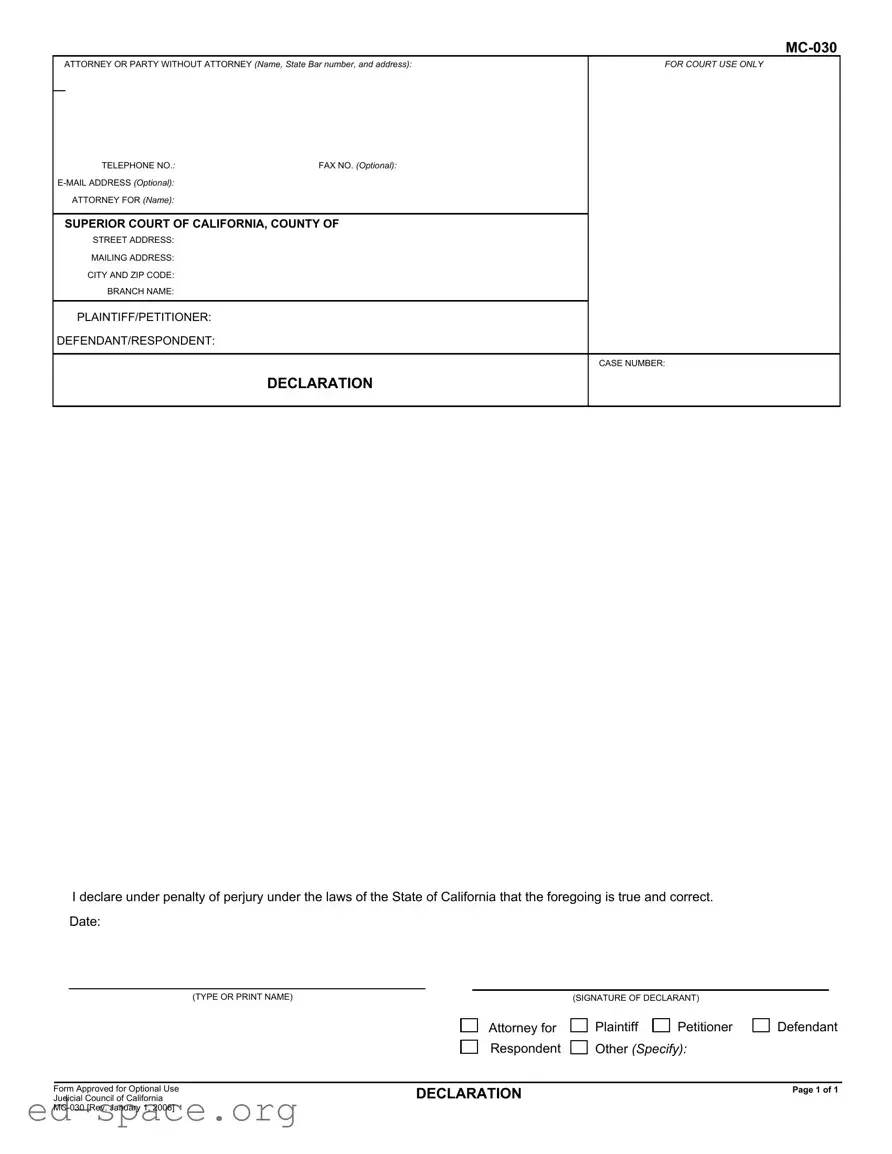
The MC-030 form is an essential document used in California's legal system, particularly for individuals representing themselves or those who are not represented by an attorney. This form serves multiple purposes, primarily allowing a party to declare specific information relevant to their case. It includes sections for the name and contact details of the individual or attorney involved, ensuring that the court has accurate information for communication. Additionally, the MC-030 requires the declaration to be signed under penalty of perjury, which emphasizes the importance of honesty and accuracy in legal proceedings. The form is designed to be user-friendly, allowing parties to specify their role in the case—whether as a plaintiff, petitioner, defendant, or respondent. By providing a clear framework for declarations, the MC-030 aids in maintaining the integrity of the judicial process while ensuring that all parties are appropriately identified and represented.
ATTORNEY OR PARTY WITHOUT ATTORNEY (Name, State Bar number, and address): |
FOR COURT USE ONLY |
TELEPHONE NO.: |
FAX NO. (Optional): |
|
|
ATTORNEY FOR (Name): |
|
SUPERIOR COURT OF CALIFORNIA, COUNTY OF
STREET ADDRESS:
MAILING ADDRESS:
CITY AND ZIP CODE:
BRANCH NAME:
PLAINTIFF/PETITIONER:
DEFENDANT/RESPONDENT:
CASE NUMBER:
DECLARATION
I declare under penalty of perjury under the laws of the State of California that the foregoing is true and correct.
Date:
(TYPE OR PRINT NAME) |
(SIGNATURE OF DECLARANT) |
|
|
|
||||||
|
|
Attorney for |
|
Plaintiff |
|
|
Petitioner |
|
|
Defendant |
|
|
|
|
|
|
|
||||
|
|
|
|
|
|
|||||
|
|
Respondent |
|
Other (Specify): |
|
|
|
|||
|
|
|
|
|
|
|||||
Form Approved for Optional Use Judicial Council of California
DECLARATION
Page 1 of 1
| Fact Name | Details |
|---|---|
| Purpose | The MC-030 form is used by attorneys or parties representing themselves in court to declare their information and the nature of their representation. |
| Governing Law | This form is governed by the California Rules of Court, specifically Rule 1.100. |
| Form Approval | The MC-030 form is approved for optional use by the Judicial Council of California. |
| Information Required | It requires the name, State Bar number, address, and contact information of the attorney or party, along with the case details. |
| Declaration Statement | Signers must declare under penalty of perjury that the information provided is true and correct. |
| Revision Date | The current version of the MC-030 form was last revised on January 1, 2006. |
Filling out the MC-030 form is an important step in your legal process. After completing the form, you will submit it to the appropriate court. This ensures that your declaration is officially recorded and considered in your case.
What is the MC-030 form used for?
The MC-030 form is primarily used in California courts for declarations. A declaration is a formal statement made under penalty of perjury. This form allows individuals, whether they are represented by an attorney or not, to provide a sworn statement that may be necessary for their case. It is important for parties to submit this form when they need to declare facts that support their position in a legal matter.
Who can file the MC-030 form?
Anyone involved in a legal proceeding in California can file the MC-030 form. This includes parties who are representing themselves, as well as attorneys acting on behalf of their clients. The form requires the name and contact information of the individual or attorney filing it, ensuring that the court can easily reach the declarant if necessary.
What information is required on the MC-030 form?
The MC-030 form requires several key pieces of information. This includes the name of the declarant, their State Bar number (if applicable), and their contact details such as telephone number, fax number, and email address. Additionally, it requires the name of the party they are representing, the case number, and the relevant court information, including the address and branch name. Finally, the declarant must sign and date the form, affirming that the information provided is true and correct.
Is the MC-030 form mandatory for all cases?
No, the MC-030 form is not mandatory for all cases. It is specifically used when a declaration is necessary to support a motion or other court filing. If the court does not require a declaration, then this form may not be needed. However, when a declaration is required to substantiate claims or provide evidence, the MC-030 form becomes essential.
What happens if I do not file the MC-030 form when required?
If you fail to file the MC-030 form when it is required, it may negatively impact your case. The court may not consider your statements or evidence, which could lead to unfavorable outcomes. It is crucial to adhere to court requirements and submit all necessary forms to ensure that your case is properly presented and considered.
Neglecting to provide complete contact information: Individuals often forget to fill in their telephone number, fax number, or email address, which can hinder communication with the court.
Omitting the case number: Failing to include the case number can lead to delays in processing, as the court may struggle to locate the relevant case file.
Not signing the form: A common oversight is neglecting to sign the declaration. Without a signature, the form is not valid.
Incorrectly identifying the role: Some individuals mistakenly select the wrong designation (e.g., plaintiff, defendant) when indicating their role in the case, which can lead to confusion.
Failing to print or type the name clearly: Illegible handwriting can result in misunderstandings or processing errors, so clarity is essential.
Leaving out the date: Not including the date of declaration can create complications, as the court needs to know when the declaration was made.
Using outdated versions of the form: Submitting an old version of the MC-030 form can lead to rejection, as courts require the most current version.
Ignoring optional fields: While optional fields like fax number and email address may seem unimportant, providing them can facilitate better communication.
Failing to check for accuracy: Individuals sometimes do not double-check their entries for typos or inaccuracies, which can result in unnecessary complications.
Not reviewing court-specific requirements: Each court may have unique requirements for submitting forms. Ignoring these can lead to rejection or delays.
The MC-030 form is an important document used in California courts, primarily for declarations made under penalty of perjury. When filing this form, there are several other documents that might also be required or helpful in the legal process. Below is a list of these forms and documents, each serving a specific purpose in court proceedings.
These forms and documents work together to facilitate communication and ensure that all parties are heard in the legal process. Understanding their roles can help individuals navigate the complexities of the court system more effectively.
The MC-030 form is a declaration form used in California courts. It serves to provide a sworn statement regarding certain facts in a legal proceeding. Several other documents serve similar purposes in legal contexts. Below is a list of ten documents that share similarities with the MC-030 form:
When filling out the MC-030 form, there are several important things to keep in mind. Here’s a straightforward list of dos and don’ts to help you navigate the process.
Following these guidelines will help ensure that your form is filled out correctly and accepted by the court.
Understanding the MC-030 form can be challenging. Here are five common misconceptions about it:
Being informed about these misconceptions can help you navigate the legal process more effectively.
When filling out and using the MC-030 form, there are several important aspects to keep in mind. This form is essential for individuals representing themselves or their clients in legal proceedings in California. Here are four key takeaways: