When planning a film, photo shoot, or any creative project, securing the right permissions is crucial. The Location Release form plays a vital role in this process, serving as a legal agreement between the property owner and the production team. This document outlines the specific terms under which the location can be used, ensuring that all parties understand their rights and responsibilities. It typically includes details such as the duration of use, any compensation involved, and the scope of activities permitted on the property. Additionally, the form protects the property owner by limiting liability and ensuring that the production team respects the location. Without this essential document, you risk potential disputes and legal complications that could derail your project. Understanding and utilizing a Location Release form can save time and resources while fostering a professional relationship between creatives and property owners.
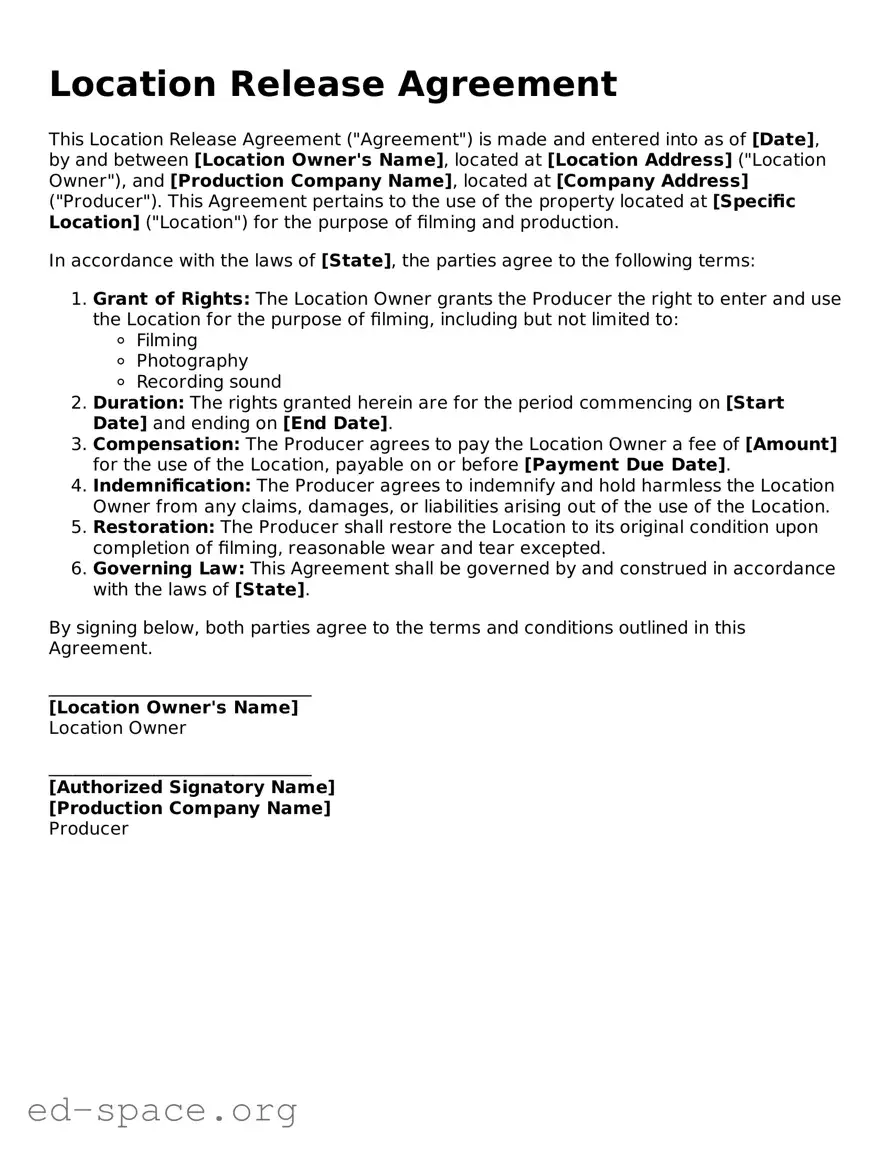
Location Release Agreement
This Location Release Agreement ("Agreement") is made and entered into as of [Date], by and between [Location Owner's Name], located at [Location Address] ("Location Owner"), and [Production Company Name], located at [Company Address] ("Producer"). This Agreement pertains to the use of the property located at [Specific Location] ("Location") for the purpose of filming and production.
In accordance with the laws of [State], the parties agree to the following terms:
By signing below, both parties agree to the terms and conditions outlined in this Agreement.
______________________________
[Location Owner's Name]
Location Owner
______________________________
[Authorized Signatory Name]
[Production Company Name]
Producer
| Fact Name | Description |
|---|---|
| Purpose | A Location Release form grants permission to use a specific location for filming or photography. |
| Parties Involved | The form typically involves the property owner and the production company or individual seeking to use the location. |
| Consideration | In many cases, the property owner may receive compensation for the use of their location. |
| Governing Law (California) | In California, the form is governed by the California Civil Code, particularly sections related to property rights. |
| Governing Law (New York) | In New York, the form falls under the New York Real Property Law, which addresses property use and rights. |
| Duration of Use | The form should specify the duration for which the location can be used, ensuring clarity for both parties. |
| Liability Protection | The form often includes clauses that protect the production company from liability related to the use of the location. |
| Signature Requirement | A valid Location Release form must be signed by the property owner to be enforceable. |
After obtaining the Location Release form, you will need to fill it out accurately to ensure all necessary information is provided. This form is essential for documenting the agreement regarding the use of a specific location. Follow the steps carefully to complete the form without any errors.
What is a Location Release form?
A Location Release form is a legal document that grants permission to use a specific location for filming, photography, or other media projects. This form ensures that the property owner agrees to the use of their space and outlines any terms or conditions associated with that use. It's a way to protect both the property owner and the production team by clearly defining rights and responsibilities.
Why do I need a Location Release form?
Using a location without permission can lead to legal issues, including potential lawsuits for trespassing or copyright infringement. A Location Release form provides legal protection by ensuring that you have explicit permission from the property owner. It also helps clarify what can and cannot be done on the property, which can prevent misunderstandings down the line.
What should be included in a Location Release form?
A comprehensive Location Release form should include several key elements. First, it should identify the property owner and the location being used. Next, it should outline the specific dates and times when the location will be used. Additionally, the form should detail any compensation, if applicable, and any specific terms or conditions set by the property owner. Finally, both parties should sign the document to make it legally binding.
Can I use a Location Release form for private residences?
Yes, you can use a Location Release form for private residences. In fact, it's highly recommended. Homeowners may have specific concerns about privacy and property damage, so having a signed agreement can help address those issues. It’s important to communicate openly with the homeowner about your plans and ensure they feel comfortable with the use of their space.
What happens if I don’t use a Location Release form?
If you choose not to use a Location Release form, you risk facing legal challenges. The property owner may claim that you trespassed or used their property without permission. This can lead to costly legal disputes, including potential damages or fines. In short, not having a Location Release form can jeopardize your project and your reputation in the industry.
Failing to provide complete contact information. It is essential to include a phone number and email address for any necessary follow-up.
Not specifying the exact location. A clear description or address of the location being released is crucial to avoid any confusion.
Omitting the dates of use. Clearly state the start and end dates for the permission granted, as this helps define the scope of the release.
Neglecting to sign the form. A signature is required to validate the agreement. Without it, the release may not be considered legally binding.
Forgetting to include any restrictions. If there are specific conditions or limitations regarding the use of the location, these should be clearly outlined.
Using unclear language. It is important to be precise and straightforward in the wording to prevent misunderstandings.
Not providing the name of the individual or entity requesting the release. Including this information helps establish who is authorized to use the location.
Leaving out the purpose of the use. Clearly stating why the location is being used can help clarify the intent of the release.
Failing to review the form before submission. Taking a moment to double-check for errors or omissions can save time and prevent issues later.
Not keeping a copy of the completed form. Retaining a copy for personal records is wise, as it provides proof of the agreement.
When working on a project that involves filming or photography at a specific location, it’s essential to have the proper documentation in place. The Location Release form is just one of the many important documents that help protect your rights and clarify permissions. Below is a list of other forms and documents that are often used in conjunction with the Location Release form. Each of these documents plays a crucial role in ensuring a smooth production process.
Having these documents in place not only streamlines the production process but also helps mitigate potential legal issues. It’s crucial to ensure that every aspect of your project is well-documented and agreed upon by all parties involved. This proactive approach will contribute to a successful and hassle-free production experience.
The Location Release form is an important document used in various situations. There are several other documents that serve similar purposes. Here are four documents that share similarities with the Location Release form:
When filling out a Location Release form, attention to detail is crucial. Below are ten recommendations that can help ensure the process goes smoothly.
Things You Should Do:
Things You Shouldn't Do:
When it comes to the Location Release form, there are several misconceptions that can lead to confusion. Understanding these can help you navigate the world of filming and photography more smoothly. Here are four common misconceptions:
Many people believe that only commercial endeavors require a Location Release form. However, even personal projects or student films can benefit from having one. It helps clarify permissions and protects the rights of everyone involved.
Some think that a handshake or a verbal agreement is enough to secure a location. In reality, having a written Location Release form provides clear documentation of the agreement. This can prevent misunderstandings and disputes down the line.
While the form does protect the location owner's rights, it also benefits the filmmaker or photographer. It ensures that they have the right to use the location as agreed upon, which can be crucial for the success of the project.
Some believe that a signed Location Release form is set in stone. However, amendments can be made if both parties agree. It’s always best to communicate any changes to ensure everyone is on the same page.
Filling out and using a Location Release form is an essential step for anyone involved in filming or photography at a specific location. Here are some key takeaways to consider: