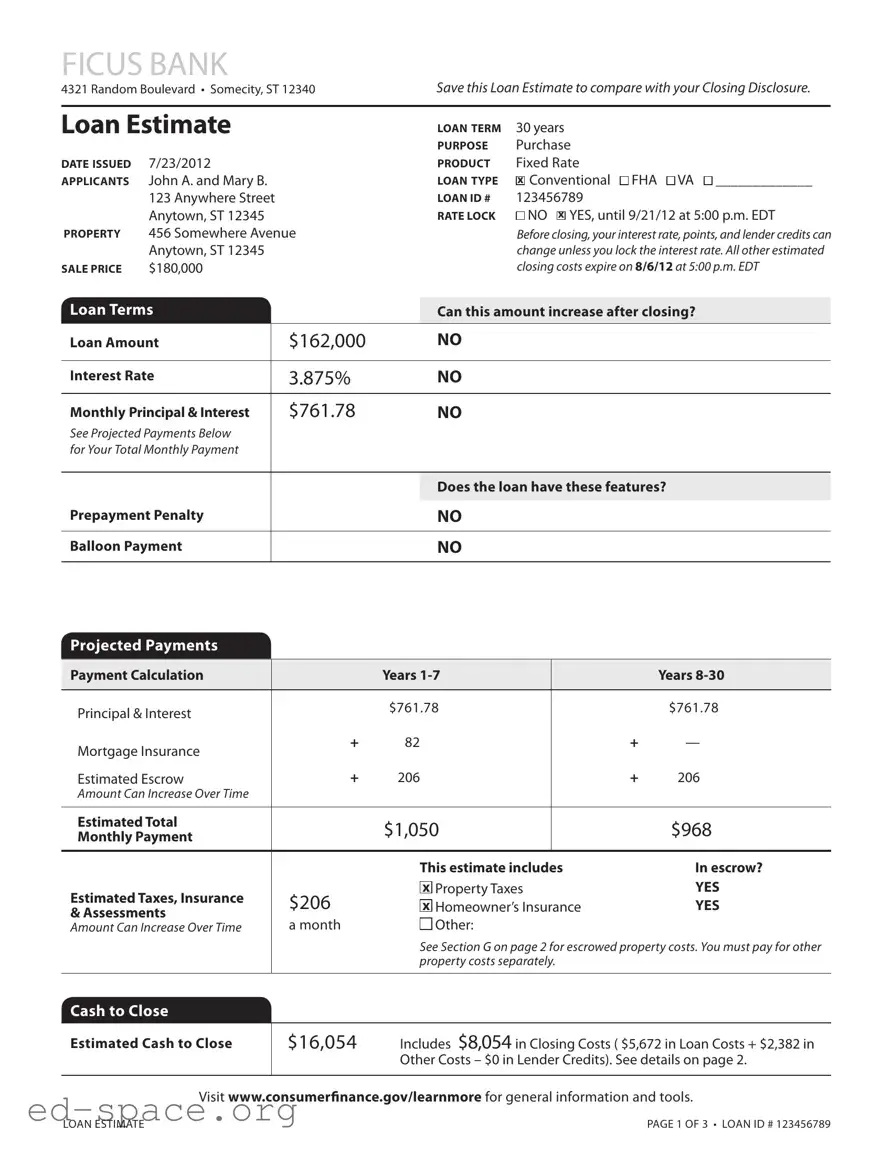
The Loan Estimate form is an essential document for anyone considering a mortgage, providing a detailed overview of the loan terms and associated costs. This form outlines critical information such as the loan amount, interest rate, and monthly payments, allowing borrowers to understand their financial commitments clearly. It also includes a breakdown of closing costs, which encompass various fees related to the loan process, such as origination charges and taxes. Borrowers will find projected payments for the first several years, helping them anticipate future expenses. Additionally, the form highlights key features of the loan, including whether there are prepayment penalties or balloon payments. This document is not just a summary; it serves as a tool for comparison against other loan offers, enabling informed decisions. By providing insights into the total cash required at closing and the potential for costs to change, the Loan Estimate empowers borrowers to approach their home financing with confidence and clarity.

FICUS BANK
4321 Random Boulevard • Somecity, ST 12340Save this Loan Estimate to compare with your Closing Disclosure.
Loan estimate |
LOAN TeRM |
30 years |
|
|
|
PuRPOse |
Purchase |
DATe IssueD |
7/23/2012 |
PRODuCT |
Fixed Rate |
APPLICANTs |
John A. and Mary B. |
LOAN TyPe |
x Conventional FHA VA _____________ |
|
123 Anywhere Street |
LOAN ID # |
123456789 |
|
Anytown, ST 12345 |
RATe LOCK |
NO x YES, until 9/21/12 at 5:00 p.m. EDT |
PROPeRTy |
456 Somewhere Avenue |
|
Before closing, your interest rate, points, and lender credits can |
|
Anytown, ST 12345 |
|
change unless you lock the interest rate. All other estimated |
sALe PRICe |
$180,000 |
|
closing costs expire on 8/6/12 at 5:00 p.m. EDT |
Loan Terms |
|
Can this amount increase after closing? |
Loan Amount |
$162,000 |
NO |
|
|
|
Interest Rate |
3.875% |
NO |
|
|
|
Monthly Principal & Interest |
$761.78 |
NO |
See Projected Payments Below |
|
|
for Your Total Monthly Payment |
|
|
|
|
|
|
|
Does the loan have these features? |
Prepayment Penalty |
|
|
|
NO |
|
|
|
|
Balloon Payment |
|
NO |
|
|
|
Projected Payments
Payment Calculation |
|
years |
|
|
years |
|
|
|
|
|
|
Principal & Interest |
|
$761.78 |
|
|
$761.78 |
|
|
|
|
|
|
Mortgage Insurance |
+ |
82 |
|
+ |
— |
|
|
|
|
|
|
Estimated Escrow |
+ |
206 |
|
+ |
206 |
Amount Can Increase Over Time |
|
|
|
|
|
|
|
|
|
|
|
estimated Total |
|
$1,050 |
|
|
$968 |
Monthly Payment |
|
|
|
||
|
|
|
|
|
|
|
|
|
|
|
|
|
|
This estimate includes |
|
In escrow? |
|
estimated Taxes, Insurance |
$206 |
x Property Taxes |
|
yes |
|
x Homeowner’s Insurance |
|
yes |
|||
& Assessments |
|
||||
a month |
Other: |
|
|
||
Amount Can Increase Over Time |
|
|
|||
|
|
See Section G on page 2 for escrowed property costs. You must pay for other |
|||
|
|
property costs separately. |
|
|
|
|
|
|
|
|
|
Cash to Close |
|
|
|
|
|
|
|
|
|
||
estimated Cash to Close |
$16,054 |
Includes $8,054 in Closing Costs ( $5,672 in Loan Costs + $2,382 in |
|||
|
|
Other Costs – $0 in Lender Credits). See details on page 2. |
|||
|
|
|
|
|
|
Visit www.consumerinance.gov/learnmore for general information and tools.
LOAN ESTIMATE |
page 1 of 3 • Loan ID # 123456789 |

Closing Cost Details
Loan Costs
A. Origination Charges |
$1,802 |
.25 % of Loan Amount (Points) |
$405 |
Application Fee |
$300 |
Underwriting Fee |
$1,097 |
Other Costs
e. Taxes and Other Government Fees |
$85 |
||||||
Recording Fees and Other Taxes |
|
|
$85 |
||||
Transfer Taxes |
|
|
$0 |
||||
|
|
|
|
|
|
|
|
F. Prepaids |
|
|
$867 |
||||
Homeowner’s Insurance Premium ( |
6 months) |
$605 |
|||||
|
|
|
|
|
|
|
|
Mortgage Insurance Premium ( 0 |
months) |
$0 |
|||||
|
|
|
|
|
|
||
Prepaid Interest ( $17.44 per day for 15 days @ 3.875%) |
$262 |
||||||
Property Taxes ( 0 months) |
|
|
$0 |
||||
|
|
|
|
|
|
|
|
B. services you Cannot shop For |
$672 |
Appraisal Fee |
$405 |
Credit Report Fee |
$30 |
Flood Determination Fee |
$20 |
Flood Monitoring Fee |
$32 |
Tax Monitoring Fee |
$75 |
Tax Status Research Fee |
$110 |
G. Initial escrow Payment at Closing |
|
|
$413 |
|
Homeowner’s Insurance |
$100.83 per month for |
23mo. $202 |
||
Mortgage Insurance |
per month for |
0 |
mo. |
|
Property Taxes |
$105.30 per month for |
2 |
mo. |
$211 |
H. Other |
$1,017 |
Title – Owner’s Title Policy (optional) |
$1,017 |
C. services you Can shop For |
$3,198 |
Pest Inspection Fee |
$135 |
Survey Fee |
$65 |
Title – Insurance Binder |
$700 |
Title – Lender’s Title Policy |
$535 |
Title – Title Search |
$1,261 |
Title – Settlement Agent Fee |
$502 |
D. TOTAL LOAN COsTs (A + B + C) |
$5,672 |
I. TOTAL OTHeR COsTs (e + F + G + H) |
$2,382 |
|
|
J. TOTAL CLOsING COsTs |
$8,054 |
|
|
D + I |
$8,054 |
Lender Credits |
$0 |
Calculating Cash to Close |
|
|
|
Total Closing Costs (J) |
$8,054 |
Closing Costs Financed (Included in Loan Amount) |
$0 |
Down Payment/Funds from Borrower |
$18,000 |
Deposit |
– $10,000 |
Funds for Borrower |
$0 |
Seller Credits |
$0 |
Adjustments and Other Credits |
$0 |
estimated Cash to Close |
$16,054 |
|
|
LOAN ESTIMATE |
page 2 of 3 • Loan ID # 123456789 |

Additional Information About This Loan
LeNDeR NMLs/LICeNse ID
LOAN OFFICeR
NMLs ID
PHONe
Ficus Bank
Joe Smith 12345 [email protected]
MORTGAGe BROKeR NMLs/LICeNse ID LOAN OFFICeR NMLs ID
eMAIL PHONe
Comparisons |
use these measures to compare this loan with other loans. |
||
|
|
|
|
In 5 years |
$56,582 |
Total you will have paid in principal, interest, mortgage insurance, and loan costs. |
|
$15,773 |
Principal you will have paid of. |
||
|
|||
|
|
|
|
Annual Percentage Rate (APR) |
4.494% |
Your costs over the loan term expressed as a rate. This is not your interest rate. |
|
|
|
|
|
Total Interest Percentage (TIP) |
69.447% |
The total amount of interest that you will pay over the loan term as a |
|
|
|
percentage of your loan amount. |
|
|
|
|
|
Other Considerations
Appraisal |
We may order an appraisal to determine the property’s value and charge you for this |
|
appraisal. We will promptly give you a copy of any appraisal, even if your loan does not close. |
|
You can pay for an additional appraisal for your own use at your own cost. |
Assumption |
If you sell or transfer this property to another person, we |
|
will allow, under certain conditions, this person to assume this loan on the original terms. |
|
x will not allow this person to assume this loan on the original terms. |
Homeowner’s |
This loan requires homeowner’s insurance on the property, which you may obtain from a |
Insurance |
company of your choice that we ind acceptable. |
Late Payment |
If your payment is more than 15 days late, we will charge a late fee of 5% of the monthly |
|
principal and interest payment. |
Reinance |
Reinancing this loan will depend on your future inancial situation, the property value, and |
|
market conditions. You may not be able to reinance this loan. |
servicing |
We intend |
|
to service your loan. If so, you will make your payments to us. |
|
x to transfer servicing of your loan. |
Conirm Receipt
By signing, you are only conirming that you have received this form. You do not have to accept this loan because you have signed or received this form.
Applicant Signature |
Date |
Date |
LOAN ESTIMATE |
page 3 of 3 • Loan ID #123456789 |
| Fact Name | Details |
|---|---|
| Purpose | The Loan Estimate form provides borrowers with key information about the mortgage they are applying for, including loan terms and estimated closing costs. |
| Loan Term | This document typically outlines the loan term, which in this case is 30 years. |
| Interest Rate | The interest rate specified is 3.875%, which is fixed for the duration of the loan. |
| Projected Payments | Monthly payments are detailed, including principal and interest as well as estimated taxes and insurance. |
| Cash to Close | The estimated cash needed to close the loan is $16,054, which includes various closing costs. |
| Comparative Measures | Borrowers can compare this loan with others using metrics like Total Interest Percentage (TIP) and Annual Percentage Rate (APR). |
| Regulatory Compliance | In the U.S., the Loan Estimate form is governed by the Truth in Lending Act (TILA) and the Real Estate Settlement Procedures Act (RESPA). |
Completing the Loan Estimate form is a crucial step in the mortgage process. This form outlines the key terms and costs associated with your loan, allowing you to make informed comparisons with other offers. Follow these steps carefully to ensure accuracy.
After completing the Loan Estimate, it is essential to review the information for accuracy. This form will guide you through the next steps in the mortgage process, including comparing it with other loan offers and preparing for the closing process.
What is a Loan Estimate form?
The Loan Estimate form provides borrowers with important information about the loan they are considering. It outlines the loan terms, projected payments, and closing costs. This form helps borrowers understand their financial obligations before they finalize their mortgage agreement.
When will I receive my Loan Estimate?
You will receive your Loan Estimate within three business days after you submit a loan application. This timeline allows lenders to provide you with a detailed overview of the loan terms and costs associated with your mortgage.
What information is included in the Loan Estimate?
The Loan Estimate includes several key pieces of information, such as the loan amount, interest rate, monthly payments, estimated closing costs, and cash to close. It also details whether the loan has features like prepayment penalties or balloon payments.
Can the terms in the Loan Estimate change?
Yes, the terms in the Loan Estimate can change before closing. However, if you lock in your interest rate, that rate will remain fixed until closing. Other estimated costs may also change, but the lender must provide you with a revised Loan Estimate if significant changes occur.
What are closing costs?
Closing costs are fees associated with the purchase of a home that you must pay at the closing of the transaction. These costs can include origination fees, appraisal fees, title insurance, and other related expenses. The Loan Estimate provides a detailed breakdown of these costs.
What is the significance of the Annual Percentage Rate (APR)?
The APR represents the total cost of borrowing expressed as a yearly interest rate. It includes not only the interest rate but also any fees or additional costs associated with the loan. This allows borrowers to compare different loan offers more effectively.
What happens if I miss a payment?
If your payment is more than 15 days late, you will incur a late fee. This fee is typically 5% of the monthly principal and interest payment. It is important to make payments on time to avoid additional costs and potential impacts on your credit score.
What should I do if I have questions about my Loan Estimate?
If you have questions about your Loan Estimate, you should contact your lender directly. They can provide clarification on any aspects of the form and help you understand the terms of your loan. It is essential to address any uncertainties before proceeding with your mortgage.
Ignoring the Purpose of the Loan Estimate: Many people overlook the primary purpose of the Loan Estimate, which is to provide a clear comparison of loan offers. Failing to recognize this can lead to poor decision-making.
Not Comparing Estimates: Some applicants fill out the form but do not compare it with other Loan Estimates. This can result in missing out on better rates or terms.
Overlooking Closing Costs: Individuals often fail to pay attention to the total closing costs listed. These costs can significantly impact the overall affordability of the loan.
Misunderstanding Rate Lock Information: Many applicants do not fully grasp the implications of locking in an interest rate. This can lead to confusion about potential changes in costs.
Assuming All Costs are Included: Some borrowers mistakenly believe that all costs are included in the estimated monthly payment. It’s crucial to recognize that additional costs may arise.
Failing to Review Projected Payments: Ignoring the section detailing projected payments over the life of the loan can lead to unexpected financial burdens later.
Not Understanding Prepayment Penalties: Applicants sometimes overlook whether a prepayment penalty applies. This can affect their ability to pay off the loan early without incurring fees.
Neglecting to Ask Questions: Many individuals do not take the time to ask questions about unclear terms or sections of the Loan Estimate. This can lead to misunderstandings and poor financial choices.
The Loan Estimate form is a crucial document in the mortgage process, providing borrowers with essential information about their loan terms and costs. However, it is not the only form you will encounter. Here are four other important documents that are often used alongside the Loan Estimate:
Understanding these documents can empower borrowers to make informed decisions throughout the mortgage process. Being well-prepared with this knowledge will help ensure a smoother and more transparent experience when securing a loan.
When filling out the Loan Estimate form, it is crucial to approach the process with care. Here are some important guidelines to follow:
Following these guidelines can help ensure that you make informed decisions regarding your loan. Remember, clarity and understanding are key components in this process.
The Loan Estimate form is an important document for anyone applying for a mortgage, but there are several misconceptions that can lead to confusion. Here are eight common misunderstandings:
Understanding these misconceptions can help you navigate the mortgage process more effectively. Always ask questions and seek clarification if you’re unsure about any aspect of your Loan Estimate.
Understand the Purpose: The Loan Estimate form provides essential information about the terms and costs of your mortgage, helping you make informed decisions.
Compare Costs: Save this form to compare with the Closing Disclosure, which you will receive later in the process. This comparison can reveal any discrepancies.
Interest Rate Lock: Be aware that your interest rate can change unless you lock it in. This is crucial for budgeting your monthly payments accurately.
Projected Payments: Review the projected payments section carefully. It outlines what your monthly payments will look like over different periods, including principal, interest, and escrowed costs.
Closing Costs Breakdown: The form details your closing costs, separating them into loan costs and other costs. Understanding these can help you prepare financially.
Cash to Close: Calculate your cash to close amount, which includes your down payment and closing costs. This total is essential for ensuring you have sufficient funds available.
Additional Information: Familiarize yourself with additional loan details, such as potential late fees and requirements for homeowner’s insurance.
Sign for Receipt: Signing the form confirms that you received it, but it does not obligate you to accept the loan. This is an important distinction to remember.