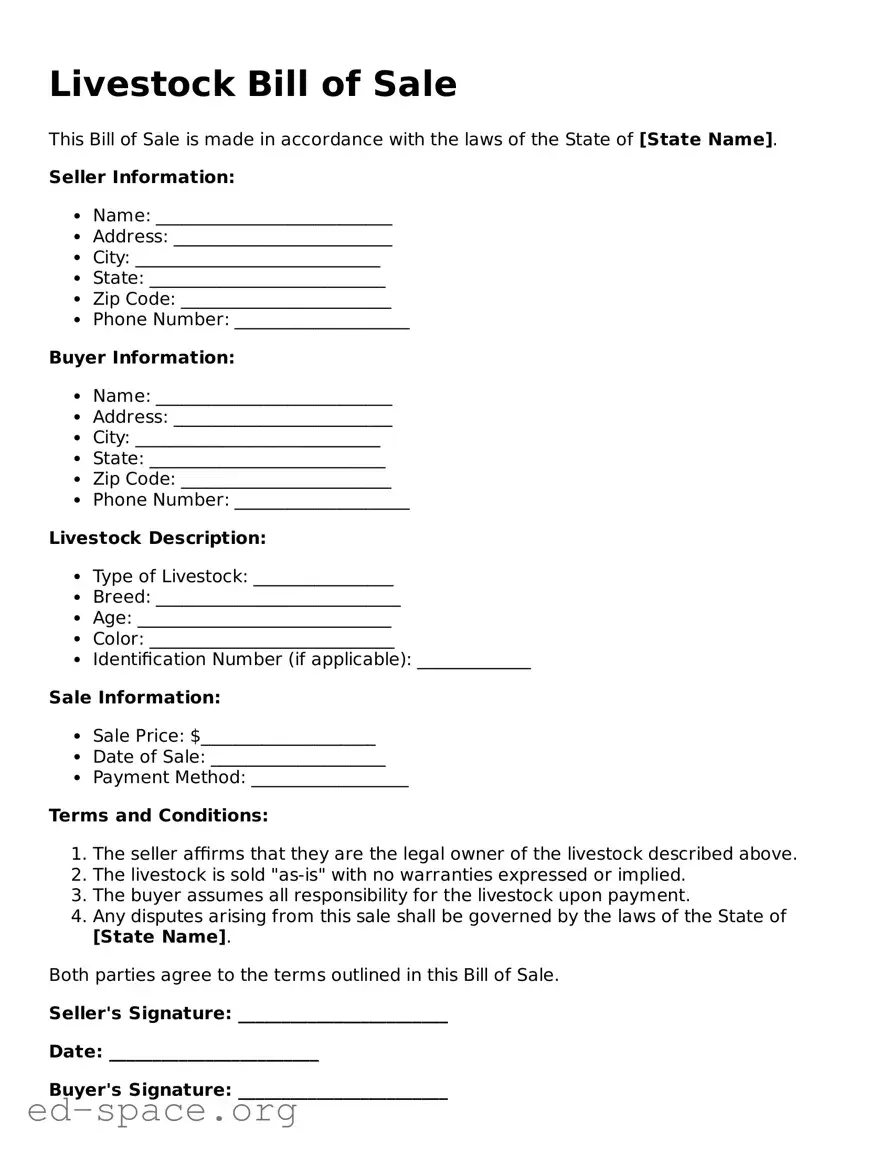
When it comes to buying or selling livestock, having the right documentation is crucial for both parties involved in the transaction. The Livestock Bill of Sale form serves as an essential legal document that outlines the details of the sale, ensuring a smooth transfer of ownership. This form typically includes key information such as the names and addresses of the buyer and seller, a detailed description of the livestock being sold—including breed, age, and any identifying marks—and the agreed-upon sale price. Furthermore, it often contains clauses that address warranties, liabilities, and any conditions of the sale, protecting both the buyer and seller. By using this form, individuals can formalize the transaction, providing clarity and security for both parties. Understanding the importance of this document not only facilitates a trustworthy exchange but also helps prevent potential disputes in the future.
Livestock Bill of Sale
This Bill of Sale is made in accordance with the laws of the State of [State Name].
Seller Information:
Buyer Information:
Livestock Description:
Sale Information:
Terms and Conditions:
Both parties agree to the terms outlined in this Bill of Sale.
Seller's Signature: ________________________
Date: ________________________
Buyer's Signature: ________________________
Date: ________________________
| Fact Name | Description |
|---|---|
| Purpose | The Livestock Bill of Sale form is used to document the sale of livestock, providing a written record for both buyer and seller. |
| Legal Requirement | In many states, a bill of sale is not legally required but is highly recommended to protect both parties in the transaction. |
| Identification | The form typically includes details about the livestock, such as breed, age, and identification numbers, to ensure clarity in the transaction. |
| State-Specific Forms | Some states, like Texas and Florida, have specific forms that must be used to comply with local regulations. |
| Governing Laws | In Texas, the governing law for livestock transactions falls under the Texas Agriculture Code, while Florida follows the Florida Statutes Chapter 686. |
| Notarization | Some states may require notarization of the bill of sale to enhance its legal validity. |
| Transfer of Ownership | The bill of sale serves as proof of transfer of ownership from the seller to the buyer once signed by both parties. |
| Payment Terms | It is common to include payment terms, such as the purchase price and any payment plans, directly on the form. |
| Liability | The form may include clauses that outline liability and warranties related to the livestock, clarifying responsibilities post-sale. |
| Record Keeping | Both parties should keep a copy of the signed bill of sale for their records, as it can be crucial for future reference. |
Once you have the Livestock Bill of Sale form ready, it’s time to fill it out accurately. This form will help document the sale and transfer of ownership of livestock. Follow these steps to ensure you complete it correctly.
After filling out the form, make copies for both the seller and buyer. Keep these copies for your records. This will help ensure that both parties have proof of the transaction.
What is a Livestock Bill of Sale form?
A Livestock Bill of Sale form is a legal document that records the sale and transfer of ownership of livestock. This form typically includes details such as the type of livestock, the seller's and buyer's information, sale price, and any specific terms of the sale. It serves as proof of the transaction and helps protect both parties involved in the sale.
Why is a Livestock Bill of Sale important?
This document is crucial for establishing ownership. It provides legal protection in case of disputes regarding the sale. Additionally, it may be required for registration purposes or when transferring livestock across state lines. Having a formal record can help clarify the terms of the sale and prevent misunderstandings.
What information should be included in the form?
The form should include the names and addresses of both the buyer and seller, a detailed description of the livestock being sold (including breed, age, and identification numbers), the sale price, and the date of the transaction. Any warranties or guarantees regarding the livestock should also be clearly stated.
Is a Livestock Bill of Sale required by law?
While a Livestock Bill of Sale is not universally required by law, it is highly recommended. Certain states may have specific regulations regarding livestock sales, and having a bill of sale can help ensure compliance with those laws. It also provides a clear record that can be useful for tax purposes or in case of legal disputes.
Can a Livestock Bill of Sale be modified after signing?
Once a Livestock Bill of Sale is signed by both parties, it is generally considered a binding contract. Modifications to the document should be made in writing and signed by both the buyer and seller to ensure clarity and mutual agreement. Verbal changes are not advisable as they can lead to misunderstandings.
Do I need a witness or notarization for the form?
In most cases, a Livestock Bill of Sale does not require a witness or notarization to be valid. However, some states may have specific requirements, so it is wise to check local laws. Having a notarized document can provide an additional layer of security and authenticity.
What should I do if I lose the Bill of Sale?
If the Bill of Sale is lost, it is advisable to create a new document that includes all the original details. Both parties should sign this new document to reaffirm the sale. If possible, keep a copy of the original for your records to prevent future issues.
Where can I obtain a Livestock Bill of Sale form?
Livestock Bill of Sale forms can be obtained from various sources. Many agricultural associations, legal websites, and local government offices provide templates. It is essential to ensure that the form complies with your state’s regulations to avoid potential legal issues.
Failing to include complete identification of the livestock. It's essential to provide details such as breed, age, and any identifying marks.
Not including the seller's and buyer's information. Both parties must have their names, addresses, and contact details clearly stated.
Omitting the sale price. The document should specify the agreed-upon price for the livestock to avoid future disputes.
Neglecting to include the date of sale. This date is crucial for legal records and potential future references.
Using vague language. Be specific about the terms of the sale. General phrases can lead to misunderstandings.
Not signing the document. Both the seller and buyer must sign the Bill of Sale for it to be legally binding.
Forgetting to keep copies. Each party should retain a copy of the signed document for their records.
Ignoring local laws. Different states may have specific requirements for livestock sales. Always check local regulations.
Not disclosing any known issues with the livestock. Full transparency helps build trust and can prevent legal issues later.
When buying or selling livestock, the Livestock Bill of Sale form is an essential document that outlines the details of the transaction. However, several other forms and documents often accompany it to ensure a smooth and legally compliant process. Below is a list of commonly used documents that can provide additional clarity and protection for both parties involved.
Utilizing these additional documents alongside the Livestock Bill of Sale form can help protect both buyers and sellers. They provide clarity and assurance, reducing the risk of disputes and ensuring compliance with relevant laws and regulations. Being thorough in documentation is always a wise approach in livestock transactions.
The Livestock Bill of Sale form serves a specific purpose in the sale of livestock, but it shares similarities with various other documents. Below are nine documents that are comparable, along with an explanation of how they relate to the Livestock Bill of Sale.
When filling out the Livestock Bill of Sale form, attention to detail is crucial. Here are some important dos and don'ts to keep in mind:
By following these guidelines, you can help ensure a smooth transaction and protect the interests of both parties involved.
When it comes to the Livestock Bill of Sale form, there are several misconceptions that can lead to confusion for buyers and sellers alike. Understanding the truth behind these misconceptions is crucial for a smooth transaction. Here are four common misunderstandings:
Many people believe that a verbal agreement is sufficient for selling livestock. However, a written Bill of Sale is essential. This document provides clear evidence of the transaction, protecting both the buyer and the seller in case of disputes.
Another common misconception is that the requirements for a Bill of Sale are uniform across the country. In reality, each state has its own laws governing livestock sales. It’s vital to check your state’s specific requirements to ensure compliance.
Some individuals think that a Bill of Sale is only necessary for expensive animals. This is misleading. Regardless of the animal's value, having a Bill of Sale is important for any livestock transaction to ensure legal protection and clarity.
While a signed Bill of Sale does signify that the transaction has taken place, it doesn’t mean that all terms are set in stone. If both parties agree, modifications can be made to the agreement, but this should be documented in writing to avoid future issues.
By addressing these misconceptions, individuals can navigate livestock transactions with greater confidence and security. Always consider consulting a professional if you have questions or need assistance with the process.
When filling out and using the Livestock Bill of Sale form, it is important to keep several key points in mind. Here are some essential takeaways:
By following these guidelines, individuals can ensure that their livestock transactions are clear, legal, and binding.