Homepage Fillable Letter of Recommendation for Internship Template
Article Guide

When embarking on the journey of securing an internship, one of the most valuable tools at your disposal is a Letter of Recommendation. This document serves as a testament to your skills, work ethic, and potential, often influencing the decisions of hiring managers. The Letter of Recommendation for Internship form typically includes essential sections that guide the recommender in crafting a compelling endorsement. These sections may request details about the candidate's relationship with the recommender, specific examples of the candidate's accomplishments, and insights into their character and abilities. Additionally, the form often provides space for the recommender to discuss how the candidate's experiences align with the goals of the internship position. By ensuring that all relevant information is included, this form not only facilitates a structured approach to writing the letter but also enhances the overall impact of the recommendation. Ultimately, a well-crafted Letter of Recommendation can significantly bolster an applicant's chances of landing that coveted internship opportunity.

Document Preview

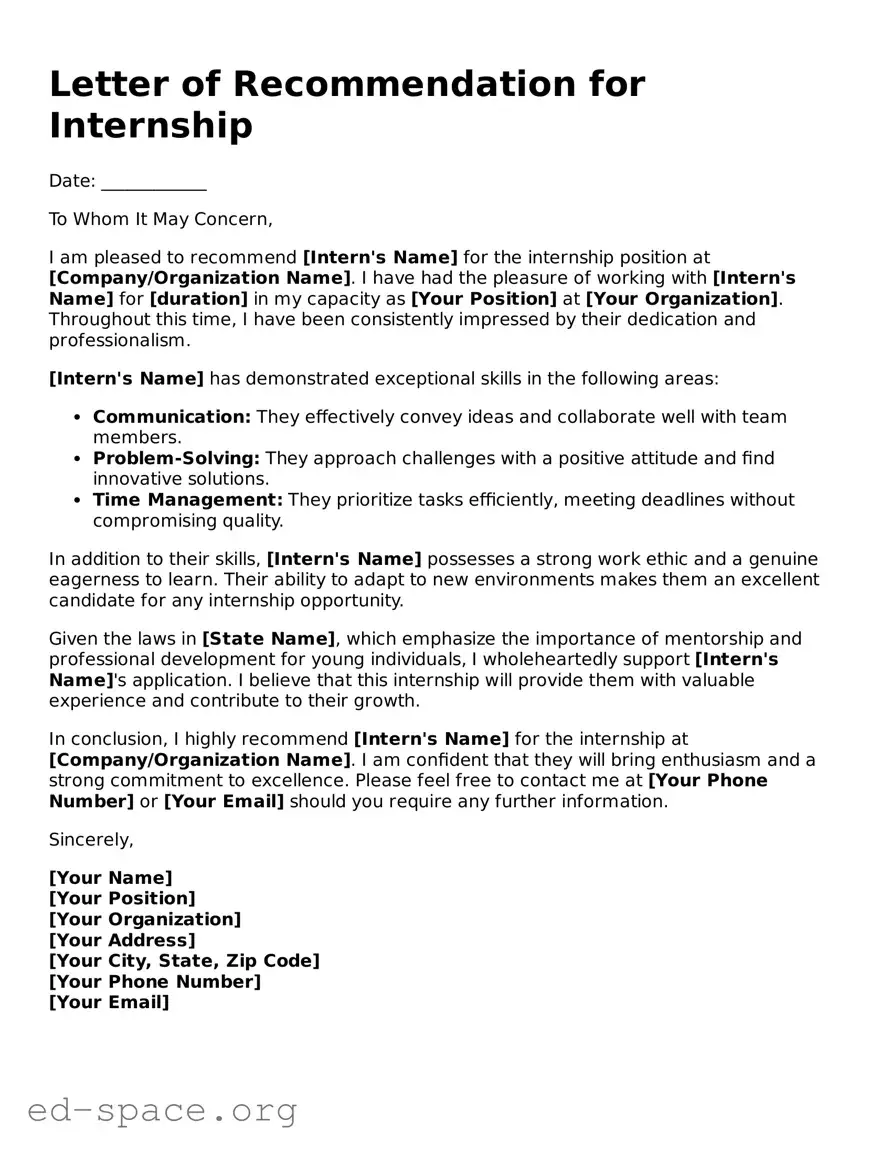
Letter of Recommendation for Internship

Date: ____________

To Whom It May Concern,

I am pleased to recommend [Intern's Name] for the internship position at [Company/Organization Name]. I have had the pleasure of working with [Intern's Name] for [duration] in my capacity as [Your Position] at [Your Organization]. Throughout this time, I have been consistently impressed by their dedication and professionalism.

[Intern's Name] has demonstrated exceptional skills in the following areas:

  • Communication: They effectively convey ideas and collaborate well with team members.
  • Problem-Solving: They approach challenges with a positive attitude and find innovative solutions.
  • Time Management: They prioritize tasks efficiently, meeting deadlines without compromising quality.

In addition to their skills, [Intern's Name] possesses a strong work ethic and a genuine eagerness to learn. Their ability to adapt to new environments makes them an excellent candidate for any internship opportunity.

Given the laws in [State Name], which emphasize the importance of mentorship and professional development for young individuals, I wholeheartedly support [Intern's Name]'s application. I believe that this internship will provide them with valuable experience and contribute to their growth.

In conclusion, I highly recommend [Intern's Name] for the internship at [Company/Organization Name]. I am confident that they will bring enthusiasm and a strong commitment to excellence. Please feel free to contact me at [Your Phone Number] or [Your Email] should you require any further information.

Sincerely,

[Your Name]
[Your Position]
[Your Organization]
[Your Address]
[Your City, State, Zip Code]
[Your Phone Number]
[Your Email]

PDF Form Details

Fact Name Description
Purpose The Letter of Recommendation for Internship form is designed to provide insight into a candidate's skills, work ethic, and character from a trusted source.
Importance A strong letter can significantly enhance a candidate's chances of securing an internship by highlighting their qualifications and experiences.
Submission Process Typically, the form must be completed and submitted directly by the recommender to ensure authenticity and confidentiality.
State-Specific Requirements Some states may have specific guidelines regarding the content and format of the letter; always check local regulations.
Governing Laws In states like California, the Fair Employment and Housing Act may influence how recommendations are written to avoid discrimination.

Letter of Recommendation for Internship: Usage Guidelines

After you have gathered all necessary information, you are ready to complete the Letter of Recommendation for Internship form. This form will help your recommender articulate your strengths and qualifications effectively.

  1. Begin by entering the date at the top of the form.
  2. Provide the name of the person writing the recommendation.
  3. Include the recommender's title or position.
  4. Fill in the name of the organization or institution where the recommender works.
  5. List the address of the organization, including street, city, state, and zip code.
  6. In the next section, write the name of the student for whom the recommendation is being written.
  7. Indicate the internship position the student is applying for.
  8. Provide a brief description of your relationship with the student, including how long you have known them.
  9. In the designated area, highlight the student's strengths, skills, and relevant experiences.
  10. Conclude with any additional comments that may support the student's application.
  11. Finally, sign and date the form at the bottom.

Your Questions, Answered

What is a Letter of Recommendation for Internship?

A Letter of Recommendation for Internship is a document written by someone who knows you well, such as a teacher, employer, or mentor. This letter highlights your skills, experiences, and character traits that make you a suitable candidate for an internship. It provides potential employers with insight into your abilities and work ethic.

Who should write my Letter of Recommendation?

It is best to choose someone who is familiar with your work or academic performance. This could be a professor, a supervisor from a job, or a volunteer coordinator. The writer should be able to speak positively about your strengths and contributions. Make sure to ask someone who can provide a detailed and honest perspective on your abilities.

What information should be included in the letter?

The letter should include the writer's relationship to you, specific examples of your skills or achievements, and an overall assessment of your suitability for the internship. It may also mention your personal qualities, such as teamwork, leadership, or problem-solving skills. The more specific the examples, the stronger the recommendation will be.

How should I request a Letter of Recommendation?

When asking for a letter, do so politely and well in advance of any deadlines. You can make your request in person or via email. Be clear about why you need the letter and provide any details about the internship. It can also be helpful to share your resume or a list of your accomplishments to assist the writer in crafting a more personalized letter.

Common mistakes

  1. Failing to provide specific examples of the candidate’s skills and achievements. Generic statements do not effectively showcase the candidate's strengths.

  2. Not addressing the letter to a specific person or organization. A personalized greeting makes the letter more impactful.

  3. Using overly formal language or jargon. Clear and straightforward language is more relatable and effective.

  4. Neglecting to proofread for spelling and grammatical errors. Mistakes can undermine the credibility of the recommendation.

  5. Overlooking the importance of the letter’s structure. A well-organized letter enhances readability and clarity.

  6. Not including the recommender’s contact information. This allows the recipient to follow up for additional information if needed.

  7. Focusing too much on personal attributes rather than professional qualifications. Highlighting relevant skills and experiences is crucial for internship applications.

Documents used along the form

When applying for internships, candidates often submit various documents alongside the Letter of Recommendation for Internship form. These documents provide additional context about the applicant's skills, experiences, and qualifications. Here are some commonly used forms and documents that accompany the recommendation letter:

  • Resume: This document outlines the applicant's educational background, work experience, skills, and relevant achievements. It serves as a comprehensive summary of the candidate's qualifications.
  • Cover Letter: A personalized letter that introduces the applicant to the employer. It highlights the candidate's interest in the internship and explains how their background aligns with the organization's goals.
  • Transcript: An official record of the applicant's academic performance, showing grades and courses completed. This document can help demonstrate the candidate's academic qualifications and commitment to their field of study.
  • Portfolio: A collection of work samples that showcases the applicant's skills and accomplishments. This is particularly useful for candidates in creative fields, as it provides tangible evidence of their abilities.
  • Application Form: Some organizations require candidates to fill out a specific application form. This form typically includes personal information, educational history, and other details relevant to the internship.

Including these documents can enhance an applicant's profile and provide a more complete picture of their qualifications. Each document plays a unique role in the application process, helping to convey the candidate's strengths and suitability for the internship opportunity.

Similar forms

  • Letter of Recommendation for Employment: Similar to an internship recommendation, this document highlights a candidate's skills and experiences, but it is specifically tailored for job applications. It emphasizes professional qualifications and work ethic.
  • Academic Reference Letter: This type of letter is often used for college admissions or scholarship applications. It focuses on a student's academic achievements and character, much like an internship recommendation emphasizes relevant skills and potential.
  • Character Reference Letter: A character reference provides insight into a person's character traits and personal qualities. Like an internship recommendation, it supports the individual’s suitability for a specific role or opportunity.
  • Graduate School Recommendation Letter: This letter is written to support a candidate’s application to graduate programs. It highlights academic and research capabilities, similar to how an internship recommendation focuses on relevant experience and skills.
  • Professional Endorsement: Often used in networking or professional contexts, a professional endorsement vouches for someone's abilities and character. This is akin to an internship recommendation, which serves to advocate for the candidate's potential in a practical setting.
  • Volunteer Reference Letter: This document speaks to an individual’s contributions and skills in a volunteer capacity. It mirrors the internship recommendation by focusing on relevant experience, albeit in a non-paid context.
  • Job Shadowing Recommendation: A letter written after a job shadowing experience can serve to recommend an individual for internships or entry-level positions. It highlights observations of skills and work ethic, similar to an internship recommendation.
  • Mentorship Reference: A mentor may write a reference that discusses the growth and potential of their mentee. This type of document shares similarities with an internship recommendation, as both aim to showcase the individual’s readiness for new opportunities.

Dos and Don'ts

When filling out the Letter of Recommendation for Internship form, it is important to follow certain guidelines to ensure the process is smooth and effective. Below is a list of things you should and shouldn't do.

  • Do provide specific examples of the intern's skills and achievements.
  • Do maintain a professional tone throughout the letter.
  • Do ensure the letter is addressed to the correct person or organization.
  • Do proofread the letter for spelling and grammatical errors.
  • Do keep the letter concise and focused on relevant qualifications.
  • Don't use vague language or general statements.
  • Don't include personal opinions that are unrelated to the intern's qualifications.
  • Don't exceed the recommended length for the letter.
  • Don't forget to sign and date the letter before submission.

Misconceptions

When it comes to securing an internship, a letter of recommendation can be a crucial component of your application. However, there are several misconceptions that can cloud understanding of its purpose and importance. Here are six common misconceptions about the Letter of Recommendation for Internship form:

  • Anyone can write a letter of recommendation. Many believe that any person can provide a recommendation. However, it's essential that the writer has a credible relationship with you, such as a professor, employer, or mentor who can speak to your skills and character.
  • Letters of recommendation are optional. Some students think that they can skip this step and still be competitive. In reality, many employers expect letters of recommendation as part of the application process, especially for internships.
  • All letters of recommendation are the same. Not true! A generic letter lacks the personal touch that specific examples and anecdotes provide. Tailored letters that highlight your unique qualifications can make a significant difference.
  • Once written, a letter cannot be changed. Many assume that once a recommendation is written, it cannot be altered. In fact, writers can revise their letters to better reflect your growth or to address specific qualities relevant to the internship.
  • Letters of recommendation are only about academic performance. While grades are important, letters can also discuss your work ethic, teamwork, and leadership skills. A well-rounded recommendation speaks to your overall character and potential.
  • It's enough to just ask for a letter. Simply requesting a letter is not sufficient. Providing your recommender with details about the internship, your resume, and your goals can help them write a more compelling letter.

Understanding these misconceptions can help you approach the process of securing a letter of recommendation with clarity and purpose. A strong letter can significantly enhance your internship application and set you apart from other candidates.

Key takeaways

When it comes to filling out and using the Letter of Recommendation for Internship form, there are several important points to keep in mind. These takeaways will help ensure that the process is smooth and effective.

  • Choose the right recommender: Select someone who knows you well and can speak positively about your skills and experiences. This could be a professor, employer, or mentor.
  • Provide context: Share details about the internship you are applying for. This helps the recommender tailor their letter to highlight relevant experiences and skills.
  • Be clear about deadlines: Inform your recommender of any deadlines associated with the submission of the letter. This ensures that they have ample time to write a thoughtful recommendation.
  • Offer a resume or personal statement: Providing your recommender with your resume or a brief personal statement can give them a better understanding of your achievements and aspirations.
  • Follow up politely: After you’ve made your request, it’s appropriate to check in with your recommender as the deadline approaches. A gentle reminder can be helpful.
  • Express gratitude: Always thank your recommender for their time and effort. A simple thank-you note can go a long way in showing your appreciation.
  • Review the letter: If possible, ask to see the letter before it is submitted. This allows you to ensure that the content aligns with your goals and the internship requirements.

By keeping these key takeaways in mind, you can help facilitate a successful recommendation process that enhances your internship application.