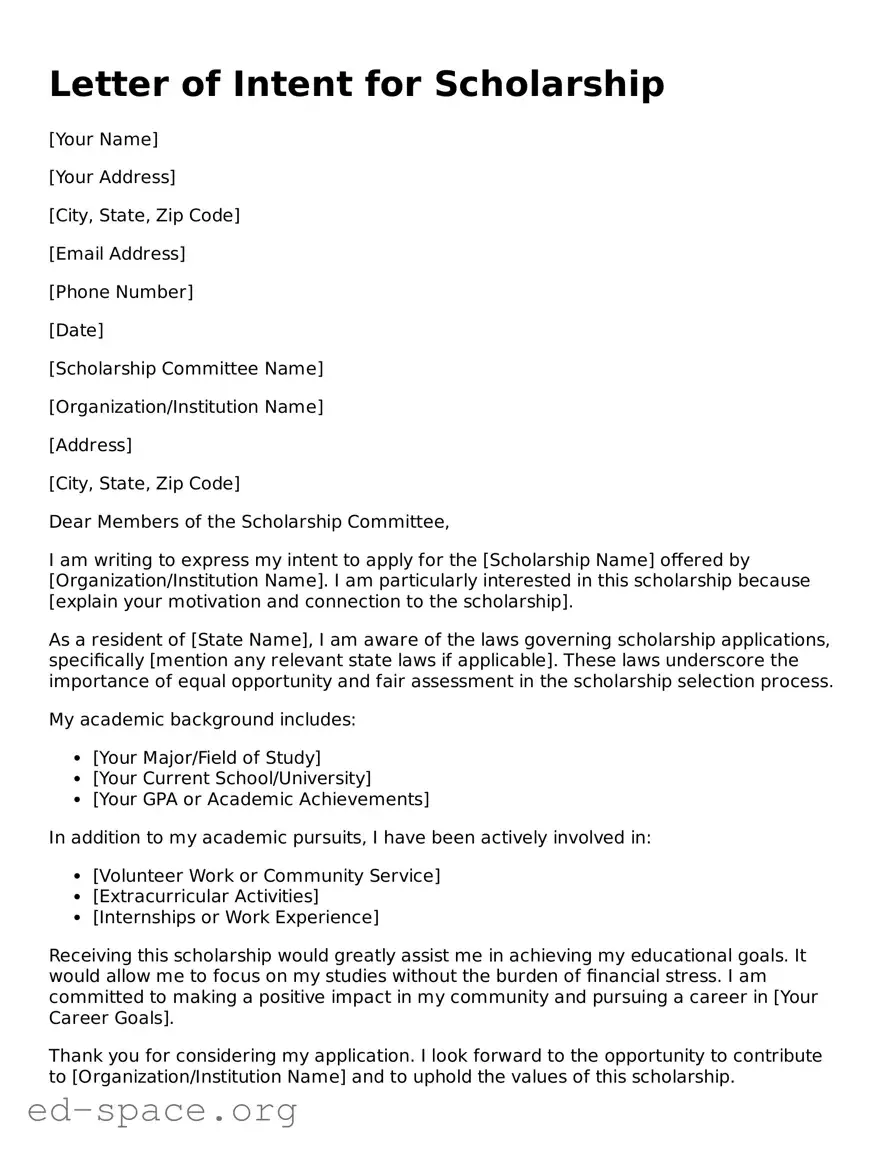
When pursuing scholarship opportunities, a Letter of Intent for Scholarship plays a crucial role in showcasing a student's commitment and qualifications. This document serves as a formal introduction, allowing applicants to express their intentions and aspirations regarding the scholarship. Typically, the form requires personal information, academic achievements, and extracurricular activities, all of which provide a comprehensive view of the candidate. Additionally, applicants often include a personal statement that highlights their goals, motivations, and how the scholarship aligns with their educational journey. Understanding the components of this letter is essential, as it not only reflects the applicant's dedication but also helps scholarship committees gauge the potential impact of their investment. By crafting a thoughtful and well-structured Letter of Intent, students can significantly enhance their chances of securing financial support for their academic pursuits.
Letter of Intent for Scholarship
[Your Name]
[Your Address]
[City, State, Zip Code]
[Email Address]
[Phone Number]
[Date]
[Scholarship Committee Name]
[Organization/Institution Name]
[Address]
[City, State, Zip Code]
Dear Members of the Scholarship Committee,
I am writing to express my intent to apply for the [Scholarship Name] offered by [Organization/Institution Name]. I am particularly interested in this scholarship because [explain your motivation and connection to the scholarship].
As a resident of [State Name], I am aware of the laws governing scholarship applications, specifically [mention any relevant state laws if applicable]. These laws underscore the importance of equal opportunity and fair assessment in the scholarship selection process.
My academic background includes:
In addition to my academic pursuits, I have been actively involved in:
Receiving this scholarship would greatly assist me in achieving my educational goals. It would allow me to focus on my studies without the burden of financial stress. I am committed to making a positive impact in my community and pursuing a career in [Your Career Goals].
Thank you for considering my application. I look forward to the opportunity to contribute to [Organization/Institution Name] and to uphold the values of this scholarship.
Sincerely,
[Your Name]
| Fact Name | Description |
|---|---|
| Purpose | A Letter of Intent for Scholarship serves as a formal expression of a student's interest in receiving financial assistance for their education. |
| Components | This document typically includes personal information, academic achievements, and reasons for requesting the scholarship. |
| Submission Guidelines | Students must follow specific guidelines set by the scholarship provider, including deadlines and required documentation. |
| Governing Laws | The laws governing scholarship agreements may vary by state. For example, in California, the California Education Code applies, while in New York, relevant laws include the New York State Education Law. |
After you have gathered all necessary information, you are ready to fill out the Letter of Intent for Scholarship form. This letter is an important step in your scholarship application process. It allows you to express your interest and outline your qualifications. Follow the steps below to complete the form accurately.
What is a Letter of Intent for Scholarship?
A Letter of Intent for Scholarship is a formal document that expresses a student's intention to apply for a scholarship. It outlines the applicant's qualifications, goals, and reasons for seeking financial assistance. This letter is typically submitted along with the scholarship application.
Who should submit a Letter of Intent for Scholarship?
Any student who wishes to apply for a scholarship should consider submitting a Letter of Intent. This includes high school students, college students, and graduate students. It is especially important for those applying for competitive scholarships.
What information should be included in the Letter of Intent?
The letter should include your personal information, educational background, career goals, and reasons for applying for the scholarship. Highlight any relevant achievements, experiences, or challenges you have faced. Be sure to express your passion for your field of study and how the scholarship will help you achieve your goals.
How long should the Letter of Intent be?
The Letter of Intent should typically be one page long. Aim for a concise and clear presentation of your thoughts. Avoid unnecessary details, but ensure that you cover all important points effectively.
Is there a specific format for the Letter of Intent?
While there is no strict format, it is advisable to use a standard business letter format. Include your contact information, the date, and the scholarship committee's address at the top. Use a professional tone and clear language throughout the letter.
When is the deadline for submitting the Letter of Intent?
Deadlines vary by scholarship program. It is crucial to check the specific scholarship guidelines for submission dates. Plan to submit your letter well in advance to ensure you meet the deadline.
Can I use the same Letter of Intent for multiple scholarships?
While you can use a similar template, it is best to customize each Letter of Intent for the specific scholarship. Tailoring your letter shows genuine interest and helps you address the unique criteria of each scholarship program.
Should I proofread my Letter of Intent?
Absolutely. Proofreading is essential to ensure your letter is free of grammatical errors and typos. A well-written letter reflects your professionalism and attention to detail. Consider asking someone else to review it as well for additional feedback.
What should I do if I have questions about the Letter of Intent?
If you have questions, reach out to the scholarship provider for clarification. They can provide specific guidance on what they are looking for in the Letter of Intent. Don’t hesitate to ask for help if needed.
Not following instructions: One of the most common mistakes is failing to read and follow the specific instructions provided with the scholarship application. Each scholarship may have unique requirements that need to be addressed.
Missing deadlines: Applicants often overlook deadlines. It’s crucial to submit the Letter of Intent on time, as late submissions are typically not considered.
Generic content: Writing a generic letter can hurt an application. Personalizing the letter to reflect individual experiences and goals can make a significant difference.
Neglecting proofreading: Spelling and grammatical errors can detract from the overall quality of the letter. Failing to proofread may lead to mistakes that could have been easily corrected.
Overly formal or informal tone: Striking the right balance in tone is important. An overly formal tone can seem stiff, while an overly casual tone may come off as unprofessional.
Omitting personal stories: Personal anecdotes can help illustrate commitment and passion. Not including these stories can make the letter feel flat and unengaging.
Failing to highlight achievements: Applicants sometimes forget to mention their accomplishments. Highlighting relevant achievements can strengthen the application and showcase qualifications.
Ignoring the scholarship’s mission: Each scholarship has its own mission and values. Not aligning the letter with these principles can weaken the application’s impact.
A Letter of Intent for Scholarship is an important document that outlines a student’s desire to apply for financial assistance. However, several other forms and documents often accompany this letter to provide additional context and information. Below is a list of these documents, each serving a unique purpose in the scholarship application process.
Each of these documents plays a critical role in the scholarship application process. Together, they provide a comprehensive picture of the applicant, helping scholarship committees make informed decisions. It is essential for students to prepare these materials carefully to maximize their chances of receiving financial support for their education.
The Letter of Intent for Scholarship form serves a specific purpose, but it shares similarities with several other important documents. Each of these documents plays a role in formalizing intentions, agreements, or applications. Below is a list of nine documents that are similar to the Letter of Intent for Scholarship:
When filling out a Letter of Intent for a scholarship, it’s important to approach the task with care. Here are some essential dos and don’ts to keep in mind:
When it comes to scholarships, the Letter of Intent (LOI) can be a crucial component of the application process. However, several misconceptions surround this important document. Understanding the truth can help applicants present themselves more effectively. Here are eight common misconceptions about the Letter of Intent for Scholarship forms:
By debunking these misconceptions, applicants can approach their Letters of Intent with a clearer understanding of what makes an impactful submission. This understanding not only enhances their chances of receiving a scholarship but also aids in personal growth and self-reflection.
When filling out and utilizing the Letter of Intent for Scholarship form, it is essential to keep several key considerations in mind. Below are important takeaways that can guide you through the process.
By keeping these key takeaways in mind, you can create a compelling Letter of Intent that effectively communicates your passion and qualifications for the scholarship opportunity.