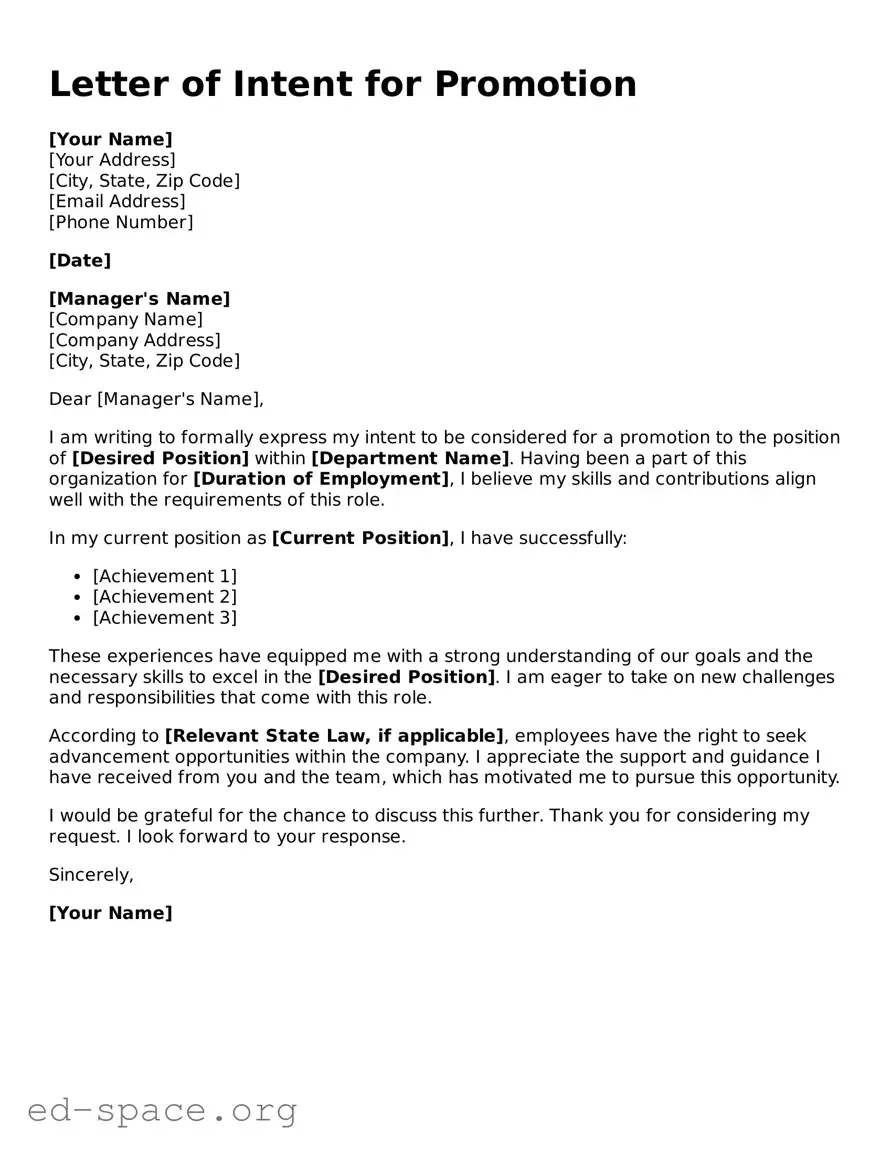
When navigating the complexities of career advancement, the Letter of Intent for Promotion form serves as a vital tool for employees seeking to elevate their professional status within an organization. This form is designed to clearly articulate an employee's desire for promotion while outlining their qualifications and contributions to the company. It typically includes sections for personal information, a summary of achievements, and a detailed explanation of how the employee meets the criteria for the desired position. By presenting a well-structured case, the form not only demonstrates the employee's readiness for increased responsibilities but also helps management understand the value the employee brings to the team. Completing this form thoughtfully can significantly impact the decision-making process, making it essential for employees to invest the necessary time and effort into crafting a compelling narrative that aligns with the organization's goals and values. In this article, we will explore the key components of the Letter of Intent for Promotion form, discuss best practices for filling it out, and highlight common pitfalls to avoid, ensuring that employees are well-prepared to take this important step in their career journey.
Letter of Intent for Promotion
[Your Name]
[Your Address]
[City, State, Zip Code]
[Email Address]
[Phone Number]
[Date]
[Manager's Name]
[Company Name]
[Company Address]
[City, State, Zip Code]
Dear [Manager's Name],
I am writing to formally express my intent to be considered for a promotion to the position of [Desired Position] within [Department Name]. Having been a part of this organization for [Duration of Employment], I believe my skills and contributions align well with the requirements of this role.
In my current position as [Current Position], I have successfully:
These experiences have equipped me with a strong understanding of our goals and the necessary skills to excel in the [Desired Position]. I am eager to take on new challenges and responsibilities that come with this role.
According to [Relevant State Law, if applicable], employees have the right to seek advancement opportunities within the company. I appreciate the support and guidance I have received from you and the team, which has motivated me to pursue this opportunity.
I would be grateful for the chance to discuss this further. Thank you for considering my request. I look forward to your response.
Sincerely,
[Your Name]
| Fact Name | Description |
|---|---|
| Purpose | The Letter of Intent for Promotion form is used to express an employee's interest in a promotional opportunity within the organization. |
| Structure | This form typically includes sections for the employee's current position, desired position, and reasons for seeking the promotion. |
| Submission | Employees usually submit this form to their immediate supervisor or human resources department for consideration. |
| State-Specific Forms | Some states may have specific requirements or additional forms that need to be completed alongside the Letter of Intent for Promotion. |
| Governing Law | The governing laws regarding employment and promotion practices can vary by state, impacting how the form is utilized. |
| Confidentiality | Generally, the contents of the Letter of Intent for Promotion are treated as confidential and should not be disclosed without consent. |
| Follow-Up | After submission, employees may need to follow up to discuss their application and any next steps in the promotion process. |
| Impact on Career | Completing this form can significantly impact an employee's career trajectory by formally indicating their ambition and readiness for advancement. |
Once you have gathered all necessary information, you can proceed to fill out the Letter of Intent for Promotion form. This form is essential for formally expressing your desire for a promotion within the organization. Following the steps below will ensure that you complete the form accurately and effectively.
What is a Letter of Intent for Promotion?
A Letter of Intent for Promotion is a formal document that an employee submits to express their desire to be considered for a promotion within their organization. It outlines the employee’s qualifications, achievements, and reasons for seeking the promotion. This letter serves as a way to formally communicate interest and initiate the promotion process.
Who should submit a Letter of Intent for Promotion?
Any employee who believes they meet the qualifications for a higher position within their organization can submit a Letter of Intent for Promotion. It is typically used by those who have demonstrated strong performance and are ready to take on more responsibilities.
What should be included in the Letter of Intent for Promotion?
The letter should include your current position, the position you are seeking, and a brief overview of your relevant skills and accomplishments. It’s also helpful to mention any additional training or certifications you have completed. Personalizing the letter to reflect your passion for the role and the company can make a positive impression.
Is there a specific format for the Letter of Intent for Promotion?
While there is no strict format, it is recommended to use a professional tone. Start with a clear subject line, followed by a greeting. Use paragraphs to organize your thoughts, and conclude with a respectful closing. Keeping it concise and focused will make it easier for the reader to understand your intent.
When is the best time to submit a Letter of Intent for Promotion?
Timing can be important. Consider submitting your letter during performance review periods or when the company is planning to fill a higher position. It’s also wise to submit your letter after you have successfully completed significant projects or achieved key milestones that demonstrate your readiness for a promotion.
Will submitting a Letter of Intent for Promotion guarantee a promotion?
Submitting a Letter of Intent for Promotion does not guarantee that you will receive the promotion. However, it does express your interest and can put you on the radar of decision-makers. The final decision will depend on various factors, including your qualifications, the availability of the position, and the company’s needs.
Can I follow up after submitting my Letter of Intent for Promotion?
Yes, following up is a good practice. After a reasonable amount of time, you can reach out to your manager or HR to inquire about the status of your request. This shows your continued interest and can help keep your application top of mind.
What if my request for promotion is denied?
If your request for promotion is denied, it’s important to seek feedback. Ask your supervisor for specific reasons and what steps you can take to improve your chances in the future. Use this information to set goals and work on areas that may enhance your qualifications for the next opportunity.
Neglecting to read the instructions: Many individuals skip the guidelines provided with the form, which can lead to misunderstandings about what is required.
Inadequate self-assessment: Failing to accurately evaluate one’s own qualifications and achievements can result in an underwhelming application.
Using vague language: General statements about skills and experiences do not convey the full picture. Specific examples are much more persuasive.
Ignoring formatting: A cluttered or poorly formatted document can detract from the content. Clear organization helps the reader follow your points.
Forgetting to proofread: Typos and grammatical errors can undermine professionalism. Taking the time to review can make a significant difference.
Not tailoring the letter: Submitting a generic letter without addressing the specific position or department can make it seem less genuine.
Overlooking deadlines: Missing submission deadlines can disqualify an application. Keeping track of timelines is essential for success.
Failing to seek feedback: Not asking for input from peers or mentors can result in missed opportunities for improvement before submission.
Being overly modest: Downplaying achievements can lead to a lack of confidence in the application. It’s important to highlight accomplishments appropriately.
Neglecting to follow up: After submission, not checking in can lead to uncertainty about the status of the application. A polite follow-up can provide clarity.
When seeking a promotion, a Letter of Intent for Promotion form is often just one piece of the puzzle. Various other documents can support the promotion request, providing additional context and evidence of qualifications. Below is a list of commonly used forms and documents that can accompany the Letter of Intent.
Including these documents alongside the Letter of Intent for Promotion can create a compelling case for advancement. Each piece of evidence adds depth to the narrative of an employee's career, showcasing their readiness to take on new challenges and responsibilities.
The Letter of Intent for Promotion form is a crucial document in various professional settings, particularly when it comes to advancing in one's career. It shares similarities with several other documents that also serve to express intentions, outline goals, or facilitate transitions. Below are eight documents that are akin to the Letter of Intent for Promotion, along with a brief explanation of how they relate.
When filling out a Letter of Intent for Promotion form, it's essential to approach the task thoughtfully. Here’s a helpful list of things you should and shouldn’t do to ensure your submission is effective and professional.
By following these guidelines, you can create a strong Letter of Intent that effectively communicates your desire for promotion and showcases your qualifications.
Understanding the Letter of Intent for Promotion form is crucial for anyone navigating the promotion process. However, several misconceptions can lead to confusion. Here are seven common misconceptions:
Being aware of these misconceptions can help employees navigate the promotion process more effectively. Understanding the true purpose and value of the Letter of Intent for Promotion is key to maximizing its potential.
Here are key takeaways about filling out and using the Letter of Intent for Promotion form:
Using this form effectively can help convey your readiness for advancement.