Applying to law school is a significant step in one's academic and professional journey, and a well-crafted letter of recommendation can play a crucial role in that process. The Law School Letter of Recommendation form serves as a vital tool for both applicants and recommenders, ensuring that the necessary information is communicated effectively. Typically, this form requests details about the applicant’s academic performance, personal attributes, and potential for success in law school. Recommenders are often asked to provide specific examples that illustrate the applicant's skills, work ethic, and character. Furthermore, the form may include questions about the recommender’s relationship with the applicant, allowing admissions committees to gauge the depth of the recommender's insights. By clearly outlining expectations, the form helps streamline the recommendation process, making it easier for recommenders to provide meaningful and impactful endorsements. Ultimately, a strong letter of recommendation can significantly enhance an applicant's chances of admission, making it essential to approach this aspect of the application with care and thoughtfulness.
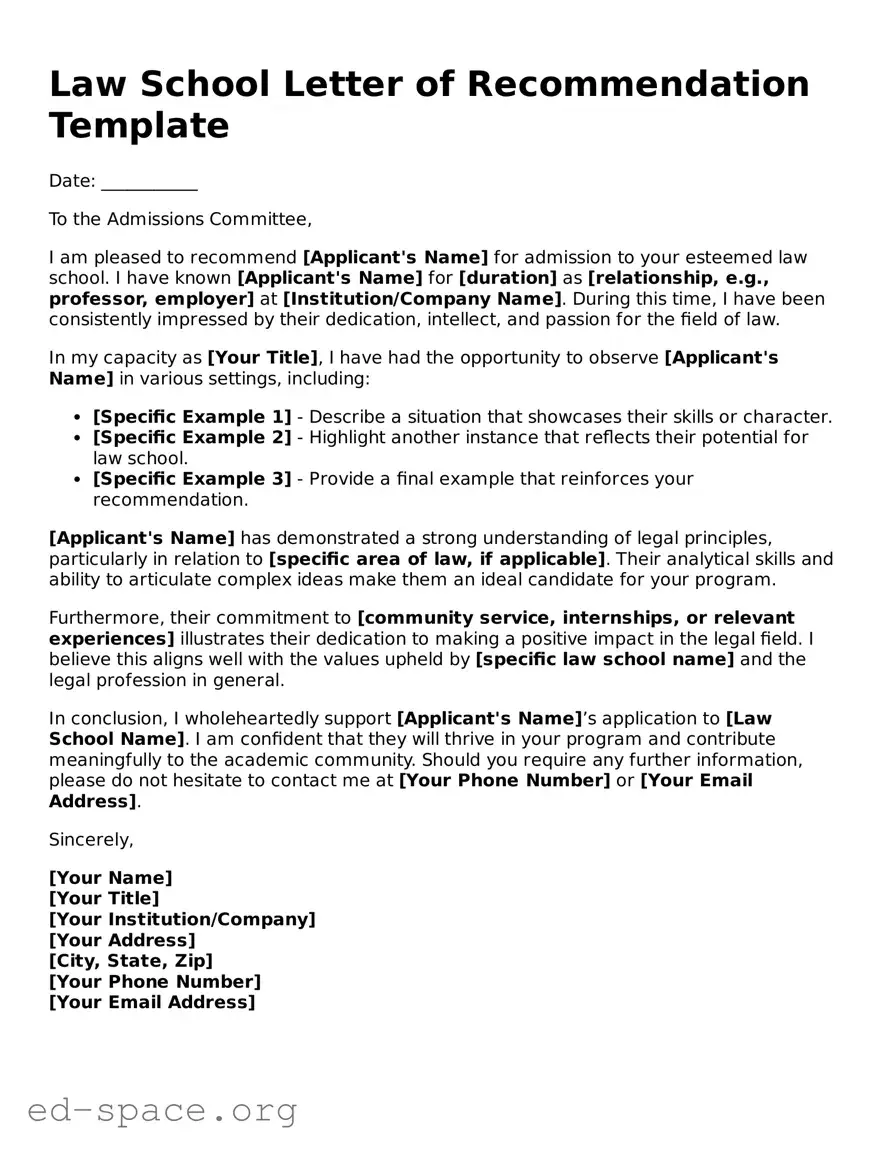
Law School Letter of Recommendation Template
Date: ___________
To the Admissions Committee,
I am pleased to recommend [Applicant's Name] for admission to your esteemed law school. I have known [Applicant's Name] for [duration] as [relationship, e.g., professor, employer] at [Institution/Company Name]. During this time, I have been consistently impressed by their dedication, intellect, and passion for the field of law.
In my capacity as [Your Title], I have had the opportunity to observe [Applicant's Name] in various settings, including:
[Applicant's Name] has demonstrated a strong understanding of legal principles, particularly in relation to [specific area of law, if applicable]. Their analytical skills and ability to articulate complex ideas make them an ideal candidate for your program.
Furthermore, their commitment to [community service, internships, or relevant experiences] illustrates their dedication to making a positive impact in the legal field. I believe this aligns well with the values upheld by [specific law school name] and the legal profession in general.
In conclusion, I wholeheartedly support [Applicant's Name]’s application to [Law School Name]. I am confident that they will thrive in your program and contribute meaningfully to the academic community. Should you require any further information, please do not hesitate to contact me at [Your Phone Number] or [Your Email Address].
Sincerely,
[Your Name]
[Your Title]
[Your Institution/Company]
[Your Address]
[City, State, Zip]
[Your Phone Number]
[Your Email Address]
| Fact Name | Description |
|---|---|
| Purpose | The Law School Letter of Recommendation form is designed to provide insights into a candidate's qualifications, character, and potential for success in law school. |
| Who Can Write | Typically, professors, employers, or professionals who know the applicant well can write the recommendation letters. |
| Confidentiality | Many law schools allow applicants to waive their right to view the letters, which can enhance the credibility of the recommendations. |
| Format Requirements | Most forms require specific formatting, such as length, font size, and submission method, which applicants must follow closely. |
| State-Specific Forms | Some states may have specific forms or guidelines that vary based on local law or institutional requirements. |
| Governing Laws | In states like California, the California Education Code governs aspects of recommendation letters, focusing on privacy and disclosure. |
| Submission Process | Applicants usually submit the recommendation forms directly to the law school, often through an online portal. |
| Deadline | Each law school has its own deadline for submission, and it’s crucial for applicants to ensure that their recommenders are aware of these dates. |
Once you have received the Law School Letter of Recommendation form, it's time to fill it out carefully. This form is essential for your application, and it will help your recommenders provide the necessary information to support your candidacy. Follow these steps to ensure you complete the form correctly.
After completing these steps, your recommenders will have the necessary information to write a compelling letter on your behalf. It's important to follow up with them to ensure they have everything they need and to express your appreciation for their support.
What is a Law School Letter of Recommendation form?
A Law School Letter of Recommendation form is a document that prospective law students provide to individuals who will write letters on their behalf. This form typically includes sections for the recommender's contact information, their relationship to the applicant, and specific questions or prompts to guide the recommender in writing a meaningful letter. The purpose of this form is to ensure that the recommendation is structured and addresses the qualities that law schools are looking for in candidates.
Who should I ask to write my letter of recommendation?
Choosing the right person to write your letter of recommendation is crucial. Ideally, you should seek out individuals who know you well and can speak to your abilities, character, and potential for success in law school. Common choices include professors, employers, or supervisors from internships. It is beneficial to select someone who can provide specific examples of your skills, work ethic, and achievements, as this will add depth to the recommendation.
How many letters of recommendation do I need to submit?
Most law schools require two to three letters of recommendation as part of the application process. Each school may have its own specific requirements, so it is important to check the guidelines for each institution you are applying to. Some schools may allow a third letter, which can be beneficial if you have a strong recommendation from a different perspective, such as a community leader or a mentor.
What should I do if my recommender is unsure about writing a letter?
If your recommender expresses uncertainty about writing a letter, it is essential to address their concerns openly. You might ask if they feel they can provide a strong endorsement of your abilities. If they hesitate, consider asking someone else who may be more enthusiastic about your candidacy. It’s important that the person writing your letter feels confident in their ability to support your application, as a lukewarm recommendation can be less effective than none at all.
Ignoring Specificity: Many applicants fail to provide specific examples of their accomplishments or skills. Instead of general statements, detailed anecdotes can significantly strengthen a recommendation.
Choosing the Wrong Recommender: Selecting someone who does not know the applicant well can lead to lukewarm or generic letters. It’s essential to choose recommenders who can speak to the applicant's strengths and potential in a meaningful way.
Failing to Communicate Clearly: Some applicants do not provide their recommenders with enough context about the program or their goals. Clear communication about what the applicant hopes to achieve can help recommenders tailor their letters effectively.
Overlooking Deadlines: Missing deadlines can jeopardize an application. Applicants should ensure that recommenders are aware of submission timelines and follow up politely to confirm that letters are sent on time.
Neglecting to Proofread: Spelling and grammatical errors in the recommendation form can reflect poorly on the applicant. Taking the time to review the form for mistakes is crucial.
Not Following Instructions: Each law school may have specific requirements for the recommendation letters. Failing to adhere to these guidelines can lead to complications or even disqualification from the application process.
When applying to law school, candidates often need to submit various documents alongside the Law School Letter of Recommendation form. These documents provide a comprehensive view of the applicant's qualifications, experiences, and character. Below is a list of common forms and documents that are frequently required in the application process.
Each of these documents plays a vital role in the law school admissions process. Together, they help admissions committees evaluate the applicant's readiness for the rigors of legal education and their potential contributions to the legal profession.
College Application Recommendation Letters: Similar to the Law School Letter of Recommendation, these letters are often required by undergraduate institutions. They provide insight into a student's character, achievements, and potential, helping admissions committees understand the applicant's fit for their programs.
Job Reference Letters: These letters serve a similar purpose in the employment context. They offer potential employers a glimpse into a candidate's work ethic, skills, and accomplishments, thereby influencing hiring decisions.
Graduate School Recommendation Letters: Like the Law School recommendations, these letters assess a candidate's qualifications for advanced study. They highlight academic performance, research capabilities, and personal attributes relevant to the field of study.
Scholarship Recommendation Letters: These documents are crucial for scholarship applications. They emphasize a student's achievements and contributions, helping scholarship committees determine who deserves financial support based on merit and potential.
Professional Certification Recommendations: When pursuing professional certifications, candidates often need endorsements from colleagues or supervisors. These letters validate the individual's expertise and readiness for certification, paralleling the supportive role of law school recommendations.
When filling out the Law School Letter of Recommendation form, certain practices can enhance the quality of the recommendation. Here are five things to do and avoid:
Adhering to these guidelines can lead to a more effective recommendation that supports the applicant's law school application.
Understanding the Law School Letter of Recommendation form can be challenging. Here are ten common misconceptions regarding this important document:
While professors are common choices, anyone who can speak to your abilities, character, or experiences can write a letter. This includes employers, mentors, or community leaders.
A concise, well-written letter can be just as impactful as a longer one. Quality matters more than quantity.
While some schools may have guidelines, there is no universally required format. Each recommender can present their letter in their own style.
Admissions committees appreciate insights into personal qualities, leadership skills, and work ethic, not just academic performance.
A strong recommendation can come from someone who has worked with you recently, even if the relationship is relatively new.
While there are deadlines for applications, recommenders often have their own timelines. It's important to communicate clearly with them about your deadlines.
Different law schools may have varying requirements for recommendations. Always check the specific guidelines for each institution.
Sharing personal anecdotes can enhance a letter. These stories can provide context and depth to your qualifications.
Customizing letters for specific schools can make them more effective. Tailored letters can highlight why you are a good fit for that particular program.
Recommenders can often update or revise their letters if necessary. Open communication is key to ensuring the letter reflects your most current qualifications.
When filling out and using the Law School Letter of Recommendation form, keep these key takeaways in mind: