When seeking a new rental property, a Landlord Recommendation Letter can serve as a valuable asset for prospective tenants. This form acts as a testament to a tenant's reliability and positive rental history, providing future landlords with insights into the tenant's behavior and responsibilities. Typically, the letter includes essential details such as the tenant's name, the duration of their stay, and the rent payment history. It may also highlight the tenant's adherence to lease agreements, their respect for property, and interactions with neighbors. A well-crafted recommendation can significantly enhance a tenant's application, setting them apart in a competitive rental market. Additionally, the letter should be signed by the previous landlord, lending credibility to the claims made within. Understanding how to properly utilize this form can empower tenants to present themselves in the best light possible, ultimately increasing their chances of securing their desired home.
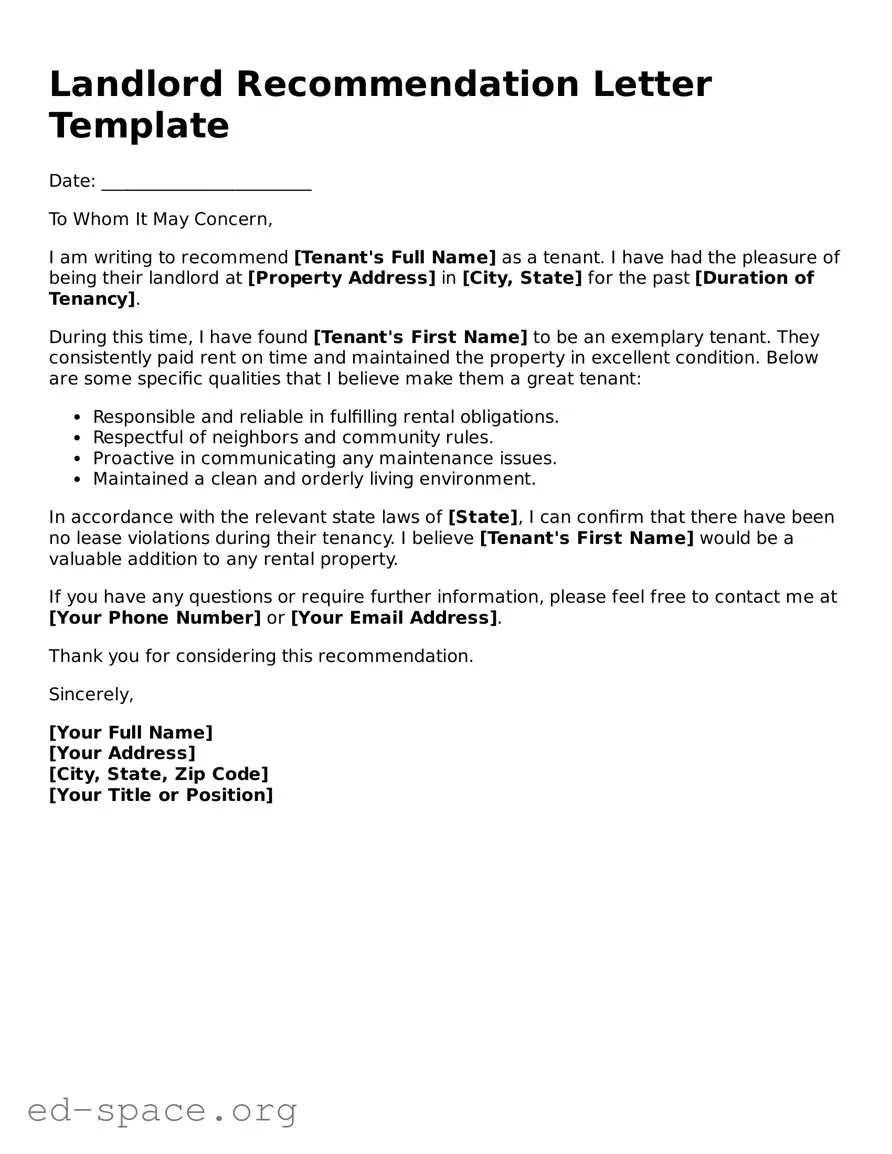
Landlord Recommendation Letter Template
Date: ________________________
To Whom It May Concern,
I am writing to recommend [Tenant's Full Name] as a tenant. I have had the pleasure of being their landlord at [Property Address] in [City, State] for the past [Duration of Tenancy].
During this time, I have found [Tenant's First Name] to be an exemplary tenant. They consistently paid rent on time and maintained the property in excellent condition. Below are some specific qualities that I believe make them a great tenant:
In accordance with the relevant state laws of [State], I can confirm that there have been no lease violations during their tenancy. I believe [Tenant's First Name] would be a valuable addition to any rental property.
If you have any questions or require further information, please feel free to contact me at [Your Phone Number] or [Your Email Address].
Thank you for considering this recommendation.
Sincerely,
[Your Full Name]
[Your Address]
[City, State, Zip Code]
[Your Title or Position]
| Fact Name | Description |
|---|---|
| Purpose | A Landlord Recommendation Letter form is used to provide a reference for a tenant, showcasing their reliability and character. |
| Content | The letter typically includes the tenant's rental history, payment behavior, and any relevant personal traits. |
| Format | It should be formatted professionally, often on the landlord's letterhead, and signed by the landlord or property manager. |
| State-Specific Forms | Some states may have specific requirements for landlord recommendation letters, so it's important to check local laws. |
| Governing Laws | In California, for example, the letter should comply with Civil Code Section 1942.5 regarding tenant rights. |
| Usage | This letter can be used by prospective landlords to assess a tenant's suitability for a new rental property. |
Once you have the Landlord Recommendation Letter form in hand, you will need to complete it with accurate and relevant information. This process will ensure that your recommendation is clear and effective, allowing the prospective tenant to present a strong application.
What is a Landlord Recommendation Letter?
A Landlord Recommendation Letter is a document that a current or previous landlord provides to vouch for a tenant's reliability and character. It typically includes information about the tenant's payment history, behavior during the lease, and overall responsibility as a renter. This letter can be useful for prospective landlords when evaluating a tenant's application.
Why do I need a Landlord Recommendation Letter?
If you are applying for a new rental property, a Landlord Recommendation Letter can strengthen your application. It serves as a reference that highlights your positive qualities as a tenant. This letter can differentiate you from other applicants, especially in competitive rental markets.
What should be included in the Landlord Recommendation Letter?
The letter should include the landlord's name, contact information, and the dates of the tenant's occupancy. It should detail the tenant's payment history, including whether rent was paid on time. Additionally, the letter may mention the tenant's behavior, how well they maintained the property, and any interactions with neighbors. Personal anecdotes can add value, but they should remain relevant to the tenant's rental history.
How do I request a Landlord Recommendation Letter?
Can a landlord refuse to write a recommendation letter?
Yes, a landlord can choose not to write a recommendation letter. Reasons for refusal may include concerns about the tenant's behavior or payment history. If a landlord declines, it is important to respect their decision and consider seeking a letter from another landlord or reference.
Is there a standard format for a Landlord Recommendation Letter?
While there is no strict standard format, a typical Landlord Recommendation Letter should be written in a formal tone. It should start with the landlord's contact information, followed by the date and the tenant's information. The body of the letter should be concise and focused on the tenant's strengths. Finally, it should end with a closing statement and the landlord's signature.
Failing to include the tenant's full name. This can lead to confusion and delays in processing the recommendation.
Not providing accurate contact information for the landlord. Ensure that the phone number and email address are correct.
Omitting the rental period. It is important to specify how long the tenant lived at the property.
Using vague language. Clear and specific details about the tenant's behavior and reliability are essential.
Neglecting to mention any issues. If there were problems, it is better to address them honestly rather than avoid the topic.
Forgetting to sign the letter. A signature adds authenticity and credibility to the recommendation.
Not dating the letter. A date helps to establish the timeline of the tenant's rental history.
Using an unprofessional tone. Maintain a respectful and formal tone throughout the letter.
Providing insufficient information about the property. Include details such as the type of property and its location.
Not proofreading the letter. Spelling or grammatical errors can undermine the professionalism of the recommendation.
When seeking a rental property, various documents may complement the Landlord Recommendation Letter. Each of these forms plays a crucial role in establishing credibility and ensuring a smooth rental process. Below is a list of commonly used documents.
Each of these documents serves to protect both the landlord and the tenant, fostering a transparent and respectful rental relationship. Having these forms ready can facilitate a more efficient leasing process.
The Landlord Recommendation Letter form is an important document that serves to provide a reference for potential tenants. It is similar to several other documents in its purpose and structure. Below are seven documents that share similarities with the Landlord Recommendation Letter form:
When filling out a Landlord Recommendation Letter form, it's essential to approach the task with care. Here are some guidelines to follow and avoid:
Following these guidelines will help ensure that the recommendation letter is both helpful and appropriate.
When it comes to the Landlord Recommendation Letter form, several misconceptions can lead to confusion. Understanding these can help tenants and landlords navigate the rental process more effectively.
While a recommendation letter can strengthen an application, it is not required by law. Many landlords consider other factors, such as credit history and income, when evaluating potential tenants.
Though past landlords are ideal sources, anyone familiar with the tenant's rental history, such as roommates or property managers, can also provide a valid recommendation.
A concise letter that highlights key attributes of the tenant can be just as impactful as a longer one. Clarity and relevance are more important than length.
Notarization is not a requirement for a landlord recommendation letter. A simple signature from the landlord is typically sufficient to validate the document.
While it is important to highlight positive aspects, a balanced view that includes any challenges faced can provide a more realistic picture of the tenant.
Landlords can write recommendation letters for tenants who have lived in their property for any duration, provided they have enough experience with the tenant to make an informed statement.
Not all landlords feel comfortable providing recommendations. Some may choose not to write a letter due to company policy or personal reasons, and this should be respected.
Filling out and using a Landlord Recommendation Letter form can significantly impact your rental application. Here are key takeaways to keep in mind:
By following these takeaways, you can enhance your chances of securing your desired rental property.