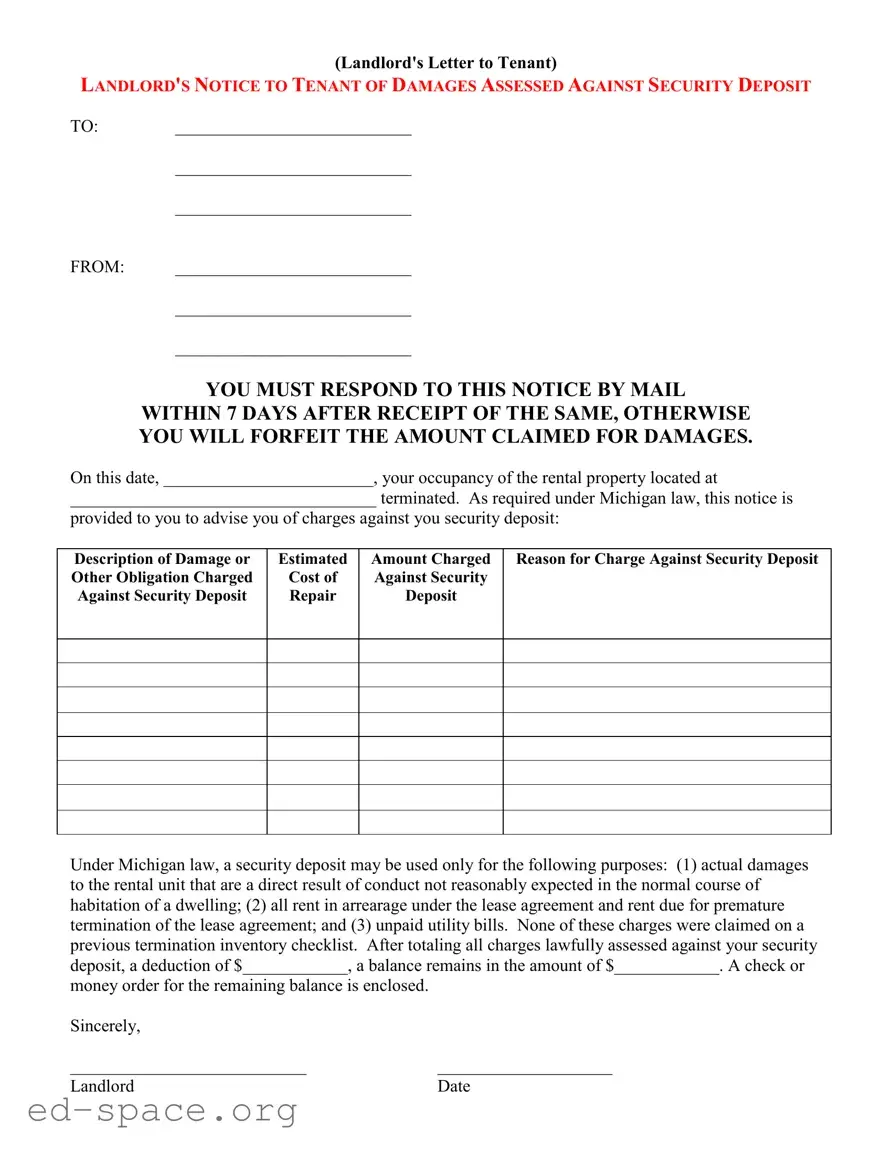
When a tenant vacates a rental property, the landlord often needs to address any damages that may have occurred during the tenancy. This is where the Landlord Damages Letter form comes into play. It serves as a crucial communication tool between landlords and tenants, outlining the charges assessed against the tenant's security deposit. The letter must be sent within a specific timeframe and requires the tenant to respond within seven days to avoid forfeiting the claimed amount. The form details the date the tenant's occupancy ended and provides a breakdown of damages, including descriptions and estimated costs. It also clarifies the legal basis for each charge, ensuring compliance with Michigan law, which stipulates that security deposits can only be used for certain purposes such as actual damages, unpaid rent, and utility bills. Importantly, the letter must indicate that none of the charges were previously noted in a termination inventory checklist. Finally, it summarizes the total charges, outlines any deductions, and states the remaining balance, if applicable, along with a check for that amount. This structured approach not only protects the landlord's interests but also informs the tenant of their rights and obligations.

(Landlord's Letter to Tenant)
LANDLORD'S NOTICE TO TENANT OF DAMAGES ASSESSED AGAINST SECURITY DEPOSIT
TO: ___________________________
___________________________
___________________________
FROM: ___________________________
___________________________
___________________________
YOU MUST RESPOND TO THIS NOTICE BY MAIL
WITHIN 7 DAYS AFTER RECEIPT OF THE SAME, OTHERWISE YOU WILL FORFEIT THE AMOUNT CLAIMED FOR DAMAGES.
On this date, ________________________, your occupancy of the rental property located at
___________________________________ terminated. As required under Michigan law, this notice is
provided to you to advise you of charges against you security deposit:
Description of Damage or |
Estimated |
Amount Charged |
Reason for Charge Against Security Deposit |
Other Obligation Charged |
Cost of |
Against Security |
|
Against Security Deposit |
Repair |
Deposit |
|
|
|
|
|
|
|
|
|
|
|
|
|
|
|
|
|
|
|
|
|
|
|
|
|
|
|
|
|
|
|
|
|
|
|
|
|
Under Michigan law, a security deposit may be used only for the following purposes: (1) actual damages to the rental unit that are a direct result of conduct not reasonably expected in the normal course of habitation of a dwelling; (2) all rent in arrearage under the lease agreement and rent due for premature termination of the lease agreement; and (3) unpaid utility bills. None of these charges were claimed on a previous termination inventory checklist. After totaling all charges lawfully assessed against your security deposit, a deduction of $____________, a balance remains in the amount of $____________. A check or
money order for the remaining balance is enclosed.
Sincerely, |
|
___________________________ |
____________________ |
Landlord |
Date |
| Fact Name | Details |
|---|---|
| Purpose of the Letter | This letter serves to inform the tenant about damages assessed against their security deposit. |
| Response Requirement | The tenant must respond within 7 days of receiving the notice to avoid forfeiting the claimed amount. |
| Governing Law | This form is governed by Michigan law regarding security deposits and tenant rights. |
| Allowed Uses of Security Deposit | Security deposits can be used for actual damages, unpaid rent, and unpaid utility bills. |
| Previous Claims | The letter indicates that none of the charges were claimed on a previous termination inventory checklist. |
| Balance Calculation | The letter provides a total of charges assessed and indicates the remaining balance after deductions. |
| Enclosure | A check or money order for the remaining balance is enclosed with the letter. |
Filling out the Landlord Damages Letter form is an important step in communicating any damages assessed against a tenant's security deposit. After completing this form, it should be sent to the tenant, who will then have a specific timeframe to respond. Here’s how to fill it out step-by-step:
Once you have completed the form, ensure that it is mailed to the tenant promptly. They will need to respond within seven days to avoid forfeiting the amount claimed for damages.
What is a Landlord Damages Letter?
A Landlord Damages Letter is a formal notification sent by a landlord to a tenant, informing them of deductions made from their security deposit due to damages or other charges. This letter outlines the specific damages assessed, the reasons for these charges, and the remaining balance of the security deposit after deductions. It is an important document that ensures transparency in the handling of security deposits and provides the tenant with an opportunity to respond.
What should I do if I receive a Landlord Damages Letter?
If you receive a Landlord Damages Letter, it is crucial to respond promptly. You have seven days from the date of receipt to reply by mail. Your response could include acknowledgment of the charges, a dispute of any inaccuracies, or requests for further clarification. Failing to respond within this timeframe may result in forfeiting the amount claimed for damages, so take this matter seriously.
What types of damages can be deducted from my security deposit?
Under Michigan law, a security deposit can only be used for specific purposes. These include actual damages to the rental unit that arise from conduct not typically expected during normal habitation, unpaid rent, and unpaid utility bills. It is essential to note that landlords cannot deduct for normal wear and tear or any damages not documented in a prior termination inventory checklist.
How can I dispute the charges listed in the Landlord Damages Letter?
If you believe the charges are unjustified, you can dispute them in your response. Clearly outline your reasons for disputing each charge and provide any supporting evidence, such as photographs or witness statements. It may also be helpful to refer to your lease agreement or any prior documentation that supports your position. Open communication with your landlord can often lead to a resolution.
What happens if the landlord does not follow the legal requirements for the security deposit?
If a landlord fails to comply with Michigan's legal requirements regarding security deposits, such as not providing a proper damages letter or making unauthorized deductions, you may have grounds for a legal dispute. In such cases, it is advisable to seek legal counsel to understand your rights and options for recourse. You may be entitled to recover your full deposit or additional damages, depending on the circumstances.
Failing to include complete names and addresses of both the landlord and tenant. Ensure all fields are filled accurately.
Not specifying the date of termination of the rental agreement. This date is essential for clarity.
Omitting the rental property address. This information helps identify the location in question.
Neglecting to provide a detailed description of the damages. Clear descriptions prevent misunderstandings.
Incorrectly calculating the total charges against the security deposit. Double-check all math to ensure accuracy.
Failing to mention any previous charges claimed on a termination inventory checklist. Transparency is crucial.
Not including a deadline for response. Clearly state that the tenant has 7 days to respond.
Using vague language in the reason for charges. Specificity helps the tenant understand the basis for the charges.
Forgetting to sign and date the letter. This step is necessary to validate the notice.
Not enclosing a check or money order for any remaining balance. This is a key part of the communication.
When dealing with rental agreements and security deposits, landlords often utilize various forms and documents to ensure clarity and compliance with legal requirements. These documents serve different purposes, providing essential information and facilitating communication between landlords and tenants. Below are four commonly used forms that accompany the Landlord Damages Letter.
Utilizing these documents alongside the Landlord Damages Letter can help establish a clear framework for managing rental properties. By maintaining accurate records and providing transparent communication, landlords can foster positive relationships with their tenants while protecting their rights and interests.
The Landlord Damages Letter form serves a specific purpose in the rental process, particularly regarding the return of security deposits. However, it shares similarities with several other documents that landlords and tenants might encounter. Here are eight documents that are comparable to the Landlord Damages Letter:
Understanding these documents can help both landlords and tenants navigate their rights and responsibilities effectively.
When filling out the Landlord Damages Letter form, it is important to follow certain guidelines to ensure clarity and compliance. Below is a list of things you should and shouldn't do:
Understanding the Landlord Damages Letter form is crucial for both landlords and tenants. Unfortunately, several misconceptions can lead to confusion. Here’s a list of common misunderstandings:
Clarifying these misconceptions can help both landlords and tenants navigate their rights and responsibilities more effectively.
Key Takeaways for Using the Landlord Damages Letter Form: