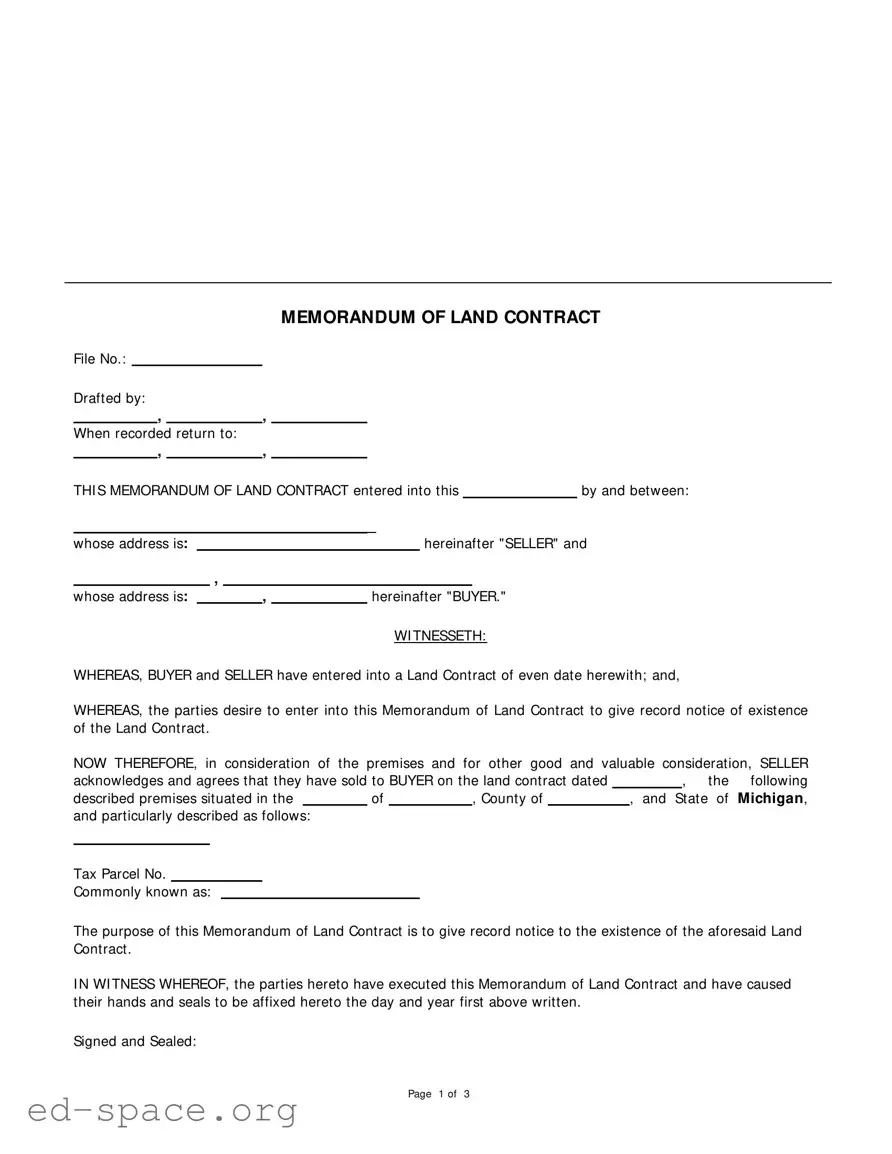
The Land Contract in Michigan serves as a crucial legal instrument for facilitating real estate transactions between buyers and sellers, particularly when traditional financing options may not be viable. This form outlines the agreement between the seller and the buyer, establishing the terms under which the buyer will purchase the property. It includes essential details such as the identities and addresses of both parties, the description of the property being sold, and the tax parcel number associated with it. The form also emphasizes the intent to create a legally binding agreement, providing record notice of the contract’s existence. By doing so, it protects both parties’ interests and ensures clarity regarding ownership and payment obligations. Additionally, the document requires signatures from both parties, along with notarization, to validate the agreement. This process adds a layer of security, confirming that both the seller and buyer understand and accept the terms laid out in the contract. Understanding the nuances of the Land Contract Michigan form is vital for anyone involved in a real estate transaction in the state.

MEMORANDUM OF LAND CONTRACT
File No.:
Drafted by:
,,
When recorded return to:
,,
THI S MEMORANDUM OF LAND CONTRACT entered into this |
|
by and between: |
|||||||||
|
|
|
|
|
|
|
|
|
|
||
whose address is: |
|
|
|
|
|
|
|
hereinafter "SELLER" and |
|||
|
|
, |
|
|
|
|
|
|
|
|
|
whose address is: |
|
, |
|
hereinafter "BUYER." |
|
||||||
WI TNESSETH:
WHEREAS, BUYER and SELLER have entered into a Land Contract of even date herewith; and,
WHEREAS, the parties desire to enter into this Memorandum of Land Contract to give record notice of existence of the Land Contract .
NOW THEREFORE, in consideration of the premises and for other good and valuable consideration, SELLER
acknowledges and agrees that they have sold to BUYER on the land contract dated |
|
, |
the |
following |
|||||||
described premises situated in the |
|
of |
, County of |
|
, and State |
of |
Michigan, |
||||
|
|
|
|
|
|
|
|
|
|
|
|
and particularly described as follows: |
|
|
|
|
|
|
|
|
|
||
|
|
|
|
|
|
|
|
|
|
|
|
Tax Parcel No.
Commonly known as:
The purpose of this Memorandum of Land Contract is to give record notice to the existence of the aforesaid Land Contract .
I N WI TNESS WHEREOF, the parties hereto have executed this Memorandum of Land Contract and have caused their hands and seals to be affixed hereto the day and year first above written.
Signed and Sealed:
Page 1 of 3
File No.: |
Memorandum of Land Contract - continued |
____________________________________ |
____________________________________ |
____________________________________ |
|
= |
|
Page 2 of 3
File No.: dgsalemi () |
Memorandum of Land Contract - continued |
|
||||
= |
|
|
|
|
|
|
STATE OF |
Michigan |
} |
|
|
|
|
|
|
} ss |
|
|
|
|
COUNTY OF |
|
} |
|
|
|
|
The foregoing instrument was acknowledged before me on |
|
, by |
|
. |
||
|
|
|
Notary Public: _________________________________ |
|||
|
|
|
Printed Name: |
|
||
|
|
|
|
County, Michigan |
|
|
|
|
|
Acting in the County of |
|
||
|
|
|
My Commission Expires: |
|
||
STATE OF |
Michigan |
} |
|
|
|
|
|
|
} ss |
|
|
|
|
COUNTY OF |
|
} |
|
|
|
|
The foregoing instrument was acknowledged before me on XXX, by Pet er Piper, a single person .
Notary Public: ______________________________
Printed Name:
County, Michigan
Acting in the County of
My Commission Expires:
Page 3 of 3
| Fact Name | Details |
|---|---|
| Document Purpose | The Memorandum of Land Contract serves to provide public notice of the existence of a land contract between the buyer and seller. |
| Governing Law | The Land Contract in Michigan is governed by the Michigan Compiled Laws, particularly MCL 565.1 et seq. |
| Parties Involved | The document identifies two main parties: the "SELLER" and the "BUYER," each with specified addresses. |
| Tax Parcel Information | It includes the tax parcel number, which uniquely identifies the property involved in the land contract. |
| Execution Requirement | The memorandum must be signed and sealed by both parties to be considered valid and enforceable. |
| Notary Acknowledgment | A notary public must acknowledge the signatures of the parties to ensure the document’s authenticity. |
| Recording | This memorandum is intended to be recorded with the county register of deeds to provide public notice. |
| Property Description | The memorandum requires a detailed description of the property, including its location and common name. |
| Legal Effect | Once recorded, the memorandum serves as a legal notice to third parties of the buyer's interest in the property. |
Filling out the Land Contract Michigan form requires careful attention to detail. This document serves as a record of the agreement between the seller and buyer regarding property ownership. Follow the steps below to ensure the form is completed accurately.
Once you have completed the form, it’s important to keep a copy for your records. The signed and notarized document should then be recorded with the appropriate county office to ensure the agreement is legally recognized.
What is a Land Contract in Michigan?
A Land Contract is a legal agreement between a buyer and a seller for the purchase of real estate. In this arrangement, the seller finances the purchase, allowing the buyer to make installment payments over time. The buyer gains possession of the property while the seller retains legal title until the contract is fully paid. This type of agreement can be beneficial for buyers who may not qualify for traditional financing options.
What are the key components of a Land Contract?
A typical Land Contract includes several important elements. These components often consist of the purchase price, the payment schedule, interest rates, and any conditions or contingencies. It also details the property description, including its tax parcel number and common name. This information is crucial for both parties to understand their rights and obligations under the agreement.
How does a Memorandum of Land Contract work?
A Memorandum of Land Contract serves as a public record of the existence of the Land Contract. It is filed with the county register of deeds, providing notice to third parties that a contract exists between the buyer and seller. This document does not convey ownership but protects the buyer's interest in the property. It is an important step for buyers to ensure their rights are recognized and safeguarded.
What happens if the buyer defaults on the Land Contract?
If a buyer fails to make payments as agreed in the Land Contract, the seller has the right to take action. This could include initiating a foreclosure process, which allows the seller to reclaim the property. It's essential for buyers to understand the terms of default outlined in the contract, as well as any potential consequences. Open communication with the seller can sometimes lead to alternative arrangements if difficulties arise.
Can a Land Contract be transferred to another party?
Yes, a Land Contract can often be assigned or transferred to another party, but this typically requires the seller's consent. The new buyer would need to agree to the terms of the original contract. It’s advisable for both parties to consult with a legal professional to ensure that the transfer is handled correctly and that all necessary documentation is in place. This helps avoid any future disputes regarding the contract.
Failing to include the correct date of the land contract can lead to confusion about when the agreement was made.
Not providing complete names and addresses of both the seller and buyer may result in legal complications down the line.
Omitting the tax parcel number can hinder the identification of the property involved in the contract.
Neglecting to describe the property accurately can create disputes about what is being sold.
Using ambiguous language in the contract can lead to different interpretations of the terms.
Not having the document witnessed or notarized can make it unenforceable in court.
Forgetting to include the county where the property is located may lead to jurisdiction issues.
Failing to provide a clear description of the premises can create confusion about what is included in the sale.
Not specifying the consideration given for the land contract can make the agreement appear incomplete.
Leaving out the signatures of both parties invalidates the contract.
When engaging in a land contract in Michigan, it's essential to understand the various forms and documents that often accompany this agreement. Each document plays a crucial role in ensuring that both parties are protected and that the transaction proceeds smoothly. Here’s a list of essential forms you might need alongside the Land Contract Michigan form.
Understanding these forms can significantly streamline the process of buying or selling property in Michigan. Each document serves a specific purpose and collectively helps to safeguard the interests of both parties. Make sure to gather and review these forms carefully to ensure a successful transaction.
When filling out the Land Contract Michigan form, it's important to be careful and thorough. Here are some things you should and shouldn't do:
Understanding the Land Contract in Michigan is crucial for both buyers and sellers. However, misconceptions can lead to confusion and potential issues down the line. Here are six common misconceptions about the Land Contract Michigan form:
Being aware of these misconceptions can help you navigate the complexities of real estate transactions in Michigan. Always consult with a knowledgeable professional when considering a Land Contract to ensure you are making informed decisions.
When dealing with a Land Contract in Michigan, it is essential to understand the key aspects involved in filling out and utilizing the associated form. Here are some important takeaways:
Understanding these points can help navigate the process of filling out and using the Land Contract form effectively.