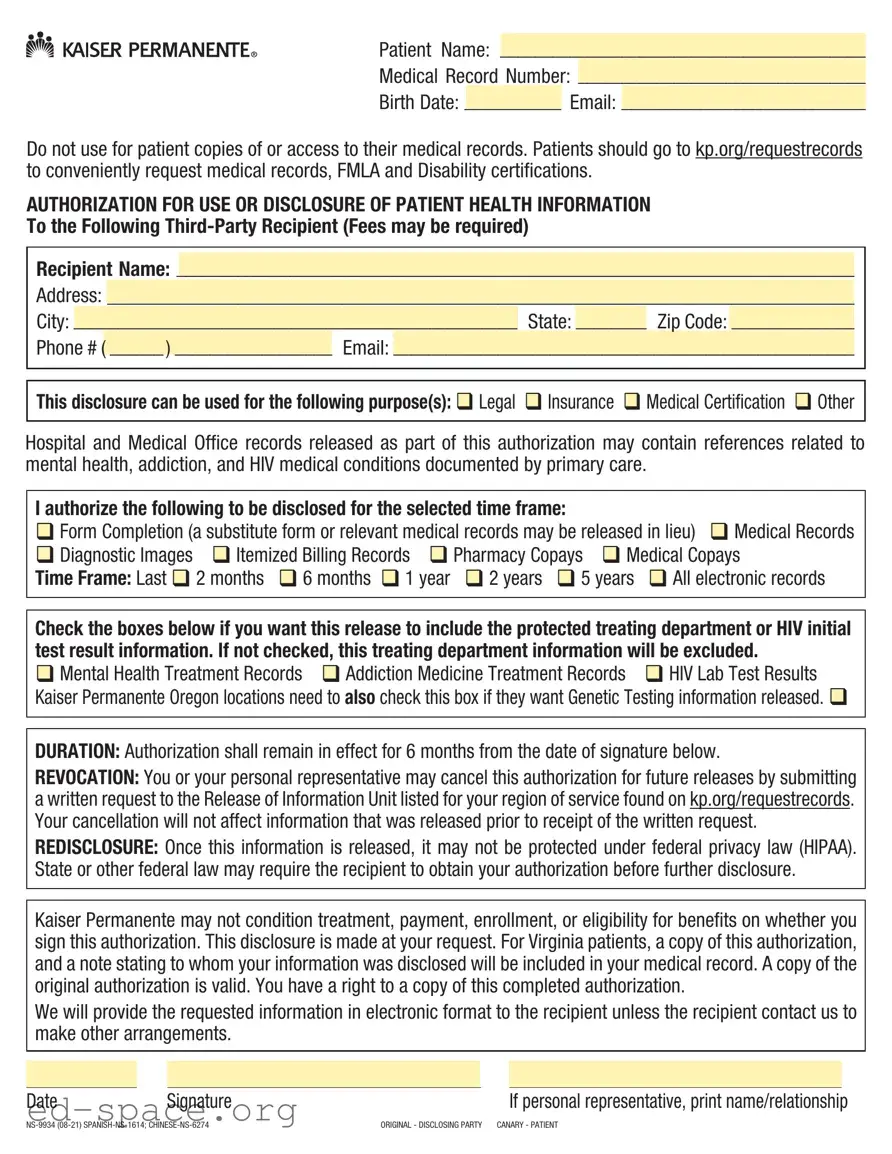
The Kaiser Records Request form serves as an essential tool for patients seeking to authorize the release of their medical information to a third party. This form is designed to facilitate the sharing of important health data while ensuring compliance with privacy laws. Patients must fill in their personal details, including their name, medical record number, and date of birth, as well as provide the recipient's contact information. Notably, this form is not intended for patients to access their own medical records directly; instead, they should use the kp.org/requestrecords website for that purpose. The form includes sections where patients can specify the purpose of the disclosure, such as for legal, insurance, or medical certification needs. Additionally, patients can select the types of information they wish to disclose, including medical records, diagnostic images, and billing records, and indicate the time frame for which the records are requested. It also allows for the inclusion of sensitive information related to mental health, addiction, or HIV testing, should the patient choose to do so. Importantly, the authorization remains valid for six months and can be revoked at any time by submitting a written request. Understanding these components is crucial for anyone looking to navigate the process of medical record disclosure effectively.

Patient Name: __________________________________________
Medical Record Number: _________________________________
Birth Date: ___________ Email: ____________________________
Do not use for patient copies of or access to their medical records. Patients should go to kp.org/requestrecords to conveniently request medical records, FMLA and Disability certifications.
AUTHORIZATION FOR USE OR DISCLOSURE OF PATIENT HEALTH INFORMATION
To the Following
Recipient Name: ______________________________________________________________________________
Address: ______________________________________________________________________________________
City: ___________________________________________________ State: ________ Zip Code: ______________
Phone # ( ______ ) __________________ Email: _____________________________________________________
This disclosure can be used for the following purpose(s): Legal Insurance Medical Certification Other
Hospital and Medical Office records released as part of this authorization may contain references related to mental health, addiction, and HIV medical conditions documented by primary care.
I authorize the following to be disclosed for the selected time frame:
Form Completion (a substitute form or relevant medical records may be released in lieu) Medical Records
|
Diagnostic Images |
|
|
Itemized Billing Records |
|
Pharmacy Copays |
|
Medical Copays |
||||||||||
|
|
|
||||||||||||||||
|
|
|
|
|||||||||||||||
Time Frame: Last |
|
2 months |
|
6 months |
|
1 year |
2 years |
|
5 years |
|
All electronic records |
|||||||
|
|
|
|
|||||||||||||||
|
|
|
|
|
|
|||||||||||||
Check the boxes below if you want this release to include the protected treating department or HIV initial test result information. If not checked, this treating department information will be excluded.
Mental Health Treatment Records Addiction Medicine Treatment Records HIV Lab Test Results Kaiser Permanente Oregon locations need to also check this box if they want Genetic Testing information released.
DURATION: Authorization shall remain in effect for 6 months from the date of signature below.
REVOCATION: You or your personal representative may cancel this authorization for future releases by submitting a written request to the Release of Information Unit listed for your region of service found on kp.org/requestrecords. Your cancellation will not affect information that was released prior to receipt of the written request.
REDISCLOSURE: Once this information is released, it may not be protected under federal privacy law (HIPAA). State or other federal law may require the recipient to obtain your authorization before further disclosure.
Kaiser Permanente may not condition treatment, payment, enrollment, or eligibility for benefits on whether you sign this authorization. This disclosure is made at your request. For Virginia patients, a copy of this authorization, and a note stating to whom your information was disclosed will be included in your medical record. A copy of the original authorization is valid. You have a right to a copy of this completed authorization.
We will provide the requested information in electronic format to the recipient unless the recipient contact us to make other arrangements.
|
|
|
|
|
|
|
Date |
|
Signature |
|
|
If personal representative, print name/relationship |
|
ORIGINAL - DISCLOSING PARTY CANARY - PATIENT |
||||||
Instructions:
1)Complete the patient identification information on the top
2)Complete all required information for the recipient including a valid email address
3)Check the box for purpose of disclosure
4)Check the box(es) for the type of information to be disclosed and also check the box for a timeframe
5)If you want specially protected information to be included, check the appropriate box(es)
6)Enter the date you are signing the authorization
7)Sign the form
8)If you are a personal representative, print your name and relationship. We may reach out for you to provide additional documentation if needed.
9)Submit this form to the third party you are authorizing to obtain records
10)Keep a copy for your records
“Kaiser Permanente” means both your insurance company (a Kaiser Permanente health plan) and your doctors (a Permanente medical or dental group). It also includes different groups depending on where you live.
To find contact information go to kp.org and search locations for your region/market listed below or alternatively go to kp.org/requestrecords and indicate your region/market.
All states where we do business:
•Kaiser Foundation Hospitals
•Kaiser Permanente Insurance Company
Colorado:
•Kaiser Foundation Health Plan of Colorado
•Colorado Permanente Medical Group, P.C.
Georgia:
•Kaiser Foundation Health Plan of Georgia, Inc.
•The Southeast Permanente Medical Group, Inc.
•Kaiser Foundation Health Plan of the
•
Washington:
•Kaiser Foundation Health Plan of Washington
•Washington Permanente Medical Group, P.C.
Hawaii:
•Kaiser Foundation Health Plan, Inc., Hawaii Region
•Hawaii Permanente Medical Group, Inc.
•Maui Health Systems
Northwest (Oregon/SW Washington):
•Kaiser Foundation Health Plan of the Northwest
•Northwest Permanente, P.C.
•Permanente Dental Associates, P.C.
California - North:
•Kaiser Foundation Health Plan, Inc., Northern California Region
•The Permanente Medical Group, Inc.
California - South:
•Kaiser Foundation Health Plan, Inc., Southern California Region
•Southern California Permanente Medical Group

Patient Name: __________________________________________
Medical Record Number: _________________________________
Birth Date: ___________ Email: ____________________________
Do not use for patient copies of or access to their medical records. Patients should go to kp.org/requestrecords to conveniently request medical records, FMLA and Disability certifications.
AUTHORIZATION FOR USE OR DISCLOSURE OF PATIENT HEALTH INFORMATION
To the Following
Recipient Name: ______________________________________________________________________________
Address: ______________________________________________________________________________________
City: ___________________________________________________ State: ________ Zip Code: ______________
Phone # ( ______ ) __________________ Email: _____________________________________________________
This disclosure can be used for the following purpose(s): Legal Insurance Medical Certification Other
Hospital and Medical Office records released as part of this authorization may contain references related to mental health, addiction, and HIV medical conditions documented by primary care.
I authorize the following to be disclosed for the selected time frame:
Form Completion (a substitute form or relevant medical records may be released in lieu) Medical Records
Diagnostic Images |
Itemized Billing Records Pharmacy Copays Medical Copays |
Time Frame: Last |
2 months 6 months 1 year 2 years 5 years All electronic records |
Check the boxes below if you want this release to include the protected treating department or HIV initial test result information. If not checked, this treating department information will be excluded.
Mental Health Treatment Records Addiction Medicine Treatment Records HIV Lab Test Results Kaiser Permanente Oregon locations need to also check this box if they want Genetic Testing information released.
DURATION: Authorization shall remain in effect for 6 months from the date of signature below.
REVOCATION: You or your personal representative may cancel this authorization for future releases by submitting a written request to the Release of Information Unit listed for your region of service found on kp.org/requestrecords. Your cancellation will not affect information that was released prior to receipt of the written request.
REDISCLOSURE: Once this information is released, it may not be protected under federal privacy law (HIPAA). State or other federal law may require the recipient to obtain your authorization before further disclosure.
Kaiser Permanente may not condition treatment, payment, enrollment, or eligibility for benefits on whether you sign this authorization. This disclosure is made at your request. For Virginia patients, a copy of this authorization, and a note stating to whom your information was disclosed will be included in your medical record. A copy of the original authorization is valid. You have a right to a copy of this completed authorization.
We will provide the requested information in electronic format to the recipient unless the recipient contact us to make other arrangements.
|
|
|
|
|
|
|
Date |
Signature |
|
|
If personal representative, print name/relationship |
||
ORIGINAL - DISCLOSING PARTY CANARY - PATIENT |
||||||
| Fact Name | Details |
|---|---|
| Patient Information Required | The form requires the patient's name, medical record number, birth date, and email address. |
| Third-Party Disclosure | The form authorizes the release of medical information to a specified third party, which may involve fees. |
| Purpose of Disclosure | Patients can indicate the purpose for the disclosure, such as legal, insurance, or medical certification. |
| Time Frame Selection | Patients can choose a time frame for the records requested, ranging from the last two months to all electronic records. |
| Protected Information | Patients can request the inclusion of sensitive information, such as mental health records and HIV test results. |
| Duration of Authorization | The authorization remains valid for six months from the date it is signed. |
| Revocation Process | Patients can revoke their authorization at any time by submitting a written request to the designated unit. |
| Redisclosure Warning | Once information is released, it may not be protected under federal privacy laws, and further disclosure may require additional authorization. |
| State-Specific Laws | For Virginia patients, a copy of the authorization and a disclosure note will be included in their medical record. |
| Record Keeping | Patients are advised to keep a copy of the completed authorization for their own records. |
After completing the Kaiser Records Request form, the next steps involve submitting it to the designated third party you have authorized to obtain your records. Be sure to keep a copy for your own records. You may receive follow-up communication if any additional documentation is needed.
What is the Kaiser Records Request form used for?
The Kaiser Records Request form is designed to authorize the release of your medical records to a third party. This could be for various purposes, including legal matters, insurance claims, or medical certifications. It’s important to note that this form should not be used by patients to access their own medical records. Instead, patients should visit kp.org/requestrecords for that purpose.
Who can I authorize to receive my medical records?
You can authorize any third party to receive your medical records. This could be a lawyer, an insurance company, or another healthcare provider. Just fill in their name and contact information on the form. Make sure the recipient is someone you trust to handle your information appropriately.
What information do I need to provide on the form?
You will need to provide your name, medical record number, birth date, and email address at the top of the form. Additionally, you must fill in the recipient's name, address, phone number, and email. It's also necessary to specify the purpose for which the records are being requested and the type of information you want to be disclosed.
How long is the authorization valid?
The authorization you provide on the form remains in effect for six months from the date you sign it. If you need to revoke this authorization before the six months are up, you can do so by submitting a written request to the appropriate Release of Information Unit.
What types of records can I request?
You can request various types of records, including medical records, diagnostic images, itemized billing records, pharmacy copays, and medical copays. You can also choose to include sensitive information, such as mental health treatment records or HIV lab test results, by checking the appropriate boxes on the form.
Can I include sensitive health information in my request?
Yes, you can include sensitive health information, such as mental health treatment records and HIV lab test results, in your request. Make sure to check the corresponding boxes on the form to ensure this information is included in the disclosure.
What happens if I change my mind after signing the form?
If you decide to cancel your authorization after signing the form, you can do so by submitting a written request to the Release of Information Unit. Keep in mind that any information already released before your cancellation request will not be affected.
How will the information be provided to the recipient?
The requested information will typically be provided in electronic format unless the recipient contacts Kaiser to arrange otherwise. This helps ensure that the information is delivered quickly and securely.
Are there any fees associated with the release of my records?
There may be fees associated with the release of your medical records, depending on the recipient and the type of information requested. It's a good idea to check with the recipient to understand any potential costs before submitting the request.
Where can I find more information about the records request process?
For more details about the records request process, you can visit kp.org/requestrecords. This website provides comprehensive information and guidance tailored to your specific region and needs.
Incomplete Patient Information: Failing to fill out all required fields such as the patient name, medical record number, and birth date can lead to delays. Ensure that all personal details are complete and accurate.
Missing Recipient Details: Not providing the recipient's name and contact information can result in the request being rejected. Always include a valid email address and phone number for the recipient.
Not Specifying the Purpose: Omitting the purpose of the disclosure can create confusion. Be sure to check the appropriate box that describes why the information is needed, such as for legal or insurance purposes.
Ignoring Special Protections: If you want to include sensitive information, such as mental health records or HIV lab test results, remember to check the corresponding boxes. Not doing so may exclude important information from the request.
When requesting medical records from Kaiser Permanente, several other forms and documents may accompany the Kaiser Records Request form. Each of these documents serves a specific purpose and can facilitate the process of obtaining the necessary information. Below is a list of commonly used forms and documents that may be relevant.
Understanding these documents can help streamline the process of obtaining medical records and ensure that all necessary information is accurately conveyed. If you have any questions about which forms you may need, it is advisable to consult with a healthcare professional or a legal expert.
The Kaiser Records Request form serves a specific purpose in facilitating the disclosure of patient health information. Several other documents share similarities in structure and function. Below is a list of four such documents:
When filling out the Kaiser Records Request form, there are several important steps to follow to ensure the process goes smoothly. Here are five things you should and shouldn't do:
By following these guidelines, you can help ensure that your records request is processed efficiently and without unnecessary delays.
This form is not intended for patients seeking personal copies of their medical records. Instead, patients should visit kp.org/requestrecords to conveniently obtain their records.
Fees may apply when disclosing information to third-party recipients. Patients should be aware of this potential cost before submitting the form.
The authorization is valid for only six months from the date of signature. After this period, a new authorization must be submitted.
Once the information is disclosed, it may not be protected under federal privacy law. Recipients may be allowed to share the information further without additional authorization.
While patients can revoke their authorization, this cancellation only applies to future releases. It does not affect any information that was already disclosed prior to the revocation.
Patients must submit the completed form to the designated third party. They should ensure that the recipient is prepared to receive the records in the specified format.
Patients must specify the time frame for which they want records. If they choose a limited time frame, only records from that period will be disclosed.
Kaiser Permanente cannot condition treatment, payment, or enrollment on the patient's decision to sign this authorization. It is strictly voluntary.
When filling out and utilizing the Kaiser Records Request form, there are several important points to keep in mind. Understanding these key takeaways can streamline the process and ensure that the necessary information is obtained efficiently.
By following these guidelines, individuals can navigate the Kaiser Records Request form more effectively, ensuring that they receive the appropriate medical information in a timely manner.