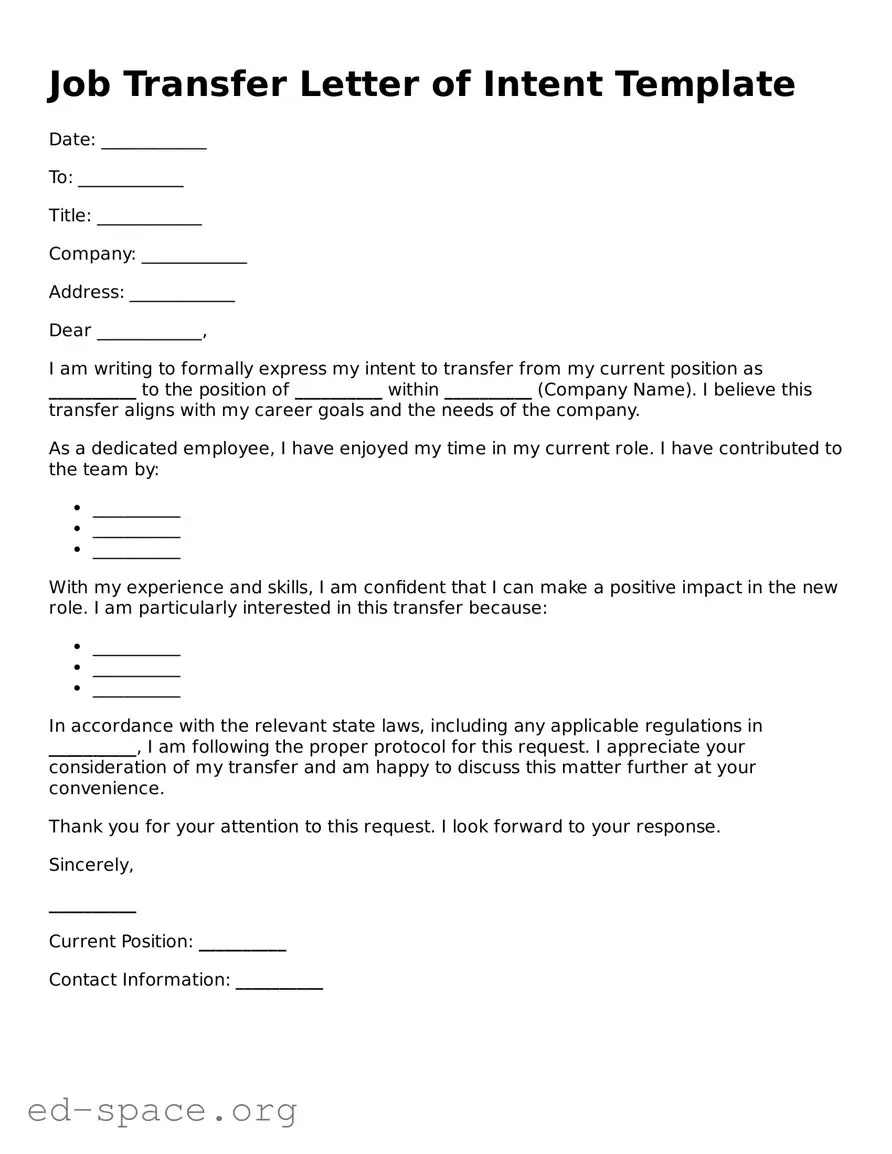
The Job Transfer Letter of Intent form plays a crucial role in the employee transfer process within an organization. This document serves as a formal request from an employee seeking to move from their current position to another role, either within the same department or across different departments. It outlines the employee’s reasons for the transfer, highlighting their skills and experiences that align with the new position. Additionally, it provides an opportunity for the employee to express their enthusiasm for the potential new role and how they envision contributing to the team. By clearly articulating their motivations and qualifications, employees can effectively communicate their desire for career advancement and growth. This form not only facilitates a smooth transition but also helps management assess the suitability of the employee for the new role, ensuring that both parties benefit from the transfer process.
Job Transfer Letter of Intent Template
Date: ____________
To: ____________
Title: ____________
Company: ____________
Address: ____________
Dear ____________,
I am writing to formally express my intent to transfer from my current position as __________ to the position of __________ within __________ (Company Name). I believe this transfer aligns with my career goals and the needs of the company.
As a dedicated employee, I have enjoyed my time in my current role. I have contributed to the team by:
With my experience and skills, I am confident that I can make a positive impact in the new role. I am particularly interested in this transfer because:
In accordance with the relevant state laws, including any applicable regulations in __________, I am following the proper protocol for this request. I appreciate your consideration of my transfer and am happy to discuss this matter further at your convenience.
Thank you for your attention to this request. I look forward to your response.
Sincerely,
__________
Current Position: __________
Contact Information: __________
| Fact Name | Description |
|---|---|
| Purpose | The Job Transfer Letter of Intent form is used to express an employee's desire to transfer to a different position or location within the same company. |
| Contents | The form typically includes details such as the employee's current position, the desired position, and reasons for the transfer. |
| Submission Process | Employees usually submit the form to their immediate supervisor or HR department for consideration. |
| State-Specific Forms | Some states may have specific requirements or forms related to job transfers, governed by state employment laws. |
| Confidentiality | Information provided in the form is generally kept confidential and should only be reviewed by relevant personnel. |
| Impact on Employment | Submitting a transfer request does not guarantee a job change; decisions depend on company policy and availability of positions. |
Once you have your Job Transfer Letter of Intent form in hand, it’s time to fill it out accurately and thoughtfully. Completing this form will set the stage for your next career move within the organization. Be sure to gather all necessary information beforehand to streamline the process.
After completing the form, review it carefully to ensure all information is accurate. Once satisfied, submit it to your supervisor or the appropriate HR representative, following your company’s protocol. Be prepared for any follow-up discussions regarding your transfer request.
What is a Job Transfer Letter of Intent?
A Job Transfer Letter of Intent is a formal document that an employee submits to express their desire to transfer to a different position within the same organization. This letter serves as a way to communicate your interest in a new role and outlines your qualifications, reasons for the transfer, and any relevant experiences that make you a suitable candidate for the position.
When should I submit a Job Transfer Letter of Intent?
You should submit your Job Transfer Letter of Intent as soon as you become aware of a position that interests you. Ideally, this should be done after you have discussed your intentions with your supervisor or HR department, if applicable. Timing is important; submitting your letter promptly can demonstrate your enthusiasm and commitment to your career growth within the company.
What should be included in my Job Transfer Letter of Intent?
Your letter should include several key elements. Start with a clear statement of your intent to transfer. Follow this with a brief overview of your current role and accomplishments. Highlight your skills and experiences that align with the new position. Finally, express your enthusiasm for the opportunity and your willingness to discuss the transfer further. A professional tone is essential throughout the letter.
Is a Job Transfer Letter of Intent legally binding?
No, a Job Transfer Letter of Intent is not legally binding. It is primarily a formal expression of interest and intent. While it shows your desire to transfer, it does not guarantee that the transfer will take place. The decision ultimately rests with management and HR, who will consider various factors before making a final decision.
Can I withdraw my Job Transfer Letter of Intent after submitting it?
Yes, you can withdraw your Job Transfer Letter of Intent at any time before a formal decision is made regarding your transfer. If you choose to do so, it is advisable to communicate your decision clearly and professionally, either in writing or in a meeting with your supervisor or HR. This ensures that all parties are informed and can adjust their plans accordingly.
What happens after I submit my Job Transfer Letter of Intent?
After you submit your letter, it will typically be reviewed by your supervisor and the HR department. They may reach out to discuss your qualifications and interest in the position further. Depending on the company’s process, you may be invited for an interview for the new role. Keep in mind that this is an opportunity for both you and the organization to assess whether the transfer is a good fit.
Failing to include contact information. Ensure your phone number and email address are clearly stated.
Not specifying the position you are applying for. Clearly state the job title and department.
Neglecting to mention reasons for the transfer. Explain why you want to move to a different position.
Using inappropriate language. Maintain a professional tone throughout the letter.
Omitting current job details. Include your current position and responsibilities for context.
Not addressing the letter to the right person. Make sure to find out who should receive your letter.
Failing to proofread for spelling and grammar errors. Mistakes can undermine your professionalism.
Not providing relevant experience. Highlight your skills and experiences that relate to the new position.
Ignoring submission guidelines. Follow any specific instructions for submitting the form.
A Job Transfer Letter of Intent is a formal document expressing an employee's desire to transfer to a different position within the organization. It is often accompanied by various other forms and documents that facilitate the transfer process. Below is a list of commonly used documents that may accompany the Job Transfer Letter of Intent.
These documents help ensure a smooth transition for the employee and provide necessary information for management to make informed decisions. Understanding each of these forms can facilitate a successful job transfer process.
When filling out the Job Transfer Letter of Intent form, it's important to approach the task thoughtfully. Here are some key dos and don'ts to consider:
Following these guidelines can help make your transfer request more effective and professional.
When it comes to the Job Transfer Letter of Intent form, many people hold misconceptions that can lead to confusion. Here’s a list of common misunderstandings and clarifications to help you navigate this important document.
Understanding these misconceptions can help you approach the Job Transfer Letter of Intent with clarity and confidence. Always remember that clear communication is key to expressing your career aspirations.
When filling out and using the Job Transfer Letter of Intent form, it’s important to keep several key points in mind. Here are some essential takeaways:
By keeping these points in mind, you can effectively communicate your desire for a job transfer and increase your chances of a successful transition within your organization.