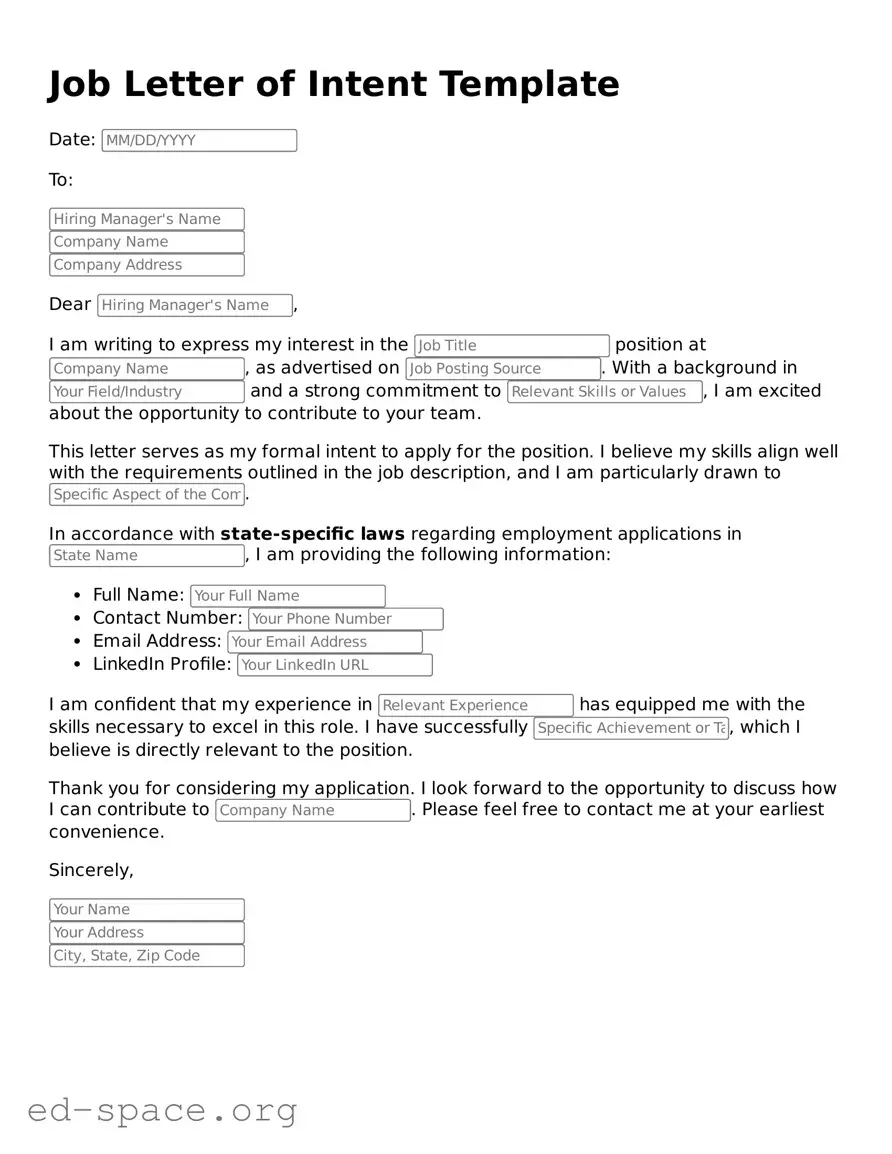
When embarking on a job search, one of the most important documents you may need is a Job Letter of Intent. This form serves as a powerful tool to express your interest in a specific position and to highlight your qualifications and enthusiasm for the role. It typically includes key elements such as your contact information, the position you are applying for, and a brief introduction that captures your professional background. Additionally, the letter should articulate why you are a good fit for the job and how your skills align with the company's goals. Furthermore, it often concludes with a call to action, encouraging the employer to consider your application and inviting them to reach out for further discussion. Crafting a compelling Job Letter of Intent can set you apart from other candidates, making it essential to approach this task with care and intention.
Job Letter of Intent Template
Date:
To:
Dear ,
I am writing to express my interest in the position at , as advertised on . With a background in and a strong commitment to , I am excited about the opportunity to contribute to your team.
This letter serves as my formal intent to apply for the position. I believe my skills align well with the requirements outlined in the job description, and I am particularly drawn to .
In accordance with state-specific laws regarding employment applications in , I am providing the following information:
I am confident that my experience in has equipped me with the skills necessary to excel in this role. I have successfully , which I believe is directly relevant to the position.
Thank you for considering my application. I look forward to the opportunity to discuss how I can contribute to . Please feel free to contact me at your earliest convenience.
Sincerely,
| Fact Name | Description |
|---|---|
| Purpose | The Job Letter of Intent form expresses an individual's interest in a specific job position, outlining qualifications and intentions to apply. |
| Content Requirements | This form typically includes the applicant's contact information, a brief introduction, relevant experience, and reasons for interest in the position. |
| Submission Guidelines | Applicants should submit the form along with their resume and cover letter, following the employer's specified application process. |
| Governing Laws | State-specific forms may be governed by employment law regulations, which vary by state. It's important to check local laws for compliance. |
After you have gathered the necessary information, it’s time to fill out the Job Letter of Intent form. Completing this form accurately is important for ensuring that your intentions are clearly communicated. Follow these steps carefully to fill it out correctly.
Once you have completed the form, review it for any errors before submitting it. Make sure all information is accurate and clearly presented. This will help make a positive impression on potential employers.
What is a Job Letter of Intent?
A Job Letter of Intent is a formal document that expresses your interest in a specific job position. It serves as a way to introduce yourself to a potential employer and outline your qualifications, skills, and reasons for wanting to work with their organization. This letter is often sent alongside a resume and can help set you apart from other candidates by showcasing your enthusiasm and fit for the role.
When should I use a Job Letter of Intent?
You should consider using a Job Letter of Intent when applying for a job, particularly if the position is not publicly advertised. This letter can be beneficial if you are reaching out to a company to express interest in future opportunities or if you are applying for a position that may not have a formal application process. Additionally, it can be useful when you want to highlight specific skills or experiences that make you a strong candidate for a role.
What should I include in my Job Letter of Intent?
Your Job Letter of Intent should include several key components. Start with a professional greeting, followed by an introduction that states the position you are interested in. Next, outline your relevant skills, experiences, and qualifications, making sure to connect them to the job requirements. It’s also important to convey your enthusiasm for the company and the role. Finally, close with a call to action, inviting the employer to contact you for further discussion.
How is a Job Letter of Intent different from a cover letter?
Incomplete Information: Many individuals fail to provide all the required details. This can include missing personal information, such as a current address or contact number. Ensure that every section of the form is filled out completely to avoid delays in processing.
Generic Content: Some applicants use a one-size-fits-all approach when writing their letters. A lack of specificity regarding the position or organization can make the letter less impactful. Tailoring the content to reflect genuine interest in the specific job opportunity is crucial.
Ignoring Formatting Guidelines: Proper formatting is often overlooked. Applicants may neglect to follow specific instructions regarding font size, margins, or spacing. Adhering to these guidelines not only presents a professional image but also demonstrates attention to detail.
Failure to Proofread: Spelling and grammatical errors can undermine the professionalism of a letter. Many people submit their forms without a thorough review. Taking the time to proofread can help ensure clarity and convey a strong sense of professionalism.
When applying for a job, the Job Letter of Intent form is an essential document, but it's often accompanied by other important forms and documents. Each of these plays a crucial role in presenting your qualifications and intentions to potential employers. Below are five common documents you might consider including with your Job Letter of Intent.
Including these documents along with your Job Letter of Intent can enhance your application and present a well-rounded picture of your qualifications. Each piece contributes to a narrative that showcases your strengths and aspirations, making it easier for employers to see why you are the right fit for the job.
Cover Letter: A cover letter accompanies a resume and provides a personal introduction to the applicant. Similar to the Job Letter of Intent, it expresses interest in a position and outlines relevant qualifications. Both documents aim to make a strong first impression on potential employers.
Statement of Purpose: Often required for academic applications, a statement of purpose outlines an individual’s goals and motivations. Like the Job Letter of Intent, it serves to convey the applicant's intentions and aspirations, providing insight into their professional journey.
Job Application: A job application is a formal request for employment, often requiring detailed personal and professional information. While the Job Letter of Intent expresses interest and intent, the application focuses on qualifications and experience, both aiming to secure an interview.
Resume: A resume summarizes an individual's work experience, education, and skills. Although it presents factual information, like the Job Letter of Intent, it seeks to persuade employers of the applicant’s suitability for a position, highlighting key achievements and relevant experiences.
When filling out a Job Letter of Intent form, there are important practices to keep in mind. Here are some things to do and avoid:
Understanding the Job Letter of Intent form is crucial for job seekers. However, several misconceptions can lead to confusion. Here are five common misconceptions:
When filling out and using the Job Letter of Intent form, consider the following key takeaways: