Homepage Blank IRS W-2 PDF Form
Content Overview

The importance of understanding the IRS W-2 form cannot be overstated for both employers and employees in the United States. This crucial document, which must be issued by employers to every employee who received a salary, wages, or other types of compensation, serves as a key player in the annual tax filing process. Detailing the amount of money earned by an employee and the taxes withheld from their paycheck throughout the tax year, the W-2 form is indispensable for accurately reporting income and calculating taxes owed or refunds due to taxpayers. Furthermore, it plays a pivotal role in ensuring employees can fully account for their earnings and taxes paid, thus avoiding potential issues with the IRS. Employers are also required to send a copy of this form to the IRS, ensuring that reported earnings match those recorded by the government, which underscores its critical role in the tax reporting ecosystem. The multifaceted aspects of the W-2 form, from its contributions to employee tax filings to its significance in maintaining the integrity of the tax system, highlight the necessity for both employers and employees to fully grasp its contents and implications.


Document Preview

Attention:
You may file Forms W-2 and W-3 electronically on the SSA’s Employer
W-2 Filing Instructions and Information web page, which is also accessible
at www.socialsecurity.gov/employer. You can create fill-in versions of
Forms W-2 and W-3 for filing with SSA. You may also print out copies for
filing with state or local governments, distribution to your employees, and
for your records.
Note: Copy A of this form is provided for informational purposes only. Copy A appears in
red, similar to the official IRS form. The official printed version of this IRS form is scannable,
but the online version of it, printed from this website, is not. Do not print and file Copy A
downloaded from this website with the SSA; a penalty may be imposed for filing forms that
can’t be scanned. See the penalties section in the current General Instructions for Forms
W-2 and W-3, available at www.irs.gov/w2, for more information.
Please note that Copy B and other copies of this form, which appear in black, may be
downloaded, filled in, and printed and used to satisfy the requirement to provide the
information to the recipient.
To order official IRS information returns such as Forms W-2 and W-3, which include a
scannable Copy A for filing, go to IRS’ Online Ordering for Information Returns and
Employer Returns page, or visit www.irs.gov/orderforms and click on Employer and
Information returns. We’ll mail you the scannable forms and any other products you order.
See IRS Publications 1141, 1167, and 1179 for more information about printing these tax
forms.
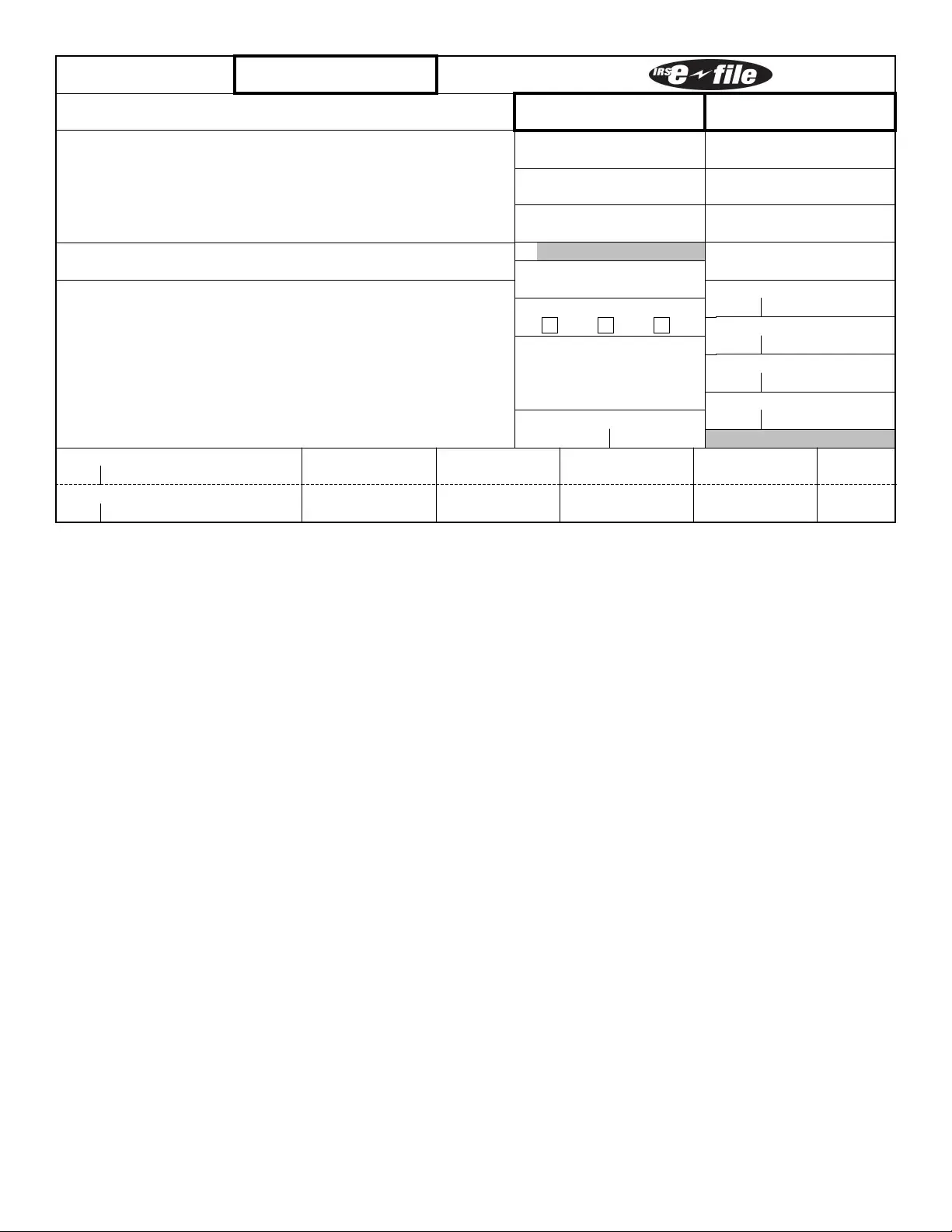
22222
VOID
a Employee’s social security number
For Official Use Only
OMB No. 1545-0029
b Employer identification number (EIN)
c Employer’s name, address, and ZIP code
d Control number
e Employee’s first name and initial Last name Suff.
f Employee’s address and ZIP code
1 Wages, tips, other compensation
2 Federal income tax withheld
3 Social security wages 4 Social security tax withheld
5 Medicare wages and tips 6 Medicare tax withheld
7 Social security tips 8 Allocated tips
9 10 Dependent care benefits
11 Nonqualified plans
12a See instructions for box 12
C
o
d
e
12b
C
o
d
e
12c
C
o
d
e
12d
C
o
d
e
13
Statutory
employee
Retirement
plan
Third-party
sick pay
14a Other
14b
Treasury Tipped Occupation Code(s)
15 State Employer’s state ID number 16 State wages, tips, etc. 17 State income tax 18 Local wages, tips, etc. 19 Local income tax 20
Locality name
Form
W-2
Wage and Tax Statement
2026
Department of the Treasury—Internal Revenue Service
For Privacy Act and Paperwork Reduction
Act Notice, see the separate instructions.
Copy A—For Social Security Administration. Send this entire page with
Form W-3 to the Social Security Administration; photocopies are not acceptable.
Cat. No. 10134D Created 1/7/26
Do Not Cut, Fold, or Staple Forms on This Page
22222
a Employee’s social security number
OMB No. 1545-0029
b Employer identification number (EIN)
c Employer’s name, address, and ZIP code
d Control number
e Employee’s first name and initial Last name Suff.
f Employee’s address and ZIP code
1 Wages, tips, other compensation
2 Federal income tax withheld
3 Social security wages 4 Social security tax withheld
5 Medicare wages and tips 6 Medicare tax withheld
7 Social security tips 8 Allocated tips
9 10 Dependent care benefits
11 Nonqualified plans
12a
C
o
d
e
12b
C
o
d
e
12c
C
o
d
e
12d
C
o
d
e
13
Statutory
employee
Retirement
plan
Third-party
sick pay
14a Other
14b
Treasury Tipped Occupation Code(s)
15 State Employer’s state ID number 16 State wages, tips, etc. 17 State income tax 18 Local wages, tips, etc. 19 Local income tax 20
Locality name
Form
W-2
Wage and Tax Statement
2026
Department of the Treasury—Internal Revenue Service
Copy 1—For State, City, or Local Tax Department
a Employee’s social security number
OMB No. 1545-0029
Safe, accurate,
FAST! Use
Visit the IRS website at
www.irs.gov/efile.
b Employer identification number (EIN)
c Employer’s name, address, and ZIP code
d Control number
e Employee’s first name and initial Last name Suff.
f Employee’s address and ZIP code
1 Wages, tips, other compensation
2 Federal income tax withheld
3 Social security wages 4 Social security tax withheld
5 Medicare wages and tips 6 Medicare tax withheld
7 Social security tips 8 Allocated tips
9 10 Dependent care benefits
11 Nonqualified plans
12a See instructions for box 12
C
o
d
e
12b
C
o
d
e
12c
C
o
d
e
12d
C
o
d
e
13
Statutory
employee
Retirement
plan
Third-party
sick pay
14a Other
14b
Treasury Tipped Occupation Code(s)
15 State Employer’s state ID number 16 State wages, tips, etc. 17 State income tax 18 Local wages, tips, etc. 19 Local income tax 20
Locality name
Form
W-2
Wage and Tax Statement
2026
Department of the Treasury—Internal Revenue Service
Copy B—To Be Filed With Employee’s FEDERAL Tax Return.
This information is being furnished to the Internal Revenue Service.
Future developments. For the latest information about
developments related to Form W-2, such as legislation enacted
after it was published, go to www.irs.gov/FormW2.
Notice to Employee
Do you have to file? Refer to the Form 1040 instructions to
determine if you are required to file a tax return. Even if you
don’t have to file a tax return, you may be eligible for a refund if
box 2 shows an amount or if you are eligible for any credit.
Earned income tax credit (EITC). You may be able to take the
EITC for 2026 if your adjusted gross income (AGI) is less than a
certain amount. The amount of the credit is based on income
and family size. Workers without children could qualify for a
smaller credit. You and any qualifying children must have valid
social security numbers (SSNs). You can’t take the EITC if your
investment income is more than the specified amount for 2026
or if income is earned for services provided while you were an
inmate at a penal institution. For 2026 income limits and more
information, visit www.irs.gov/EITC. See also Pub. 596. Any
EITC that is more than your tax liability is refunded to you,
but only if you file a tax return.
Employee’s social security number (SSN). For your
protection, this form may show only the last four digits of your
SSN. However, your employer has reported your complete SSN
to the IRS and the Social Security Administration (SSA).
Clergy and religious workers. If you aren’t subject to social
security and Medicare taxes, see Pub. 517.
Corrections. If your name, SSN, or address is incorrect, correct
Copies B, C, and 2 and ask your employer to correct your
employment record. Be sure to ask the employer to file Form
W-2c, Corrected Wage and Tax Statement, with the SSA to
correct any name, SSN, or money amount error reported to the
SSA on Form W-2. Be sure to get your copies of Form W-2c
from your employer for all corrections made so you may file
them with your tax return. If your name and SSN are correct but
aren’t the same as shown on your social security card, you
should ask for a new card that displays your correct name at
any SSA office or by calling 800-772-1213. You may also visit
the SSA website at www.SSA.gov.
Cost of employer-sponsored health coverage (if such cost is
provided by the employer). The reporting in box 12, using
code DD, of the cost of employer-sponsored health coverage is
for your information only. The amount reported with code DD
is not taxable.
Credit for excess taxes. If you had more than one employer in
2026 and more than $11,439.00 in social security and/or Tier 1
railroad retirement (RRTA) taxes were withheld, you may be able
to claim a credit for the excess against your federal income tax.
See the Form 1040 instructions. If you had more than one
railroad employer and more than $6,717.90 in Tier 2 RRTA tax
was withheld, you may be able to claim a refund on Form 843.
See the Instructions for Form 843.
(See also Instructions for Employee on the back of Copy C.)
a Employee’s social security number
OMB No. 1545-0029
This information is being furnished to the Internal Revenue Service. If you
are required to file a tax return, a negligence penalty or other sanction
may be imposed on you if this income is taxable and you fail to report it.
b Employer identification number (EIN)
c Employer’s name, address, and ZIP code
d Control number
e Employee’s first name and initial Last name Suff.
f Employee’s address and ZIP code
1 Wages, tips, other compensation
2 Federal income tax withheld
3 Social security wages 4 Social security tax withheld
5 Medicare wages and tips 6 Medicare tax withheld
7 Social security tips 8 Allocated tips
9 10 Dependent care benefits
11 Nonqualified plans
12a See instructions for box 12
C
o
d
e
12b
C
o
d
e
12c
C
o
d
e
12d
C
o
d
e
13
Statutory
employee
Retirement
plan
Third-party
sick pay
14a Other
14b
Treasury Tipped Occupation Code(s)
15 State Employer’s state ID number 16 State wages, tips, etc. 17 State income tax 18 Local wages, tips, etc. 19 Local income tax 20
Locality name
Form
W-2
Wage and Tax Statement
2026
Department of the Treasury—Internal Revenue Service
Copy C—For EMPLOYEE’S RECORDS
(See Notice to Employee on the back of Copy B.)
Safe, accurate,
FAST! Use
Instructions for Employee
(See also Notice to Employee on the back of Copy B.)
Box 1. Enter this amount on the wages line of your tax return unless those
instructions direct you to report it elsewhere.
Box 2. Enter this amount on the federal income tax withheld line of your tax
return.
Box 5. You may be required to report this amount on Form 8959. See the
Form 1040 instructions to determine if you are required to complete Form
8959.
Box 6. This amount includes the 1.45% Medicare tax withheld on all
Medicare wages and tips shown in box 5, as well as the 0.9% Additional
Medicare Tax on any of those Medicare wages and tips above $200,000.
Box 8. This amount is not included in box 1, 3, 5, or 7. For information on
how to report tips on your tax return, see the Form 1040 instructions.
You must file Form 4137 with your income tax return to report at least the
allocated tip amount unless you can prove with adequate records that you
received a smaller amount. If you have records that show the actual amount
of tips you received, report that amount even if it is more or less than the
allocated tips. Use Form 4137 to figure the social security and Medicare tax
owed on tips you didn’t report to your employer. Enter this amount on the
wages line of your tax return. By filing Form 4137, your social security tips
will be credited to your social security record (used to figure your benefits).
Box 10. This amount includes the total dependent care benefits that your
employer paid to you or incurred on your behalf (including amounts from a
section 125 (cafeteria) plan). Any amount over your employer’s plan limit is
also included in box 1. See Form 2441.
Box 11. This amount is (a) reported in box 1 if it is a distribution made to you
from a nonqualified deferred compensation or nongovernmental section
457(b) plan, or (b) included in box 3 and/or box 5 if it is a prior year deferral
under a nonqualified or section 457(b) plan that became taxable for social
security and Medicare taxes this year because there is no longer a
substantial risk of forfeiture of your right to the deferred amount. This box
shouldn’t be used if you had a deferral and a distribution in the same
calendar year. If you made a deferral and received a distribution in the same
calendar year, and you are or will be age 62 by the end of the calendar year,
your employer should file Form SSA-131, Employer Report of Special Wage
Payments, with the Social Security Administration and give you a copy.
Box 12. The following list explains the codes shown in box 12. You may
need this information to complete your tax return. Elective deferrals (codes
D, E, F, and S) and designated Roth contributions (codes AA, BB, and EE)
under all plans are generally limited to a total of $24,500 (generally, $17,000
for SIMPLE plans; $27,500 for section 403(b) plans if you qualify for the
15-year rule explained in Pub. 571). Deferrals under code G are limited to
$24,500. Deferrals under code H are limited to $7,000.
However, if you were at least age 50 in 2026, your employer may have
allowed an additional elective deferral or designated Roth contribution
(catch-up contribution) to your plan. For information about the limits on these
catch-up contributions, including the higher limit if you were age 60 through
63 as of December 31, 2026, see Pub. 525. Contact your plan administrator
for more information. Amounts in excess of the overall elective deferral limit
must be included in income. See the Form 1040 instructions.
Note: If a year follows code D through H, S, Y, AA, BB, or EE, you made a
make-up pension contribution for a prior year(s) when you were in military
service. To figure whether you made excess deferrals, consider these
amounts for the year shown, not the current year. If no year is shown, the
contributions are for the current year.
A—Uncollected social security or RRTA tax on tips. Include this tax on Form
1040 or 1040-SR. See the Form 1040 instructions.
B—Uncollected Medicare tax on tips. Include this tax on Form 1040 or
1040-SR. See the Form 1040 instructions.
C—Taxable cost of group-term life insurance over $50,000 (included in
boxes 1, 3 (up to the social security wage base), and 5).
D—Elective deferrals to a section 401(k) cash or deferred arrangement. Also
includes deferrals under a SIMPLE retirement account that is part of a
section 401(k) arrangement.
E—Elective deferrals under a section 403(b) salary reduction agreement.
F—Elective deferrals under a section 408(k)(6) salary reduction SEP. (This
includes elective deferrals made to a Roth SEP IRA.)
G—Elective deferrals and employer contributions (including nonelective
deferrals) to a section 457(b) deferred compensation plan.
H—Elective deferrals to a section 501(c)(18)(D) tax-exempt organization plan.
See the Form 1040 instructions for how to deduct.
J—Nontaxable sick pay (information only, not included in box 1, 3, or 5).
K—20% excise tax on excess golden parachute payments. See the Form
1040 instructions.
L—Substantiated employee business expense reimbursements (nontaxable).
(continued on back of Copy 2)
a Employee’s social security number
OMB No. 1545-0029
b Employer identification number (EIN)
c Employer’s name, address, and ZIP code
d Control number
e Employee’s first name and initial Last name Suff.
f Employee’s address and ZIP code
1 Wages, tips, other compensation
2 Federal income tax withheld
3 Social security wages 4 Social security tax withheld
5 Medicare wages and tips 6 Medicare tax withheld
7 Social security tips 8 Allocated tips
9 10 Dependent care benefits
11 Nonqualified plans
12a
C
o
d
e
12b
C
o
d
e
12c
C
o
d
e
12d
C
o
d
e
13
Statutory
employee
Retirement
plan
Third-party
sick pay
14a Other
14b
Treasury Tipped Occupation Code(s)
15 State Employer’s state ID number 16 State wages, tips, etc. 17 State income tax 18 Local wages, tips, etc. 19 Local income tax 20
Locality name
Form
W-2
Wage and Tax Statement
2026
Department of the Treasury—Internal Revenue Service
Copy 2—To Be Filed With Employee’s State, City, or Local
Income Tax Return
Instructions for Employee
(continued from back of Copy C)
Box 12 (continued)
M—Uncollected social security or RRTA tax on taxable cost of group-term
life insurance over $50,000 (former employees only). See the Form 1040
instructions.
N—Uncollected Medicare tax on taxable cost of group-term life insurance
over $50,000 (former employees only). See the Form 1040 instructions.
P—Excludable moving expense reimbursements paid directly to a member
of the U.S. Armed Forces or intelligence community (not included in box 1, 3,
or 5).
Q—Nontaxable combat pay. See the Form 1040 instructions for details on
reporting this amount.
R—Employer contributions to your Archer MSA. Report on Form 8853.
S—Employee salary reduction contributions under a section 408(p) SIMPLE
plan. (This includes salary reduction contributions made to a Roth SIMPLE
IRA.)
T—Adoption benefits (not included in box 1). Complete Form 8839 to figure
any taxable and nontaxable amounts.
V—Income from exercise of nonstatutory stock option(s) (included in boxes
1, 3 (up to the social security wage base), and 5). See Pub. 525 for reporting
requirements.
W—Employer contributions (including amounts the employee elected to
contribute using a section 125 (cafeteria) plan) to your health savings
account. Report on Form 8889.
Y—Deferrals under a section 409A nonqualified deferred compensation plan.
Z—Income under a nonqualified deferred compensation plan that fails to
satisfy section 409A. This amount is also included in box 1. It is subject to an
additional 20% tax plus interest. See the Form 1040 instructions.
AA—Designated Roth contributions under a section 401(k) plan.
BB—Designated Roth contributions under a section 403(b) plan.
DD—Cost of employer-sponsored health coverage. The amount reported
with code DD is not taxable.
EE—Designated Roth contributions under a governmental section 457(b)
plan. This amount does not apply to contributions under a tax-exempt
organization section 457(b) plan.
FF—Permitted benefits under a qualified small employer health
reimbursement arrangement.
GG—Income from qualified equity grants under section 83(i).
HH—Aggregate deferrals under section 83(i) elections as of the close of the
calendar year.
II—Medicaid waiver payments excluded from gross income under Notice
2014-7.
TA—Employer contributions under a section 128 Trump account contribution
program paid to a Trump account of an employee or a dependent of an
employee.
TP—Total amount of cash tips reported to the employer. “Cash tips”
includes tips received in cash, charged, or under a tip-sharing arrangement.
Use this amount when determining the qualified tip deduction in Part II of
Schedule 1-A (Form 1040).
TT—Total amount of qualified overtime compensation. Use this amount
when determining the qualified overtime compensation deduction in Part III
of Schedule 1-A (Form 1040).
Box 13. If the “Retirement plan” box is checked, special limits may apply to
the amount of traditional IRA contributions you may deduct. See Pub. 590-A.
Box 14a. Employers may use this box to report information such as state
disability insurance taxes withheld, union dues, uniform payments, health
insurance premiums deducted, nontaxable income, educational assistance
payments, or a member of the clergy’s parsonage allowance and utilities.
Railroad employers use this box to report railroad retirement (RRTA)
compensation, Tier 1 tax, Tier 2 tax, Medicare tax, and Additional Medicare
Tax. Include tips reported by the employee to the employer in railroad
retirement (RRTA) compensation.
Box 14b. Employers use this box to report up to two Treasury Tipped
Occupation Code(s) for your tipped occupation(s). Use this code(s) and the
amount of tips reported in box 12 (code TP) when determining the qualified
tip deduction in Part II of Schedule 1-A (Form 1040). If the occupation code
000 is used, and no other code is included in box 14b, your cash tips are
not qualified tips; do not use the amount reported in box 12 (code TP) for the
deduction for qualified tips.
Note: Keep Copy C of Form W-2 for at least 3 years after the due date for
filing your income tax return. However, to help protect your social security
benefits, keep Copy C until you begin receiving social security benefits, just
in case there is a question about your work record and/or earnings in a
particular year.
VOID
a Employee’s social security number
OMB No. 1545-0029
b Employer identification number (EIN)
c Employer’s name, address, and ZIP code
d Control number
e Employee’s first name and initial Last name Suff.
f Employee’s address and ZIP code
1 Wages, tips, other compensation
2 Federal income tax withheld
3 Social security wages 4 Social security tax withheld
5 Medicare wages and tips 6 Medicare tax withheld
7 Social security tips 8 Allocated tips
9 10 Dependent care benefits
11 Nonqualified plans
12a See instructions for box 12
C
o
d
e
12b
C
o
d
e
12c
C
o
d
e
12d
C
o
d
e
13
Statutory
employee
Retirement
plan
Third-party
sick pay
14a Other
14b
Treasury Tipped Occupation Code(s)
15 State Employer’s state ID number 16 State wages, tips, etc. 17 State income tax 18 Local wages, tips, etc. 19 Local income tax 20
Locality name
Form
W-2
Wage and Tax Statement
2026
Department of the Treasury—Internal Revenue Service
For Privacy Act and Paperwork Reduction
Act Notice, see the separate instructions.
Copy D—For Employer

Form Specifications

Fact Name Description
Purpose of Form W-2 The W-2 form is used by employers to report an employee's annual wages and the amount of taxes withheld from their paycheck.
Who Must File Employers must file a W-2 form for each employee from whom Income, Social Security, or Medicare tax was withheld.
Filing Deadline Employers are required to send the W-2 form to employees by January 31st of the year following the reporting year.
Electronic Filing Employers filing 250 or more W-2 forms are required to submit them electronically to the Social Security Administration.
Correction Form If an employer makes a mistake on a W-2, they must file a W-2c form to correct the information.
State-Specific Forms Some states have their own requirements for state tax reporting, which may involve additional forms or filings beyond the federal W-2.
Governing Law(s) The IRS governs the use and filing of Form W-2 under the Internal Revenue Code. State-specific requirements may be governed by each state's tax code or revenue department guidelines.

IRS W-2: Usage Guidelines

Every year, employers are required to provide a W-2 form to each of their employees. This form plays a critical role in tax filing, as it documents the employee's annual wages and the amount of taxes withheld from their paycheck. Completing the W-2 form accurately is paramount for both the employer's adherence to tax regulation and the employee's ability to file their taxes correctly. The process involves entering detailed financial data. Failure to precisely complete this form can lead to penalties for businesses and confusion for individuals. Here are the crucial steps to fill out the IRS W-2 form:

  1. Start by entering the employer's identification number (EIN) in box a. This is a unique nine-digit number assigned by the IRS.
  2. In box b, fill in the employer's name, address, and ZIP code, ensuring accuracy to avoid any discrepancies.
  3. Box c is reserved for the employee's Social Security Number (SSN). Double-check this number for correctness to prevent identity issues.
  4. The employee’s full name and address go into box e, following the format directed on the form.
  5. In boxes 1 and 2, report the total wages, tips, and other compensation paid to the employee, alongside the federal income tax withheld from those earnings.
  6. Social Security wages are entered in box 3. This might differ from box 1 if the employee's income exceeds the Social Security wage base limit for the year.
  7. Box 4 is where you document the amount withheld for Social Security taxes, calculated as a fixed percentage of the wages in box 3.
  8. Enter Medicare wages and tips in box 5. Usually, these amounts match the figures in box 1 unless specific exclusions apply.
  9. In box 6, note the Medicare taxes withheld from the employee's paycheck throughout the year.
  10. Use boxes 7 and 8 to report any social security tips and allocated tips, respectively, if applicable.
  11. Box 9 is reserved and should be left blank, as it's not currently in use.
  12. Boxes 10 through 14 may be used for state and local income tax information, along with other compensation or deductions not covered in the previous sections.
  13. Finally, box 15 is for the employer’s state ID number, and boxes 16 and 17 should detail the state wages and state tax withheld, reflecting the amounts relevant to state taxation requirements.
  14. Repeat the state tax information process in boxes 18 through 20 for any applicable local taxes that have been withheld.

Completing the W-2 form accurately is essential for ensuring that employees can properly file their taxes and that employers meet their tax filing obligations. It's a yearly task that requires careful attention to detail to avoid issues down the line. Employers should take their time to review the information thoroughly before submitting the forms to their employees and the IRS.

Your Questions, Answered

What is a W-2 form?

The W-2 form, also known as the Wage and Tax Statement, is a document employers are required to send to each of their employees and the Internal Revenue Service (IRS) at the end of each year. It reports the employee's annual wages and the amount of taxes withheld from their paycheck.

Who receives a W-2 form?

Any employee who has earned a salary, wage, or other compensation from an employer should receive a W-2 form. This applies if you are a full-time or part-time worker and regardless of how long you worked during the year.

When is the W-2 form issued?

Employers are required to send out W-2 forms to their employees by January 31st of the year following the reporting year. For example, for the 2022 tax year, the W-2 forms should be mailed by January 31, 2023.

What should I do if I haven't received my W-2 form?

If you haven't received your W-2 by mid-February, you should first contact your employer to ensure they have your correct address and to request a reissued W-2. If you still do not receive your W-2, you can contact the IRS for assistance.

How is the W-2 form used for tax filing?

The information on the W-2 form is used to fill out your tax return. It includes vital data such as the amount of income you earned, the taxes withheld from your earnings, and contributions to retirement plans, which are necessary for accurately reporting your annual income and determining how much you owe in taxes or how much of a refund you may receive.

What if there are mistakes on my W-2?

If you discover errors on your W-2 form, such as incorrect income or tax amounts, you should immediately contact your employer to issue a corrected W-2. It's important to wait for the corrected W-2 before filing your tax return to avoid processing delays with the IRS.

Can I file my taxes without a W-2?

If you have not received your W-2 in time for tax filing, you may use Form 4852, Substitute for Form W-2, Wage and Tax Statement. However, you should attempt to obtain your W-2 by contacting your employer or the IRS first as estimates can lead to errors in tax filing.

Are there electronic versions of the W-2 form?

Yes, many employers offer electronic versions of the W-2 form through secure websites. Employees can opt to receive their W-2 electronically instead of by mail. These electronic versions are valid documents for tax filing purposes.

What is the difference between a W-2 form and a 1099 form?

The W-2 form is issued to employees whose employer withholds payroll taxes from their earnings. Meanwhile, the 1099 form is used for independent contractors who are responsible for paying their own taxes. The key difference lies in the employment relationship and tax treatment.

How long should I keep my W-2 forms?

It's recommended to keep your W-2 forms for at least three years from the date you filed your income tax return. Holding onto them is important for referencing past income and taxes paid, and they may be needed to amend a previous year's tax return or to apply for certain loans.

Common mistakes

Filling out IRS forms, such as the W-2, requires attention to detail and an understanding of tax-related information. Mistakes made during this process can lead to complications with the Internal Revenue Service (IRS) and potentially affect an individual's tax liabilities and financial well-being. Here are four common errors that people often make when completing the W-2 form:

  1. Incorrect Social Security Numbers: One of the most critical yet frequently made errors is providing an incorrect Social Security number. This mistake can lead to misfiled taxes and complications in the individual’s tax record, potentially affecting future benefits.

  2. Failure to Report All Income: Individuals might not report all their income due to oversight or misunderstanding of what constitutes taxable income. This oversight can lead to inaccurate tax reports and potential penalties.

  3. Misclassification of Employees: Employers may mistakenly classify workers as independent contractors instead of employees, or vice versa, leading to improper reporting of wages and taxes withheld. This error impacts not only the employer’s tax liabilities but also the rights and benefits entitled to the worker.

  4. Incorrect Tax Year Information: Another common mistake is filling in information for the wrong tax year. This can happen when forms are prepared manually or preprinted forms from a previous year are used. Such an error complicates the filing process and may lead to the rejection of the form by the IRS.

To ensure accuracy when completing the W-2 form, individuals and employers should double-check the Social Security numbers and tax year, review all documentation for correct income reporting, and understand the distinctions between employee classifications. These steps can help avoid the mistakes listed above and promote a smoother interaction with the IRS.

Documents used along the form

When tax season approaches, it's important to gather all the necessary documents to ensure a smooth filing process. One of the most well-known forms is the IRS W-2, which reports an employee's annual wages and the amount of taxes withheld from their paycheck. However, to provide a comprehensive view of your financial situation to the IRS, other forms and documents often come into play. These additional documents help clarify your income sources, tax deductions, and investment incomes, among other financial activities.

  • Form 1099-MISC: This document reports income you might have received outside of traditional employment, such as freelance income, rent received, or other miscellaneous income. It's essential for individuals who are self-employed or have various income sources.
  • Form 1099-INT: Banks and other financial institutions use this form to report the interest income you've earned on savings accounts, interest-bearing checking accounts, and other investment vehicles. It’s crucial for accurately reporting your income from investments.
  • Form 1099-DIV: This form is used to report dividends and distributions you've received from investments in stocks and mutual funds. It's important for investors to report this income accurately to pay any necessary taxes on their investment earnings.
  • Form 1098: Homeowners typically receive this document from their mortgage lender. It reports the amount of mortgage interest and related expenses you've paid over the year, which can be crucial for itemizing deductions and lowering your taxable income.
  • Schedule SE (Form 1040): For those who are self-employed, this form is used to calculate the amount of self-employment tax owed. It's important for freelancers, consultants, and independent contractors to accurately report their earnings and pay the appropriate taxes.
  • Schedule C (Form 1040): This form is used by sole proprietors to report the income or loss from a business they own. It's essential for small business owners to report their business income accurately and take advantage of potential deductions.
  • Form 8863: For students or parents, this form is used to claim education credits, such as the American Opportunity Credit and the Lifetime Learning Credit. It’s vital for reducing the amount of tax owed by accounting for education expenses.

In addition to the IRS W-2 form, these documents serve as a foundation for individuals to report their financial activities accurately and optimize their tax situation. Gathering all relevant forms and documents before filing taxes can help avoid errors and maximize any potential refunds or reduce tax liabilities. Understanding the purpose of each document can empower one to navigate through tax season with confidence and ease.

Similar forms

  • IRS Form 1099-MISC: This form is akin to the W-2 in that it reports income. However, while W-2 forms are for employees, 1099-MISC forms are used for independent contractors or freelancers to report payments received for services rendered during the tax year. Both forms are essential for preparing income tax returns.

  • IRS Form 1099-NEC: Recently distinguished from the 1099-MISC, the 1099-NEC is used to report non-employee compensation, specifically. It parallels the W-2 in its function to report income but is designed for individuals who are not considered employees of the payer, carving out a distinct use similar yet separate from the 1099-MISC.

  • IRS Form 1099-DIV: This document reports dividends and distributions from investments, comparable to how a W-2 reports wages. Both forms detail income that individuals must report on their tax returns, though the sources of income differ.

  • IRS Form 1099-INT: Similar to the W-2's role in reporting wages, the 1099-INT form reports interest income from banks and other financial institutions. It's crucial for taxpayers to include information from both forms when filing their annual income tax returns.

  • IRS Form W-4: The W-4 form is complementary to the W-2 in the employment and tax documentation process. Employees use the W-4 to determine the amount of federal income tax to be withheld from their paychecks, which is later reported on the W-2 form provided by the employer, summarizing the yearly wages and taxes withheld.

  • IRS Form 1040: The 1040 is the main tax form for individuals, into which information from the W-2 is entered. This form compiles all income types, deductions, and credits to calculate the total tax owed or refund due. The completion of Form 1040 relies on accurate information from forms such as the W-2.

  • State Income Tax Forms: Many states have their own versions of income tax forms that residents must complete, using information from their W-2 forms. These documents are similar to the W-2 in that they report income and taxes withheld, but are specific to state tax liabilities and credits.

Dos and Don'ts

Filling out the IRS W-2 form is an essential task for employers at the beginning of the year, detailing employees' wages and taxes withheld. To ensure accuracy and compliance, it's important to keep in mind what you should and shouldn't do. Here's a helpful guide:

Things You Should Do:

  1. Ensure all employees' personal information is accurate. This includes their name, address, and Social Security Number (SSN).
  2. Double-check the figures for wages paid, tax withheld, and any contributions to retirement plans. Accuracy here is critical to avoid issues for both the employer and employee.
  3. Report any additional income, such as tips and other compensation, that may not be part of the regular salary or wages.
  4. Use the IRS’s official W-2 form or a software that meets the IRS’s requirements to ensure all information is reported in the correct format.
  5. File the forms by the IRS deadline, typically January 31st, to avoid penalties for late submission.

Things You Shouldn't Do:

  • Avoid guessing or estimating figures. Verify all amounts with payroll records to ensure they are correct.
  • Don't neglect state or local tax reporting requirements, which may require additional forms or information beyond what's on the federal W-2.
  • Refrain from using whiteout or making manual corrections on the form. If you make a mistake, start with a new form to maintain legibility and accuracy.
  • Don't forget to distribute copies to your employees by the deadline, allowing them to file their taxes in a timely manner.
  • Avoid overlooking the requirement to file Copy A with the Social Security Administration, in addition to providing copies to your employees.

By following these dos and don'ts, you’ll ensure the W-2 forms are filled out accurately and submitted on time, maintaining compliance and fostering a trustworthy relationship with your employees.

Misconceptions

Understanding the IRS W-2 form is crucial for both employees and employers. However, many misconceptions exist about this fundamental document. Let's clear up some of the most common misunderstandings.

  • Only full-time employees receive a W-2. This is not true. Regardless of whether you are a full-time or part-time employee, if you have received wages, you should receive a W-2 form from your employer. This form reports your annual wages and the amount of taxes withheld from your paycheck.

  • Freelancers and contractors receive W-2 forms. Actually, freelancers and independent contractors will not receive a W-2. Instead, they should expect to receive a 1099 form from their clients, which details the income they received for services performed.

  • W-2 forms are only necessary for tax filing. While it's true that the W-2 form is essential for preparing your tax return, it also serves other purposes. For example, it may be required when applying for loans or financial aid, as it provides verification of your income.

  • Employers have until the end of February to send out W-2 forms. In fact, the deadline for employers to send out W-2 forms to employees is January 31. This ensures that employees have sufficient time to file their taxes before the April 15 tax deadline.

  • If you don't receive your W-2, you can't file your taxes. If you haven't received your W-2 by mid-February, you should first contact your employer to request a copy. If it's still not received by the end of February, you can contact the IRS for assistance. You may also file your taxes using Form 4852 as a substitute for the W-2.

  • Incorrect information on a W-2 form is the employee's responsibility. While employees should report any discrepancies or errors to their employer as soon as possible, it is ultimately the employer's responsibility to correct any information on the W-2 forms. Amended forms, known as W-2c, are to be issued for any corrections.

It's important for both employees and employers to be well-informed about the W-2 form to ensure compliance with tax laws and to smooth the tax filing process. Understanding these common misconceptions is a good starting point.

Key takeaways

Understanding and accurately completing the IRS W-2 form is crucial for both employers and employees, ensuring compliance with tax regulations and avoiding potential penalties. Here are key takeaways to keep in mind when dealing with the W-2 form:

  • Timeliness Is Key: Employers must send out W-2 forms to employees by January 31st each year. This ensures employees have sufficient time to file their income taxes by April 15th.
  • Accuracy Matters: It's imperative to accurately report an employee's income, tax withholdings, and other pertinent information. Errors can lead to audits, fines, and the need for issuing corrected forms.
  • Understand the Boxes: The W-2 form includes various boxes that report different types of income and deductions. Employers should familiarize themselves with what each box represents to fill out the form correctly. For example, box 1 reports an employee’s total taxable wages, while box 2 shows the federal income tax withheld.
  • State and Local Taxes: For employees working in states or localities with income taxes, employers must also report these withholdings on the W-2 form. This can involve multiple state or local tax entries if an employee works in different jurisdictions.
  • Retirement Contributions: Employer contributions to retirement plans such as a 401(k) are reported on the W-2. This helps the IRS ensure that limits on contributions are not exceeded and that employees report their retirement income correctly.
  • Electronic Filing: Employers with a large number of employees are encouraged, and sometimes required, to file W-2 forms electronically. Electronic filing can speed up the process and help prevent errors.
  • Confidentiality Is Crucial: The W-2 form contains sensitive personal information, including Social Security numbers. Employers must protect this information to prevent identity theft and comply with data protection laws.
  • Record Keeping: Employers must keep copies of W-2 forms for at least four years, ensuring they can respond to any inquiries from the IRS or resolve potential disputes with employees.

By attending to these essential points, both employers and employees can navigate the intricacies of the W-2 process more smoothly, maintaining compliance and ensuring the accuracy of their financial records.