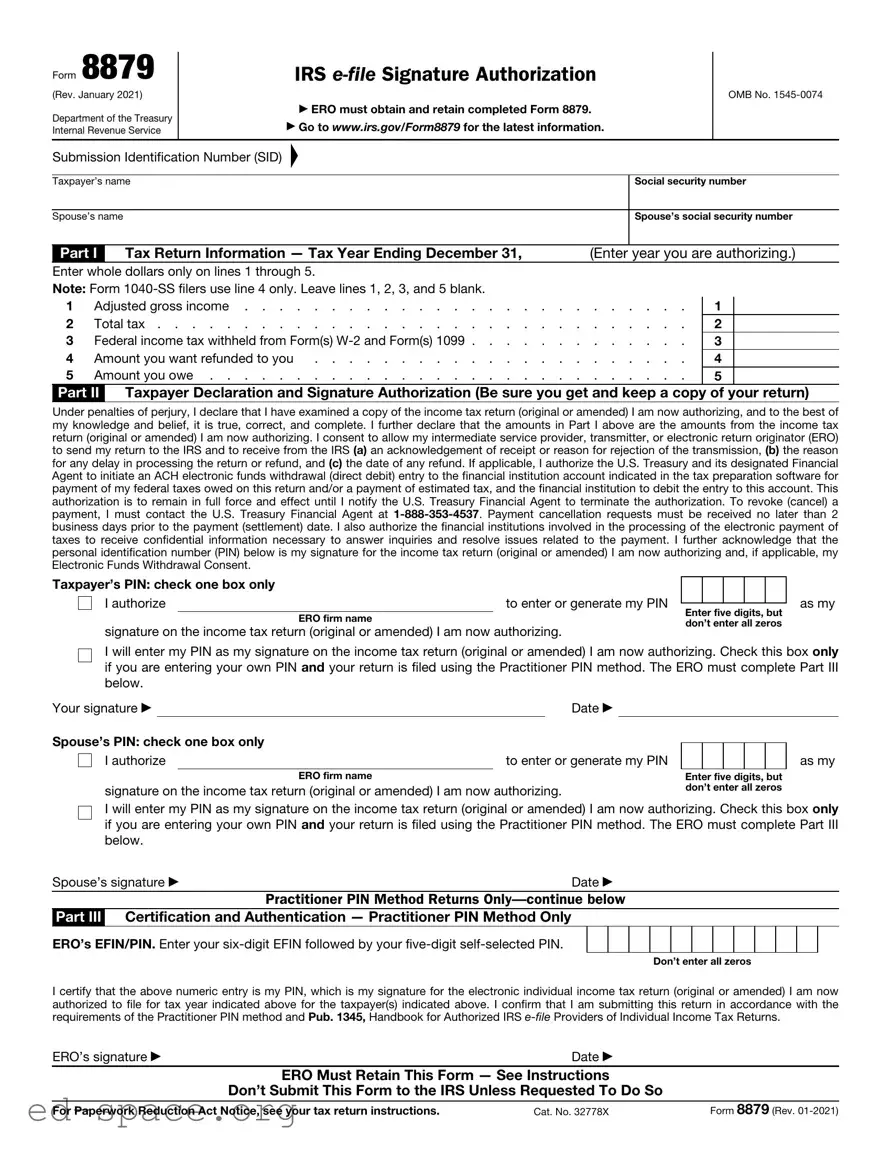
The IRS 8879 form plays a crucial role in the tax filing process for many individuals and businesses. This form serves as an e-signature authorization for tax returns prepared by tax professionals. By using IRS 8879, taxpayers confirm their agreement with the information submitted on their tax return, allowing for electronic filing. It streamlines the process, ensuring that returns are filed accurately and efficiently. Furthermore, the form includes essential details such as the taxpayer's name, Social Security number, and the tax preparer's information. Understanding the significance of the IRS 8879 form is vital for anyone looking to navigate the complexities of tax preparation and submission, especially as deadlines approach and compliance becomes increasingly important. This form not only facilitates a smoother filing experience but also provides a safeguard against potential discrepancies, ensuring that taxpayers can confidently submit their returns with the necessary authorizations in place.
Form 8879
(Rev. January 2021)
Department of the Treasury Internal Revenue Service
IRS
▶ ERO must obtain and retain completed Form 8879.
▶Go to www.irs.gov/Form8879 for the latest information.
OMB No.
Submission Identification Number (SID)
▲
Taxpayer’s name |
|
|
|
Social security number |
||||
|
|
|
|
|
|
|
||
Spouse’s name |
|
|
|
|
Spouse’s social security number |
|||
|
|
|
|
|
|
|||
Part I |
|
Tax Return Information — Tax Year Ending December 31, |
|
(Enter |
year you are authorizing.) |
|||
Enter whole dollars only on lines 1 through 5. |
|
|
|
|
|
|||
Note: Form |
|
|
|
|
|
|||
1 |
Adjusted gross income |
. |
. . |
. |
. . . |
1 |
||
2 |
Total tax |
. |
. . |
. |
. . . |
2 |
||
3 |
Federal income tax withheld from Form(s) |
. |
. . |
. |
. . . |
3 |
||
4 |
Amount you want refunded to you |
. |
. . |
. |
. . . |
4 |
||
5 |
Amount you owe |
. |
. . |
. |
. . . |
5 |
||
Part II Taxpayer Declaration and Signature Authorization (Be sure you get and keep a copy of your return)
Under penalties of perjury, I declare that I have examined a copy of the income tax return (original or amended) I am now authorizing, and to the best of my knowledge and belief, it is true, correct, and complete. I further declare that the amounts in Part I above are the amounts from the income tax return (original or amended) I am now authorizing. I consent to allow my intermediate service provider, transmitter, or electronic return originator (ERO) to send my return to the IRS and to receive from the IRS (a) an acknowledgement of receipt or reason for rejection of the transmission, (b) the reason for any delay in processing the return or refund, and (c) the date of any refund. If applicable, I authorize the U.S. Treasury and its designated Financial Agent to initiate an ACH electronic funds withdrawal (direct debit) entry to the financial institution account indicated in the tax preparation software for payment of my federal taxes owed on this return and/or a payment of estimated tax, and the financial institution to debit the entry to this account. This authorization is to remain in full force and effect until I notify the U.S. Treasury Financial Agent to terminate the authorization. To revoke (cancel) a payment, I must contact the U.S. Treasury Financial Agent at
Taxpayer’s PIN: check one box only |
|
|
|
|
|
|
|
||
I authorize |
|
|
to enter or generate my PIN |
|
|
|
|
|
|
|
Enter five digits, but |
||||||||
|
|
ERO firm name |
|||||||
|
|
don’t enter all zeros |
|||||||
signature on the income tax return (original or amended) I am now authorizing. |
|||||||||
|
|
|
|
|
|||||
as my
I will enter my PIN as my signature on the income tax return (original or amended) I am now authorizing. Check this box only if you are entering your own PIN and your return is filed using the Practitioner PIN method. The ERO must complete Part III below.
Your signature ▶ |
|
|
Date ▶ |
|
|
|
|
|
|
Spouse’s PIN: check one box only |
|
|
|
|
|
|
|
||
|
|
|
|
|
|
|
|||
I authorize |
to enter or generate my PIN |
|
|
|
|
|
|||
|
|
ERO firm name |
|
|
Enter five digits, but |
||||
signature on the income tax return (original or amended) I am now authorizing. |
don’t enter all zeros |
||||||||
as my
I will enter my PIN as my signature on the income tax return (original or amended) I am now authorizing. Check this box only if you are entering your own PIN and your return is filed using the Practitioner PIN method. The ERO must complete Part III below.
Spouse’s signature ▶ |
Date ▶ |
|
Practitioner PIN Method Returns |
Part III Certification and Authentication — Practitioner PIN Method Only
ERO’s EFIN/PIN. Enter your
Don’t enter all zeros
I certify that the above numeric entry is my PIN, which is my signature for the electronic individual income tax return (original or amended) I am now authorized to file for tax year indicated above for the taxpayer(s) indicated above. I confirm that I am submitting this return in accordance with the requirements of the Practitioner PIN method and Pub. 1345, Handbook for Authorized IRS
ERO’s signature ▶ |
Date ▶ |
|
ERO Must Retain This Form — See Instructions |
|
|
Don’t Submit This Form to the IRS Unless Requested To Do So |
|
|
For Paperwork Reduction Act Notice, see your tax return instructions. |
Cat. No. 32778X |
Form 8879 (Rev. |
Form 8879 (Rev. |
Page 2 |
General Instructions
Section references are to the Internal Revenue Code unless otherwise noted.
Future developments. For the latest information about developments related to Form 8879 and its instructions, such as legislation enacted after they were published, go to www.irs.gov/Form8879.
What's New. Form 8879 is used to authorize the electronic filing
Purpose of Form
Form 8879 is the declaration document and signature authorization for an
|
|
▲ |
|
! |
Don’t send this form to the IRS. |
The ERO must retain Form 8879. |
|
CAUTION |
|
When and How To Complete
Use this chart to determine when and how to complete Form 8879.
IF the ERO is . . . |
THEN . . . |
|
|
|
|
Not using the Practitioner |
Don’t complete |
|
PIN method and the |
Form 8879. |
|
taxpayer enters his or her |
|
|
own PIN |
|
|
|
|
|
Not using the Practitioner |
Complete Form |
|
PIN method and is |
8879, Parts I and II. |
|
authorized to enter or |
|
|
generate the taxpayer’s |
|
|
PIN |
|
|
|
|
|
Using the Practitioner PIN |
Complete Form 8879, |
|
method and is authorized |
Parts I, II, and III. |
|
to enter or generate the |
|
|
taxpayer’s PIN |
|
|
|
|
|
Using the Practitioner PIN |
Complete Form 8879, |
|
Parts I, II, and III. |
||
method and the taxpayer |
||
|
||
enters his or her own PIN |
|
|
|
|
ERO Responsibilities
The ERO must:
1.Enter the name(s) and social security number(s) of the taxpayer(s) at the top of the form.
2.Complete Part I using the amounts (zeros may be entered when appropriate) from the taxpayer’s tax return. Form
3.Enter or generate, if authorized by the taxpayer, the taxpayer’s PIN and enter it in the boxes provided in Part II.
4.Enter on the authorization line in Part II the ERO firm name (not the name of the individual preparing the return) if the ERO is authorized to enter the taxpayer’s PIN.
5.Provide the taxpayer(s) Form 8879 by hand delivery, U.S. mail, private delivery service, email, Internet website, or fax.
6.Enter the
You must receive the completed ▲! and signed Form 8879 from the
taxpayer before the electronic CAUTION return is transmitted (or released
for transmission).
For additional information, see Pub. 1345.
Taxpayer Responsibilities
Taxpayers must:
1.Verify the accuracy of the prepared income tax return, including direct deposit information.
2.Check the appropriate box in Part II to authorize the ERO to enter or generate your PIN or to do it yourself.
3.Indicate or verify your PIN when authorizing the ERO to enter or generate it (the PIN must be five digits other than all zeros).
4.Sign and date Form 8879. Taxpayers must sign Form 8879 by handwritten signature, or electronic signature if supported by computer software.
5.Return the completed Form 8879 to the ERO by hand delivery, U.S. mail, private delivery service, email, Internet website, or fax.
Your return won’t be transmitted to the IRS until the ERO receives your signed Form 8879.
Refund information. You can check on the status of your refund if it has been at least 72 hours since the IRS acknowledged receipt of your
•Go to www.irs.gov/Refunds.
•Call
•Call
Important Notes for EROs
•Don’t send Form 8879 to the IRS unless requested to do so. Retain the completed Form 8879 for 3 years from the return due date or IRS received date, whichever is later. Form 8879 may be retained electronically in accordance with the recordkeeping guidelines in Rev. Proc.
•Confirm the identity of the taxpayer(s).
•Complete Part III only if you are filing the return using the Practitioner PIN method. You aren’t required to enter the taxpayer’s date of birth, prior year adjusted gross income, or PIN in the Authentication Record of the electronically filed return.
•If you aren’t using the Practitioner PIN method, enter the taxpayer(s) date of birth and either the adjusted gross income or the PIN, or both, from the taxpayer’s prior year originally filed return in the Authentication Record of the taxpayer’s electronically filed return. Don’t use an amount from an amended return or a math error correction made by the IRS.
•Enter the taxpayer’s PIN(s) on the input screen only if the taxpayer has authorized you to do so. If married filing jointly, it is acceptable for one spouse to authorize you to enter his or her PIN, and for the other spouse to enter his or her own PIN. It isn’t acceptable for a taxpayer to select or enter the PIN of an absent spouse.
•Taxpayers must use a PIN to sign their
•Provide the taxpayer with a copy of the signed Form 8879 for his or her records upon request.
•Provide the taxpayer with a corrected copy of Form 8879 if changes are made to the return (for example, based on taxpayer review).
•EROs can sign the form using a rubber stamp, mechanical device (such as a signature pen), or computer software program. See Notice
•Go to www.irs.gov/Efile for the latest information.
| Fact Name | Description |
|---|---|
| Purpose | The IRS Form 8879 is used to authorize an electronic return originator (ERO) to file a taxpayer's federal income tax return electronically. |
| Signature Requirement | This form serves as the taxpayer's electronic signature, allowing the ERO to submit the return on their behalf. |
| Eligibility | Form 8879 can be used by individual taxpayers, including those filing jointly or separately. |
| Filing Deadline | Taxpayers must complete and sign Form 8879 by the tax return filing deadline to authorize electronic submission. |
| State-Specific Forms | Some states have their own versions of Form 8879 for electronic filing. For example, California uses Form 8453 for similar purposes. |
| Record Keeping | Taxpayers should keep a copy of Form 8879 for their records, as it contains important information regarding their tax return. |
| Changes in Information | If any information on the return changes after signing Form 8879, the taxpayer must provide a new authorization. |
| Signature Date | The date on which the taxpayer signs Form 8879 is crucial, as it indicates the authorization date for the electronic filing. |
| Compliance | Using Form 8879 helps ensure compliance with IRS regulations regarding electronic filing and taxpayer authorization. |
Filling out the IRS 8879 form is an important step in the tax filing process. Once completed, this form will allow you to electronically sign your tax return, ensuring it is submitted properly. Here’s how to fill it out step-by-step:
After filling out the form, ensure that all information is accurate before submission. This will help facilitate a smooth filing process for your tax return.
What is the IRS Form 8879?
The IRS Form 8879, also known as the "IRS e-file Signature Authorization," is a document that allows taxpayers to authorize an electronic return originator (ERO) to file their tax returns electronically on their behalf. This form is essential for ensuring that your return is filed correctly and securely without the need for a physical signature.
Who needs to use Form 8879?
If you are having your taxes prepared by a tax professional and choose to file electronically, you will need to use Form 8879. This applies to individuals, partnerships, and corporations. Essentially, if you want to e-file and your preparer is doing it for you, Form 8879 is a must.
How do I fill out Form 8879?
Filling out Form 8879 is straightforward. You’ll need to provide basic information such as your name, Social Security number, and the tax year for which you are filing. Your tax preparer will also fill in their details. After reviewing your return, you’ll sign and date the form, which gives your preparer the green light to e-file on your behalf.
What happens if I don’t sign Form 8879?
If you don’t sign Form 8879, your tax return cannot be filed electronically. This means your return will need to be submitted by mail, which can delay processing and any potential refund. It’s crucial to sign this form to ensure a smooth e-filing process.
Can I revoke my authorization after signing Form 8879?
Yes, you can revoke your authorization at any time before your tax return is filed. However, once your return has been submitted electronically, revoking the authorization is not possible. If you have concerns, discuss them with your tax preparer as soon as possible.
How long do I need to keep Form 8879?
It’s a good practice to keep Form 8879 for at least three years after the tax return is filed. This is in line with the IRS’s recommendation for retaining tax records. Keeping a copy helps in case of any future inquiries or audits.
Is Form 8879 required for all e-filed tax returns?
Not all e-filed tax returns require Form 8879. If you are filing your own return using tax software, you may not need this form. However, if a tax professional is preparing your return and filing it electronically, Form 8879 is necessary to authorize the e-filing.
Failing to provide accurate information. Many individuals overlook the importance of double-checking their name, Social Security number, and other personal details. Any discrepancies can lead to delays or complications.
Not signing the form. It seems simple, yet some forget to sign the IRS 8879 form. Without a signature, the form is incomplete and cannot be processed.
Ignoring the importance of the date. Some filers neglect to date their signature. The date is crucial as it indicates when the form was completed and can affect processing timelines.
Using the wrong version of the form. Taxpayers sometimes use outdated versions of the IRS 8879 form. Always ensure you have the most current version to avoid issues.
Overlooking the e-file authorization. Individuals may forget to check the box authorizing the tax preparer to e-file on their behalf. This step is essential for the e-filing process.
Not keeping a copy. Some people fail to retain a copy of the signed form for their records. Keeping a copy can be helpful for future reference or in case of an audit.
Missing the deadline. Taxpayers sometimes submit the form after the e-filing deadline. Timeliness is critical to avoid penalties or complications with the IRS.
Providing incomplete information. In some cases, filers may skip sections or fail to fill out all required fields. Each section must be completed to ensure the form is valid.
Failing to verify the tax preparer's information. It is vital to confirm that the tax preparer's details are accurate. Mismatched information can lead to processing delays.
The IRS 8879 form is an important document used for e-filing tax returns. It serves as a signature authorization for taxpayers to allow their tax preparers to file returns electronically. Along with this form, several other documents are commonly used to ensure a smooth tax filing process. Below is a list of those forms and documents.
These documents help in the accurate preparation and filing of tax returns. Having them ready can simplify the process and ensure compliance with IRS regulations.
The IRS 8879 form is an important document used for e-filing tax returns. It serves as an electronic signature authorization for taxpayers. Here are ten other documents that are similar to the IRS 8879 form, along with how they compare:
When filling out the IRS 8879 form, it’s essential to follow certain guidelines to ensure accuracy and compliance. Here’s a list of things you should and shouldn't do:
By following these guidelines, you can help ensure that your IRS 8879 form is completed correctly and submitted on time.
The IRS Form 8879, also known as the "IRS e-file Signature Authorization," is a document that many taxpayers encounter during the e-filing process. However, there are several misconceptions surrounding this form that can lead to confusion. Here are nine common misconceptions:
Understanding these misconceptions can help you navigate the e-filing process more effectively. Clarity about Form 8879 can lead to a smoother experience when filing your taxes.
The IRS 8879 form, also known as the e-file Signature Authorization, plays a crucial role in the electronic filing process for tax returns. Here are some key takeaways to keep in mind when filling out and using this form:
Understanding these key points can help ensure a smooth e-filing experience. Proper use of the IRS 8879 form can facilitate timely and accurate tax submissions.