The IRS 8233 form plays a crucial role in the tax compliance process for non-resident aliens and foreign individuals receiving compensation for services performed in the United States. This form is primarily used to claim a tax exemption under a tax treaty between the United States and the individual's home country. By submitting the 8233, individuals can request that their income not be subject to withholding taxes, provided they meet specific eligibility criteria outlined in the relevant tax treaty. The form requires detailed information, including the individual’s personal details, the nature of the services provided, and the applicable treaty provisions. Proper completion and timely submission of the IRS 8233 form can significantly impact the financial obligations of foreign workers, allowing them to retain more of their earnings while ensuring compliance with U.S. tax laws. Understanding the nuances of this form is essential for both taxpayers and employers who engage foreign talent, as it helps navigate the complexities of international tax regulations.
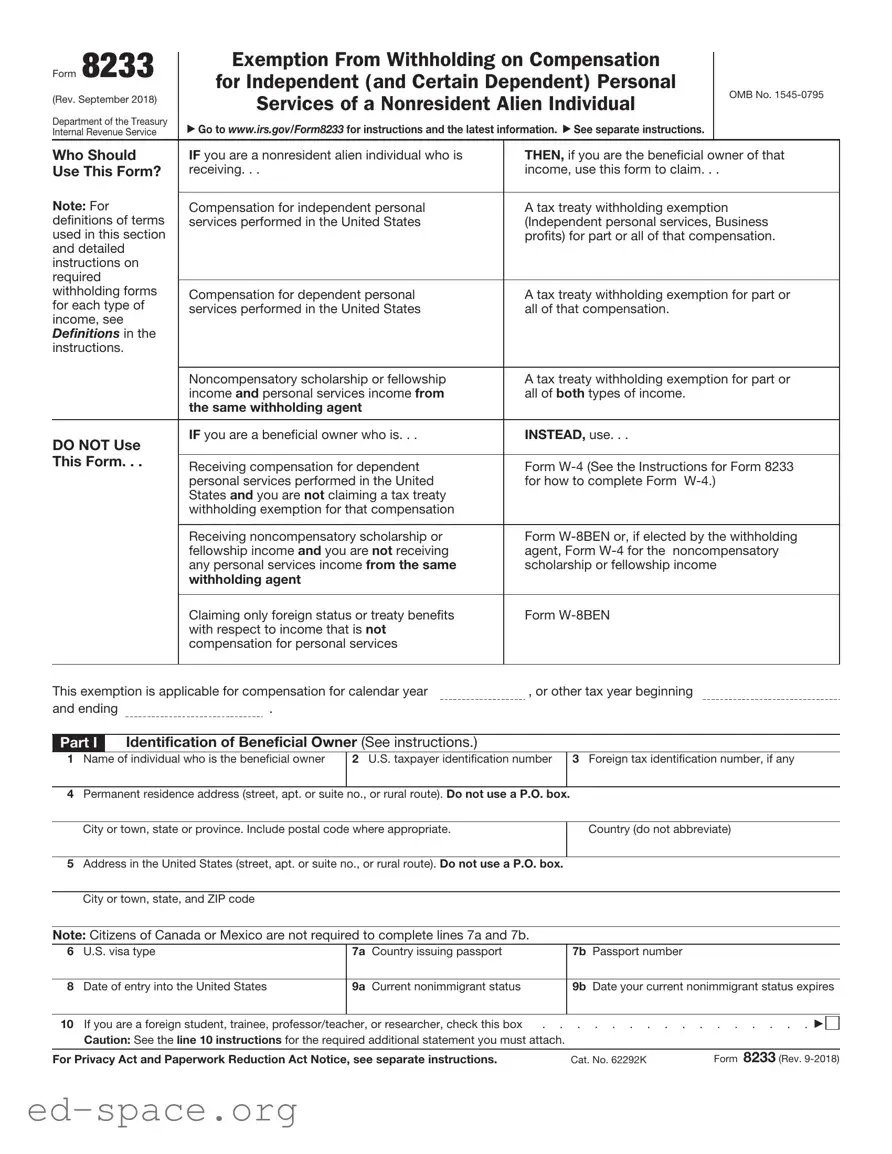
Form 8233
(Rev. September 2018)
Department of the Treasury Internal Revenue Service
Exemption From Withholding on Compensation for Independent (and Certain Dependent) Personal Services of a Nonresident Alien Individual
Go to www.irs.gov/Form8233 for instructions and the latest information. See separate instructions.
OMB No.
Who Should |
IF you are a nonresident alien individual who is |
THEN, if you are the beneficial owner of that |
Use This Form? |
receiving. . . |
income, use this form to claim. . . |
Note: For |
|
|
Compensation for independent personal |
A tax treaty withholding exemption |
|
definitions of terms |
services performed in the United States |
(Independent personal services, Business |
used in this section |
|
profits) for part or all of that compensation. |
and detailed |
|
|
instructions on |
|
|
required |
|
|
|
|
|
withholding forms |
Compensation for dependent personal |
A tax treaty withholding exemption for part or |
for each type of |
services performed in the United States |
all of that compensation. |
income, see |
|
|
Definitions in the |
|
|
instructions. |
|
|
|
|
|
|
Noncompensatory scholarship or fellowship |
A tax treaty withholding exemption for part or |
|
income and personal services income from |
all of both types of income. |
|
the same withholding agent |
|
|
|
|
DO NOT Use |
IF you are a beneficial owner who is. . . |
INSTEAD, use. . . |
|
|
|
This Form. . . |
Receiving compensation for dependent |
Form |
|
||
|
personal services performed in the United |
for how to complete Form |
|
States and you are not claiming a tax treaty |
|
|
withholding exemption for that compensation |
|
|
|
|
|
Receiving noncompensatory scholarship or |
Form |
|
fellowship income and you are not receiving |
agent, Form |
|
any personal services income from the same |
scholarship or fellowship income |
|
withholding agent |
|
|
|
|
|
Claiming only foreign status or treaty benefits |
Form |
|
with respect to income that is not |
|
|
compensation for personal services |
|
|
|
|
This exemption is applicable for compensation for calendar year |
, or other tax year beginning |
|
and ending |
. |
|
Part I Identification of Beneficial Owner (See instructions.)
1Name of individual who is the beneficial owner
2U.S. taxpayer identification number
3Foreign tax identification number, if any
4Permanent residence address (street, apt. or suite no., or rural route). Do not use a P.O. box.
City or town, state or province. Include postal code where appropriate.
Country (do not abbreviate)
5Address in the United States (street, apt. or suite no., or rural route). Do not use a P.O. box.
City or town, state, and ZIP code
Note: Citizens of Canada or Mexico are not required to complete lines 7a and 7b.
6U.S. visa type
7a Country issuing passport
7b Passport number
8Date of entry into the United States
9a Current nonimmigrant status
9b Date your current nonimmigrant status expires
10 If you are a foreign student, trainee, professor/teacher, or researcher, check this box |
. . . . . . . . . . . . . . . . |
|
Caution: See the line 10 instructions for the required additional statement you must attach. |
|
|
For Privacy Act and Paperwork Reduction Act Notice, see separate instructions. |
Cat. No. 62292K |
Form 8233 (Rev. |

Form 8233 (Rev. |
Page 2 |
|
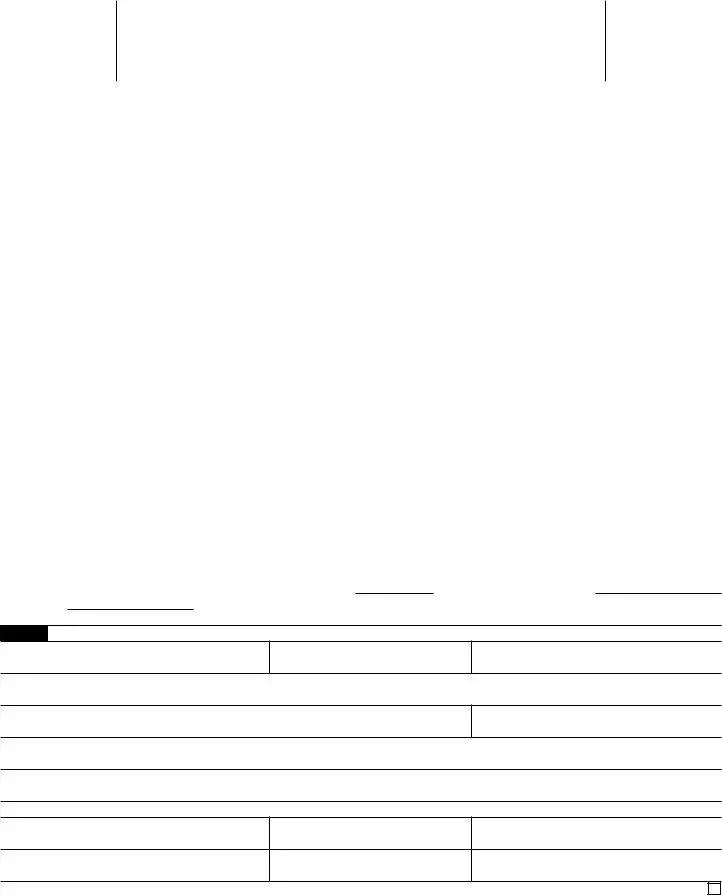
Part II |
Claim for Tax Treaty Withholding Exemption |
|
11Compensation for independent (and certain dependent) personal services: a Description of personal services you are providing
b Total compensation you expect to be paid for these services in this calendar or tax year $
12If compensation is exempt from withholding based on a tax treaty benefit, provide: a Tax treaty on which you are basing exemption from withholding
b Treaty article on which you are basing exemption from withholding
c Total compensation listed on line 11b above that is exempt from tax under this treaty $ d Country of residence
Note: Do not complete lines 13a through 13d unless you also received compensation for personal services from the same withholding agent.
13Noncompensatory scholarship or fellowship income:
aAmount $
bTax treaty on which you are basing exemption from withholding
cTreaty article on which you are basing exemption from withholding
dTotal income listed on line 13a above that is exempt from tax under this treaty $
14Sufficient facts to justify the exemption from withholding claimed on line 12 and/or line 13 (see instructions)
Part III Certification
Under penalties of perjury, I declare that I have examined the information on this form and to the best of my knowledge and belief it is true, correct, and complete. I further certify under penalties of perjury that:
•I am the beneficial owner (or am authorized to sign for the beneficial owner) of all the income to which this form relates.
•The beneficial owner is not a U.S. person.
•The beneficial owner is a resident of the treaty country listed on line 12a and/or 13b above within the meaning of the income tax treaty
between the United States and that country, or was a resident of the treaty country listed on line 12a and/or 13b above at the time of, or immediately prior to, entry into the United States, as required by the treaty.
Furthermore, I authorize this form to be provided to any withholding agent that has control, receipt, or custody of the income of which I am the beneficial owner or any withholding agent that can disburse or make payments of the income of which I am the beneficial owner.
Sign Here |
▶ Signature of beneficial owner (or individual authorized to sign for beneficial owner) |
Date |
|
|
|
|
|
Part IV |
|
Withholding Agent Acceptance and Certification |
|
Name
Employer identification number
Address (number and street) (Include apt. or suite no. or P.O. box, if applicable.)
City, state, and ZIP code
Telephone number
Under penalties of perjury, I certify that I have examined this form and any accompanying statements, that I am satisfied that an exemption from withholding is warranted, and that I do not know or have reason to know that the nonresident alien individual is not entitled to the exemption or that the nonresident alien’s eligibility for the exemption cannot be readily determined.
Signature of withholding agent |
Date |
Form 8233 (Rev.
| Fact Name | Description |
|---|---|
| Purpose | The IRS Form 8233 is used by non-resident aliens to claim exemption from withholding on compensation for independent personal services. |
| Eligibility | Only individuals who are non-resident aliens and are performing services in the United States may use this form. |
| Submission | The completed form must be submitted to the withholding agent or employer, not directly to the IRS. |
| Governing Laws | The use of Form 8233 is governed by the Internal Revenue Code, specifically sections related to tax treaties and withholding exemptions. |
Completing the IRS Form 8233 is an important step for individuals seeking to claim tax treaty benefits. After filling out the form, it will need to be submitted to the appropriate withholding agent, typically your employer or the entity making payments to you. This process ensures that you are not subject to unnecessary withholding on your income.
What is the IRS 8233 form?
The IRS 8233 form is used by non-resident aliens to claim exemption from withholding on compensation for independent personal services. This form is particularly relevant for individuals receiving payments for services performed in the United States, such as independent contractors or freelancers. By submitting this form, individuals can ensure that the correct amount of tax is withheld, if any, based on their eligibility for tax treaty benefits.
Who should use the IRS 8233 form?
This form is intended for non-resident aliens who are receiving income for independent personal services. If you are a foreign national working in the U.S. and believe you may qualify for a tax treaty exemption, you should consider using this form. It's important to note that this form is not for U.S. citizens or resident aliens.
How do I complete the IRS 8233 form?
Completing the IRS 8233 form involves providing personal information, including your name, address, and taxpayer identification number. You will also need to include details about the income you are receiving and the specific tax treaty that applies to your situation. Follow the instructions carefully to ensure accuracy. If you have questions about specific sections, consulting a tax professional may be beneficial.
Where do I submit the IRS 8233 form?
The completed IRS 8233 form should be submitted to the withholding agent or payer who is responsible for making the payments to you. They will review the form and determine if the exemption from withholding can be granted. It's also advisable to keep a copy of the form for your records.
What happens after I submit the IRS 8233 form?
Once you submit the form, the withholding agent will assess your eligibility for tax treaty benefits. If approved, they will adjust the withholding on your payments accordingly. If denied, you may be subject to standard withholding rates. It's crucial to follow up with the withholding agent to confirm the status of your form.
Is there a deadline for submitting the IRS 8233 form?
There is no specific deadline for submitting the IRS 8233 form, but it should be submitted before any payments are made to ensure that the correct withholding rates are applied. It is advisable to submit the form as early as possible to avoid any issues with tax withholding on your income.
Can I submit the IRS 8233 form electronically?
Currently, the IRS 8233 form must be submitted in paper format. However, some withholding agents may have their own processes for accepting electronic submissions. Check with the payer to see if they allow electronic submissions or if they require a physical copy.
What should I do if my circumstances change?
If your circumstances change, such as a change in residency status or the nature of your income, you may need to submit a new IRS 8233 form. It's essential to keep your information updated to ensure compliance with tax regulations and to maintain the correct withholding status on your payments.
Not providing accurate personal information. Ensure that your name, address, and taxpayer identification number are correct.
Failing to check the eligibility criteria. Review whether you qualify for the exemption before submitting.
Incorrectly completing the tax treaty information. Make sure to list the correct treaty country and article number.
Omitting required signatures. Sign and date the form where indicated to validate your submission.
Using an outdated version of the form. Always download the latest version from the IRS website.
Not providing supporting documentation. Attach necessary documents that prove eligibility for the tax exemption.
Neglecting to keep copies of the form. Retain a copy for your records after submission.
Submitting the form to the wrong address. Verify the correct submission address based on your specific situation.
Ignoring deadlines. Be aware of the submission deadlines to avoid penalties or delays.
The IRS 8233 form is essential for non-resident aliens seeking to claim exemption from withholding on compensation for independent personal services. However, several other forms and documents often accompany this form to ensure compliance with IRS regulations and to facilitate the processing of claims. Below is a list of these commonly used documents.
These documents, when used alongside the IRS 8233 form, help ensure that non-resident aliens can accurately report their income and claim the appropriate tax benefits. Proper completion of these forms is crucial for compliance and to avoid potential tax issues.
The IRS Form 8233 is used by non-resident aliens to claim a tax exemption on certain types of income. Several other forms serve similar purposes or are related in function. Here are eight documents that share similarities with Form 8233:
When filling out the IRS 8233 form, it's important to follow certain guidelines to ensure the process goes smoothly. Here’s a list of things you should and shouldn’t do:
The IRS 8233 form is often misunderstood. Here are five common misconceptions about this form, along with clarifications.
The IRS 8233 form is an important document for certain non-resident aliens who receive compensation for personal services performed in the United States. Here are five key takeaways about filling out and using this form:
Understanding these points can help ensure that you navigate the tax implications of working in the U.S. effectively.