Homepage Blank IRS 4852 PDF Form
Article Guide

The IRS 4852 form plays a crucial role for taxpayers who have not received their W-2 or 1099 forms by the tax filing deadline. This substitute form allows individuals to report their income and withholding information, ensuring compliance with federal tax regulations. When a taxpayer cannot obtain the necessary documentation from their employer or payer, the IRS 4852 serves as a valid alternative to help avoid penalties for late or incorrect filings. It requires the taxpayer to estimate their income and withholding based on available records, such as pay stubs or prior year documents. Additionally, it is essential to provide accurate and complete information to avoid complications with the IRS. Filing this form can be a straightforward process, but understanding its requirements and implications is vital for a smooth tax experience.
Document Preview

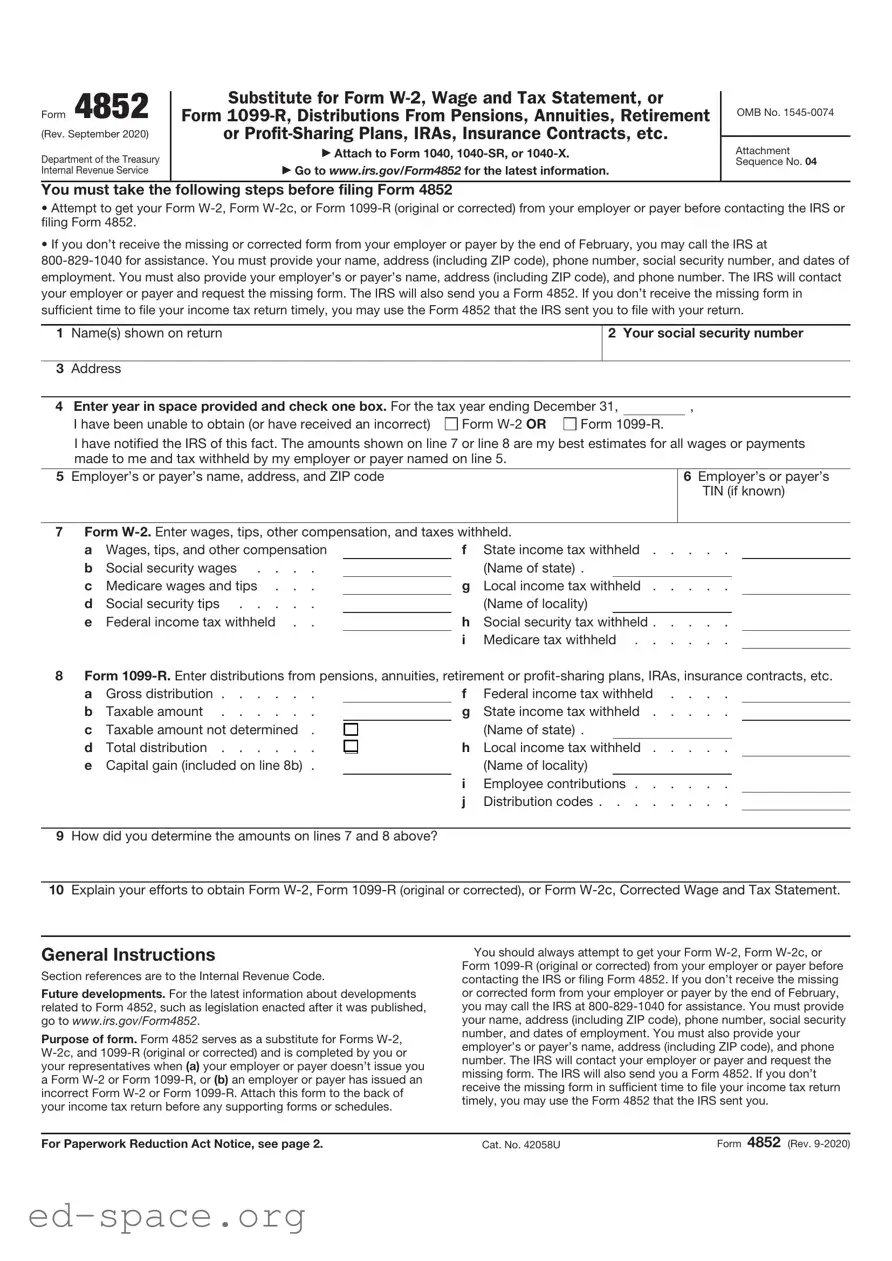
Form 4852

(Rev. September 2020)

Department of the Treasury Internal Revenue Service

Substitute for Form W-2, Wage and Tax Statement, or

Form 1099-R, Distributions From Pensions, Annuities, Retirement

or Profit-Sharing Plans, IRAs, Insurance Contracts, etc.

Attach to Form 1040, 1040-SR, or 1040-X.

Go to www.irs.gov/Form4852 for the latest information.

OMB No. 1545-0074

Attachment Sequence No. 04

You must take the following steps before filing Form 4852

Attempt to get your Form W-2, Form W-2c, or Form 1099-R (original or corrected) from your employer or payer before contacting the IRS or filing Form 4852.

If you don’t receive the missing or corrected form from your employer or payer by the end of February, you may call the IRS at

800-829-1040 for assistance. You must provide your name, address (including ZIP code), phone number, social security number, and dates of employment. You must also provide your employer’s or payer’s name, address (including ZIP code), and phone number. The IRS will contact your employer or payer and request the missing form. The IRS will also send you a Form 4852. If you don’t receive the missing form in sufficient time to file your income tax return timely, you may use the Form 4852 that the IRS sent you to file with your return.

1Name(s) shown on return

3Address

2 Your social security number

4 Enter year in space provided and check one box. For the tax year ending December 31,


,

I have been unable to obtain (or have received an incorrect)

Form W-2 OR

Form 1099-R.


I have notified the IRS of this fact. The amounts shown on line 7 or line 8 are my best estimates for all wages or payments made to me and tax withheld by my employer or payer named on line 5.

5Employer’s or payer’s name, address, and ZIP code

6Employer’s or payer’s TIN (if known)

7Form W-2. Enter wages, tips, other compensation, and taxes withheld.

a

Wages, tips, and other compensation


f

State income tax withheld

b

Social security wages . . . .


(Name of state) .


c

Medicare wages and tips . . .


g

Local income tax withheld

d

Social security tips


(Name of locality)


e

Federal income tax withheld . .


h

Social security tax withheld


i

Medicare tax withheld

8Form 1099-R. Enter distributions from pensions, annuities, retirement or profit-sharing plans, IRAs, insurance contracts, etc.

a

Gross distribution


f

Federal income tax withheld . . . .

b

Taxable amount


g

State income tax withheld

c

Taxable amount not determined .


(Name of state) .


d

Total distribution


h

Local income tax withheld

e

Capital gain (included on line 8b) .


(Name of locality)


i

Employee contributions


j

Distribution codes

9How did you determine the amounts on lines 7 and 8 above?

10Explain your efforts to obtain Form W-2, Form 1099-R (original or corrected), or Form W-2c, Corrected Wage and Tax Statement.

General Instructions

Section references are to the Internal Revenue Code.

Future developments. For the latest information about developments related to Form 4852, such as legislation enacted after it was published, go to www.irs.gov/Form4852.

Purpose of form. Form 4852 serves as a substitute for Forms W-2, W-2c, and 1099-R (original or corrected) and is completed by you or your representatives when (a) your employer or payer doesn’t issue you a Form W-2 or Form 1099-R, or (b) an employer or payer has issued an incorrect Form W-2 or Form 1099-R. Attach this form to the back of your income tax return before any supporting forms or schedules.

You should always attempt to get your Form W-2, Form W-2c, or Form 1099-R (original or corrected) from your employer or payer before contacting the IRS or filing Form 4852. If you don’t receive the missing or corrected form from your employer or payer by the end of February, you may call the IRS at 800-829-1040 for assistance. You must provide your name, address (including ZIP code), phone number, social security number, and dates of employment. You must also provide your employer’s or payer’s name, address (including ZIP code), and phone number. The IRS will contact your employer or payer and request the missing form. The IRS will also send you a Form 4852. If you don’t receive the missing form in sufficient time to file your income tax return timely, you may use the Form 4852 that the IRS sent you.

For Paperwork Reduction Act Notice, see page 2.

Cat. No. 42058U

Form 4852 (Rev. 9-2020)

Form 4852 (Rev. 9-2020)

Page 2

If you received an incorrect Form W-2 or Form 1099-R, you should always attempt to have your employer or payer issue a corrected form before filing Form 4852.

Note: Retain a copy of Form 4852 for your records. To help protect your social security benefits, keep a copy of Form 4852 until you begin receiving social security benefits, just in case there is a question about your work record and/or earnings in a particular year. After September 30 following the date shown on line 4, you may use your Social Security online account to verify wages reported by your employers. Please visit www.SSA.gov/myaccount. Or, you may contact your local SSA office to verify wages reported by your employer.

Will I need to amend my return? If you receive a Form W-2, Form W-2c, or Form 1099-R (original or corrected) after your return is filed with Form 4852, and the information you receive indicates that the information reported on your original return is incorrect, you must amend your return by filing Form 1040-X, Amended U.S. Individual Income Tax Return. You are responsible for filing your income tax return with accurate information regardless of whether you receive a Form W-2, Form W-2c, or Form 1099-R (original or corrected) and regardless of whether the information on any forms received is correct.

Penalties. The IRS will challenge the claims of individuals who attempt to avoid or evade their federal tax liability by using Form 4852 in a manner other than as prescribed. Potential penalties for the improper use of Form 4852 include:

Accuracy-related penalties equal to 20% of the amount of taxes that should have been paid,

Civil fraud penalties equal to 75% of the amount of taxes that should have been paid, and

A $5,000 civil penalty for filing a frivolous return or submitting a specified frivolous submission as described by section 6702.

Specific Instructions

Lines 1 through 3. Enter your name, social security number, and current address including street, city, state, and ZIP code.

Line 4. Enter the year for which Form W-2 or Form 1099-R wasn’t received or was incorrect.

Line 5. Enter your employer’s or payer’s name, address, and ZIP code.

Line 6. Enter your employer’s or payer’s taxpayer identification number (TIN), if known. If you had the same employer or payer in the prior year, use the employer identification number (EIN) shown on the prior year’s Form W-2 or Form 1099-R. If you don’t know the EIN, but you know a different TIN associated with the employer or payer, such as a social security number (SSN), you may enter that TIN.

Line 7—Form W-2. To the extent the Form W-2 you received reported correct information, complete line 7 by entering that correct information. If you don’t have complete and accurate information from a Form W-2, use your final pay stub to help complete line 7. For additional information, get Form W-2 and the General Instructions for Forms W-2 and W-3.

a—Wages, tips, and other compensation. Enter your total wages received (include wages, noncash income, tips reported, and all other compensation before deductions for taxes, insurance, etc.).

b—Social security wages. Enter your total wages subject to employee social security tax. Don’t include social security tips and allocated tips.

c—Medicare wages and tips. Enter your total wages and tips subject to Medicare tax. This amount may be required to be entered on Form 8959, Additional Medicare Tax. See the Instructions for Forms 1040 and 1040-SR to determine if you are required to complete Form 8959.

d—Social security tips. Enter the tips you reported to your employer for the year. The total of lines 7b and 7d can’t exceed the social security wage base for the year reported on line 4. The total amount of tips received during the year should be included on line 7a. You can find the social security wage base for any given year at www.SSA.gov/OACT/ COLA/cbb.html. The social security wage base for a given year can be found in Pub. 15 (Circular E), Employer’s Tax Guide, for that year, usually under What’s New at the beginning of the publication.

e—Federal income tax withheld. Enter the amount of federal income taxes withheld from your wages for the year. Include the 20% excise tax withheld on excess parachute payments on this line.

f—State income tax withheld. Enter the amount of state income tax withheld from wages for the year. Enter the name of the state.

g—Local income tax withheld. Enter the amount of local income tax withheld from wages for the year. Enter the name of the locality.

h—Social security tax withheld. Enter the amount of social security tax withheld (not including the employer’s share), including social security tax on tips.

i—Medicare tax withheld. Enter the amount of Medicare tax withheld (not including the employer’s share). This amount includes the 1.45% Medicare tax withheld on all Medicare wages and tips you report on line 7c, as well as the 0.9% Additional Medicare Tax withheld on any of those Medicare wages and tips above $200,000. For more information on Additional Medicare Tax, go to www.irs.gov/AdMT.

Line 8—Form 1099-R. To the extent the Form 1099-R you received reported correct information, complete line 8 by entering that correct information. If you don’t have complete and accurate information from a Form 1099-R, use a distribution statement from your plan trustee to help complete line 8. For additional information, get Form 1099-R and the Instructions for Forms 1099-R and 5498.

a—Gross distribution. Enter the total amount you received for the year as a gross distribution.

b—Taxable amount. Enter the taxable amount of your distribution.

c—Taxable amount not determined. Check this box if you are unable to compute your taxable distribution. If you check this box, leave line 8b blank.

d—Total distribution. Check this box only if the payment shown on line 8a is a total distribution.

e—Capital gain (included on line 8b). Enter the capital gain on your lump-sum distributions that you also included on line 8b. Only certain individuals can elect to treat lump-sum distributions as a capital gain on Form 4972, Tax on Lump-Sum Distributions. See the Instructions for Form 4972 for details.

f—Federal income tax withheld. Enter the amount of federal income tax withheld.

g—State income tax withheld. Enter the amount of state income tax withheld. Enter the name of the state.

h—Local income tax withheld. Enter the amount of local income tax withheld. Enter the name of the locality.

i—Employee contributions. Enter your investment in the contract (after-tax contributions), if any, recovered tax free this year.

j—Distribution codes. Enter the distribution code or codes that apply. If you are reporting more than one code, separate the codes with a comma. See the Instructions for Forms 1099-R and 5498 for a complete list of codes. If your distribution was from a traditional IRA, SEP IRA, or SIMPLE IRA, write “IRA,” “SEP,” or “SIMPLE” in the right margin.

Line 9. Explain how you determined the amounts on line 7 or 8. For example, tell us if you estimated the amounts, used your pay stubs, or used a statement reporting your distribution.

Line 10. Explain any attempts made to get the missing or corrected Form W-2, Form 1099-R, or Form W-2c from your employer or payer.

Paperwork Reduction Act Notice. We ask for the information on Form 4852 to carry out the Internal Revenue laws of the United States. You are required to give us the information. We need it to figure and collect the right amount of tax.

You are not required to provide the information requested on a form that is subject to the Paperwork Reduction Act unless the form displays a valid OMB control number. Books or records relating to a form or its instructions must be retained as long as their contents may become material in the administration of any Internal Revenue law. Generally, tax returns and return information are confidential, as required by section 6103.

The average time and expenses required to complete and file this form vary depending on individual circumstances. For the estimated averages, see the instructions for your income tax return.

If you have suggestions for making Form 4852 simpler, we would be happy to hear from you. See the instructions for your income tax return.

Form Specifications

Fact Name Description
Purpose The IRS Form 4852 is used to report wages and taxes withheld when a taxpayer does not receive a Form W-2 or Form 1099.
Eligibility Taxpayers can use Form 4852 if they have not received their W-2 or 1099 by the tax filing deadline.
Filing Deadline The form must be submitted by the tax filing deadline, typically April 15, unless an extension has been granted.
State-Specific Forms Some states require their own forms for similar situations. For example, California uses Form DE 4581 under California Revenue and Taxation Code Section 13020.
Information Required Taxpayers must provide estimated wages, taxes withheld, and other relevant information on Form 4852.
Signature Requirement Taxpayers must sign and date the form, certifying that the information provided is accurate to the best of their knowledge.
IRS Processing Form 4852 may delay the processing of a tax return, as the IRS may need additional verification of the information provided.

IRS 4852: Usage Guidelines

After obtaining the IRS Form 4852, it’s essential to complete it accurately to ensure proper processing. Follow these steps carefully to fill out the form correctly.

  1. Begin by downloading the IRS Form 4852 from the official IRS website or obtain a physical copy.
  2. In the top section, enter your personal information. Provide your name, address, and Social Security Number (SSN).
  3. Next, fill in the information about your employer. This includes the employer's name, address, and Employer Identification Number (EIN).
  4. In the section labeled "Part I," indicate the tax year for which you are filing the form.
  5. Provide the details of your wages and withholdings. If you have estimates, enter them in the appropriate boxes.
  6. Move to "Part II" and answer the questions regarding your attempts to obtain a Form W-2 from your employer.
  7. Complete the signature section. Sign and date the form to certify that the information provided is accurate.
  8. Finally, make a copy of the completed form for your records before submitting it to the IRS.

Once you have filled out the form, review it for accuracy. Submit it along with your tax return to ensure that your tax obligations are met. Make sure to keep a copy for your records, as this document serves as a substitute for the W-2.

Your Questions, Answered

What is the IRS Form 4852?

The IRS Form 4852 is a substitute for Form W-2 or Form 1099-R. Taxpayers use it when they do not receive these forms from their employer or financial institution. It allows individuals to report their wages and taxes withheld accurately, ensuring compliance with tax obligations.

Who should use Form 4852?

Individuals who have not received their W-2 or 1099-R forms by the tax filing deadline should consider using Form 4852. This situation often arises when an employer fails to issue the necessary documents or if the documents are lost. It is crucial for taxpayers to file this form to avoid penalties for underreporting income.

How do I complete Form 4852?

To complete Form 4852, you will need to provide your personal information, including your name, address, and Social Security number. You must also estimate your wages and the taxes withheld for the year. If you have made any attempts to obtain the original W-2 or 1099-R, document these efforts. This information is essential for the IRS to understand your situation.

When is Form 4852 due?

Form 4852 is due on the same date as your tax return. Typically, this is April 15 for most taxpayers. If you file for an extension, you must also submit Form 4852 by the extended deadline. Timely submission is vital to avoid penalties and interest on any taxes owed.

What should I do if I receive my W-2 or 1099-R after filing Form 4852?

If you receive your W-2 or 1099-R after filing Form 4852, you must compare the information on both forms. If the amounts differ, you may need to file an amended tax return using Form 1040-X. This step ensures that your tax records are accurate and up to date, which is essential for maintaining compliance with IRS regulations.

Common mistakes

  1. Incorrect Information Entry: One common mistake is entering inaccurate information on the form. This can include misspelling names, entering the wrong Social Security number, or providing incorrect income figures. Such errors can lead to delays in processing or even an audit.

  2. Failure to Sign: Many individuals forget to sign their IRS 4852 form. A signature is essential, as it verifies that the information provided is accurate to the best of the individual's knowledge. Without a signature, the form may be considered incomplete.

  3. Not Providing Sufficient Documentation: When filling out the form, it is crucial to include any supporting documents that justify the information reported. Failing to attach these documents can result in the IRS questioning the validity of the claim.

  4. Ignoring Deadlines: Some people overlook the importance of submitting the form by the IRS deadlines. Late submissions can lead to penalties or complications with tax refunds.

  5. Overlooking Instructions: The IRS provides detailed instructions for completing the 4852 form. Ignoring these guidelines can lead to misunderstandings and mistakes. Reading the instructions carefully ensures that the form is filled out correctly.

Documents used along the form

The IRS 4852 form is used to report wages and taxes when a taxpayer has not received their Form W-2 or Form 1099. However, there are several other forms and documents that often accompany it. Understanding these can help ensure accurate reporting and compliance with tax regulations.

  • Form W-2: This form is issued by employers to report an employee's annual wages and the taxes withheld. It is the primary document for reporting income from employment.
  • Form 1099: This is used to report various types of income other than wages, salaries, and tips. For example, freelancers and independent contractors receive a Form 1099 for their earnings.
  • Form 1040: The standard individual income tax return form used by taxpayers to report their income, claim deductions, and calculate their tax liability.
  • Form 4852 Instructions: These instructions provide guidance on how to fill out the IRS 4852 form correctly, ensuring taxpayers understand what information is required.
  • Pay Stubs: These documents show the amount of money earned during a pay period and the taxes withheld. They can serve as supporting evidence when filling out the IRS 4852.
  • Form 1095-A: This form is used to report health insurance coverage obtained through the Health Insurance Marketplace. It is essential for those claiming premium tax credits.
  • Form 1098: This form is used to report mortgage interest paid during the year. Taxpayers can use it to claim deductions related to home mortgage interest.

Gathering these forms and documents can streamline the tax filing process. It ensures that all income and deductions are accurately reported, reducing the risk of errors and potential audits. Always keep copies for your records, as they may be needed for future reference or verification.

Similar forms

The IRS Form 4852 is used by taxpayers to report income when they do not receive a W-2 or 1099 form from their employer or payer. It serves as a substitute for these forms. Below are five documents that are similar to the IRS Form 4852, along with a brief explanation of how they relate to it.

  • W-2 Form: This form is provided by employers to report wages, tips, and other compensation paid to employees. If a taxpayer does not receive a W-2, they can use Form 4852 to estimate their income and tax withholding.
  • 1099-MISC Form: This document is used to report various types of income other than wages, such as freelance earnings. If an individual does not receive a 1099-MISC, they may complete Form 4852 to report this income instead.
  • 1099-NEC Form: Similar to the 1099-MISC, this form specifically reports non-employee compensation. Taxpayers can use Form 4852 if they do not get their 1099-NEC to declare their earnings.
  • Schedule C: This form is utilized by sole proprietors to report income or loss from a business. If a business owner lacks a W-2 or 1099, they can rely on Form 4852 to help report their income when filing their taxes.
  • Form 1040: This is the standard individual income tax return form. Taxpayers who use Form 4852 must also file Form 1040 to report their total income, including the income reported on the 4852.

Dos and Don'ts

When filling out the IRS Form 4852, which serves as a substitute for a missing or incorrect Form W-2 or 1099-R, it is crucial to approach the task with care. Here are ten essential do's and don'ts to guide you through the process.

  • Do ensure you have all necessary information ready, such as your personal details and income information.
  • Do double-check the accuracy of the information you provide to avoid delays in processing.
  • Do use the most recent version of Form 4852, which can be found on the IRS website.
  • Do provide a detailed explanation of why you are using Form 4852, as this can help clarify your situation.
  • Do keep a copy of the completed form for your records, as it may be needed for future reference.
  • Don't leave any sections of the form blank; every part needs to be filled out to the best of your ability.
  • Don't forget to sign and date the form, as an unsigned form may be considered invalid.
  • Don't use estimates if you can find the exact figures; accuracy is key.
  • Don't ignore the instructions provided with the form; they offer valuable guidance.
  • Don't hesitate to seek assistance if you encounter difficulties; the IRS offers resources and help.

By adhering to these guidelines, you can navigate the complexities of IRS Form 4852 with greater confidence and clarity.

Misconceptions

The IRS Form 4852 is often misunderstood. Here are ten common misconceptions about this form, along with clarifications to help you navigate its use effectively.

  1. Form 4852 is only for people who lost their W-2. Many believe this form is solely for those who cannot find their W-2. However, it can also be used if the employer fails to provide a W-2 or if the W-2 contains incorrect information.
  2. You can only use Form 4852 for the current tax year. Some taxpayers think this form is limited to the current year. In reality, you can use it for any tax year if you are missing a W-2.
  3. Filing Form 4852 guarantees a refund. It is a common belief that using this form will automatically lead to a tax refund. The form simply allows you to report your income; the IRS will still review your entire return.
  4. Form 4852 must be filed with your tax return. Many assume that this form must accompany your tax return. While it is often filed together, it can also be submitted separately if needed.
  5. There is a deadline for submitting Form 4852. Some people think there is a strict deadline for this form. In fact, it should be filed by the tax return due date, but the IRS may accept it later if you can show a valid reason.
  6. Using Form 4852 is complicated. While it may seem daunting, many find that filling out Form 4852 is straightforward. The form is designed to be user-friendly, with clear instructions.
  7. Form 4852 is only for employees. There is a misconception that only employees can use this form. However, independent contractors and self-employed individuals can also utilize it if they are missing income statements.
  8. Once you file Form 4852, you cannot amend it. Some taxpayers worry that filing this form locks them into their reported income. You can still amend your return if you receive the correct W-2 later.
  9. Form 4852 is not accepted by the IRS. A common myth is that the IRS does not accept this form. On the contrary, the IRS recognizes and accepts Form 4852 as a valid substitute for a missing W-2.
  10. Filing Form 4852 will delay your refund. Many believe that using this form will automatically slow down the refund process. While it may take longer than a standard filing, the IRS processes these forms regularly.

Understanding these misconceptions can help you use Form 4852 more effectively. If you find yourself in a situation where you need to file this form, take action promptly to ensure your tax matters are handled correctly.

Key takeaways

The IRS Form 4852 serves as a substitute for Form W-2 or Form 1099-R when taxpayers do not receive these forms from their employers or payers. Here are key takeaways regarding the use of this form:

  • Form 4852 is used to report wages, withholding, and other income when the original forms are unavailable.
  • Taxpayers must provide as much information as possible about their income and withholding amounts.
  • It is essential to attempt to obtain the missing W-2 or 1099-R before using Form 4852.
  • Form 4852 can be filed with your tax return, or you may need to file it separately if the original forms are not received in time.
  • Accuracy is crucial; incorrect information may lead to delays in processing or potential penalties.
  • Taxpayers should keep a copy of Form 4852 and any supporting documents for their records.
  • Using Form 4852 does not exempt taxpayers from the requirement to report all income accurately.
  • It is advisable to check the IRS website for the most current version of the form and instructions.
  • Filing Form 4852 may delay the processing of your tax return, especially if additional verification is needed.
  • Seek assistance from a tax professional if you have questions or concerns about filling out Form 4852.
