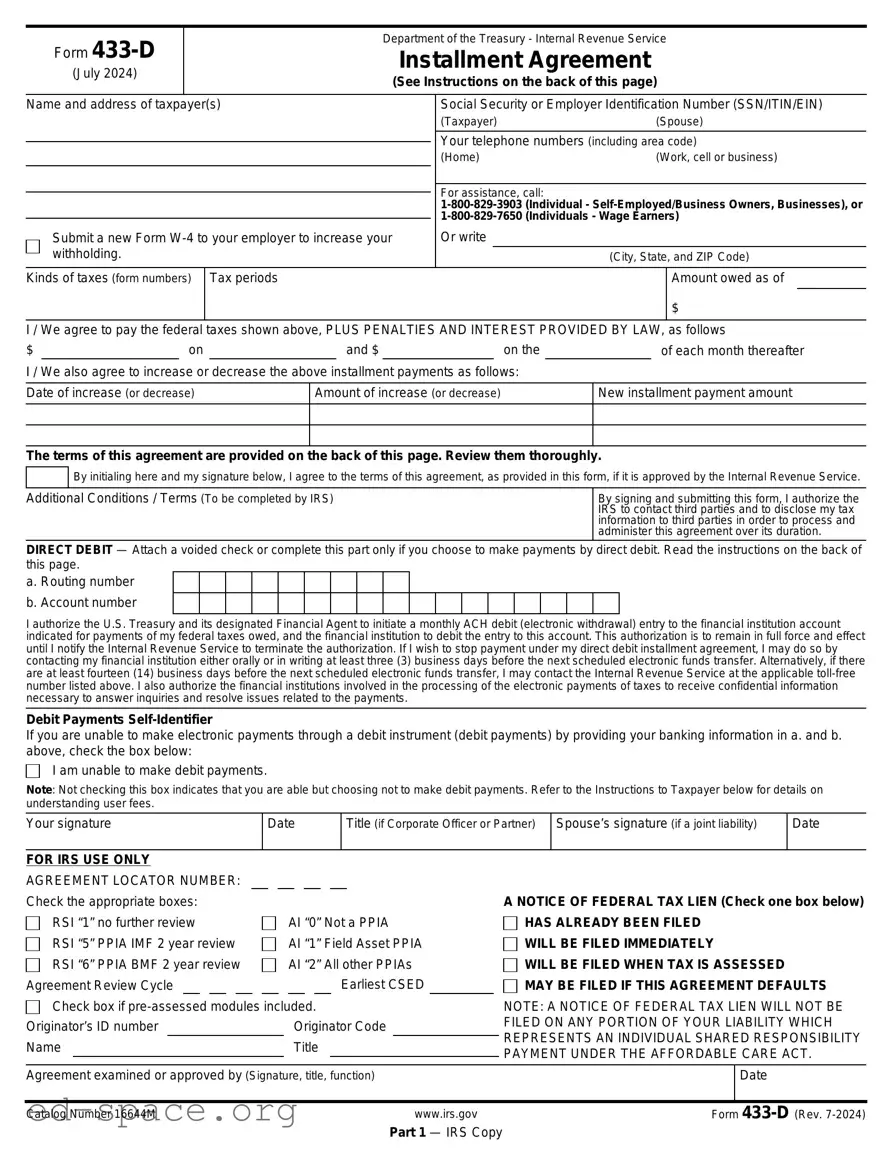
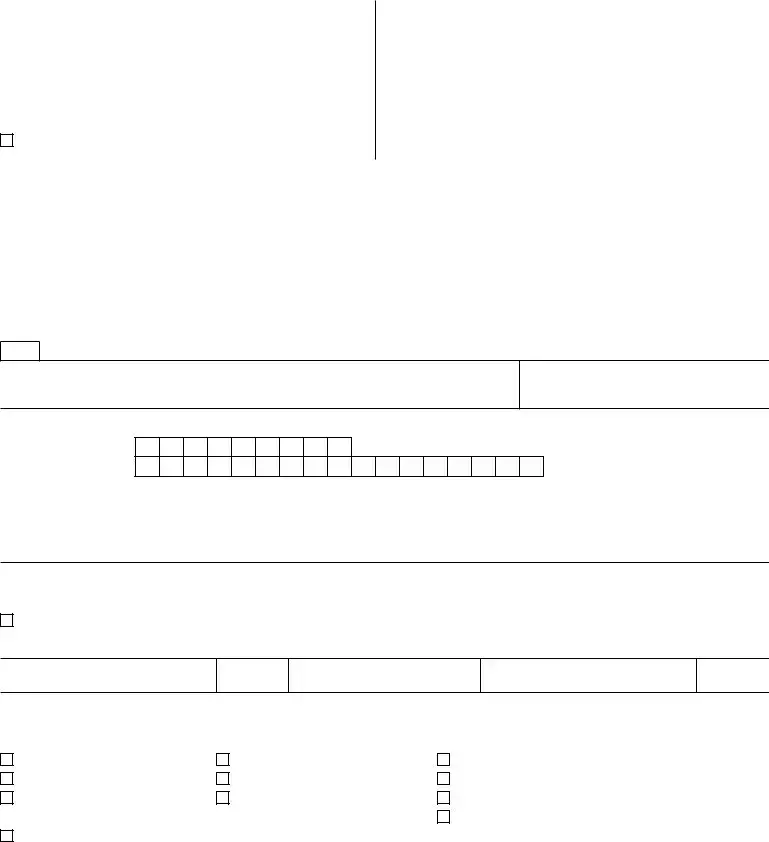
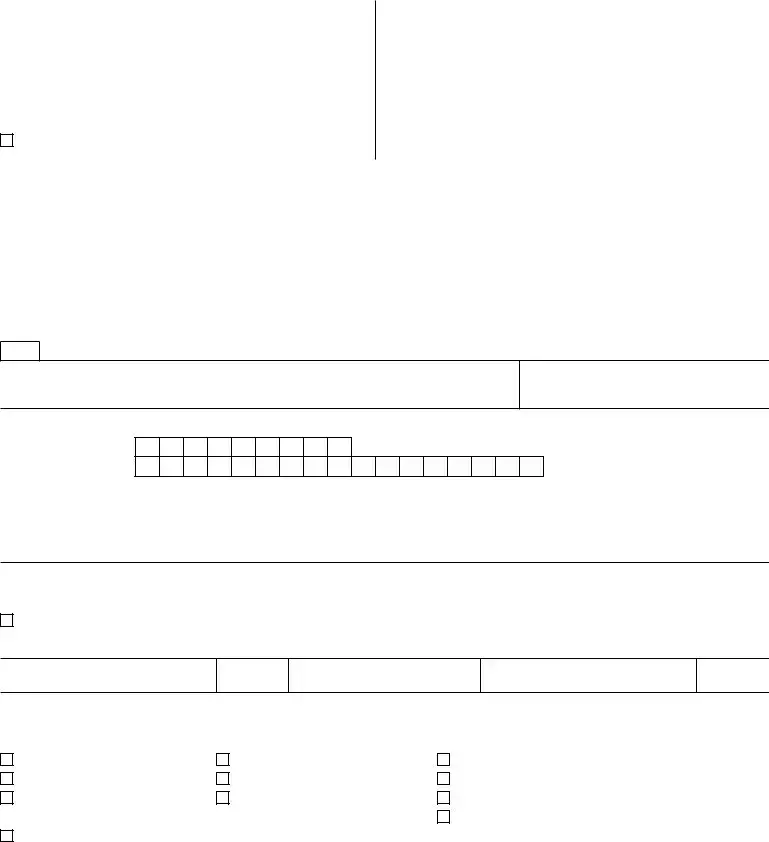
The IRS 433-D form plays a crucial role for individuals and businesses seeking to resolve tax debts through an installment agreement. This form is essentially a written promise to pay back what is owed over time, making it a vital tool for taxpayers facing financial difficulties. When completing the 433-D, taxpayers must provide essential information about their income, expenses, and assets, allowing the IRS to assess their ability to make payments. This form is typically used in conjunction with the IRS 433-A or 433-B forms, which provide a more detailed financial picture. By submitting the 433-D, taxpayers can formalize their agreement with the IRS, ensuring that both parties understand the terms of repayment. Understanding how to properly fill out this form can alleviate some of the stress associated with tax debt, offering a pathway toward financial stability and peace of mind.
Form |
Department of the Treasury - Internal Revenue Service |
|
Installment Agreement |
||
(July 2024) |
||
(See Instructions on the back of this page) |
||
|
||
|
|
Name and address of taxpayer(s) |
|
Social Security or Employer Identification Number (SSN/ITIN/EIN) |
||||||||||||||
|
|
|
|
|
|
|
|
|
(Taxpayer) |
|
|
(Spouse) |
||||
|
|
|
|
|
|
|
|
|
Your telephone numbers (including area code) |
|||||||
|
|
|
|
|
|
|
|
|||||||||
|
|
|
|
|
|
|
|
|
(Home) |
|
|
(Work, cell or business) |
||||
|
|
|
|
|
|
|
|
|
|
|
|
|
|
|
|
|
|
|
|
|
|
|
|
|
|
For assistance, call: |
|
|
|
|
|
||
|
|
|
|
|
|
|
|
|
|
|
|
|
||||
|
|
|
|
|
|
|
|
|
||||||||
|
|
|
|
|
|
|
|
|
||||||||
|
|
|
|
|
|
|
|
|||||||||
|
Submit a new Form |
|
Or write |
|
|
|
|
|
||||||||
|
withholding. |
|
|
|
|
|
|
|
|
|
|
(City, State, and ZIP Code) |
||||
|
|
|
|
|
|
|
|
|
|
|
|
|
|
|
|
|
Kinds of taxes (form numbers) |
|
Tax periods |
|
|
|
|
|
|
|
Amount owed as of |
||||||
|
|
|
|
|
|
|
|
|
|
|
|
|
|
|
$ |
|
|
|
|
|
|
|
|
|
|
|
|
|
|||||
I / We agree to pay the federal taxes shown above, PLUS PENALTIES AND INTEREST PROVIDED BY LAW, as follows |
||||||||||||||||
$ |
|
on |
|
|
|
and $ |
|
|
|
|
on the |
|
|
of each month thereafter |
||
I / We also agree to increase or decrease the above installment payments as follows: |
|
|
|
|
|
|||||||||||
|
|
|
|
|
|
|||||||||||
Date of increase (or decrease) |
|
|
Amount of increase (or decrease) |
|
New installment payment amount |
|||||||||||
|
|
|
|
|
|
|
|
|
|
|
|
|
|
|
|
|
|
|
|
|
|
|
|
|
|
|
|
|
|
|
|
|
|
|
|
|
|
|
|
|
|
|
|
|
|
|
|
|
|
|
The terms of this agreement are provided on the back of this page. Review them thoroughly.
By initialing here and my signature below, I agree to the terms of this agreement, as provided in this form, if it is approved by the Internal Revenue Service.
Additional Conditions / Terms (To be completed by IRS)
By signing and submitting this form, I authorize the IRS to contact third parties and to disclose my tax information to third parties in order to process and administer this agreement over its duration.
DIRECT DEBIT — Attach a voided check or complete this part only if you choose to make payments by direct debit. Read the instructions on the back of this page.
a. Routing number b. Account number
I authorize the U.S. Treasury and its designated Financial Agent to initiate a monthly ACH debit (electronic withdrawal) entry to the financial institution account indicated for payments of my federal taxes owed, and the financial institution to debit the entry to this account. This authorization is to remain in full force and effect until I notify the Internal Revenue Service to terminate the authorization. If I wish to stop payment under my direct debit installment agreement, I may do so by contacting my financial institution either orally or in writing at least three (3) business days before the next scheduled electronic funds transfer. Alternatively, if there are at least fourteen (14) business days before the next scheduled electronic funds transfer, I may contact the Internal Revenue Service at the applicable
Debit Payments
If you are unable to make electronic payments through a debit instrument (debit payments) by providing your banking information in a. and b. above, check the box below:
I am unable to make debit payments.
Note: Not checking this box indicates that you are able but choosing not to make debit payments. Refer to the Instructions to Taxpayer below for details on understanding user fees.
Your signature
Date
Title (if Corporate Officer or Partner)
Spouse’s signature (if a joint liability)
Date
FOR IRS USE ONLY |
|
|
|
|
|
|
|
|
|
|
|
|
|
|
|
|
|
|
|
|
|
|||||||
AGREEMENT LOCATOR NUMBER: |
|
|
|
|
|
|
|
|
|
|
|
|
|
|
|
|
|
|
|
|
|
|||||||
Check the appropriate boxes: |
|
|
|
|
|
|
|
|
|
|
|
|
|
|
|
|
|
|
|
A NOTICE OF FEDERAL TAX LIEN (Check one box below) |
||||||||
RSI “1” no further review |
|
|
|
|
|
|
|
AI “0” Not a PPIA |
|
HAS ALREADY BEEN FILED |
||||||||||||||||||
RSI “5” PPIA IMF 2 year review |
|
|
|
|
|
|
|
AI “1” Field Asset PPIA |
|
WILL BE FILED IMMEDIATELY |
||||||||||||||||||
RSI “6” PPIA BMF 2 year review |
|
|
|
|
|
|
|
AI “2” All other PPIAs |
|
WILL BE FILED WHEN TAX IS ASSESSED |
||||||||||||||||||
Agreement Review Cycle |
|
|
|
|
|
|
|
|
|
|
|
|
|
|
|
|
|
|
|
Earliest CSED |
|
|
MAY BE FILED IF THIS AGREEMENT DEFAULTS |
|||||
Check box if |
|
NOTE: A NOTICE OF FEDERAL TAX LIEN WILL NOT BE |
||||||||||||||||||||||||||
Originator’s ID number |
|
|
|
|
|
|
|
Originator Code |
|
FILED ON ANY PORTION OF YOUR LIABILITY WHICH |
||||||||||||||||||
|
|
|
|
|
|
|
|
|
|
|
|
|
|
|
|
|
|
|
|
|
|
|
|
|
|
|
REPRESENTS AN INDIVIDUAL SHARED RESPONSIBILITY |
|
Name |
|
|
|
|
|
|
|
Title |
|
|||||||||||||||||||
|
|
|
|
|
|
|
|
PAYMENT UNDER THE AFFORDABLE CARE ACT. |
||||||||||||||||||||
|
|
|
|
|
|
|
|
|
|
|
|
|
|
|
|
|
|
|
|
|
|
|
|
|
|
|
||
|
|
|
|
|||||||||||||||||||||||||
Agreement examined or approved by (Signature, title, function) |
|
|
Date |
|||||||||||||||||||||||||
|
|
|
|
|
|
|
|
|
|
|
|
|
|
|
|
|
|
|
|
|
||||||||
Catalog Number 16644M |
|
|
|
|
|
|
|
|
|
|
|
|
|
|
|
|
www.irs.gov |
|
Form |
|||||||||
Part 1 — IRS Copy
Form |
Department of the Treasury - Internal Revenue Service |
|
Installment Agreement |
||
(July 2024) |
||
(See Instructions on the back of this page) |
||
|
||
|
|
Name and address of taxpayer(s) |
|
Social Security or Employer Identification Number (SSN/ITIN/EIN) |
||||||||||||||
|
|
|
|
|
|
|
|
|
(Taxpayer) |
|
|
(Spouse) |
||||
|
|
|
|
|
|
|
|
|
Your telephone numbers (including area code) |
|||||||
|
|
|
|
|
|
|
|
|||||||||
|
|
|
|
|
|
|
|
|
(Home) |
|
|
(Work, cell or business) |
||||
|
|
|
|
|
|
|
|
|
|
|
|
|
|
|
|
|
|
|
|
|
|
|
|
|
|
For assistance, call: |
|
|
|
|
|
||
|
|
|
|
|
|
|
|
|
|
|
|
|
||||
|
|
|
|
|
|
|
|
|
||||||||
|
|
|
|
|
|
|
|
|
||||||||
|
|
|
|
|
|
|
|
|||||||||
|
Submit a new Form |
|
Or write |
|
|
|
|
|
||||||||
|
withholding. |
|
|
|
|
|
|
|
|
|
|
(City, State, and ZIP Code) |
||||
|
|
|
|
|
|
|
|
|
|
|
|
|
|
|
|
|
Kinds of taxes (form numbers) |
|
Tax periods |
|
|
|
|
|
|
|
Amount owed as of |
||||||
|
|
|
|
|
|
|
|
|
|
|
|
|
|
|
$ |
|
|
|
|
|
|
|
|
|
|
|
|
|
|||||
I / We agree to pay the federal taxes shown above, PLUS PENALTIES AND INTEREST PROVIDED BY LAW, as follows |
||||||||||||||||
$ |
|
on |
|
|
|
and $ |
|
|
|
|
on the |
|
|
of each month thereafter |
||
I / We also agree to increase or decrease the above installment payments as follows: |
|
|
|
|
|
|||||||||||
|
|
|
|
|
|
|||||||||||
Date of increase (or decrease) |
|
|
Amount of increase (or decrease) |
|
New installment payment amount |
|||||||||||
|
|
|
|
|
|
|
|
|
|
|
|
|
|
|
|
|
|
|
|
|
|
|
|
|
|
|
|
|
|
|
|
|
|
|
|
|
|
|
|
|
|
|
|
|
|
|
|
|
|
|
The terms of this agreement are provided on the back of this page. Review them thoroughly.
By initialing here and my signature below, I agree to the terms of this agreement, as provided in this form, if it is approved by the Internal Revenue Service.
Additional Conditions / Terms (To be completed by IRS)
By signing and submitting this form, I authorize the IRS to contact third parties and to disclose my tax information to third parties in order to process and administer this agreement over its duration.
DIRECT DEBIT — Attach a voided check or complete this part only if you choose to make payments by direct debit. Read the instructions on the back of this page.
a. Routing number b. Account number
I authorize the U.S. Treasury and its designated Financial Agent to initiate a monthly ACH debit (electronic withdrawal) entry to the financial institution account indicated for payments of my federal taxes owed, and the financial institution to debit the entry to this account. This authorization is to remain in full force and effect until I notify the Internal Revenue Service to terminate the authorization. If I wish to stop payment under my direct debit installment agreement, I may do so by contacting my financial institution either orally or in writing at least three (3) business days before the next scheduled electronic funds transfer. Alternatively, if there are at least fourteen (14) business days before the next scheduled electronic funds transfer, I may contact the Internal Revenue Service at the applicable
Debit Payments
If you are unable to make electronic payments through a debit instrument (debit payments) by providing your banking information in a. and b. above, check the box below:
I am unable to make debit payments.
Note: Not checking this box indicates that you are able but choosing not to make debit payments. Refer to the Instructions to Taxpayer below for details on understanding user fees.
Your signature
Date
Title (if Corporate Officer or Partner)
Spouse’s signature (if a joint liability)
Date
FOR IRS USE ONLY |
|
|
|
|
|
|
|
|
|
|
|
|
|
|
|
|
|
|
|
|
|
|||||||
AGREEMENT LOCATOR NUMBER: |
|
|
|
|
|
|
|
|
|
|
|
|
|
|
|
|
|
|
|
|
|
|||||||
Check the appropriate boxes: |
|
|
|
|
|
|
|
|
|
|
|
|
|
|
|
|
|
|
|
A NOTICE OF FEDERAL TAX LIEN (Check one box below) |
||||||||
RSI “1” no further review |
|
|
|
|
|
|
|
AI “0” Not a PPIA |
|
HAS ALREADY BEEN FILED |
||||||||||||||||||
RSI “5” PPIA IMF 2 year review |
|
|
|
|
|
|
|
AI “1” Field Asset PPIA |
|
WILL BE FILED IMMEDIATELY |
||||||||||||||||||
RSI “6” PPIA BMF 2 year review |
|
|
|
|
|
|
|
AI “2” All other PPIAs |
|
WILL BE FILED WHEN TAX IS ASSESSED |
||||||||||||||||||
Agreement Review Cycle |
|
|
|
|
|
|
|
|
|
|
|
|
|
|
|
|
|
|
|
Earliest CSED |
|
|
MAY BE FILED IF THIS AGREEMENT DEFAULTS |
|||||
Check box if |
|
NOTE: A NOTICE OF FEDERAL TAX LIEN WILL NOT BE |
||||||||||||||||||||||||||
Originator’s ID number |
|
|
|
|
|
|
|
Originator Code |
|
FILED ON ANY PORTION OF YOUR LIABILITY WHICH |
||||||||||||||||||
|
|
|
|
|
|
|
|
|
|
|
|
|
|
|
|
|
|
|
|
|
|
|
|
|
|
|
REPRESENTS AN INDIVIDUAL SHARED RESPONSIBILITY |
|
Name |
|
|
|
|
|
|
|
Title |
|
|||||||||||||||||||
|
|
|
|
|
|
|
|
PAYMENT UNDER THE AFFORDABLE CARE ACT. |
||||||||||||||||||||
|
|
|
|
|
|
|
|
|
|
|
|
|
|
|
|
|
|
|
|
|
|
|
|
|
|
|
||
|
|
|
|
|||||||||||||||||||||||||
Agreement examined or approved by (Signature, title, function) |
|
|
Date |
|||||||||||||||||||||||||
|
|
|
|
|
|
|
|
|
|
|
|
|
|
|
|
|
|
|
|
|
||||||||
Catalog Number 16644M |
|
|
|
|
|
|
|
|
|
|
|
|
|
|
|
|
www.irs.gov |
|
Form |
|||||||||
Part 2 — Taxpayer’s Copy

INSTRUCTIONS TO TAXPAYER
If not already completed by an IRS employee, fill in the information in the spaces provided on the front of this form for:
•Your name (include spouse’s name if a joint return) and current address; Your social security number and/or employer identification number (whichever applies to your tax liability); Your home and work, cell or business telephone numbers;
•The amount you can pay now as a partial payment;
•The amount you can pay each month (or the amount determined by IRS personnel); and
•The date you prefer to make this payment (This must be the same day for each month, from the 1st to the 28th). We must receive your payment by this date. If you elect the direct debit option, this is the day you want your payment electronically withdrawn from your financial institution account.
Review the terms of this agreement. When you’ve completed this agreement form, sign and date it. Then, return Part 1 to IRS at the address on the letter that came with it or the address shown in the “For assistance” box on the front of the form.
Terms of this agreement
By completing and submitting this agreement, you (the taxpayer) agree to the following terms:
•This agreement will remain in effect until your liabilities (including penalties and interest) are paid in full, the statutory period for collection has expired, or the agreement is terminated. You will receive a notice from us prior to termination of your agreement.
•You will make each payment so that we (IRS) receive it by the monthly due date stated on the front of this form. If you cannot make a scheduled payment, contact us immediately.
•This agreement is based on your current financial condition. We may modify or terminate the agreement if our information shows that your ability to pay has significantly changed. You must provide updated financial information when requested.
•While this agreement is in effect, you must file all federal tax returns and pay any (federal) taxes you owe on time.
•We will apply your federal tax refunds or overpayments (if any) to the entire amount you owe, including the shared responsibility payment under the Affordable Care Act, until it is fully paid or the statutory period for collection has expired.
Understanding user fees
• You must pay a $178 user fee if you enter into a
• You must pay a $107 user fee if you enter into a Direct Debit agreement. Your first draft will be the cost of the user fee or your agreed upon monthly payment, whichever is more.
• For
• Lower user fees may be available through our online system. To determine if your agreement qualifies, visit
• If you default on your installment agreement, you must pay a $89 reinstatement fee if we reinstate the agreement. We have the authority to deduct this fee from your first payment(s) after the agreement is reinstated. For
• We will apply all payments on this agreement in the best interests of the United States. Generally, we will apply the payment to the oldest collection statute, which is normally the oldest tax year or period.
• We can terminate your installment agreement if:
• You do not make monthly installment payments as agreed. You do not pay any other federal tax debt when due. You do not provide financial information when requested.
• If we terminate your agreement, we may collect the entire amount you owe, EXCEPT the Individual Shared Responsibility Payment under the Affordable Care Act, by levy on your income, bank accounts or other assets, or by seizing your property.
• We may terminate this agreement at any time if we find that collection of the tax is in jeopardy.
• This agreement may require managerial approval. We’ll notify you when we approve or don’t approve the agreement.
• We may file a Notice of Federal Tax Lien if one has not been filed previously, but we will not file a Notice of Federal Tax Lien with respect to the individual shared responsibility payment under the Affordable Care Act.
• You authorize the IRS to contact third parties and to disclose your tax information to third parties in order to process and administer this agreement over its duration.
Instead of sending us a check, you can pay by direct debit (electronic withdrawal) from your checking account at a financial institution (such as a bank, mutual fund, brokerage firm, or credit union). To do so, fill in Lines a and b. Contact your financial institution to make sure that a direct debit is allowed and to get the correct routing and account numbers.
Line a. The first two digits of the routing number must be 01 through 12 or 21 through 32. Don’t use a deposit slip to verify the number because it may contain internal routing numbers that are not part of the actual routing number.
Line b. The account number can be up to 17 characters. Include hyphens but omit spaces and special symbols. Enter the number from left to right and leave any unused boxes blank.
CHECKLIST FOR MAKING INSTALLMENT PAYMENTS:
1.Write your social security or employer identification number on each payment.
2.Make your check or money order payable to “United States Treasury.”
3.Make each payment in an amount at least equal to the amount specified in this agreement.
4.Don’t double one payment and skip the next without contacting us first.
5.Enclose a copy of the reminder notice, if you received one, with each payment using the envelope provided. Make a payment even if you do not receive a reminder notice. Write the type of tax, the tax period and "Installment Agreement" on your payment. For example, "1040, 12/31/2022, Installment Agreement”. You should choose the oldest unpaid tax period on your agreement. Mail the payment to the IRS address indicated on the front of this form.
6.If you didn’t receive an envelope, call the number at the top of Part 2.
7.In the event that the payment withdrawal doesn’t occur as scheduled, allow one additional month before contacting us to report any issues.
8.To make voluntary payments electronically, go to www.IRS.gov/Payments for payment options.
This agreement will not affect your liability (if any) for backup withholding under Public Law
QUESTIONS? — If you have any questions, about the direct debit process or completing this form, call the applicable telephone number on your notice or the telephone number at the top of this form for assistance.
Catalog Number 16644M |
www.irs.gov |
Form |
Part 2 — Taxpayer’s Copy
| Fact Name | Description |
|---|---|
| Purpose | The IRS Form 433-D is used to set up a direct debit installment agreement for taxpayers who owe back taxes. |
| Eligibility | Taxpayers must have filed all required tax returns and owe less than a specified amount to qualify for an installment agreement. |
| Payment Method | This form allows taxpayers to authorize automatic withdrawals from their bank accounts for monthly payments. |
| Governing Laws | The form is governed by federal tax laws under the Internal Revenue Code, specifically Sections 6159 and 7122. |
| Submission | After completing the form, taxpayers must submit it to the IRS along with their installment agreement request. |
After obtaining the IRS 433-D form, you will need to complete it accurately to ensure your request is processed smoothly. Follow these steps carefully to fill out the form correctly.
What is the IRS Form 433-D?
The IRS Form 433-D is a document used by taxpayers to set up a direct debit installment agreement with the Internal Revenue Service. This form allows individuals to make automatic payments toward their tax debt, ensuring that payments are made on time without the need for manual intervention. By opting for this payment method, taxpayers can avoid the risk of missing a payment and incurring additional penalties.
Who should use Form 433-D?
This form is primarily for individuals who have an outstanding tax balance and wish to establish a payment plan with the IRS. If you owe taxes and cannot pay the full amount immediately, Form 433-D can help you manage your debt more effectively. It is particularly beneficial for those who prefer the convenience of automatic payments, as it reduces the likelihood of late payments and associated fees.
How do I fill out Form 433-D?
Filling out Form 433-D involves providing personal information, such as your name, address, and Social Security number. You will also need to include details about your financial situation, including income, expenses, and assets. The form requires you to specify the amount you agree to pay each month. It is essential to ensure that the information provided is accurate and reflects your current financial status, as this will affect the IRS's approval of your installment agreement.
What happens after I submit Form 433-D?
Once you submit Form 433-D, the IRS will review your application. If approved, you will receive confirmation of your installment agreement, which outlines the terms of your payment plan. The IRS will then begin withdrawing the agreed-upon amount from your bank account on the specified dates. If your application is denied, the IRS will provide an explanation, and you may have the opportunity to appeal the decision or explore other payment options.
Can I change my payment amount after submitting Form 433-D?
Yes, it is possible to change your payment amount after the form has been submitted. However, you will need to contact the IRS to request a modification of your installment agreement. This may involve submitting additional documentation to demonstrate your current financial situation. It is advisable to make such requests as soon as possible to avoid any potential issues with your payment plan.
What should I do if I miss a payment under my installment agreement?
If you miss a payment, it is crucial to act quickly. The IRS may impose penalties or terminate your installment agreement if payments are not made as scheduled. Contact the IRS immediately to discuss your situation. Depending on the circumstances, you may be able to reinstate your agreement or negotiate a new payment plan. Staying proactive in communication can help mitigate any negative consequences.
Incorrect Personal Information: Many people forget to double-check their name, address, or Social Security number. Mistakes in these areas can lead to processing delays or even rejection of the form.
Inaccurate Financial Information: Some individuals fail to provide accurate details about their income and expenses. This can result in an unrealistic representation of their financial situation, which may affect the outcome of their request.
Not Signing the Form: A common oversight is neglecting to sign and date the form. Without a signature, the IRS cannot process the request, which can lead to further complications.
Missing Required Documentation: Individuals often forget to include necessary documents that support their financial claims. This can hinder the IRS's ability to review the case thoroughly and may delay the resolution process.
The IRS 433-D form is a crucial document used for setting up an installment agreement with the IRS. However, it is often accompanied by other forms and documents that help to provide a complete financial picture. Below are four commonly used forms and documents that may be required along with the IRS 433-D.
Understanding these forms and their purposes can streamline the process of setting up an installment agreement with the IRS. Each document plays a vital role in ensuring that the IRS has the necessary information to assess your financial situation accurately.
The IRS Form 433-D is a crucial document used for establishing a Direct Debit Installment Agreement. It allows taxpayers to set up a payment plan with the IRS. Several other forms share similar purposes or functions. Below are four documents that are comparable to the IRS 433-D form:
When filling out the IRS 433-D form, it's important to follow certain guidelines to ensure a smooth process. Here are some things you should and shouldn't do:
The IRS 433-D form is often misunderstood. Here are five common misconceptions about this form, along with explanations to clarify each point.
When dealing with the IRS 433-D form, understanding its purpose and proper usage is essential. Here are some key takeaways to keep in mind: