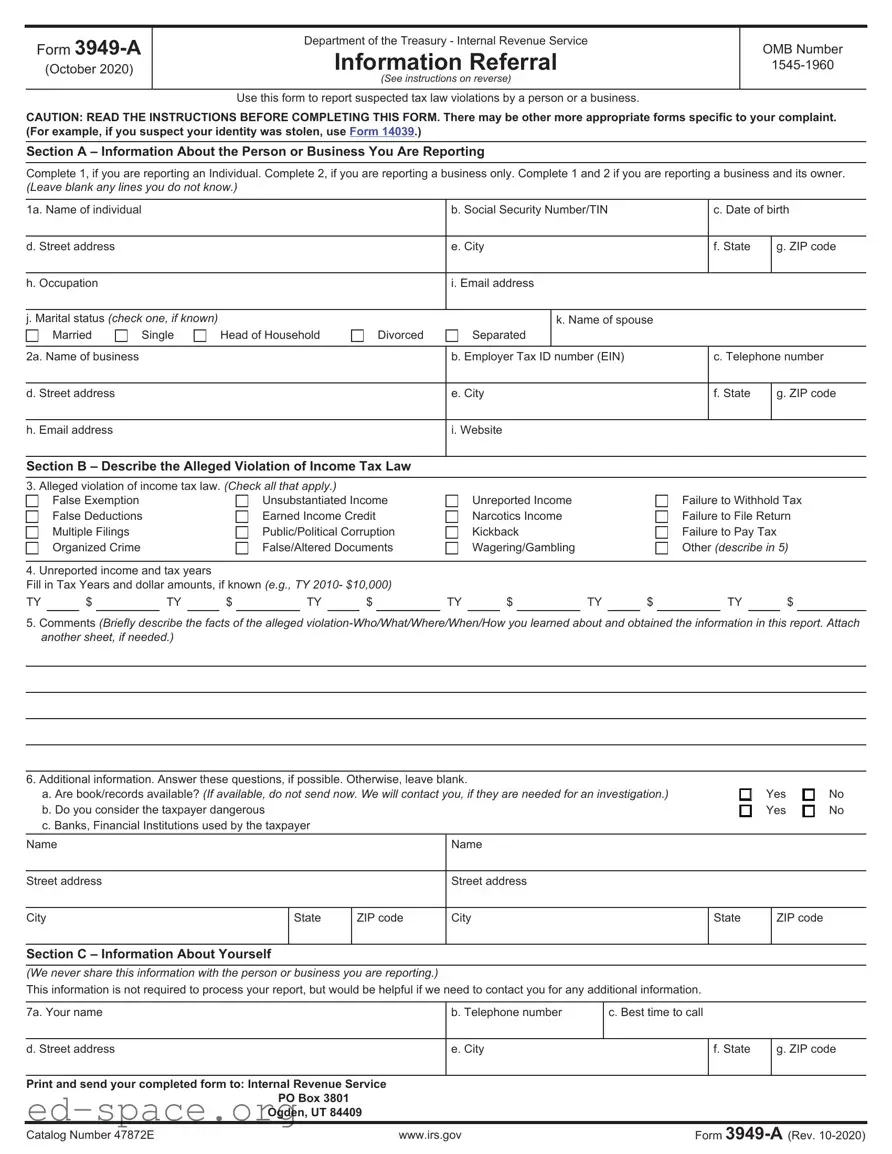
The IRS 3949-A form serves as a vital tool for individuals who wish to report suspected tax fraud or tax law violations. Designed to facilitate the reporting process, this form allows citizens to provide detailed information about potential misconduct, such as underreporting income, claiming false deductions, or failing to file tax returns altogether. By filling out this form, taxpayers play an essential role in maintaining the integrity of the tax system. The form requires specific details, including the name and address of the person being reported, a description of the alleged violation, and any relevant documentation that supports the claim. Importantly, the IRS ensures that the identity of the person reporting remains confidential, encouraging more individuals to come forward with information. Understanding the purpose and process of the IRS 3949-A form can empower citizens to take action against tax fraud, ultimately contributing to a fairer tax system for everyone.
Form |
Department of the Treasury - Internal Revenue Service |
OMB Number |
|
Information Referral |
|||
(October 2020) |
|||
|
(See instructions on reverse) |
|
|
|
Use this form to report suspected tax law violations by a person or a business. |
|
CAUTION: READ THE INSTRUCTIONS BEFORE COMPLETING THIS FORM. There may be other more appropriate forms specific to your complaint. (For example, if you suspect your identity was stolen, use Form 14039.)
Section A – Information About the Person or Business You Are Reporting
Complete 1, if you are reporting an Individual. Complete 2, if you are reporting a business only. Complete 1 and 2 if you are reporting a business and its owner. (Leave blank any lines you do not know.)
1a. Name of individual |
|
|
|
b. Social Security Number/TIN |
c. Date of birth |
||
|
|
|
|
|
|
|
|
d. Street address |
|
|
|
e. City |
f. State |
g. ZIP code |
|
|
|
|
|
|
|
|
|
h. Occupation |
|
|
|
i. Email address |
|
|
|
|
|
|
|
|
|
|
|
j. Marital status (check one, if known) |
|
|
|
k. Name of spouse |
|
|
|
Married |
Single |
Head of Household |
Divorced |
Separated |
|
|
|
|
|
|
|
|
|
|
|
2a. Name of business |
|
|
|
b. Employer Tax ID number (EIN) |
c. Telephone number |
||
|
|
|
|
|
|
|
|
d. Street address |
|
|
|
e. City |
f. State |
g. ZIP code |
|
|
|
|
|
|
|
|
|
h. Email address |
|
|
|
i. Website |
|
|
|
|
|
|
|
|
|
|
|
Section B – Describe the Alleged Violation of Income Tax Law
3. |
Alleged violation of income tax law. (Check all that apply.) |
|
|
|
|
|
|
|
|
|
|
|
|
|
|
|||||||||
|
|
False Exemption |
|
|
|
Unsubstantiated Income |
|
Unreported Income |
|
|
|
Failure to Withhold Tax |
||||||||||||
|
|
False Deductions |
|
|
|
Earned Income Credit |
|
Narcotics Income |
|
|
|
Failure to File Return |
||||||||||||
|
|
Multiple Filings |
|
|
|
Public/Political Corruption |
|
Kickback |
|
|
|
Failure to Pay Tax |
|
|
||||||||||
|
|
Organized Crime |
|
|
|
False/Altered Documents |
|
Wagering/Gambling |
|
|
|
Other (describe in 5) |
||||||||||||
|
|
|
|
|
|
|
|
|
|
|
|
|
|
|
|
|
|
|
|
|||||
4. |
Unreported income and tax years |
|
|
|
|
|
|
|
|
|
|
|
|
|
|
|
|
|
|
|||||
Fill in Tax Years and dollar amounts, if known (e.g., TY 2010- $10,000) |
|
|
|
|
|
|
|
|
|
|
|
|
||||||||||||
TY |
|
$ |
|
TY |
|
$ |
|
TY |
|
$ |
|
TY |
|
$ |
|
TY |
|
$ |
|
TY |
|
$ |
|
|
5.Comments (Briefly describe the facts of the alleged
6. Additional information. Answer these questions, if possible. Otherwise, leave blank. |
Yes |
No |
|
a. Are book/records available? (If available, do not send now. We will contact you, if they are needed for an investigation.) |
|||
b. Do you consider the taxpayer dangerous |
|
Yes |
No |
c. Banks, Financial Institutions used by the taxpayer |
|
|
|
Name |
Name |
|
|
Street address
Street address
City
State
ZIP code
City
State
ZIP code
Section C – Information About Yourself
(We never share this information with the person or business you are reporting.)
This information is not required to process your report, but would be helpful if we need to contact you for any additional information.
7a. Your name |
b. Telephone number |
c. Best time to call |
|
|
|
d. Street address
e. City
f. State
g. ZIP code
Print and send your completed form to: Internal Revenue Service
PO Box 3801
Ogden, UT 84409
Catalog Number 47872E |
www.irs.gov |
Form |

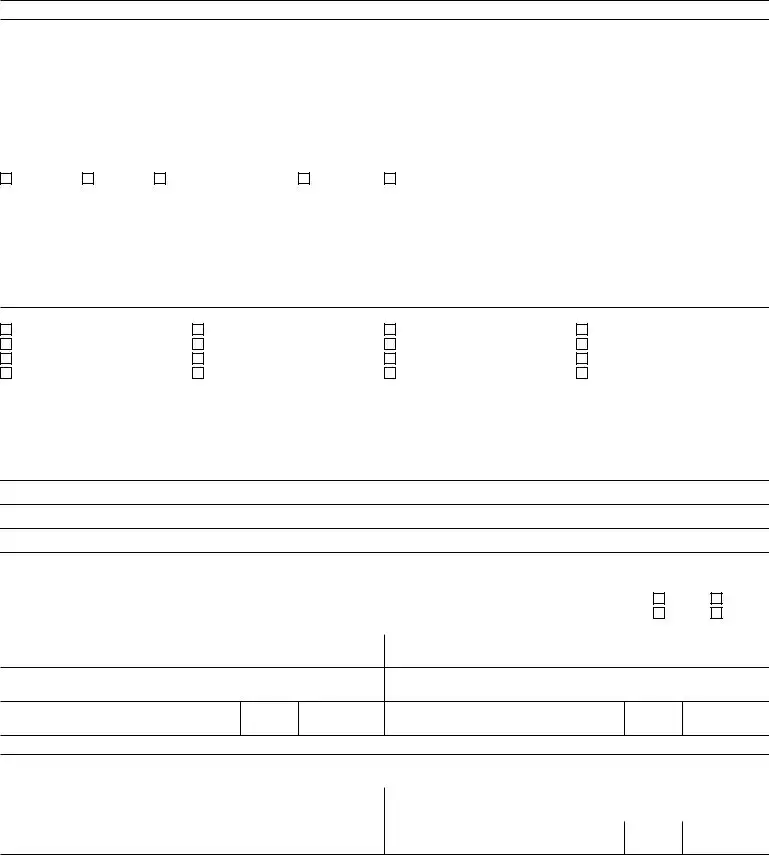
Page 2
Instructions for Form
General Instructions
Purpose of the Form
Use Form
CAUTION: DO NOT USE Form
oIf you suspect your identity was stolen. Use Form 14039. Follow “Instructions for Submitting this Form” on Page 2 of Form 14039.
oTo report suspected misconduct by your tax return preparer. Use Form 14157. Submit to the address on the Form 14157.
oIf your paid preparer filed a return or made changes to your return without your authorization. Instead, use Form 14157 AND Form
oIf you received a notice from the IRS about someone claiming your exemption or dependent. Follow the instructions on the notice. Do not complete Form
oTo report an abusive tax avoidance scheme, promotion, or a promoter of such a scheme. Use Form 14242. Mail or FAX to the address or FAX number on the Form 14242.
oTo report misconduct or wrongdoing by a tax exempt organization or its officers, directors, or authorized persons. Use Form 13909. Submit by mail, FAX, or email, according to the instructions on the Form 13909.
Have information and want to claim a reward? Use Form 211, Application For Award For Original Information. Mail it to the address in the Instructions for the form.
Specific Instructions
Section A – Provide Information About the Person/Business You Are Reporting, if known.
Provide as much information as you know about the person or business you are reporting.
1.Complete if you are reporting an individual. Include their name, street address, city, state, ZIP code, social security number or taxpayer identification number, occupation, date of birth, marital status, name of spouse (if married), and email address. Include as much information as you know.
2.Complete if you are reporting a business. Include the business name, business street address, city, state, ZIP code, employer identification number (EIN), telephone number(s), email address, and website, if known.
Note: Complete both parts if you are reporting a business and its owner.
Section B – Use to Describe the Alleged Tax Law Violation(s)
3.Check all Tax Violations That Apply to Your Report.
False Exemption- Claimed persons as dependents they are not entitled to claim.
False Deductions- Claimed false or exaggerated deductions to reduce their taxable income. Multiple Filings- Filed more than one tax return to receive fraudulent refunds.
Organized Crime- Member of a group of persons who engaged in illegal enterprises such as drugs, gambling, loansharking, extortion, or laundering illegal money through a legitimate business.
Unsubstantiated Income- Reported false income from an unverifiable source in order to get a false refund.
Earned Income Credit- Claimed Earned Income Credit which they were not entitled to receive. They may have reported income they did not earn or claimed children they were not entitled to claim.
Public/Political Corruption- Public official or politician violated laws against using their position illegally for personal gain.
False/Altered Documents- Changed documents, such as a
Unreported Income- Received cash or other untraceable payments, such as goods or services, and did not report the income.
Narcotics Income- Received income from illegal drugs or narcotics.
Catalog Number 47872E |
www.irs.gov |
Form |
Page 3
Kickback- Received illegal payments or kickbacks in exchange for referring the business of a government agency or other business towards a company or for influencing business decisions that result in part of the payment for the business received or service performed being returned to the person who made the referral.
Wagering/Gambling- Did not report income received from wagering or gambling.
Failure to Withhold Tax- Individual or business did not withhold legally owed taxes from income paid to their employee(s), such as Social Security or Medicare taxes. Example: A business treated employees as independent contractors and issued Forms 1099, with no tax withheld, instead of a
Failure to File Return- Individual or business has not filed returns legally due. Failure to Pay Tax- Individual or business has not paid taxes legally due. Other- Describe in 5.
4.If your report involves unreported income, indicate the year(s) and the dollar amount(s).
5.Briefly describe the facts of the alleged tax law violation(s) as you know them. Attach another sheet, if you need more room.
6.Additional Information, if known. Attach another sheet, if you need more room.
Section C – Provide Information about Yourself
7.Note: Information about yourself is NOT required to process your report, but may be helpful if we need additional information.
Print and send your completed form to the Internal Revenue Service at:
Internal Revenue Service
PO Box 3801
Ogden, UT 84409
Paperwork Reduction Notice
We ask for the information on this form to carry out the Internal Revenue laws of the United States. This report is voluntary and the information requested helps us determine if there has been a violation of Income Tax Law. We need it to insure that taxpayers are complying with these laws and to allow us to figure and collect the right amount of tax.
You are not required to provide the information on a form that is subject to the Paperwork Reduction Act unless the form displays a valid OMB control number. Books or records relating to a form or its instructions must be retained as long as their contents may become material in the administrations of any Internal Revenue laws. Generally, tax returns and tax return information are confidential, as required by Code section 6103.
The time required to complete this form will vary depending on individual circumstances. The estimated average time is 15 minutes.
Privacy Act Notice
We are requesting this information under authority of 26 U.S.C. 7801. The primary purpose of this form is to report potential violations of the Internal Revenue laws. The information may be disclosed to the Department of Justice to enforce the tax laws. Providing the information is voluntary. Not providing all or part of the information will not affect you.
Catalog Number 47872E |
www.irs.gov |
Form |
| Fact Name | Description |
|---|---|
| Purpose of Form | The IRS 3949-A form is used to report suspected tax fraud or tax evasion to the Internal Revenue Service. |
| Confidentiality | Information submitted via Form 3949-A is kept confidential, and the identity of the informant is protected. |
| Submission Method | The form can be submitted by mail to the appropriate IRS address, ensuring that all relevant details are included. |
| State-Specific Considerations | Some states may have their own forms for reporting tax fraud, governed by state tax laws, such as California Revenue and Taxation Code Section 19701. |
Completing the IRS 3949-A form is a straightforward process. Once filled out, the form can be submitted to the IRS for further action. Here are the steps to ensure accurate completion of the form.
What is the IRS 3949-A form?
The IRS 3949-A form is used to report suspected tax fraud or tax law violations. This form allows individuals to provide information to the Internal Revenue Service (IRS) about activities they believe may be illegal or unethical regarding tax obligations. It serves as a tool for the public to assist the IRS in identifying potential tax evasion or fraudulent activities.
Who can file the IRS 3949-A form?
Any individual can file the IRS 3949-A form if they have knowledge of suspected tax fraud or violations. This includes taxpayers, employees, or even third parties who have relevant information. However, it is important to note that the form should only be used to report serious violations, not for general complaints or grievances.
What types of activities should be reported on the IRS 3949-A form?
Activities that may warrant reporting include failing to report income, claiming false deductions, or engaging in fraudulent schemes to evade taxes. Other examples include underreporting income, using false Social Security numbers, or any actions that violate tax laws. The more specific and detailed the information provided, the better the IRS can investigate the claim.
Is there a reward for reporting tax fraud using the IRS 3949-A form?
While the IRS does have a whistleblower program that can provide rewards for reporting certain tax fraud cases, filing the 3949-A form itself does not guarantee a reward. If you believe you have information that could lead to significant tax recovery, it may be worth exploring the whistleblower program separately.
How do I submit the IRS 3949-A form?
The IRS 3949-A form can be submitted by mailing it to the appropriate address specified on the form itself. It's important to ensure that all required information is filled out completely and accurately. The IRS does not accept this form electronically, so physical submission is necessary.
Will my identity be kept confidential when I file the IRS 3949-A form?
The IRS strives to protect the identity of individuals who report suspected fraud. However, complete anonymity cannot be guaranteed. If the IRS needs to follow up on the information provided, they may require further details, which could potentially reveal the identity of the informant.
Can I file the IRS 3949-A form anonymously?
Yes, you can submit the IRS 3949-A form without providing your name or contact information. However, keep in mind that doing so may limit the IRS's ability to follow up for additional information or clarification. Providing contact information can enhance the effectiveness of the investigation.
What happens after I submit the IRS 3949-A form?
Once the IRS receives the form, they will review the information provided. If they determine that there is enough evidence to warrant an investigation, they may take further action. However, not all submissions lead to an investigation, and the IRS does not provide updates on the status of individual submissions.
Incomplete Information: Failing to provide all required fields can delay processing. Ensure every section is filled out thoroughly.
Incorrect Identification: Providing incorrect or missing taxpayer identification numbers can lead to confusion. Double-check the accuracy of these numbers.
Insufficient Details: Not including enough information about the suspected tax fraud can hinder the investigation. Be as specific as possible.
Improper Format: Submitting the form in a format other than the prescribed one can cause processing issues. Always use the official form.
Missing Signature: Omitting a signature can result in rejection of the submission. Ensure the form is signed before sending it.
Incorrect Submission Method: Not following the proper submission guidelines can lead to delays. Be aware of whether the form should be mailed or submitted electronically.
Neglecting to Keep Copies: Failing to retain a copy of the completed form can be problematic. Always keep a record for your files.
Ignoring Deadlines: Missing submission deadlines can have consequences. Stay informed about any relevant timelines to ensure timely filing.
The IRS 3949-A form is primarily used to report suspected tax fraud or tax law violations. When individuals or businesses suspect wrongdoing, they may need to submit additional documents to support their claims. Below is a list of other forms and documents that are often used alongside the IRS 3949-A form. Each document serves a specific purpose and can help in providing a clearer picture of the situation at hand.
When reporting suspected tax violations, it is crucial to gather all relevant documentation. Doing so not only strengthens your case but also helps the IRS take appropriate action. Ensure that any information provided is accurate and complete to facilitate a smooth review process.
When filling out the IRS 3949-A form, it's essential to approach the task with care. This form is used to report suspected tax fraud or other violations of the tax laws. Here are some important dos and don'ts to keep in mind:
By following these guidelines, you can ensure that your submission is clear and effective, helping the IRS address any potential issues efficiently.
The IRS 3949-A form is often misunderstood, leading to confusion among taxpayers. Here are five common misconceptions about this form:
While this form is commonly associated with reporting suspected tax fraud, it can also be used to report other violations, such as unreported income or failure to file tax returns.
Filing the 3949-A does not automatically mean the IRS will take action. The agency reviews submissions but prioritizes cases based on available resources and evidence.
You can submit the form anonymously. However, providing your contact details can help the IRS follow up if they need more information.
The IRS allows you to submit the 3949-A by mail as well. You can print the form, fill it out, and send it to the appropriate address listed on the IRS website.
There is no specific deadline for submitting the IRS 3949-A. You can report suspected violations at any time, but timely reporting may help the IRS address issues more effectively.
The IRS 3949-A form is a tool for reporting suspected tax fraud or tax law violations. Here are some key takeaways regarding its use:
Understanding these points can enhance the effectiveness of reporting suspected tax violations while ensuring compliance with IRS procedures.