The IRS 3921 form plays a crucial role in the reporting of stock transfers from an employee stock purchase plan. This form is primarily used by employers to report the transfer of stock to employees who have exercised their options. It captures essential information, including the employee's name, the date of the option exercise, and the fair market value of the stock at the time of transfer. Employers must file this form for each employee who exercises stock options during the tax year, ensuring accurate reporting for tax purposes. By doing so, they help employees understand their tax obligations related to the stock received. The IRS 3921 form also aids in maintaining compliance with tax regulations, making it an important document for both employers and employees alike.

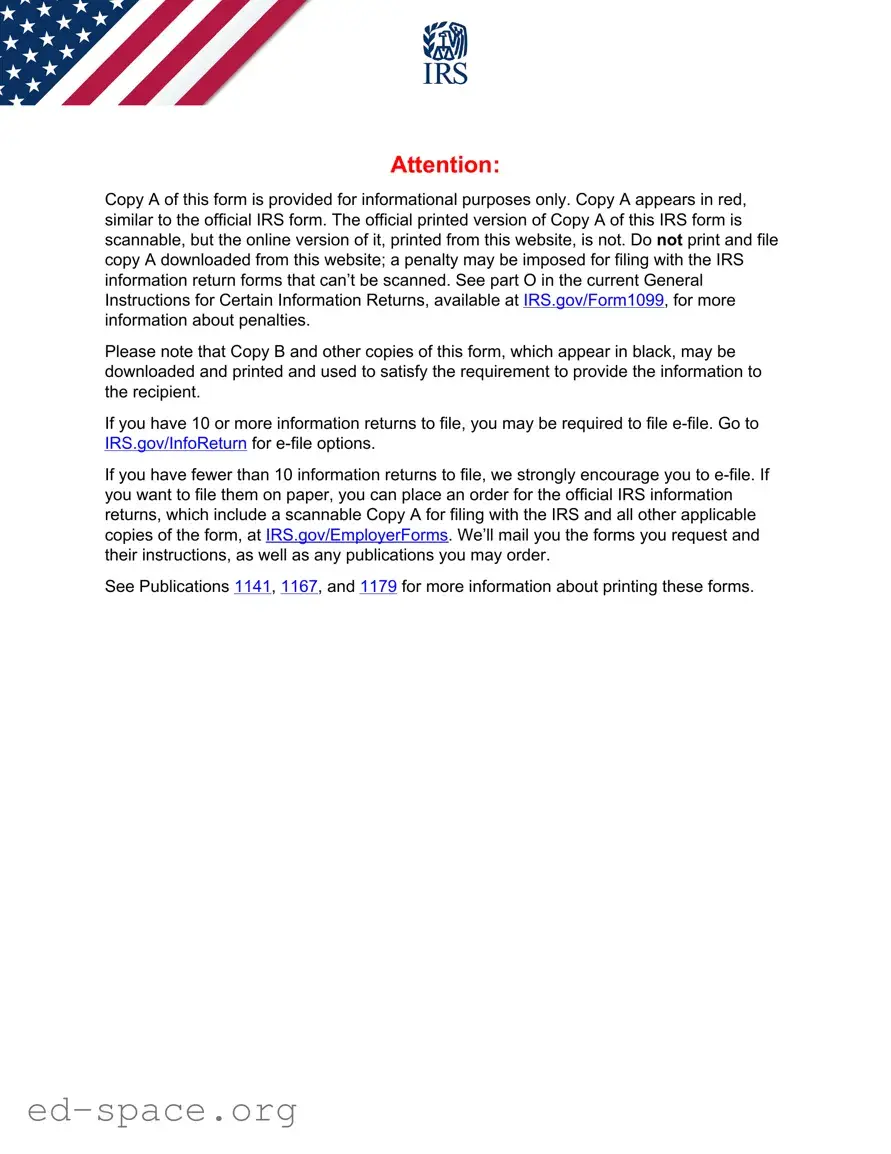
Attention:
Copy A of this form is provided for informational purposes only. Copy A appears in red, similar to the official IRS form. The official printed version of Copy A of this IRS form is scannable, but the online version of it, printed from this website, is not. Do not print and file copy A downloaded from this website; a penalty may be imposed for filing with the IRS information return forms that can’t be scanned. See part O in the current General Instructions for Certain Information Returns, available at IRS.gov/Form1099, for more information about penalties.
Please note that Copy B and other copies of this form, which appear in black, may be downloaded and printed and used to satisfy the requirement to provide the information to the recipient.
If you have 10 or more information returns to file, you may be required to file
If you have fewer than 10 information returns to file, we strongly encourage you to
See Publications 1141, 1167, and 1179 for more information about printing these forms.

2525 |
VOID |
CORRECTED |
|
|
|
|
TRANSFEROR’S name, street address, city or town, state or province, |
1 Date option granted |
OMB No. |
|
Exercise of an |
||
country, and ZIP or foreign postal code |
|
|
Form 3921 |
|
||
|
|
|
|
|
Incentive Stock |
|
|
|
|
|
|
|
Option Under |
|
|
|
2 Date option exercised |
|
|
|
|
|
|
|
(Rev. April 2025) |
|
Section 422(b) |
|
|
|
|
|
|
|
|
|
|
|
|
|
|
TRANSFEROR’S TIN |
EMPLOYEE’S TIN |
|
3 Exercise price per share |
4 Fair market value per share |
Copy A |
|
|
|
|
|
on exercise date |
For |
|
|
|
|
|
|
|
|
EMPLOYEE’S name |
|
|
$ |
$ |
|
Internal Revenue |
|
|
|
|
|
|
Service Center |
|
|
|
5 No. of shares transferred |
|
|
|
|
|
|
|
|
|
|
|
|
|
|
|
|
For filing information, |
Street address (including apt. no.) |
|
|
6 If other than TRANSFEROR, name, address, and TIN of |
|||
|
|
Privacy Act, and |
||||
|
|
|
corporation whose stock is being transferred |
|||
|
|
|
Paperwork Reduction |
|||
|
|
|
|
|
|
|
|
|
|
|
|
|
Act Notice, see the |
City or town, state or province, country, and ZIP or foreign postal code |
|
|
|
|||
|
|
|
General Instructions |
|||
|
|
|
|
|
|
|
|
|
|
|
|
|
for Certain |
|
|
|
|
|
|
Information Returns. |
Account number (see instructions) |
|
|
|
|
|
|
|
|
|
|
|
|
|
|
|
|
|
|
|
|
|
|
|
|
|
|
www.irs.gov/Form1099 |
|
|
|
|
|
|
|
Form 3921 (Rev. |
Cat. No. 41179O |
|
www.irs.gov/Form3921 |
Department of the Treasury - Internal Revenue Service |
||
Do Not Cut or Separate Forms on This Page — Do Not Cut or Separate Forms on This Page

CORRECTED (if checked)
TRANSFEROR’S name, street address, city or town, state or province, |
1 |
Date option granted |
OMB No. |
|
Exercise of an |
|
country, and ZIP or foreign postal code |
|
|
Form 3921 |
|
||
|
|
|
|
|
Incentive Stock |
|
|
|
|
|
|
|
Option Under |
|
|
2 |
Date option exercised |
|
|
|
|
|
|
|
(Rev. April 2025) |
|
Section 422(b) |
|
|
|
|
|
|
|
|
|
|
|
|
|
|
TRANSFEROR’S TIN |
EMPLOYEE’S TIN |
3 |
Exercise price per share |
4 Fair market value per share |
Copy B |
|
|
|
|
|
on exercise date |
For Employee |
|
|
|
|
|
|
|
|
EMPLOYEE’S name |
|
$ |
|
$ |
|
This is important tax |
|
|
5 |
No. of shares transferred |
|
|
information and is |
|
|
|
|
|
|
being furnished to the |
|
|
|
|
|
|
IRS. If you are required |
Street address (including apt. no.) |
|
6 |
If other than TRANSFEROR, name, address, and TIN of |
to file a return, a |
||
|
|
|
corporation whose stock is being transferred |
negligence penalty or |
||
|
|
|
|
|
|
other sanction may be |
City or town, state or province, country, and ZIP or foreign postal code |
|
|
|
|
imposed on you if this |
|
|
|
|
|
|
|
item is required to be |
|
|
|
|
|
|
reported and the IRS |
Account number (see instructions) |
|
|
|
|
|
determines that it has |
|
|
|
|
|
|
not been reported. |
|
|
|
|
|
||
Form 3921 (Rev. |
(keep for your records) |
www.irs.gov/Form3921 |
Department of the Treasury - Internal Revenue Service |
|||
Instructions for Employee
You have received this form because your employer (or transfer agent) transferred your employer’s stock to you pursuant to your exercise of an incentive stock option (ISO). You must recognize (report) gain or loss on your tax return for the year in which you sell or otherwise dispose of the stock. Keep this form and use it to figure the gain or loss. For more information, see Pub. 525, Taxable and Nontaxable Income.
When you exercise an ISO, you may have to include in alternative minimum taxable income a portion of the fair market value (FMV) of the stock acquired through the exercise of the option. For more information, see Form 6251, Alternative Minimum
Employee’s taxpayer identification number (TIN). For your protection, this form may show only the last four digits of your social security number (SSN), individual taxpayer identification number (ITIN), or adoption taxpayer identification number (ATIN). However, the employer has reported your complete TIN to the IRS.
Account number. May show an account or other unique number your employer or transfer agent assigned to distinguish your account.
Box 1. Shows the date the option to purchase the stock was granted to you.
Box 2. Shows the date you exercised the option to purchase the stock.
Box 3. Shows the exercise price per share of stock.
Box 4. Shows the FMV of a share of stock on the date the option was exercised.
Box 5. Shows the number of shares of stock transferred to you pursuant to the exercise of the option.
Box 6. Shows the name, address, and TIN of the corporation whose stock is being transferred (if other than the corporation shown in TRANSFEROR boxes in the upper left corner of the form).
Future developments. For the latest information about developments related to Form 3921 and its instructions, such as legislation enacted after they were published, go to www.irs.gov/Form3921.
Free File Program. Go to www.irs.gov/FreeFile to see if you qualify for

CORRECTED (if checked)
TRANSFEROR’S name, street address, city or town, state or province, |
1 |
Date option granted |
OMB No. |
|
Exercise of an |
|
country, and ZIP or foreign postal code |
|
|
Form 3921 |
|
||
|
|
|
|
|
Incentive Stock |
|
|
|
|
|
|
|
Option Under |
|
|
2 |
Date option exercised |
|
|
|
|
|
|
|
(Rev. April 2025) |
|
Section 422(b) |
|
|
|
|
|
|
|
|
|
|
|
|
|
|
TRANSFEROR’S TIN |
EMPLOYEE’S TIN |
3 |
Exercise price per share |
4 Fair market value per share |
|
|
|
|
|
|
on exercise date |
Copy C |
|
|
|
|
|
|
|
|
EMPLOYEE’S name |
|
$ |
|
$ |
|
For Corporation |
|
|
5 |
No. of shares transferred |
|
|
|
|
|
|
|
|
|
This copy should |
Street address (including apt. no.) |
|
6 |
If other than TRANSFEROR, name, address, and TIN of |
|||
|
be retained by the |
|||||
|
|
|
corporation whose stock is being transferred |
|||
|
|
|
corporation whose |
|||
|
|
|
|
|
|
|
City or town, state or province, country, and ZIP or foreign postal code |
|
|
|
|
stock has been |
|
|
|
|
|
|
|
transferred under |
|
|
|
|
|
|
Section 422(b). |
Account number (see instructions) |
|
|
|
|
|
|
|
|
|
|
|
||
Form 3921 (Rev. |
(keep for your records) |
www.irs.gov/Form3921 |
Department of the Treasury - Internal Revenue Service |
|||
| Fact Name | Description |
|---|---|
| Purpose | The IRS Form 3921 is used to report the transfer of stock acquired through an employee stock purchase plan. |
| Who Files | Employers are responsible for filing Form 3921 when they transfer stock to employees. |
| Filing Deadline | The form must be filed with the IRS by February 28 of the year following the transfer, or March 31 if filed electronically. |
| Employee Copy | Employers must provide a copy of Form 3921 to the employee by January 31 of the year following the transfer. |
| Information Required | Form 3921 requires details such as the employee's name, address, and the date of stock transfer. |
| State-Specific Forms | Some states may have their own reporting requirements. For example, California requires Form 592 for state tax purposes. |
| Governing Laws | The reporting of stock transfers is governed by Internal Revenue Code Section 6039. |
| Penalties | Failure to file Form 3921 on time may result in penalties imposed by the IRS. |
| Impact on Taxes | Information reported on Form 3921 can affect an employee's tax obligations, particularly regarding capital gains. |
| Electronic Filing | Employers can file Form 3921 electronically through the IRS e-file system, which may streamline the process. |
Filling out the IRS Form 3921 is an important step for reporting certain transactions involving incentive stock options. After completing the form, you will need to submit it to the IRS and provide a copy to the employee involved in the transaction. Below are the steps to accurately fill out the form.
What is the IRS 3921 form?
The IRS 3921 form is used by companies to report the transfer of stock acquired through an employee stock option plan. When an employee exercises their stock options, the employer must provide this form to the IRS and the employee. It includes important details such as the number of shares transferred, the date of exercise, and the fair market value of the stock at the time of exercise.
Who needs to file the IRS 3921 form?
Employers who grant stock options to their employees must file the IRS 3921 form. This requirement applies to both public and private companies. If an employee exercises their stock options during the tax year, the employer must report this transaction using the form. Failure to file can result in penalties.
When is the IRS 3921 form due?
The IRS 3921 form must be filed by January 31 of the year following the stock option exercise. Employers should also provide a copy of the form to the employee by the same deadline. This allows employees to accurately report their income on their tax returns.
What information is included on the IRS 3921 form?
The form includes several key pieces of information. This includes the employee's name and address, the number of shares transferred, the date of the option exercise, the fair market value of the stock on that date, and the exercise price per share. This information is crucial for both the IRS and the employee to ensure proper tax reporting.
What should an employee do if they do not receive the IRS 3921 form?
If an employee does not receive the IRS 3921 form from their employer by the January 31 deadline, they should first reach out to their employer's HR or payroll department. It's important to clarify whether the form was issued and to request a copy if it was not. Employees need this form to accurately report their income and avoid potential issues with the IRS.
Incorrect Taxpayer Identification Number (TIN): One of the most common mistakes is entering the wrong TIN. Ensure that the Social Security Number or Employer Identification Number is accurate to avoid delays.
Missing Signature: Failing to sign the form can render it invalid. Always check that the form is signed before submission.
Incorrect Date of Transfer: The date when the stock was transferred must be precise. An incorrect date can lead to confusion regarding tax obligations.
Failure to Report All Transfers: Some individuals may forget to report all stock transfers. Ensure that every transaction is documented on the form.
Using Incorrect Form Version: The IRS updates forms periodically. Using an outdated version can result in errors or rejections.
Not Following Instructions: Each form comes with specific instructions. Ignoring these can lead to mistakes that could have been easily avoided.
Inconsistent Information: Ensure that the information on the IRS 3921 form matches other tax documents. Discrepancies can raise red flags.
Failing to Keep Copies: Not retaining a copy of the completed form for personal records can lead to issues in the future. Always keep a copy for your files.
Neglecting to Check for Errors: Rushing through the form can lead to simple mistakes. Take the time to review the entire document before submission.
Submitting Late: The IRS has strict deadlines for form submission. Failing to meet these deadlines can result in penalties.
The IRS 3921 form is essential for employers and employees involved in stock option exercises. However, it is often accompanied by several other forms and documents that help clarify tax obligations and provide necessary information for both parties. Understanding these additional documents can streamline the process and ensure compliance with tax regulations.
In conclusion, while the IRS 3921 form plays a critical role in reporting stock option exercises, it is important to be aware of the accompanying documents that provide a complete picture of an individual's tax obligations. Each of these forms and agreements contributes to a clear understanding of financial responsibilities and ensures compliance with IRS regulations.
The IRS Form 3921 is used primarily for reporting the transfer of stock acquired through an employee stock purchase plan. It serves a specific purpose, but there are other forms that share similarities in function or context. Below is a list of eight documents that are comparable to the IRS Form 3921.
When filling out the IRS 3921 form, it is important to follow certain guidelines to ensure accuracy and compliance. Here are six things you should and shouldn't do:
By following these guidelines, you can help ensure that your IRS 3921 form is filled out correctly and submitted on time.
The IRS Form 3921 is often misunderstood, leading to confusion among taxpayers and businesses alike. Here are nine common misconceptions about this form, along with clarifications to help clear up any uncertainty.
Understanding these misconceptions can help ensure compliance and accurate reporting when dealing with stock options and related tax obligations.
The IRS 3921 form is essential for reporting the exercise of incentive stock options (ISOs). Understanding how to fill it out correctly can help ensure compliance and avoid penalties.