The IRS Form 2553 is a crucial document for small business owners who wish to elect S Corporation status for their entities. This form allows eligible corporations to be taxed as S Corporations, which can lead to significant tax benefits, including avoiding double taxation on corporate income. By filing Form 2553, business owners can pass corporate income, losses, deductions, and credits directly to shareholders, who then report these items on their personal tax returns. The eligibility criteria for this election include having a limited number of shareholders, all of whom must be individuals, certain trusts, or estates, and the corporation must be a domestic entity. Additionally, the form must be filed within a specific timeframe to ensure that the election is effective for the desired tax year. Understanding the nuances of this form is essential for business owners looking to optimize their tax situation while maintaining compliance with IRS regulations. Completing Form 2553 accurately and timely can significantly impact the financial health of a business.
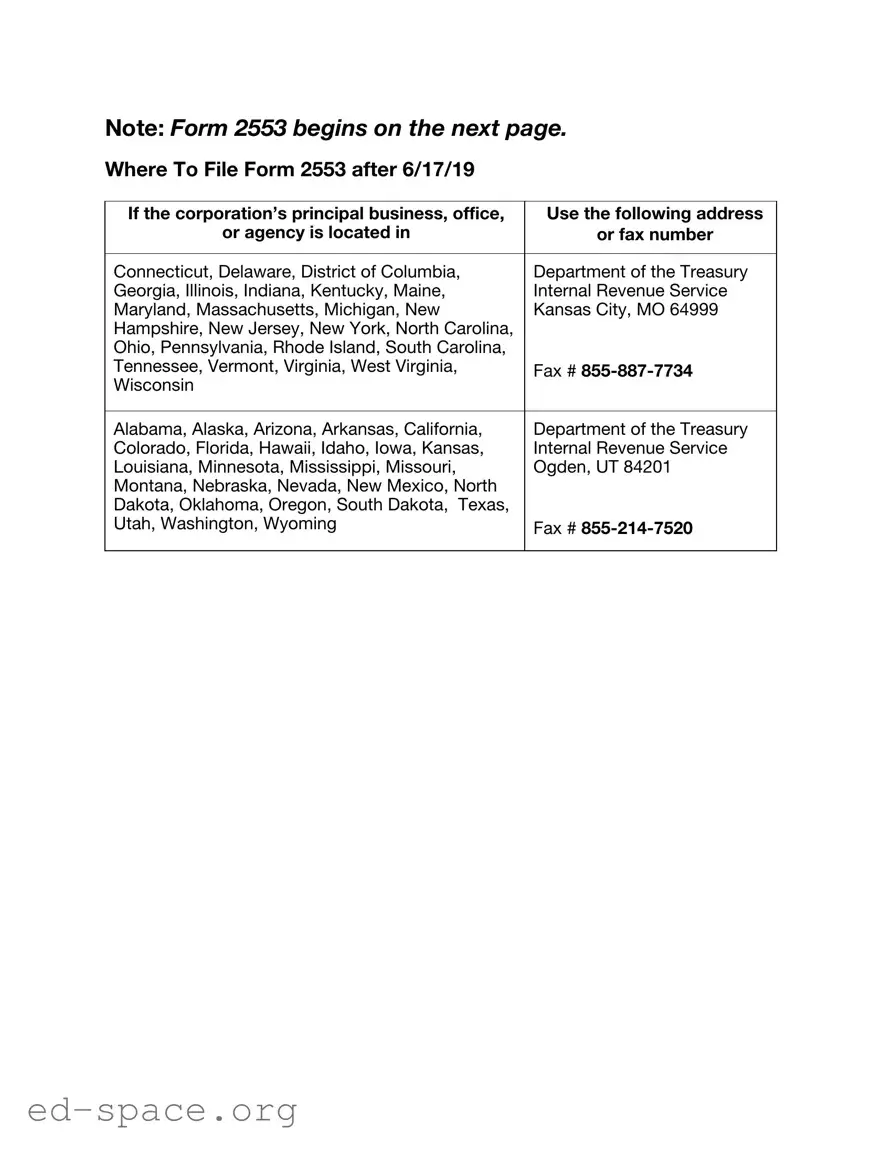
Note: Form 2553 begins on the next page.
Where To File Form 2553 after 6/17/19
If the corporation’s principal business, office, |
Use the following address |
or agency is located in |
or fax number |
|
|
Connecticut, Delaware, District of Columbia, |
Department of the Treasury |
Georgia, Illinois, Indiana, Kentucky, Maine, |
Internal Revenue Service |
Maryland, Massachusetts, Michigan, New |
Kansas City, MO 64999 |
Hampshire, New Jersey, New York, North Carolina, |
|
Ohio, Pennsylvania, Rhode Island, South Carolina, |
|
Tennessee, Vermont, Virginia, West Virginia, |
Fax # |
Wisconsin |
|
|
|
Alabama, Alaska, Arizona, Arkansas, California, |
Department of the Treasury |
Colorado, Florida, Hawaii, Idaho, Iowa, Kansas, |
Internal Revenue Service |
Louisiana, Minnesota, Mississippi, Missouri, |
Ogden, UT 84201 |
Montana, Nebraska, Nevada, New Mexico, North |
|
Dakota, Oklahoma, Oregon, South Dakota, Texas, |
|
Utah, Washington, Wyoming |
Fax # |
|
|

Form 2553
(Rev. December 2017)
Department of the Treasury Internal Revenue Service
Election by a Small Business Corporation
(Under section 1362 of the Internal Revenue Code)
(Including a late election filed pursuant to Rev. Proc.
▶You can fax this form to the IRS. See separate instructions.
▶Go to www.irs.gov/Form2553 for instructions and the latest information.
OMB No.
Note: This election to be an S corporation can be accepted only if all the tests are met under Who May Elect in the instructions, all shareholders have signed the consent statement, an officer has signed below, and the exact name and address of the corporation (entity) and other required form information have been provided.
Part I |
|
Election Information |
|
|
|
|
|
|
|
Name (see instructions) |
A Employer identification number |
||
Type |
|
|
|
|
|
|
|
Number, street, and room or suite no. If a P.O. box, see instructions. |
B Date incorporated |
|
|||
or |
|
|
|
|||
|
|
|
|
|
|
|
|
|
|
|
|
||
|
City or town, state or province, country, and ZIP or foreign postal code |
C State of incorporation |
|
|||
|
|
|
|
|||
|
|
|
|
|
|
|
D |
Check |
the applicable box(es) if the corporation (entity), after applying for the EIN shown in A above, changed its |
name or |
address |
||
EElection is to be effective for tax year beginning (month, day, year) (see instructions) . . . . . . ▶
Caution: A corporation (entity) making the election for its first tax year in existence will usually enter the beginning date of a short tax year that begins on a date other than January 1.
FSelected tax year:
(1) Calendar year
(2) Fiscal year ending (month and day) ▶
(3)
(4)
If box (2) or (4) is checked, complete Part II.
GIf more than 100 shareholders are listed for item J (see page 2), check this box if treating members of a family as one shareholder results in no more than 100 shareholders (see test 2 under Who May Elect in the instructions) ▶
HName and title of officer or legal representative whom the IRS may call for more information
Telephone number of officer or legal representative
IIf this S corporation election is being filed late, I declare I had reasonable cause for not filing Form 2553 timely. If this late election is being made by an entity eligible to elect to be treated as a corporation, I declare I also had reasonable cause for not filing an entity classification election timely and the representations listed in Part IV are true. See below for my explanation of the reasons the election or elections were not made on time and a description of my diligent actions to correct the mistake upon its discovery. See instructions.
|
Under penalties of perjury, I declare that I have examined this election, including accompanying documents, and, to the best of my |
||
Sign knowledge and belief, the election contains all the relevant facts relating to the election, and such facts are true, correct, and complete. |
|||
Here |
▲Signature of officer |
|
|
|
Title |
Date |
|
For Paperwork Reduction Act Notice, see separate instructions. |
Cat. No. 18629R |
Form 2553 (Rev. |
|

Form 2553 (Rev. |
Page 2 |
Name |
Employer identification number |
Part I Election Information (continued) Note: If you need more rows, use additional copies of page 2.
J
Name and address of each
shareholder or former shareholder required to consent to the election.
(see instructions)
K
Shareholder’s Consent Statement
Under penalties of perjury, I declare that I consent to the election of the
Signature |
Date |
L
Stock owned or
percentage of ownership
(see instructions)
Number of |
|
shares or |
|
percentage |
Date(s) |
of ownership |
acquired |
M |
|
Social security |
|
number or |
N |
employer |
Shareholder’s |
identification |
tax year ends |
number (see |
(month and |
instructions) |
day) |
Form 2553 (Rev.

Form 2553 (Rev. |
Page 3 |
|
Name |
|
Employer identification number |
|
|
|
Part II |
Selection of Fiscal Tax Year (see instructions) |
|
Note: All corporations using this part must complete item O and item P, Q, or R. |
|
|
O Check the applicable box to indicate whether the corporation is: |
|
|
1. |
A new corporation adopting the tax year entered in item F, Part I. |
|
2. |
An existing corporation retaining the tax year entered in item F, Part I. |
|
3. |
An existing corporation changing to the tax year entered in item F, Part I. |
|
PComplete item P if the corporation is using the automatic approval provisions of Rev. Proc.
1. Natural Business Year ▶ |
I represent that the corporation is adopting, retaining, or changing to a tax year that qualifies |
as its natural business year (as defined in section 5.07 of Rev. Proc.
2. Ownership Tax Year ▶ |
I represent that shareholders (as described in section 5.08 of Rev. Proc. |
than half of the shares of the stock (as of the first day of the tax year to which the request relates) of the corporation have the same tax year or are concurrently changing to the tax year that the corporation adopts, retains, or changes to per item F, Part I, and that such tax year satisfies the requirement of section 4.01(3) of Rev. Proc.
Note: If you do not use item P and the corporation wants a fiscal tax year, complete either item Q or R below. Item Q is used to request a fiscal tax year based on a business purpose and to make a
QBusiness
1. Check here ▶ if the fiscal year entered in item F, Part I, is requested under the prior approval provisions of Rev. Proc.
Yes |
No |
2.Check here ▶ to show that the corporation intends to make a
3.Check here ▶ to show that the corporation agrees to adopt or change to a tax year ending December 31 if necessary for the IRS to accept this election for S corporation status in the event (1) the corporation’s business purpose request is not approved and the corporation makes a
RSection 444
1.Check here ▶ to show that the corporation will make, if qualified, a section 444 election to have the fiscal tax year shown in item F, Part I. To make the election, you must complete Form 8716, Election To Have a Tax Year Other Than a Required Tax Year, and either attach it to Form 2553 or file it separately.
2.Check here ▶ to show that the corporation agrees to adopt or change to a tax year ending December 31 if necessary for the IRS to accept this election for S corporation status in the event the corporation is ultimately not qualified to make a section 444 election.
Form 2553 (Rev.
Form 2553 (Rev. |
Page 4 |
Name |
Employer identification number |
Part III Qualified Subchapter S Trust (QSST) Election Under Section 1361(d)(2)* Note: If you are making more than
one QSST election, use additional copies of page 4.
Income beneficiary’s name and address
Social security number
Trust’s name and address
Employer identification number
Date on which stock of the corporation was transferred to the trust (month, day, year) . . . . . . . . ▶
In order for the trust named above to be a QSST and thus a qualifying shareholder of the S corporation for which this Form 2553 is filed, I hereby make the election under section 1361(d)(2). Under penalties of perjury, I certify that the trust meets the definitional requirements of section 1361(d)(3) and that all other information provided in Part III is true, correct, and complete.
Signature of income beneficiary or signature and title of legal representative or other qualified person making the election |
|
Date |
*Use Part III to make the QSST election only if stock of the corporation has been transferred to the trust on or before the date on which the corporation makes its election to be an S corporation. The QSST election must be made and filed separately if stock of the corporation is transferred to the trust after the date on which the corporation makes the S election.
Part IV Late Corporate Classification Election Representations (see instructions)
If a late entity classification election was intended to be effective on the same date that the S corporation election was intended to be effective, relief for a late S corporation election must also include the following representations.
1The requesting entity is an eligible entity as defined in Regulations section
2The requesting entity intended to be classified as a corporation as of the effective date of the S corporation status;
3The requesting entity fails to qualify as a corporation solely because Form 8832, Entity Classification Election, was not timely filed under Regulations section
4The requesting entity fails to qualify as an S corporation on the effective date of the S corporation status solely because the S corporation election was not timely filed pursuant to section 1362(b); and
5a The requesting entity timely filed all required federal tax returns and information returns consistent with its requested classification as an S corporation for all of the years the entity intended to be an S corporation and no inconsistent tax or information returns have been filed by or with respect to the entity during any of the tax years, or
bThe requesting entity has not filed a federal tax or information return for the first year in which the election was intended to be effective because the due date has not passed for that year’s federal tax or information return.
Form 2553 (Rev.
| Fact Name | Description |
|---|---|
| Purpose | The IRS Form 2553 is used by small businesses to elect S Corporation status for tax purposes. |
| Eligibility | To qualify, the business must meet certain criteria, including having no more than 100 shareholders and only one class of stock. |
| Filing Deadline | The form must be filed within 75 days of the beginning of the tax year for which the election is to take effect. |
| State-Specific Forms | Some states require additional forms to recognize S Corporation status, governed by state laws such as California Revenue and Taxation Code Section 23800. |
Filling out the IRS Form 2553 is an important step for businesses that want to elect to be treated as an S corporation for tax purposes. Completing this form correctly is essential to ensure that your business receives the intended tax benefits. The following steps will guide you through the process of filling out the form.
What is IRS Form 2553?
IRS Form 2553 is a tax form that allows a corporation or an LLC to elect to be treated as an S corporation for federal tax purposes. By making this election, the business can avoid double taxation on corporate income. Instead, income, deductions, and credits pass through to shareholders, who report them on their individual tax returns. This can lead to significant tax savings for many small businesses.
Who is eligible to file Form 2553?
To be eligible to file Form 2553, a corporation must meet specific criteria. It must be a domestic corporation, have only allowable shareholders (which include individuals, certain trusts, and estates), and have no more than 100 shareholders. Additionally, the corporation must have only one class of stock. It's important to ensure that all eligibility requirements are met before filing to avoid complications.
When should Form 2553 be filed?
Form 2553 should generally be filed within 75 days of the beginning of the tax year for which the S corporation election is to take effect. For newly formed corporations, this means filing the form shortly after incorporation. If the deadline is missed, the business may need to wait until the next tax year to make the election, unless it qualifies for late election relief.
What happens after filing Form 2553?
After submitting Form 2553, the IRS will review the application. If approved, the corporation will receive confirmation of its S corporation status. This designation will affect how the business is taxed going forward. It is essential to maintain compliance with S corporation requirements to retain this status. Any changes in ownership or structure may necessitate additional filings or considerations.
Incorrect Entity Type Selection: Many individuals mistakenly select the wrong entity type when filling out the IRS 2553 form. It is essential to ensure that your business qualifies as an S Corporation. If you choose an incorrect type, it can lead to delays or denials.
Missing Signatures: A common oversight is failing to include the necessary signatures. Both the business owner and all shareholders must sign the form. Without these signatures, the IRS will not process the application.
Filing Deadline Confusion: Some people forget that there are strict deadlines for submitting the IRS 2553. To avoid issues, it’s crucial to file within 75 days of the beginning of the tax year. Missing this window can result in a missed opportunity for S Corporation status.
Incorrect Shareholder Information: Providing inaccurate or incomplete information about shareholders can cause significant problems. Ensure that names, addresses, and Social Security numbers are correct and match IRS records.
Failure to Include All Shareholders: It’s important to list all shareholders on the form. Omitting even one shareholder can lead to complications and may jeopardize the S Corporation election.
Not Understanding Tax Implications: Some individuals underestimate the tax implications of electing S Corporation status. It’s wise to consult with a tax professional to fully understand how this choice affects your tax situation.
Inaccurate or Incomplete Election Statement: The election statement must be filled out with care. Any inaccuracies or incomplete sections can lead to rejection. Double-checking the entire form before submission is a wise practice.
When forming an S Corporation, the IRS Form 2553 is essential for electing S Corporation status. However, several other forms and documents are often necessary to ensure compliance with federal and state regulations. Below is a list of important documents that may accompany the IRS Form 2553.
Completing the IRS Form 2553 is a significant step in establishing an S Corporation. However, understanding and gathering the accompanying documents is equally important. Each of these forms plays a crucial role in ensuring compliance and facilitating smooth operations for your business.
The IRS Form 2553 is essential for small businesses electing to be taxed as an S Corporation. However, it shares similarities with several other important tax documents. Understanding these similarities can help clarify their purposes and functions. Below are four documents that are comparable to Form 2553:
Each of these forms plays a significant role in the overall tax reporting process for businesses and individuals alike. Understanding their similarities can help ensure compliance and proper tax treatment.
When filling out the IRS 2553 form, it is important to follow certain guidelines to ensure accuracy and compliance. Here are four things to do and not to do:
The IRS Form 2553 is an important document for small businesses looking to elect S Corporation status. However, several misconceptions surround this form. Here are eight common misunderstandings:
This is incorrect. While the form is primarily for corporations, certain limited liability companies (LLCs) can also elect S Corporation status by filing Form 2553.
Not all businesses can choose to file. Only those eligible and wishing to be taxed as an S Corporation must file this form.
In reality, Form 2553 is a one-time election. Once approved, the S Corporation status remains until it is revoked or the business no longer qualifies.
In fact, businesses must file Form 2553 within a specific timeframe, typically within two months and 15 days after the start of the tax year.
This is true. All shareholders must consent to the election by signing the form, which is a requirement for approval.
Submitting the form does not guarantee approval. The IRS reviews the application, and if the business does not meet the requirements, the election may be denied.
This is a misconception. A business can revoke its S Corporation status or switch back to a C Corporation by following the proper procedures.
While the primary purpose is tax-related, electing S Corporation status can also impact other aspects of business operation, such as liability and ownership structure.
Filling out the IRS Form 2553 is a crucial step for small business owners who wish to elect S Corporation status. Understanding the process and requirements can significantly benefit your business. Here are some key takeaways to keep in mind:
By keeping these takeaways in mind, you can navigate the process of filling out and using IRS Form 2553 with greater confidence and clarity.