The IRS 1099-INT form plays a crucial role in the financial landscape, particularly for individuals who earn interest income. This form is used to report interest payments made by banks, credit unions, and other financial institutions to taxpayers. If you earned $10 or more in interest during the tax year, the institution is required to send you a 1099-INT. This document includes important information such as the amount of interest earned, any federal income tax withheld, and other relevant details. Understanding the 1099-INT is essential for accurate tax reporting, as it helps ensure that all income is properly documented and reported to the IRS. Additionally, this form can affect your overall tax liability, making it important to review it carefully. Whether you are a seasoned taxpayer or new to filing, familiarity with the 1099-INT can aid in navigating your tax responsibilities effectively.

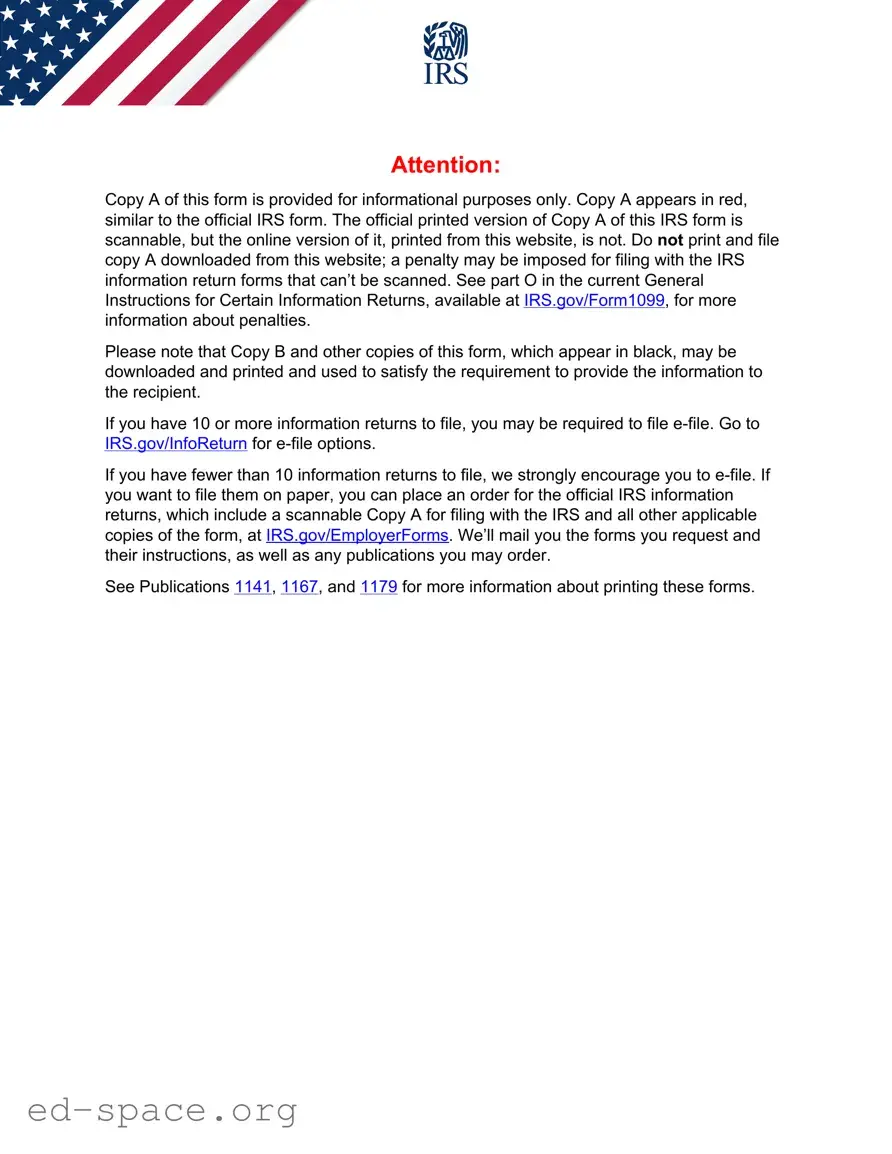
Attention:
Copy A of this form is provided for informational purposes only. Copy A appears in red, similar to the official IRS form. The official printed version of Copy A of this IRS form is scannable, but the online version of it, printed from this website, is not. Do not print and file copy A downloaded from this website; a penalty may be imposed for filing with the IRS information return forms that can’t be scanned. See part O in the current General Instructions for Certain Information Returns, available at IRS.gov/Form1099, for more information about penalties.
Please note that Copy B and other copies of this form, which appear in black, may be downloaded and printed and used to satisfy the requirement to provide the information to the recipient.
If you have 10 or more information returns to file, you may be required to file
If you have fewer than 10 information returns to file, we strongly encourage you to
See Publications 1141, 1167, and 1179 for more information about printing these forms.

9292 |
|
VOID |
CORRECTED |
|
|
|
|
|
|
PAYER’S name, street address, city or town, state or province, country, ZIP |
Payer’s RTN (optional) |
OMB No. |
|
||||||
or foreign postal code, and telephone no. |
|
|
Form |
Interest |
|||||
|
|
|
|
|
|||||
|
|
|
|
|
(Rev. January 2024) |
Income |
|||
|
|
|
|
1 Interest income |
|||||
|
|
|
|
|
|||||
|
|
|
|
|
|
|
|
|
|
|
|
|
|
|
For calendar year |
|
|||
|
|
|
|
$ |
|
|
|
|
|
|
|
|
|
|
|
|
|
|
|
|
|
|
|
2 Early withdrawal penalty |
|
|
|
|
Copy A |
|
|
|
|
|
|
|
|
|
|
|
|
|
|
$ |
|
|
|
|
|
PAYER’S TIN |
RECIPIENT’S TIN |
|
|
|
|
|
For |
||
|
|
|
|
3 Interest on U.S. Savings Bonds and Treasury obligations |
|||||
|
|
|
|
Internal Revenue |
|||||
|
|
|
|
|
|
|
|
|
|
|
|
|
|
$ |
|
|
|
|
Service Center |
|
|
|
|
|
|
|
|
||
|
|
|
|
|
|
|
|
|
|
RECIPIENT’S name |
|
|
4 Federal income tax withheld |
5 Investment expenses |
File with Form 1096. |
||||
|
|
|
|
$ |
$ |
|
|
|
|
|
|
|
|
6 Foreign tax paid |
7 Foreign country or U.S. territory |
For Privacy Act |
|||
|
|
|
|
$ |
|
|
|
|
|
Street address (including apt. no.) |
|
|
|
|
|
|
|||
|
|
|
|
|
|
and Paperwork |
|||
|
|
|
|
|
|
|
|
||
|
|
|
|
8 |
9 Specified private activity bond |
Reduction Act |
|||
|
|
|
|
|
interest |
Notice, see the |
|||
|
|
|
|
|
|
|
|
|
|
City or town, state or province, country, and ZIP or foreign postal code |
$ |
$ |
|
|
|
current General |
|||
|
|
|
|
|
|
|
Instructions for |
||
|
|
|
|
10 Market discount |
11 Bond premium |
||||
|
|
|
|
|
|
|
|
|
Certain |
|
|
|
|
$ |
$ |
|
|
|
Information |
|
|
|
FATCA filing |
|
|
|
|||
|
|
|
|
|
|
Returns. |
|||
|
|
|
requirement |
|
|
|
|||
|
|
|
12 Bond premium on Treasury obligations |
13 Bond premium on |
|||||
|
|
|
|
$ |
$ |
|
|
|
|
Account number (see instructions) |
|
|
2nd TIN not. |
14 |
15 State |
16 State identification no. |
17 State tax withheld |
||
|
|
|
|
bond CUSIP no. |
|
|
|
|
$ |
|
|
|
|
|
|
|
|
|
|
|
|
|
|
|
|
|
|
|
$ |
Form |
Cat. No. 14410K |
|
www.irs.gov/Form1099INT |
Department of the Treasury - Internal Revenue Service |
|||||
Do Not Cut or Separate Forms on This Page — Do Not Cut or Separate Forms on This Page

|
VOID |
CORRECTED |
|
|
|
|
|
|
PAYER’S name, street address, city or town, state or province, country, ZIP |
Payer’s RTN (optional) |
OMB No. |
|
|||||
or foreign postal code, and telephone no. |
|
|
Form |
Interest |
||||
|
|
|
|
|||||
|
|
|
|
(Rev. January 2024) |
Income |
|||
|
|
|
1 Interest income |
|||||
|
|
|
|
|||||
|
|
|
|
|
|
|
|
|
|
|
|
|
For calendar year |
|
|||
|
|
|
$ |
|
|
|
|
|
|
|
|
|
|
|
|
|
|
|
|
|
2 Early withdrawal penalty |
|
|
|
|
Copy 1 |
|
|
|
|
|
|
|
|
|
|
|
|
$ |
|
|
|
|
|
PAYER’S TIN |
RECIPIENT’S TIN |
|
|
|
|
|
For State Tax |
|
|
|
|
3 Interest on U.S. Savings Bonds and Treasury obligations |
|||||
|
|
|
Department |
|||||
|
|
|
|
|
|
|
|
|
|
|
|
$ |
|
|
|
|
|
RECIPIENT’S name |
|
|
4 Federal income tax withheld |
5 Investment expenses |
|
|||
|
|
|
$ |
$ |
|
|
|
|
|
|
|
6 Foreign tax paid |
7 Foreign country or U.S. territory |
|
|||
Street address (including apt. no.) |
|
|
$ |
|
|
|
|
|
|
|
|
8 |
9 Specified private activity bond |
|
|||
|
|
|
|
interest |
|
|||
City or town, state or province, country, and ZIP or foreign postal code |
$ |
$ |
|
|
|
|
||
|
|
|
10 Market discount |
11 Bond premium |
|
|||
|
|
|
$ |
$ |
|
|
|
|
|
|
FATCA filing |
|
|
|
|||
|
|
requirement |
|
|
|
|
||
|
|
12 Bond premium on Treasury obligations |
13 Bond premium on |
|
||||
|
|
|
$ |
$ |
|
|
|
|
Account number (see instructions) |
|
|
14 |
15 State |
16 State identification no. |
17 State tax withheld |
||
|
|
|
bond CUSIP no. |
|
|
|
|
$ |
|
|
|
|
|
|
|
|
|
|
|
|
|
|
|
|
|
$ |
Form |
|
|
www.irs.gov/Form1099INT |
Department of the Treasury - Internal Revenue Service |
||||

CORRECTED (if checked)
PAYER’S name, street address, city or town, state or province, country, ZIP |
Payer’s RTN (optional) |
OMB No. |
|
|||||
or foreign postal code, and telephone no. |
|
Form |
Interest |
|||||
|
|
|
|
|||||
|
|
|
|
(Rev. January 2024) |
Income |
|||
|
|
|
1 Interest income |
|||||
|
|
|
|
|||||
|
|
|
|
|
|
|
|
|
|
|
|
|
For calendar year |
|
|||
|
|
|
$ |
|
|
|
|
|
|
|
|
|
|
|
|
|
|
|
|
|
2 Early withdrawal penalty |
|
|
|
|
Copy B |
|
|
|
|
|
|
|
|
|
|
|
|
$ |
|
|
|
|
|
PAYER’S TIN |
RECIPIENT’S TIN |
|
|
|
|
For Recipient |
||
|
|
|
3 Interest on U.S. Savings Bonds and Treasury obligations |
|||||
|
|
|
|
|||||
|
|
|
$ |
|
|
|
|
|
RECIPIENT’S name |
|
|
4 Federal income tax withheld |
5 Investment expenses |
This is important tax |
|||
|
|
|
$ |
$ |
|
|
|
information and is |
|
|
|
|
|
|
being furnished to the |
||
|
|
|
6 Foreign tax paid |
7 Foreign country or U.S. territory |
||||
|
|
|
$ |
|
|
|
|
IRS. If you are |
Street address (including apt. no.) |
|
|
|
|
|
|
required to file a |
|
|
|
|
|
|
|
|
|
return, a negligence |
|
|
|
8 |
9 Specified private activity bond |
||||
|
|
|
penalty or other |
|||||
|
|
|
|
interest |
||||
|
|
|
$ |
$ |
|
|
|
sanction may be |
City or town, state or province, country, and ZIP or foreign postal code |
|
|
|
imposed on you if |
||||
|
|
|
|
|
|
|
|
this income is |
|
|
|
10 Market discount |
11 Bond premium |
||||
|
|
|
taxable and the IRS |
|||||
|
|
|
|
|
|
|
|
|
|
|
|
$ |
$ |
|
|
|
determines that it has |
|
|
FATCA filing |
|
|
|
not been reported. |
||
|
|
requirement |
|
|
|
|
||
|
|
12 Bond premium on Treasury obligations |
13 Bond premium on |
|
||||
|
|
|
$ |
$ |
|
|
|
|
Account number (see instructions) |
|
|
14 |
15 State |
16 State identification no. |
17 State tax withheld |
||
|
|
|
bond CUSIP no. |
|
|
|
|
$ |
|
|
|
|
|
|
|
|
|
|
|
|
|
|
|
|
|
$ |
Form |
(keep for your records) |
www.irs.gov/Form1099INT |
Department of the Treasury - Internal Revenue Service |
|||||
Instructions for Recipient
The information provided may be different for covered and noncovered securities. For a description of covered securities, see the Instructions for Form 8949. For a taxable covered security acquired at a premium, unless you notified the payer in writing in accordance with Regulations section
Recipient’s taxpayer identification number (TIN). For your protection, this form may show only the last four digits of your TIN (social security number (SSN), individual taxpayer identification number (ITIN), adoption taxpayer identification number (ATIN), or employer identification number (EIN)). However, the issuer has reported your complete TIN to the IRS.
FATCA filing requirement. If the FATCA filing requirement box is checked, the payer is reporting on this Form 1099 to satisfy its chapter 4 account reporting requirement. You may also have a filing requirement. See the Instructions for Form 8938.
Account number. May show an account or other unique number the payer assigned to distinguish your account.
Payer’s Routing Transit Number (RTN). A payer may include the RTN to identify the bank or financial institution where your account is held.
Box 1. Shows taxable interest paid to you during the calendar year by the payer. This does not include interest shown in box 3. May also show the total amount of the credits from clean renewable energy bonds, new clean renewable energy bonds, qualified energy conservation bonds, qualified zone academy bonds, qualified school construction bonds, and build America bonds that must be included in your interest income. These amounts were treated as paid to you during the calendar year on the credit allowance dates (March 15, June 15, September 15, and December 15). For more information, see Form 8912. See the instructions above for a taxable covered security acquired at a premium.
Box 2. Shows interest or principal forfeited because of early withdrawal of time savings. You may deduct this amount to figure your adjusted gross income on your income tax return. See the Instructions for Form 1040 to see where to take the deduction.
Box 3. Shows interest on U.S. Savings Bonds, Treasury bills, Treasury bonds, and Treasury notes. This may or may not all be taxable. See Pub. 550. This interest is exempt from state and local income taxes. This interest is not included in box 1. See the instructions above for a taxable covered security acquired at a premium.
Box 4. Shows backup withholding. Generally, a payer must backup withhold if you did not furnish your TIN or you did not furnish the correct TIN to the payer. See Form
Box 5. Any amount shown is your share of investment expenses of a single- class REMIC. This amount is included in box 1. Note: This amount is not deductible.
Box 6. Shows foreign tax paid. You may be able to claim this tax as a deduction or a credit on your Form 1040 or
Box 7. Shows the country or U.S. territory to which the foreign tax was paid.
Box 8. Shows
Box 9. Shows
Box 10. For a taxable or
(Continued on the back of Copy 2.)

CORRECTED (if checked)
PAYER’S name, street address, city or town, state or province, country, ZIP |
Payer’s RTN (optional) |
OMB No. |
|
|||||
or foreign postal code, and telephone no. |
|
Form |
Interest |
|||||
|
|
|
|
|||||
|
|
|
|
(Rev. January 2024) |
Income |
|||
|
|
|
1 Interest income |
|||||
|
|
|
|
|||||
|
|
|
|
|
|
|
|
|
|
|
|
|
For calendar year |
|
|||
|
|
|
$ |
|
|
|
|
|
|
|
|
|
|
|
|
|
|
|
|
|
2 Early withdrawal penalty |
|
|
|
|
Copy 2 |
|
|
|
|
|
|
|
|
|
|
|
|
$ |
|
|
|
|
|
PAYER’S TIN |
RECIPIENT’S TIN |
|
|
|
|
|
||
|
|
|
3 Interest on U.S. Savings Bonds and Treasury obligations |
|
||||
|
|
|
$ |
|
|
|
|
|
RECIPIENT’S name |
|
|
4 Federal income tax withheld |
5 Investment expenses |
|
|||
|
|
|
$ |
$ |
|
|
|
To be filed with |
|
|
|
6 Foreign tax paid |
7 Foreign country or U.S. territory |
||||
Street address (including apt. no.) |
|
|
$ |
|
|
|
|
recipient’s state |
|
|
|
|
|
|
income tax |
||
|
|
|
8 |
9 Specified private activity bond |
||||
|
|
|
return, when |
|||||
|
|
|
|
interest |
||||
|
|
|
|
required. |
||||
|
|
|
$ |
$ |
|
|
|
|
City or town, state or province, country, and ZIP or foreign postal code |
|
|
|
|
||||
|
|
|
10 Market discount |
11 Bond premium |
|
|||
|
|
|
$ |
$ |
|
|
|
|
|
|
FATCA filing |
|
|
|
|||
|
|
requirement |
|
|
|
|
||
|
|
12 Bond premium on Treasury obligations |
13 Bond premium on |
|
||||
|
|
|
$ |
$ |
|
|
|
|
Account number (see instructions) |
|
|
14 |
15 State |
16 State identification no. |
17 State tax withheld |
||
|
|
|
bond CUSIP no. |
|
|
|
|
$ |
|
|
|
|
|
|
|
|
|
|
|
|
|
|
|
|
|
$ |
Form |
|
|
www.irs.gov/Form1099INT |
Department of the Treasury - Internal Revenue Service |
||||
Instructions for Recipient (continued)
Box 11. For a taxable covered security (other than a U.S. Treasury obligation), shows the amount of premium amortization allocable to the interest payment(s), unless you notified the payer in writing in accordance with Regulations section
Box 12. For a U.S. Treasury obligation that is a covered security, shows the amount of premium amortization allocable to the interest payment(s), unless you notified the payer in writing in accordance with Regulations section
Box 13. For a
Box 14. Shows CUSIP number(s) for
Boxes
Nominees. If this form includes amounts belonging to another person(s), you are considered a nominee recipient. Complete a Form
Future developments. For the latest information about developments related to Form
Free File Program. Go to www.irs.gov/FreeFile to see if you qualify for
| Fact Name | Details |
|---|---|
| Purpose of Form | The IRS 1099-INT form is used to report interest income earned by individuals or entities during the tax year. |
| Who Receives It | Financial institutions and other payers must issue the 1099-INT to individuals who receive $10 or more in interest income. |
| Filing Deadline | Payers must send the 1099-INT to recipients by January 31 of the year following the tax year in which the interest was paid. |
| State-Specific Forms | Some states may require their own versions of the 1099-INT. For example, California requires Form 1099-INT to comply with California Revenue and Taxation Code Section 18662. |
After completing the IRS 1099-INT form, you will need to send it to the IRS and provide a copy to the recipient. Make sure to keep a copy for your records as well. Follow these steps to accurately fill out the form.
Once you have filled out the form, ensure that it is sent to the IRS by the deadline, typically January 31st of the following year. The recipient should also receive their copy in a timely manner.
What is the IRS 1099-INT form?
The IRS 1099-INT form is used to report interest income earned by individuals, businesses, and other entities. If you earned $10 or more in interest from a bank, credit union, or other financial institution during the tax year, you should receive this form. The 1099-INT helps the IRS track income that may not be reported on a traditional W-2 form. It is important for taxpayers to include this income when filing their tax returns to ensure compliance with tax laws.
Who receives a 1099-INT form?
Typically, individuals and businesses that have earned interest income of $10 or more in a tax year will receive a 1099-INT form. This includes interest from savings accounts, certificates of deposit (CDs), and other interest-bearing accounts. If you are a recipient, the financial institution that paid you the interest is responsible for sending you the form by January 31 of the following year. However, even if you do not receive a 1099-INT, you are still required to report any interest income on your tax return.
How do I report the information from the 1099-INT form on my tax return?
To report the information from your 1099-INT form, you will need to include the interest income on your tax return. For most taxpayers, this is done on Schedule B of Form 1040. You will list the total interest income from all 1099-INT forms you received. If you have multiple forms, simply add the amounts together. Ensure that the total is accurately reflected on your tax return to avoid discrepancies that could lead to an audit.
What should I do if I believe the information on my 1099-INT is incorrect?
If you notice any discrepancies on your 1099-INT form, it is crucial to address them promptly. First, contact the financial institution that issued the form to request a correction. They may need to issue a corrected form, known as a 1099-INT-C, if there was an error in reporting your interest income. Keep in mind that the IRS also receives a copy of the original 1099-INT, so it is important that the information you report on your tax return matches what the IRS has on file to avoid potential issues.
Are there any penalties for not reporting 1099-INT income?
Yes, failing to report interest income from a 1099-INT can lead to penalties from the IRS. If the IRS discovers that you did not report this income, they may assess additional taxes, interest, and even penalties for underreporting your income. The penalties can vary depending on the amount of unreported income and the length of time it goes unreported. To avoid these consequences, it is essential to accurately report all income, including that from 1099-INT forms, when filing your tax return.
Not including all interest income. Some people forget to report all the interest they earned during the year. This can lead to discrepancies.
Incorrect taxpayer identification number (TIN). Providing the wrong TIN can cause delays in processing and may result in penalties.
Failing to use the correct form version. The IRS updates forms periodically. Using an outdated version can lead to mistakes.
Not checking for accuracy. Simple math errors or typos can create significant issues. Always double-check the numbers.
Omitting the payer's information. It's important to include the correct name and address of the financial institution that paid the interest.
Misclassifying the type of interest. Different types of interest income may have different reporting requirements. Make sure to classify it correctly.
Not signing the form. A signature is often required for the form to be valid. Forgetting this step can invalidate the submission.
Failing to keep copies. It's wise to keep copies of all submitted forms for personal records. This helps in case of audits or discrepancies.
Ignoring deadlines. Each year, the IRS sets specific deadlines for filing. Missing these can lead to penalties and interest.
The IRS 1099-INT form is essential for reporting interest income. However, several other forms and documents are commonly used in conjunction with it. Understanding these documents can help ensure compliance and accurate reporting. Below is a list of forms that may be relevant.
Familiarity with these forms can simplify the tax filing process. It is crucial to gather all necessary documentation to ensure accurate reporting and compliance with IRS regulations.
The IRS 1099-INT form is used to report interest income earned by individuals. Several other forms serve similar purposes in reporting various types of income. Here are four documents that share similarities with the 1099-INT form:
When filling out the IRS 1099-INT form, it’s important to follow some best practices to ensure accuracy and compliance. Here’s a helpful list of things to do and things to avoid.
By following these guidelines, you can make the process smoother and ensure compliance with IRS regulations.
The IRS 1099-INT form is commonly misunderstood. Here are seven misconceptions about this important tax document:
Not all interest income is reported on this form. For example, interest earned from savings accounts, bonds, and other financial institutions will typically be reported, but some types of interest may not be included.
This is incorrect. Financial institutions are required to issue a 1099-INT if you earn $10 or more in interest during the tax year.
While the form indicates you have earned interest income, it does not automatically mean you owe taxes. Your overall tax situation will determine your tax liability.
If you find an error on your 1099-INT, you can request a corrected form from the financial institution that issued it. They are obligated to provide accurate information.
This is not true. Businesses and organizations can also receive 1099-INT forms for interest income earned.
Some interest income may be tax-exempt, such as interest from certain municipal bonds. It is essential to review the specific type of interest to determine taxability.
This is a misconception. You are required to report all interest income on your tax return, regardless of whether you receive a 1099-INT form.
Understanding these misconceptions can help you accurately report your interest income and comply with tax regulations.
When dealing with the IRS 1099-INT form, there are several important points to keep in mind. This form is essential for reporting interest income. Here are some key takeaways:
By keeping these points in mind, you can ensure that you accurately report your interest income and comply with tax regulations.