The IRS Form 1024 plays a crucial role for organizations seeking tax-exempt status under Section 501(c)(3) and other sections of the Internal Revenue Code. This form is primarily used by entities that wish to be recognized as tax-exempt by the IRS, allowing them to operate without the burden of federal income tax. Completing the form requires detailed information about the organization’s structure, purpose, and activities. Applicants must provide documentation that supports their claims of eligibility, including a narrative description of their programs and financial data. The process of submitting Form 1024 can be intricate, as it involves not only filling out the required sections accurately but also ensuring compliance with various IRS guidelines. Understanding the nuances of this form is essential for organizations aiming to establish themselves as legitimate non-profits, as it can significantly impact their operations and fundraising capabilities.

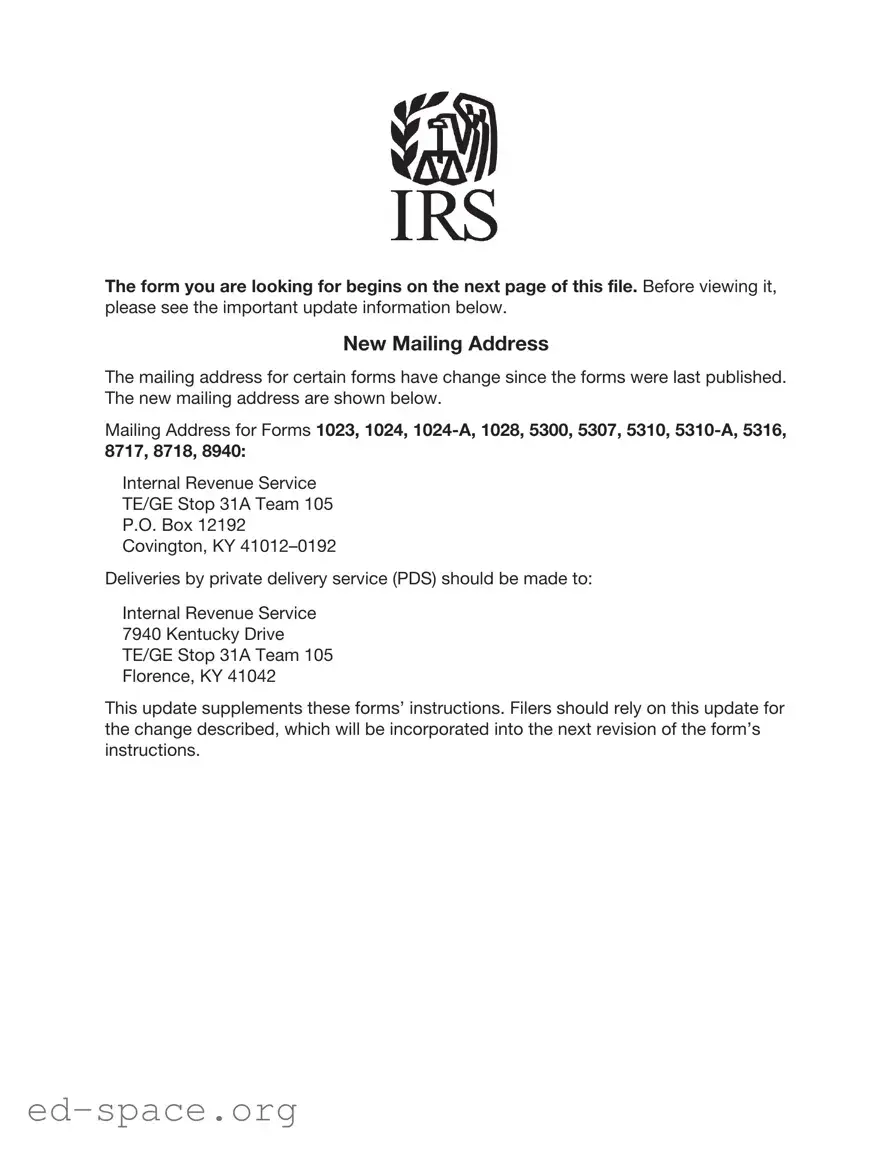
The form you are looking for begins on the next page of this file. Before viewing it, please see the important update information below.
New Mailing Address
The mailing address for certain forms have change since the forms were last published. The new mailing address are shown below.
Mailing Address for Forms 1023, 1024,
Internal Revenue Service
TE/GE Stop 31A Team 105
P.O. Box 12192
Covington, KY
Deliveries by private delivery service (PDS) should be made to:
Internal Revenue Service
7940 Kentucky Drive
TE/GE Stop 31A Team 105
Florence, KY 41042
This update supplements these forms’ instructions. Filers should rely on this update for the change described, which will be incorporated into the next revision of the form’s instructions.
This page intentionally left blank.

Form 1024 (Rev. January 2018)
Department of the Treasury Internal Revenue Service
Application for Recognition of Exemption
Under Section 501(a)
Go to www.irs.gov/Form1024 for instructions and the latest information.
OMB No.
If exempt status is approved, this application will be open for public inspection.
Read the instructions for each Part carefully. A User Fee must be attached to this application.
If the required information and appropriate documents are not submitted along with Form 8718 (with payment of the
appropriate user fee), the application may be returned to the organization.
Complete the Procedural Checklist that follows the form.
Part I. Identification of Applicant Must be completed by all applicants; also complete appropriate schedule. Submit only the schedule that applies to your organization. Do not submit blank schedules.
Check the appropriate box below to indicate the section under which the organization is applying:
a Section
b Reserved for future use
c |
Section |
d Section
e |
Section |
f |
Section |
g |
Section |
h |
Section |
i |
Section |
|
companies, or like organizations (Schedule G) |
j Section
k |
Section |
||||
l |
Section |
||||
m |
Section |
||||
n |
Section |
|
|
||
|
|
|
|
||
1a |
Full name of organization (as shown in organizing document) |
2 Employer identification number (EIN) (if |
|||
|
|
|
|
|
none, see Specific Instructions) |
|
|
|
|
||
1b c/o Name (if applicable) |
|
|
3 Name and telephone number of person to be |
||
|
|
|
|
|
contacted if additional information is needed |
|
|
|
|
|
|
1c |
Address (number and street) |
|
Room/Suite |
|
|
|
|
|
|
|
|
1d |
City, town or post office, state, and ZIP + 4. If you have a foreign address, see Specific |
|
|
||
|
Instructions for Part I. |
|
|
|
|
|
|
|
|
( |
) |
1e |
Web site address |
4 Month the annual accounting period ends |
5 Date incorporated or formed |
||
|
|
|
|
|
|
6Did the organization previously apply for recognition of exemption under this Code section or under any other section of the Code? If “Yes,” attach an explanation.
Yes
No
7 Has the organization filed Federal income tax returns or exempt organization information returns? . . . . . . . .
If “Yes,” state the form numbers, years filed, and Internal Revenue office where filed.
Yes
No
8Check the box for the type of organization. ATTACH A CONFORMED COPY OF THE CORRESPONDING ORGANIZING DOCUMENTS TO THE APPLICATION BEFORE MAILING.
a |
Corporation— |
Attach a copy of the Articles of Incorporation (including amendments and restatements) showing approval by the |
|
|
appropriate state official; also attach a copy of the bylaws. |
b |
Trust— |
Attach a copy of the Trust Indenture or Agreement, including all appropriate signatures and dates. |
c |
Association— |
Attach a copy of the Articles of Association, Constitution, or other creating document, with a declaration (see instructions) |
|
|
or other evidence that the organization was formed by adoption of the document by more than one person. Also include a |
|
|
copy of the bylaws. |
If this is a corporation or an unincorporated association that has not yet adopted bylaws, check here . . . . . . . .
I declare under the penalties of perjury that I am authorized to sign this application on behalf of the above organization, and that I have examined this application, including the accompanying schedules and attachments, and to the best of my knowledge it is true, correct, and complete.
PLEASE |
F |
|
SIGN |
|
|
HERE |
(Signature) |
For Paperwork Reduction Act Notice, see instructions.
(Type or print name and title or authority of signer) |
(Date) |
Catalog No. 12343K |
Form 1024 (Rev. |

Form 1024 (Rev. |
Page 2 |
Part II. Activities and Operational Information (Must be completed by all applicants)
1Provide a detailed narrative description of all the activities of the
2List the organization’s present and future sources of financial support, beginning with the largest source first.
Form 1024 (Rev.

Form 1024 (Rev. |
Page 3 |
Part II. Activities and Operational Information (continued)
3Give the following information about the organization’s governing body:
a Names, addresses, and titles of officers, directors, trustees, etc.
bAnnual compensation
4If the organization is the outgrowth or continuation of any form of predecessor, state the name of each predecessor, the period during which it was in existence, and the reasons for its termination. Submit copies of all papers by which any transfer of assets was effected.
5If the applicant organization is now, or plans to be, connected in any way with any other organization, describe the other organization and explain the relationship (for example, financial support on a continuing basis; shared facilities or employees; same officers, directors, or trustees).
6If the organization has capital stock issued and outstanding, state: (1) class or classes of the stock; (2) number and par value of the shares;
(3) consideration for which they were issued; and (4) if any dividends have been paid or whether your organization’s creating instrument authorizes dividend payments on any class of capital stock.
7State the qualifications necessary for membership in the organization; the classes of membership (with the number of members in each class); and the voting rights and privileges received. If any group or class of persons is required to join, describe the requirement and explain the relationship between those members and members who join voluntarily. Submit copies of any membership solicitation material. Attach sample copies of all types of membership certificates issued.
8Explain how your organization’s assets will be distributed on dissolution.
Form 1024 (Rev.

Form 1024 (Rev. |
Page 4 |
Part II. Activities and Operational Information (continued)
9Has the organization made or does it plan to make any distribution of its property or surplus funds to shareholders or
members? . . . . . . . . . . . . . . . . . . . . . . . . . . . . . . . .
If “Yes,” state the full details, including: (1) amounts or value; (2) source of funds or property distributed or to be distributed; and (3) basis of, and authority for, distribution or planned distribution.
Yes
No
10Does, or will, any part of your organization’s receipts represent payments for services performed or to be performed? . If “Yes,” state in detail the amount received and the character of the services performed or to be performed.
Yes
No
11Has the organization made, or does it plan to make, any payments to members or shareholders for services performed or
to be performed? . . . . . . . . . . . . . . . . . . . . . . . . . . . . . .
If “Yes,” state in detail the amount paid, the character of the services, and to whom the payments have been, or will be, made.
Yes
No
12Does the organization have any arrangement to provide insurance for members, their dependents, or others (including
provisions for the payment of sick or death benefits, pensions, or annuities)? . . . . . . . . . . . . .
If “Yes,” describe and explain the arrangement’s eligibility rules and attach a sample copy of each plan document and each type of policy issued.
Yes
No
13Is the organization under the supervisory jurisdiction of any public regulatory body, such as a social welfare agency, etc.? If “Yes,” submit copies of all administrative opinions or court decisions regarding this supervision, as well as copies of applications or requests for the opinions or decisions.
Yes
No
14 Does the organization now lease or does it plan to lease any property? . . . . . . . . . . . . . . .
If “Yes,” explain in detail. Include the amount of rent, a description of the property, and any relationship between the applicant organization and the other party. Also, attach a copy of any rental or lease agreement. (If the organization is a party, as a lessor, to multiple leases of rental real property under similar lease agreements, please attach a single representative copy of the leases.)
Yes
No
15Has the organization spent or does it plan to spend any money attempting to influence the selection, nomination, election,
or appointment of any person to any federal, state, or local public office or to an office in a political organization? . . If “Yes,” explain in detail and list the amounts spent or to be spent in each case.
Yes
No
16 Does the organization publish pamphlets, brochures, newsletters, journals, or similar printed material? . . . . .
If “Yes,” attach a recent copy of each.
Yes
No
Form 1024 (Rev.

Form 1024 (Rev. |
Page 5 |
Part III. Financial Data (Must be completed by all applicants) |
|
Complete the financial statements for the current year and for each of the 3 years immediately before it. If in existence less than 4 years, complete the statements for each year in existence. If in existence less than 1 year, also provide proposed budgets for the 2 years following the current year.
A. Statement of Revenue and Expenses
|
Revenue |
1 |
Gross dues and assessments of members . . . |
2 |
Gross contributions, gifts, etc |
3Gross amounts derived from activities related to the organization’s exempt purpose (attach schedule)
(Include related cost of sales on line 9.) . . . .
4Gross amounts from unrelated business activities (attach schedule)
5 Gain from sale of assets, excluding inventory items
|
(attach schedule) |
. . . . . . . . . . |
6 |
Investment income (see instructions) |
|
7 |
Other revenue (attach schedule) |
|
8Total revenue (add lines 1 through 7) . . . . .
Expenses
9Expenses attributable to activities related to the organization’s exempt purposes . . . . . .
10Expenses attributable to unrelated business activities
11Contributions, gifts, grants, and similar amounts paid
(attach schedule) |
. . . . . . . . . . |
12Disbursements to or for the benefit of members (attach schedule)
13Compensation of officers, directors, and trustees (attach schedule)
14 |
Other salaries and wages |
|
15 |
Interest |
|
16 |
Occupancy |
|
17 |
Depreciation and depletion |
. . . . . . . |
18 |
Other expenses (attach schedule) |
|
19Total expenses (add lines 9 through 18) . . . .
20Excess of revenue over expenses (line 8 minus
line 19) . . . . . . . . . . . . .
(a) Current Tax Year |
3 Prior Tax Years or Proposed Budget for Next 2 Years |
|||
From |
|
|
|
|
|
|
(b) |
(c) |
(d) |
To |
||||
|
|
|
|
|
(e)Total
B. Balance Sheet (at the end of the period shown)
|
|
|
Current Tax Year |
|
|
|
Assets |
as of |
|
1 |
Cash |
1 |
|
|
2 |
Accounts receivable, net |
2 |
|
|
3 |
Inventories |
3 |
|
|
4 |
Bonds and notes receivable (attach schedule) |
4 |
|
|
5 |
Corporate stocks (attach schedule) |
5 |
|
|
6 |
Mortgage loans (attach schedule) |
6 |
|
|
7 |
Other investments (attach schedule) |
7 |
|
|
8 |
Depreciable and depletable assets (attach schedule) |
8 |
|
|
9 |
Land |
9 |
|
|
10 |
Other assets (attach schedule) |
. . . . . . . . . . . . . . . . . . . . . . . . . . |
10 |
|
11 |
Total assets |
11 |
|
|
12 |
|
Liabilities |
12 |
|
Accounts payable |
|
|||
13 |
Contributions, gifts, grants, etc., payable |
13 |
|
|
14 |
Mortgages and notes payable (attach schedule) |
14 |
|
|
15 |
Other liabilities (attach schedule) |
15 |
|
|
16 |
Total liabilities |
16 |
|
|
17 |
|
Fund Balances or Net Assets |
17 |
|
Total fund balances or net assets |
|
|||
18 |
Total liabilities and fund balances or net assets (add line 16 and line 17) |
18 |
|
|
If there has been any substantial change in any aspect of the organization’s financial activities since the end of the period shown above, check the box and attach a detailed explanation . . . . . . . . . . . . . . . . . . . . . . . . . .
Form 1024 (Rev.

Page 6
Yes
No
Yes
No
Yes |
No |
If “Yes,” give the reasons for not filing this application within the
If “No,” answer question 4.
4If you answer “No” to question 3, your organization’s qualification as a section 501(c)(9) or 501(c)(17) organization can be recognized only from the date this application is filed. Therefore, does the organization want us to consider its application as a request for recognition of exemption as a section 501(c)(9) or 501(c)(17) organization from the date the application is received and not retroactively to the date the organization was created or formed? . . . . . . . . . . . .
Yes
No
Form 1024 (Rev.

Form 1024 (Rev. |
Page 7 |
Schedule A Organizations described in section 501(c)(2) or 501(c)(25)
1State the complete name, address, and EIN of each organization for which title to property is held and the number and type of the applicant organization’s stock held by each organization.
2If the annual excess of revenue over expenses has not been or will not be turned over to the organization for which title to property is held, state the purpose for which the excess is or will be retained by the title holding organization.
3In the case of a corporation described in section 501(c)(2), state the purpose of the organization for which title to property is held (as shown in its governing instrument) and the Code sections under which it is classified as exempt from tax. If the organization has received a determination or ruling letter recognizing it as exempt from taxation, please attach a copy of the letter.
4In the case of a corporation or trust described in section 501(c)(25), state the basis whereby each shareholder is described in section 501(c)(25)(C). For each organization described that has received a determination or ruling letter recognizing that organization as exempt from taxation, please attach a copy of the letter.
5With respect to the activities of the organization.
a Is any rent received attributable to personal property leased with real property? . . . . . . . . . . . .
If “Yes,” what percentage of the total rent, as reported on the financial statements in Part III, is attributable to personal property?
bWill the organization receive income which is incidentally derived from the holding of real property, such as income
from operation of a parking lot or from vending machines? . . . . . . . . . . . . . . . . . .
If “Yes,” what percentage of the organization’s gross income, as reported on the financial statements in Part III, is incidentally derived from the holding of real property?
cWill the organization receive income other than rent from real property or personal property leased with real property or income which is incidentally derived from the holding of real property? . . . . . . . . . . . . . .
If “Yes,” describe the source of the income.
Yes
Yes
Yes
No
No
No
Instructions
Line
Line
Line
describes the organization (as shown in its IRS determination letter).
Line
1.A qualified pension,
2.A government plan;
3.An organization described in section 501(c)(3); or
4.An organization described in section 501(c)(25).
Form 1024 (Rev.
Form 1024 (Rev. |
Page 8 |
This page left blank intentionally.
| Fact Name | Description |
|---|---|
| Purpose | The IRS Form 1024 is used to apply for recognition of exemption from federal income tax under section 501(a) for certain organizations. |
| Eligibility | Organizations that may use this form include those seeking tax-exempt status as a charitable, religious, or educational entity. |
| Filing Deadline | There is no specific deadline for filing Form 1024, but it is recommended to submit it within 27 months of formation to avoid penalties. |
| State-Specific Forms | Some states require additional forms for tax-exempt status. Check your state’s governing laws, such as California Corporations Code Section 5110. |
Filling out the IRS Form 1024 is a crucial step for organizations seeking tax-exempt status. Once the form is completed, it must be submitted to the IRS along with the required documentation. Below are the steps to ensure the form is filled out correctly and efficiently.
After submission, the IRS will review your application and may request additional information. Be prepared to respond promptly to any inquiries to facilitate the process.
What is the IRS Form 1024?
The IRS Form 1024 is used to apply for recognition of exemption from federal income tax under Section 501(a) of the Internal Revenue Code. This form is typically filed by organizations seeking to be recognized as tax-exempt under Section 501(c)(4) or other similar sections. It is an essential step for organizations that wish to operate without paying federal income tax on the money they receive for their charitable or social welfare activities.
Who needs to file Form 1024?
Organizations that are looking to be recognized as tax-exempt under Section 501(c)(4) should file Form 1024. This includes social welfare organizations, civic leagues, and local associations of employees. If your organization is formed for the promotion of social welfare and operates primarily for that purpose, you will likely need to complete this form.
What information is required on Form 1024?
Form 1024 requires detailed information about your organization. You will need to provide its name, address, and the date of formation. Additionally, you must describe your organization's purpose, activities, and how it plans to achieve its goals. Financial information, including a proposed budget and details about funding sources, is also necessary.
How long does it take to process Form 1024?
The processing time for Form 1024 can vary. Generally, it takes the IRS several months to review and respond to applications. Some organizations report waiting anywhere from three to six months, but it can take longer in certain circumstances. It’s important to plan accordingly and follow up with the IRS if you have not received a response within that time frame.
Is there a filing fee for Form 1024?
Yes, there is a filing fee associated with Form 1024. The fee varies depending on the type of organization and the specific exemption being sought. It's crucial to check the IRS website or the instructions for Form 1024 to determine the current fee and ensure you include the correct payment with your application.
Can I apply for tax-exempt status without filing Form 1024?
In most cases, no. If your organization is seeking recognition under Section 501(c)(4), you must file Form 1024. However, some organizations may qualify for simpler processes or different forms, depending on their structure and activities. Always verify the specific requirements for your organization type.
What happens after I submit Form 1024?
After you submit Form 1024, the IRS will review your application. If additional information is needed, they may contact you. Once the review is complete, you will receive a determination letter indicating whether your organization has been granted tax-exempt status. If approved, you can operate as a tax-exempt entity, while if denied, the letter will explain the reasons for the denial.
Can I appeal if my Form 1024 is denied?
Yes, if your application for tax-exempt status is denied, you have the right to appeal the decision. The denial letter will provide instructions on how to proceed with the appeal process. It’s essential to address the reasons for the denial thoroughly and provide any additional information that may strengthen your case.
Are there ongoing requirements after receiving tax-exempt status?
Yes, once your organization is granted tax-exempt status, you must comply with certain ongoing requirements. This includes filing annual information returns, such as Form 990, and ensuring that your organization continues to operate within the guidelines set forth by the IRS. Failing to meet these requirements can jeopardize your tax-exempt status.
Where can I find more information about Form 1024?
You can find more information about Form 1024 on the IRS website. There, you will find the form itself, instructions for completing it, and additional resources related to tax-exempt organizations. Consulting the IRS website is a great way to ensure you have the most up-to-date information and guidance.
Incomplete Information: Many individuals forget to fill out all required sections of the form. Each section is crucial for the IRS to understand the purpose of your application.
Incorrect Entity Type: Selecting the wrong type of entity can lead to delays. Make sure you choose the correct category that matches your organization’s structure.
Missing Signatures: Failing to sign the form is a common oversight. Remember, your signature is essential to validate the application.
Not Including Required Attachments: Supporting documents are vital. Ensure you include everything that the IRS requests to avoid processing delays.
Incorrect Tax Year: Entering the wrong tax year can cause confusion. Double-check that you are applying for the correct year.
Omitting the Purpose of the Organization: Clearly stating your organization’s purpose is key. If this section is vague, it may lead to rejection.
Failure to Provide Financial Information: Many forget to include financial statements or budgets. This information is necessary for the IRS to assess your application.
Ignoring the Instructions: Each form comes with specific instructions. Skipping these can result in errors that could have been easily avoided.
Not Keeping Copies: Failing to make copies of the submitted form can lead to issues later. Always keep a record for your files.
Missing Deadlines: Submitting the form late can hinder your organization’s status. Be aware of all deadlines and plan accordingly.
The IRS Form 1024 is essential for organizations seeking recognition of their tax-exempt status under Section 501(c)(3) or other sections of the Internal Revenue Code. However, there are several other forms and documents that often accompany this application. Below is a list of these important documents, each serving a unique purpose in the process of establishing and maintaining tax-exempt status.
Each of these documents plays a critical role in the application process for tax-exempt status. Properly preparing and submitting these forms can significantly enhance an organization's chances of receiving approval from the IRS. Being thorough and organized will help ensure a smoother application experience.
The IRS Form 1024 is used to apply for recognition of exemption from federal income tax under Section 501(a) of the Internal Revenue Code. Several other forms and documents serve similar purposes in different contexts. Here’s a list of ten documents that share similarities with Form 1024:
Filling out the IRS Form 1024 can be a crucial step in seeking tax-exempt status for your organization. To ensure a smooth process, here are some important dos and don’ts to keep in mind.
By following these guidelines, you can enhance your chances of a successful application. Remember, attention to detail is key when dealing with tax matters.
The IRS Form 1024 is an important document for organizations seeking tax-exempt status under Section 501(c)(3) and other sections of the Internal Revenue Code. However, several misconceptions surround this form. Here are six common misunderstandings:
Understanding these misconceptions can help organizations navigate the application process more effectively and avoid potential pitfalls. Accurate information is crucial for ensuring compliance and achieving the desired tax-exempt status.
The IRS Form 1024 is essential for organizations seeking tax-exempt status under Section 501(a). Here are some key takeaways for filling out and using this form: